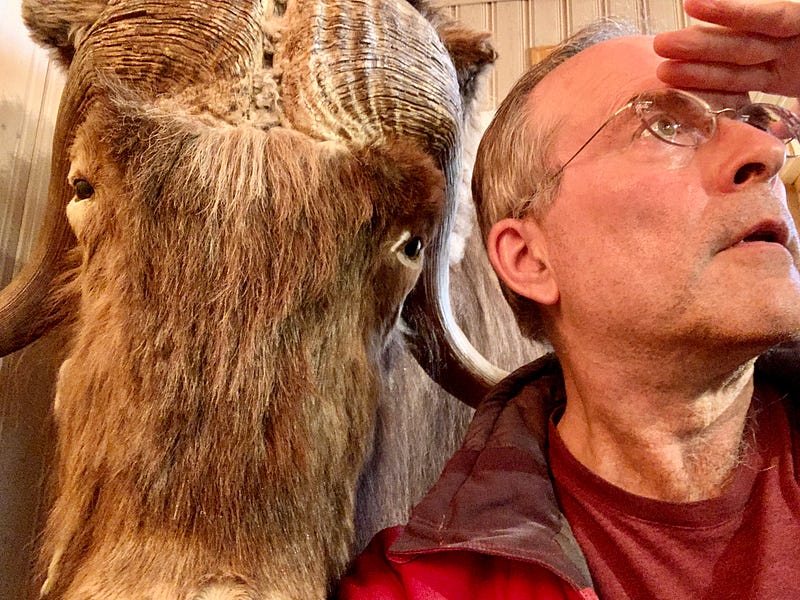
A (Norwegian) Parable of the Musk Ox
With apologies to the Zen Masters
- Hearing about the Musk Ox
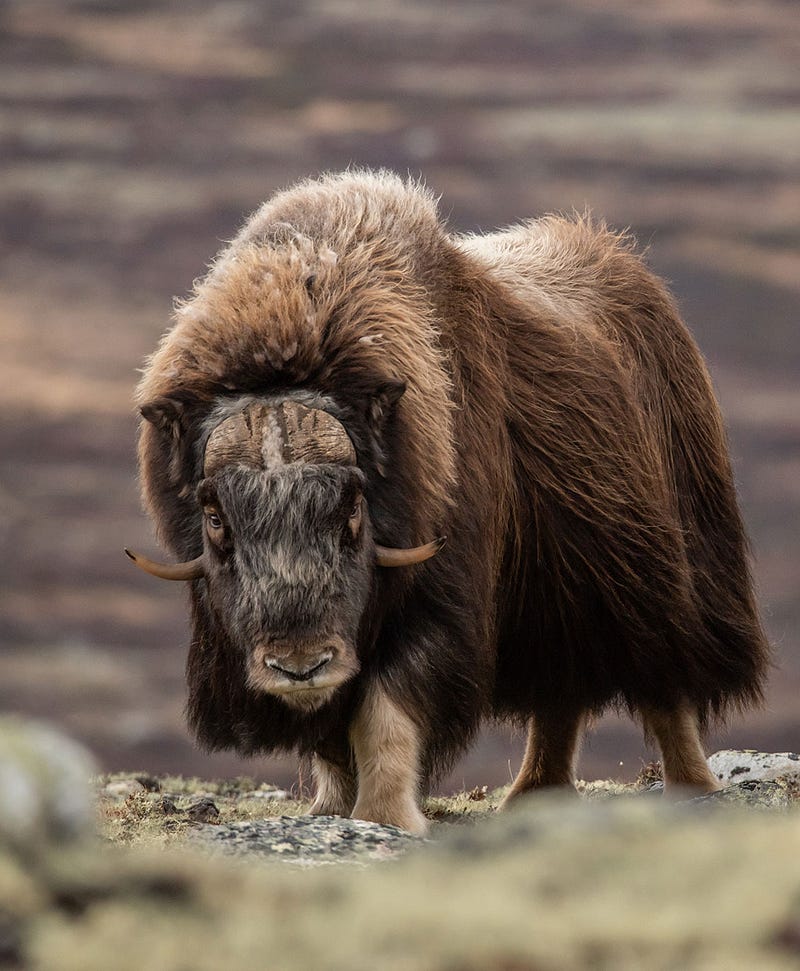
I couldn’t believe it — there are musk oxen in Norway! I was sure they only existed in the far north of Canada, Alaska and Greenland. But indeed, musk oxen have been successfully reintroduced in the mountains of central Norway. (I say “re-introduced” because musk oxen lived in northern Europe during the last glaciation, until about 9,000 years ago). After several failed attempts to transplant them to Scandinavia, about 300 musk oxen now roam Dovrefjell-Sunndalsfjella National Park. They have become a huge draw for hikers and wildlife lovers, like myself, who never thought they would have a chance to see a musk ox in the wild.
According to the park website, visitors are “(Almost) guaranteed to see musk oxen: The Musk Ox Trail — a network of paths designed to give you good chances of spotting musk oxen — opened in the summer of 2017….You can encounter musk oxen along the entire trail.”
And so, after two months in northern Norway, on our route back to Oslo, I convinced Teresa (my beloved spouse) to detour through Dovre, just south of Trondheim. Teresa, who loves me dearly, does not share my desire for close encounters of the wildlife kind. But she was happy to stay in a nearby hotel for a day while I frolicked in the land of the musk ox.
I think musk oxen are amazing creatures. For starters, they are not actually oxen. They are not related to cattle. They are genetically related to sheep and goats. But supersized. Musk Oxen are also survivors from the Pleistocene — the Ice Age. The rest of the megafauna from that time are extinct. Mammoths, woolly rhinoceroses, cave bears, sabertooth cats— all gone.
How did Musk Oxen outlast the others? They were able to thrive in the harsh Arctic environment, where few others creatures can live. They have thick, shaggy fur, and can gorge on tundra greenery all summer and then basically eat nothing all winter. There is also their famous “circle the wagons” strategy when confronted with predators: the adults form a ring standing shoulder to shoulder, horns out, keeping the young ones safe inside the circle.
2. Fearing the Musk Ox
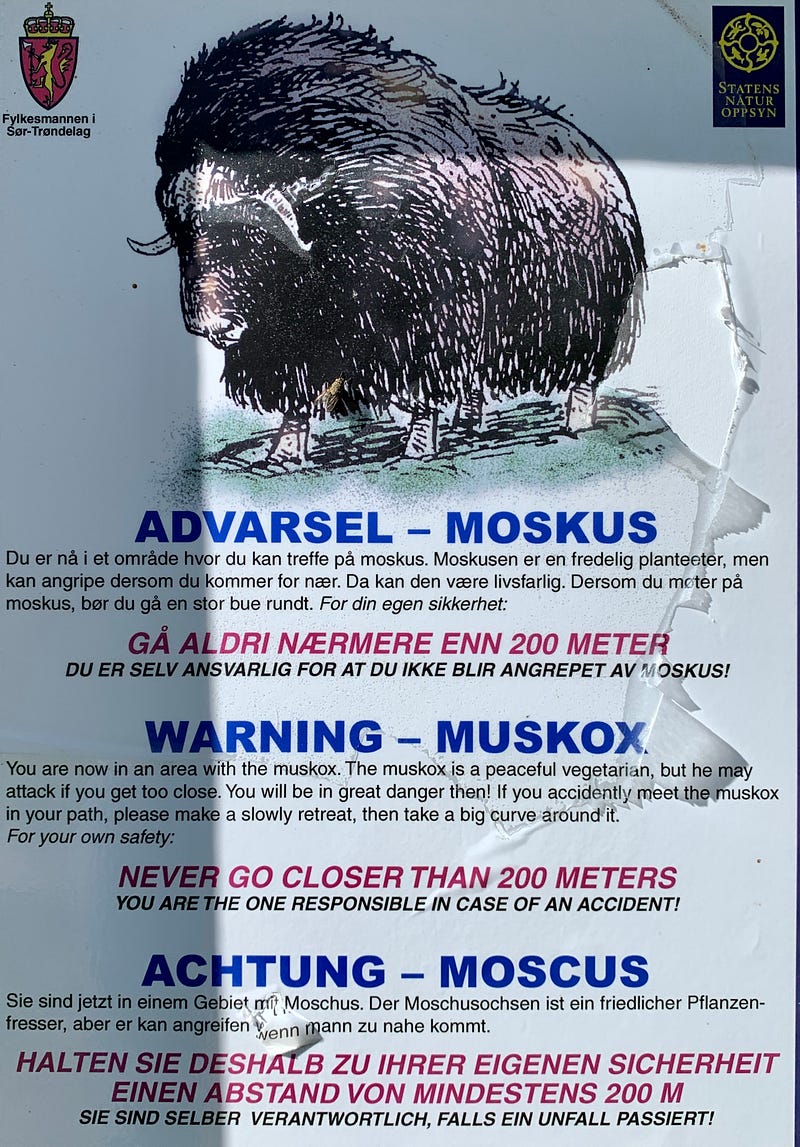
Encountering a musk ox in the wild seems kind of scary. They weigh up to 450 kilos (1000 pounds) and can also run up to 60 kph (about 35 mph). On entering the park trail, three separate signposts warn hikers in three different languages: “The musk ox is a peaceful vegetarian, but he may attack if you get too close. You will be in great danger then! If you accidentally meet the musk ox in your path, please make a slowly retreat, then take a big curve around it. For your own safety: Never go closer than 200 meters….”
3. Mistaking the Musk Ox
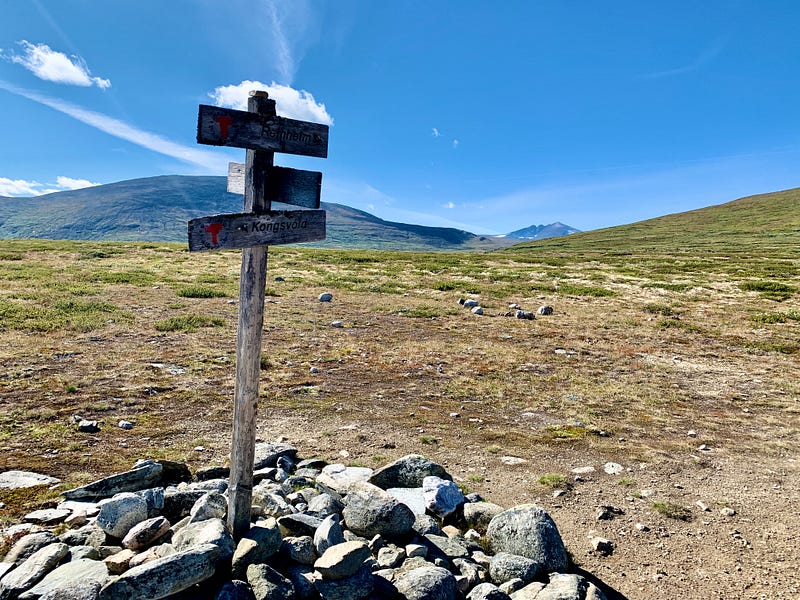
I was appropriately fearful as I began my climb up through a birch forest to the Dovrefjell Plateau, where the trees disappear and there’s nothing but alpine tundra as far as the eye can see. I expected to find a hulking beast, ready to charge, behind every tree and boulder. As I reached the rim of the plateau, I ran into a group of about 20 hikers — obviously one of the guided, musk-ox treks. It was already 2 pm, and they looked exhausted. They were clearly done for the day, so I asked them if they had any luck. They laughed ruefully and said no. Hmm. My fear took on a different pallor. What if I got skunked?
Just a few hundred meters further along the trail, I saw a dark head and two twitching ears appear over the next hill. Holy Crap! Was I too close? I crept up, stealthily, my heart pounding.
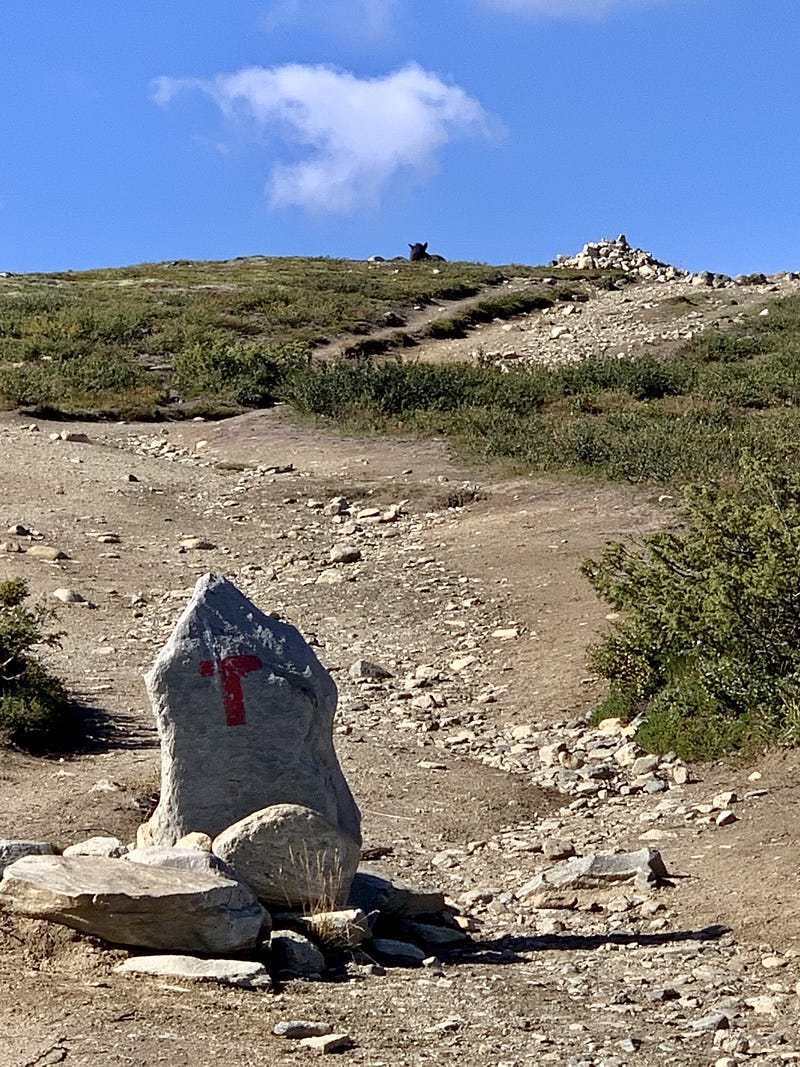
Nope. Horses. Shit.
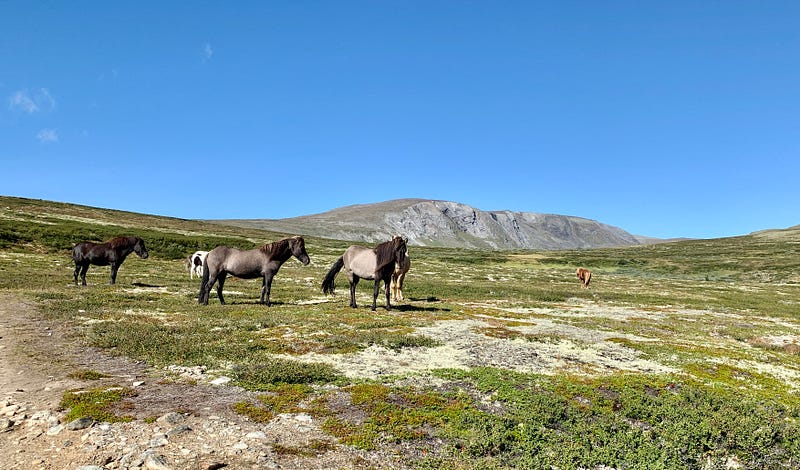
Climbing higher, I began imagining I was seeing musk oxen everywhere. How could one tell at a distance the difference between a musk ox and a big rock?
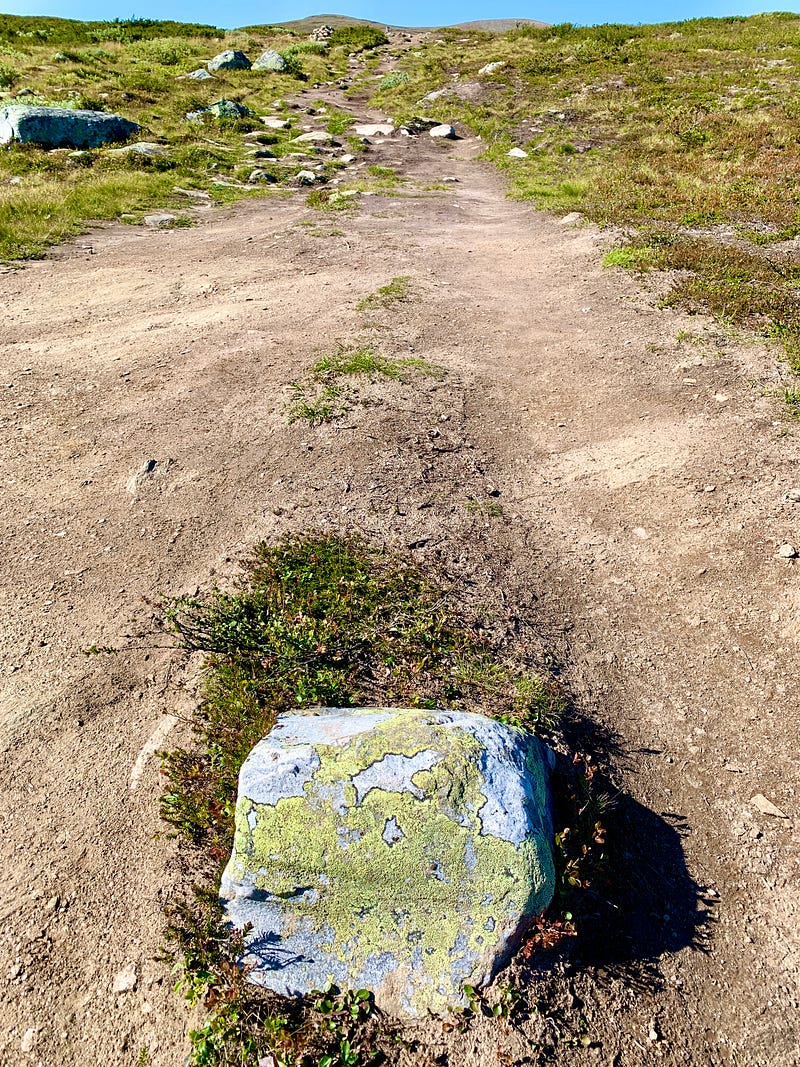
After another kilometer or so, the trail divided. The right path was the main Musk Ox Trail, a shorter path up a nearby mountain top. According to the park website, is where musk oxen are most often spotted. But I assumed that was the way the guided tour must have gone, and so I decided to go the other way, the longer route that followed a wide valley deep into the park.
4. Asking Directions to the Musk Ox
The path narrowed into an undulating trail that hid the presence of other hikers. I felt all alone on the tundra. But every twenty minutes or so a hiker would pop up, perhaps 50 meters ahead of me. It’s proper etiquette in Norway to say “hie-hie” when you meet another trekker on the road. To that greeting, I added a question: “Did you see a musk ox?” They answered me:
“Nye.”
“Nye.”
“Not today.”
“No, I turned back. But I heard they were far off, under the snow hat…”
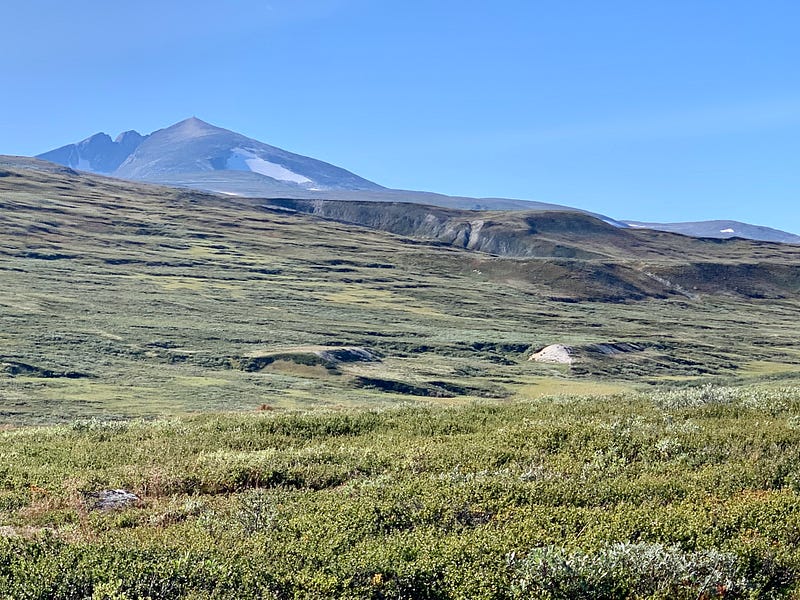
And then:
“Yes — but a way down the valley. You go about two kilometers further to a little park cabin, and then about a kilometer beyond that, take the trail to the right, and another kilometer further, we saw four musk oxen high up the hillside. But of course — they move a lot. That was hours ago. Who knows where they are now?
This sighting gave me hope. It kept me going through the next several hikers who all answered “nye.” But I had to keep daylight in mind. I had about four hours of sun left. Though it was late August, I was wearing a flannel shirt and my red, down jacket in the afternoon sun. The wind from the north had an Arctic chill in it, and I knew it would get cold when the sun went down.
5. Angry at the Musk Ox
I found myself cursing the “(almost) guaranteed” musk ox. This was a spectacular walk. I was virtually alone in these wild, high hills. I love this kind of terrain. The tundra makes me feel fully alive. When I die, I hope the last thing I imagine is walking through hills just like these. If I could do that forever, that would be heaven. And yet, here I was, strolling through my absolute perfect version of heaven, squinting at rocks, thinking only of musk oxen.
“I don’t need to see no stinkin’ ox!” I said out loud. But I knew I was lying. I wanted a musk ox, and would be bitterly disappointed if I didn’t see one, no matter how I protested.
I passed the little cabin. There were very few people on the trail now. I walked alone for some time.
“Ya,” said a solo woman hiker. “I saw six. About three kilometers from here. After where the path splits, go to the right.”
Hope. But damn, three more kilometers? It was now 4 pm. I had walked about seven kilometers. So, I knew I must walk that far back again. I didn’t have 20 kilos in me. I walked about ten minutes further, to where I could see the path forking ahead. I sat down to eat my sandwich and some blueberries and contemplated my options. I scanned the mountains one more time.
6. Seeing the Musk Ox
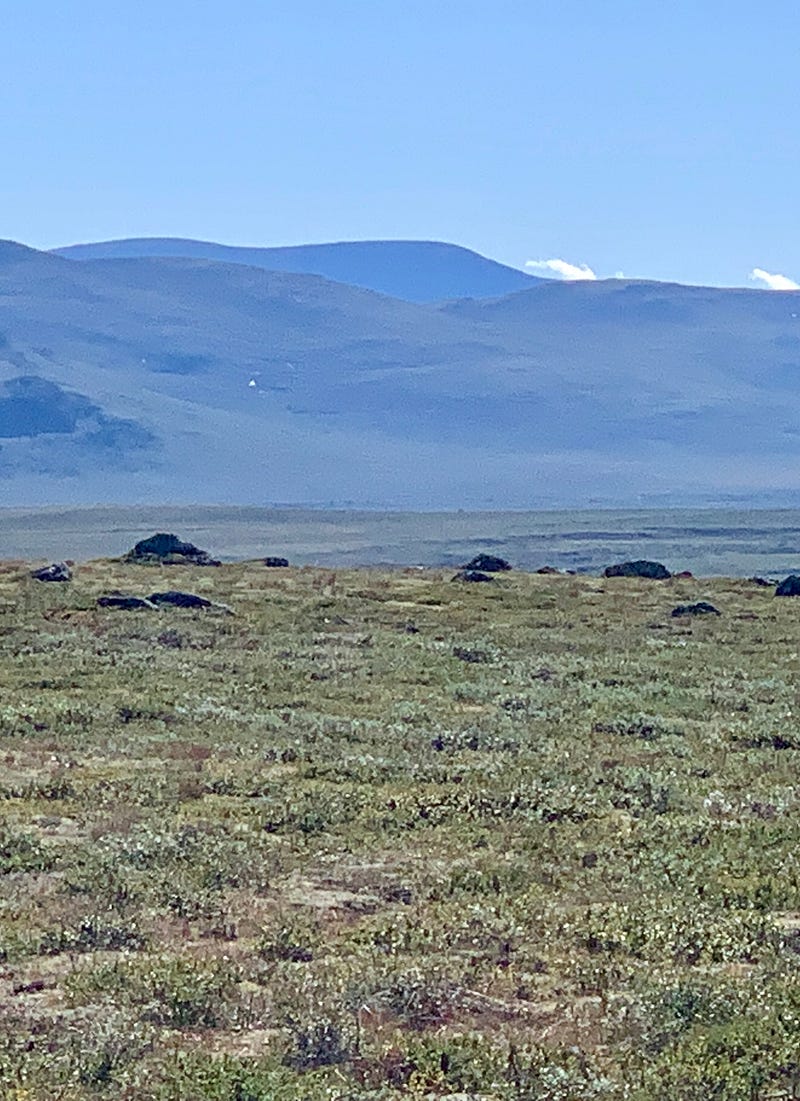
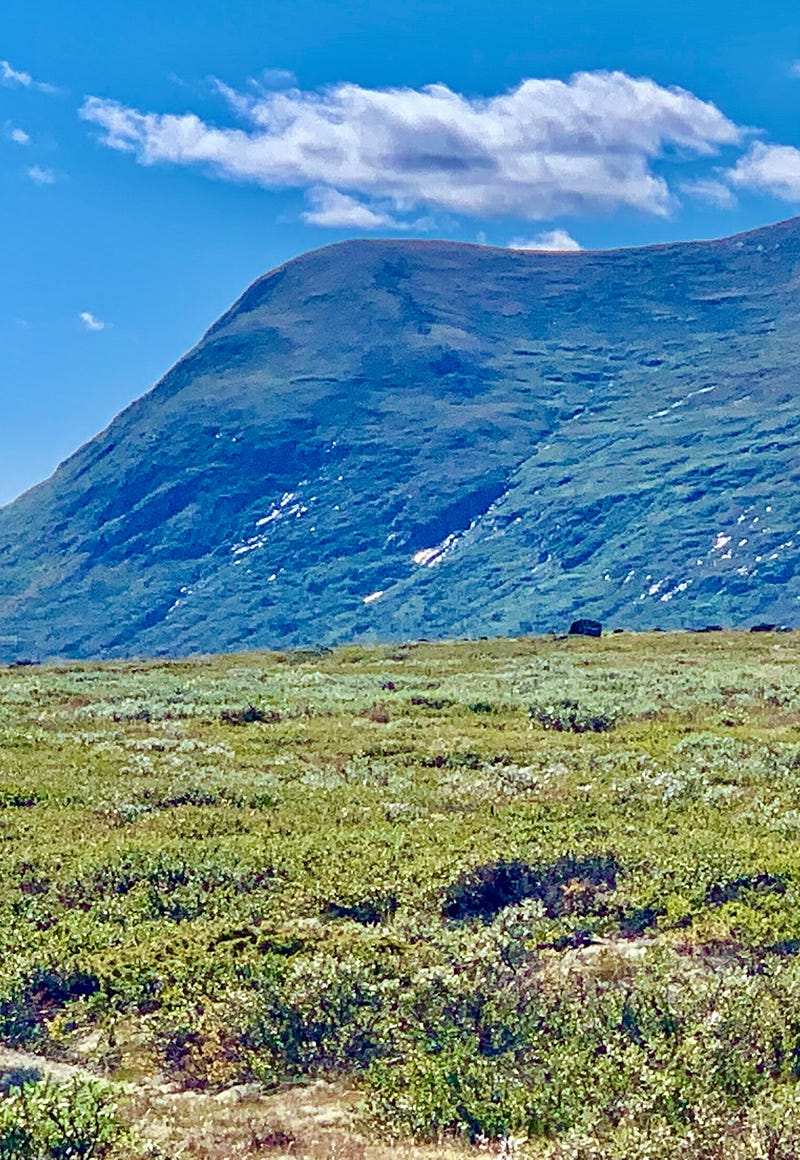
Well, look at those two tiny black dots, way up high. More musk ox delerium, surely. I chewed my sandwich, then looked again. Wait — had the dots moved? Now my attention was riveted. I cursed the fact I had no binoculars, and my lousy iPhone had a crappy camera app that barely zoomed. But, you can see clearly enough, on the photos below, the black dots in different locations on the right slope, near the horizon. This is about the size they appeared to my naked eye:
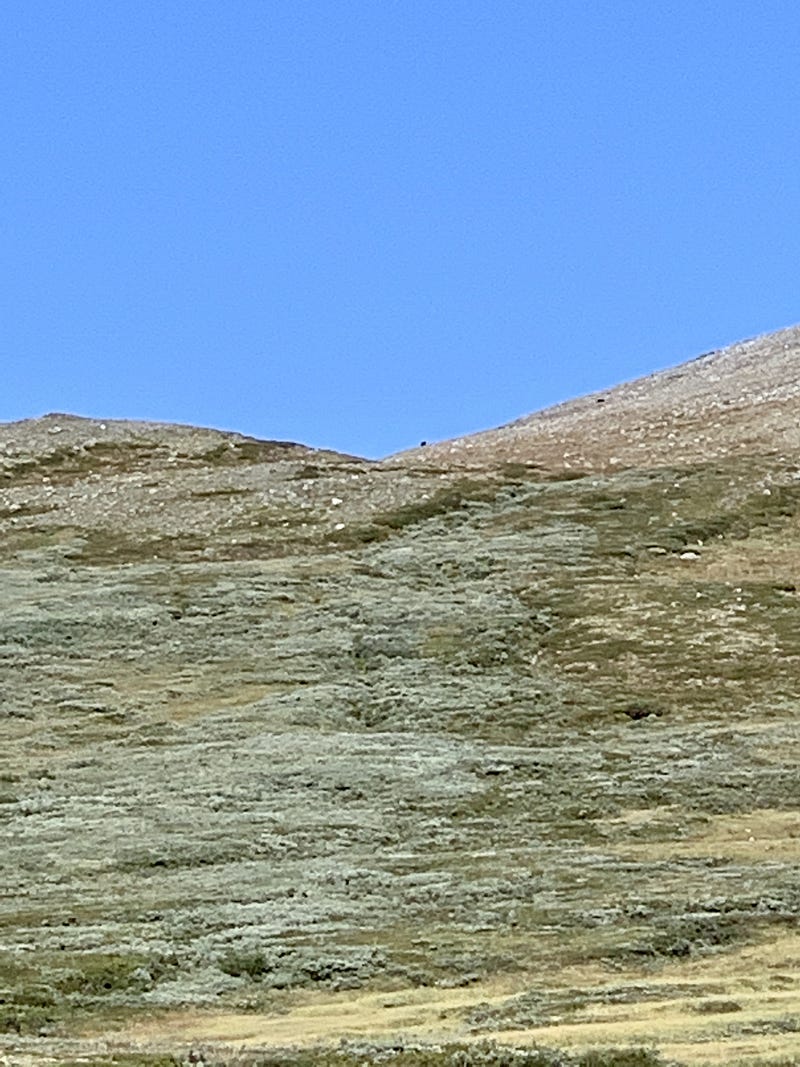
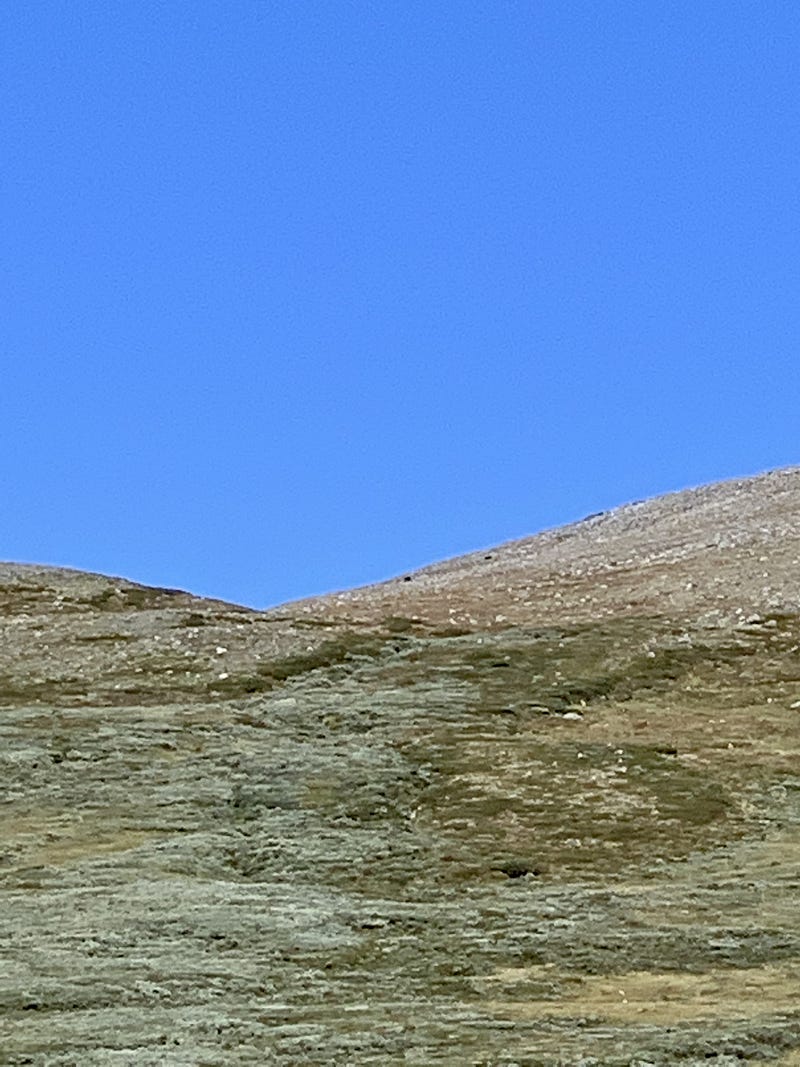
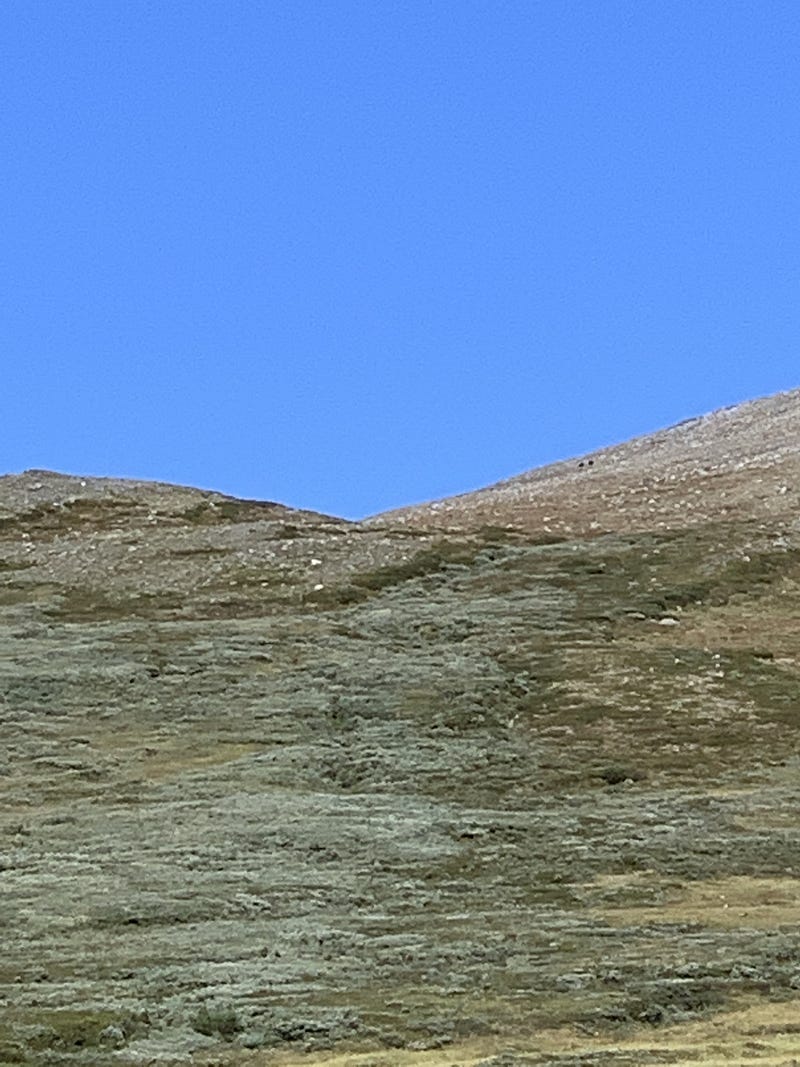
These were definitely musk oxen! Weren’t they? Was seeing these moving specks what I had come all this way for? Of course, I knew there was no getting close to a musk ox. Even if I could, that would have been a very bad idea. So, yes, I told myself, this is as good as it gets.
7. Sharing the Musk Ox
A young man wearing a green t-shirt and orange backpack rounded the bend in front of me.
“Hie, hie,” I greeted him.“ I think I see some musk oxen on the slope. Would you like me to show you where?”
He was from Switzerland — no stranger to mountains. He had also seen several musk oxen further up the valley. So these were bonus oxen as far as he was concerned. He checked out my specks, then pulled a camera out from his bag with a proper zoom lens. My eyes widened. Click, click. He showed me the photo of the two specks. At highest magnification, suddenly I could see their long dark faces, framed by the swooping horns, like a flip-curl sixties hairstyle. Their broad noses were pointed straight toward us.
8. Being Seen by the Musk Ox
With a jolt I realized that they were looking at us. I imagined what we looked like to them: a red speck and a green-orange speck, way down in the valley.
I thanked the Swiss, and he said goodbye, leaving me alone.
9. Dissolving in the Tundra
I felt a funny sensation, seeing myself as I imagined the musk-ox did. I felt their — I struggle for the word — indifference? There was no significance to this moment, from their perspective. Under their gaze, I felt I was dissolving into the tundra. Dis-solve, yes that was the word — I later looked it up, dissolve comes from the Latin root that means to untie. That was how I felt, untied, unmoored in the moor. Floating in the tundra, free of significance.
10. Leaving the Musk Ox
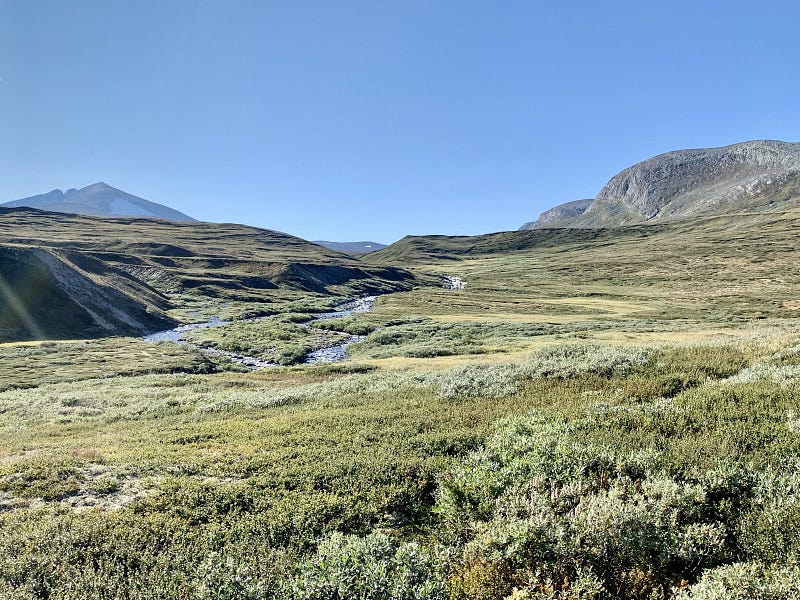
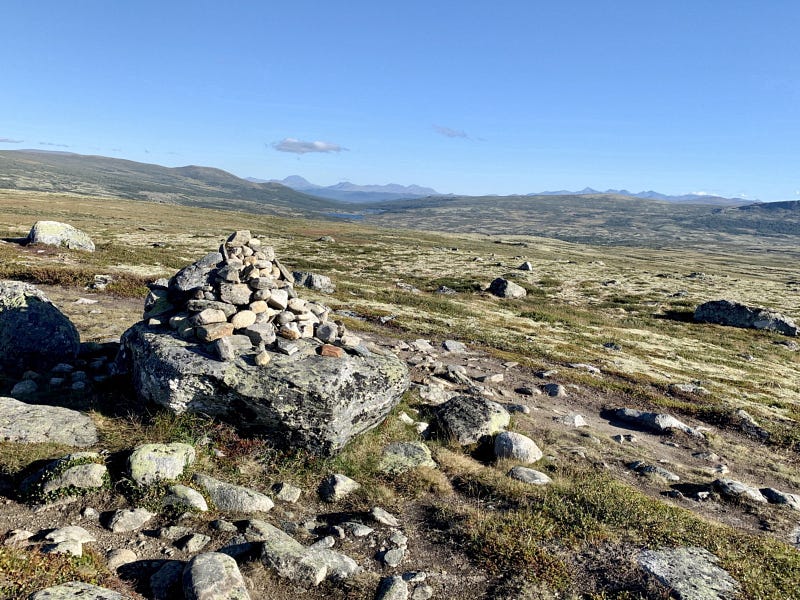
It was easy, then, to get up and turn around. I looked once more up the slope to the musk oxen, and then to the valley ahead, the river running off far into the never-ending tundra. Some day, I would walk that way, all the way. But not today. The walk back to the car was long and sweet. My step was light, and I felt at ease. There was no one coming out along the trail, as evening was near. Then to my surprise, a man and a woman popped up, walking toward me.
“Hie Hie,” they said. “Any luck with the musk ox?”
“Yes — but a long way down the valley. You go about two kilometers to a little park cabin, and then about a kilometer beyond that. But of course — musk oxen move a lot. Who knows where they are now?”