
A New Study Proves What I’ve Been Saying All Along. Accepting Your Anger Is the Path to Peace.
Avoiding your anger isn’t healing. It’s suppressing yourself into an even more dangerous place.
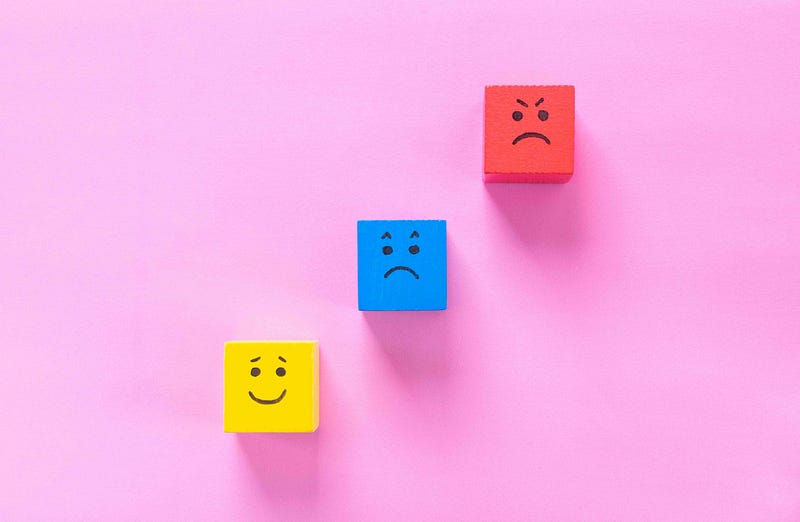
When I started sharing my emotional advice online, some of it came with a pretty big backlash. That was especially true for the advice I gave to readers and clients about anger. People didn’t like that I encouraged others to be angry and to embrace the “negative” emotions they had always been told to avoid (especially by abusive and manipulative people).
This advice hit people sideways in the back of the head because it was so different from what they had always been taught at church and by their emotionally unplugged mental health influencers and pseudo-therapists.
“Being angry is a trauma response.”
“If you’re holding on to anger you aren’t healing.”
“Once you’re better you won’t be angry.”
There’s been so much bad advice out there, and the greatest portion of it (when it comes to our anger) is rooted in suppression and avoidance. We’re told that anger is “bad” and that it destroys our bodies. But that’s not actually what the scientific evidence points to.
It turns out my emotional acceptance advice has been right all along, and now we have the collected evidence to prove it.
Are you still avoiding your anger? Still operating along the line that to be “healed” means to never feel anger or any other big, uncomfortable emotion? Well, then you’re on the wrong side of the path. As it turns out, the real journey to peace happens when you accept your anger — not when you pretend it doesn’t exist.
Your emotions have *never* been the problem. You have.
Research is now beginning to show that the way we’ve been thinking about our emotions is all wrong. For decades, we’ve focused on shutting out tough emotions and building on positive feelings alone. But those aren’t the only emotions we feel. The human experience is varied and complex and so are the emotions we feel in those experiences.
This has all been laid out in a recent study by the Center for Mental Health Education, which followed the systemic review of 48 other studies and more than 21,000 participants. What did they find? The overwhelming evidence revealed that our tendency to avoid feelings like anger, sadness, or irritation is more dangerous than embracing those emotions outright.
The findings were simple. It’s not our “negative emotions” that make us unhealthy or wreck our happiness. The real problem is our reaction to the tough emotions that we feel. Most of us aren’t operating from an emotionally intelligent place. Unable to navigate these big feelings, we opt to turn them off or outrun them instead.
That’s called emotional suppression, and it’s a dangerous way to approach your emotional balance.
That’s because it’s the opposite of emotional intelligence. When you emotionally suppress yourself, you refuse to acknowledge feelings like anger, sadness, or even anxiety. Some of you may adopt that “suck it up, buttercup” mentality or some of you may opt for the pseudo-spiritual “anger bad” way of thinking. Both can lead to disaster.
The better way to live is in a state of emotional acceptance. Instead of running away from any emotion, you pull up your bootstraps and face it. That means asking big questions and taking action to resolve the “bad” emotions that you’re feeling. That’s the real secret to finding your peace. You don’t outrun your emotions, you embrace them and change the way you relate to them.
Embracing a real path to emotional intelligence.
Essentially, what the study revealed is that cognitive reappraisal is the healthier way to manage our emotions. Studies of the past, which showed negative physical reactions to anger, had little to do with those emotions themselves. The problem was in the way we framed those emotions and the choices we believed ourselves to have on the other side of those emotions. Choosing more intelligent reactions leads us down the path to real emotional smarts.
That’s the power of cognitive reappraisal.
In the simplest terms, cognitive reappraisal is the act of learning to rate your experiences in more accurate or beneficial ways. You change the way you understand your emotional experience so that you can relate to it in a different way. Rather than seeing your anger as an enemy to be avoided, you have to start seeing it as a messenger with something important to say.
How can we move into this more balanced way of thinking?
- Look at the bigger picture: When you experience something which causes upset or hesitation, it’s wise to take a step back and question your situation. Consider what the reality is and how it would look to someone emotionally removed from the situation. What do you see? Try to look at what you’re happening from every angle.
- Don’t be afraid to play devil’s advocate: The way we interpret our experiences isn’t always accurate. Past experiences and failed questioning of emotions can lead to disproportionate reactions. That’s why it’s important to play devil’s advocate from time to time. Consider the view that’s opposite yourself and the potential humanity contained in that position.
- Get your ego out of the way: Being emotionally honest requires getting your ego out of the way and looking at things more objectively. Until you stop personalizing everything and bringing it all back to you and your pathological needs, you will continue to avoid and eventually lash out and harm others. There’s no emotional intelligence in that.
We don’t get to choose what happens to us. We may not even get to choose how we feel about it. There is always a choice when it comes to how we react and how we relate to our emotions. Ignoring our anger, discounting it, or pretending it doesn’t exist…that’s not an option anymore. We have to change the way we relate to anger so we can go from weaponizing it to using it as the tool it’s meant to be.
The biggest step in that process comes when you take a step back and allow yourself to see the fullness of your situation with empathy and a higher level of understanding. Your emotions don’t have to be an enemy. They can be your best friend when you learn to open the door and redirect your relationship with them.
How accepting your anger can open the door to peace.
That brings us down to the central point of all of this. Embracing your anger is the way out of the rut you’ve been stuck in. Everything else has been a part of the puzzle, this is the last piece. True emotional intelligence, especially as it relates to your anger, has the power to change your life from the inside out — but you have to learn how to use it for good, instead of bad.
When you accept your anger, the rage storms end. That tidal wave of upset, doesn’t swallow you up anymore. Quite the opposite. Learning to embrace your anger, to “reappraise it” give you better control, more emotional integrity, and the ability to be proud of yourself no matter how life challenges you along the way.
Better control
People who can accept their anger have better control over themselves than those who run from their anger. It’s not rocket science. It’s basic common sense. The more time you spend getting comfortable with things that are uncomfortable, the more familiar they become. When you are more familiar with your anger, it doesn’t feel as overwhelming. You can question it and decide whether or not to act on it.
Cognitive reappraisal, learning to accept and work with your anger instead of against it, has been shown to give you better control over your emotions and reactions. That brings huge benefits, not just to your self-esteem, but also to your options in life and in love.
Instead of running away from your anger, treat it like an important guard who stands watch by your boundaries and all the things which are important to you. That is the place you can begin to work with, instead of against, your natural emotional responses. This is also the starting point of emotional regulation
Emotional integrity
There is no such thing as emotional intelligence without emotional integrity and good emotional hygiene. The two come together to create an individual who is not only honest and upfront about their emotions. They can be honest and upfront about the emotions of others…including big emotions like anger.
Embracing your anger, rather than avoiding it or suppressing it, is emotional honesty. That’s emotional integrity. Speaking about it, and acting on it in a healthy way, is good emotional hygiene.
There are so many benefits that come with this type of emotional courage and openness. First, it brings you more in tune with yourself. You’ll come to understand your emotional motivations on a deeper level and find better ways to react to them. Beyond that, it will improve your relationships with others. The more honest you can be about your feelings the more in-tune and aligned you will be with the people around you.
Avoiding disappointment
Emotional avoidance and suppression is one of the big reasons that people get held back on their healing journeys. Many believe that being “healed” means not having negative emotions anymore. So, they create a world in which they have to deny the emotional parts of themselves and pretend they don’t exist in order to fit the toxic standards of “healing” that so many encourage.
This leads to disaster. How? The first time this person is challenged, the first time they feel anger or any other human emotion, they feel like a failure. They get aggravated and can think to themselves, “All this work I’ve been doing is useless. I’m still angry and have failed.”
A more emotionally honest path is beneficial. When you stop setting superhuman standards for yourself — like not having certain emotions — you’re setting yourself up for the ability to be flexible in your healing journey. Setbacks stop being major heartbreaks. Feeling emotions like anger isn’t a failure when you can embrace it honestly and navigate it as a part of your experience.
So stop running away from the big emotions. Stop treating some feelings as “inferior” to others. Your anger and your grief have as much to teach you as your joy and your excitement. Learn to value all of your emotions so you can enjoy the full width and breadth of this human experience that you’re having.
Willroth EC, Young G, Tamir M, Mauss IB. Judging emotions as good or bad: Individual differences and associations with psychological health. Emotion. 2023 Mar 13. doi: 10.1037/emo0001220. Epub ahead of print. PMID: 36913276.
Hu, T., Zhang, D., Wang, J., Mistry, R., Ran, G., & Wang, X. (2014). Relation between Emotion Regulation and Mental Health: A Meta-Analysis Review. Psychological Reports, 114(2), 341–362. https://doi.org/10.2466/03.20.PR0.114k22w4
© Practical Growth 2023
E.B. Johnson is a writer, NLP coach, and podcaster who helps women create their ideal futures. Get a FREE workbook and weekly coaching emails directly to your inbox when you join The Growth Digest, a self-recovery newsletter.


