
A new name for A-N-X-I-E-T-Y
It’s not just PTSD
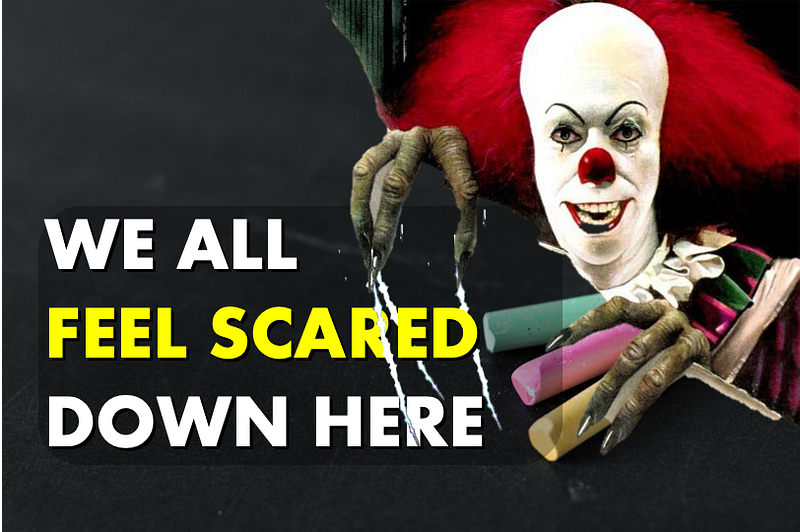
A passing car becomes the piercing wail that sends you into a panic attack. A group of friends laughing with sincere joy should feel contagious. Instead, it’s the catalyst for a terror you can’t escape.
There’s a name for the feeling that comes over so many of us suffering from PTSD and anxiety disorders.
It isn’t panic, fear, paralysis (though all of those happen, too).
It’s called grima, which is the emotional experience triggered by hearing someone scratch their fingernails on a chalkboard (offsite links).
NOTE: This article was written while listening to the music from The Legend of Zelda: Breath of the Wild. Feel free to play that while you read instead of the chalkboard lol.
I HAVEN’T BEEN THIS SCARED SINCE I TURNED THE PAGE TO SEE IF STEPHEN KING WOULD END THE STORY WITH ALIENS. AGAIN.
Scratching your nails on a chalkboard creates a sound within a certain megahertz range that activates the amygdala. The amygdala is a part of the brain that processes and moderates our fear response.
Though some neurodivergent brains certainly — err, diverge — neurotypical (and even a lot of ND) brains are so interconnected that when your fear center spikes with sensation, so does your auditory center.
You ever hear how scared you feel?
Well you can activate that same sensation with nails on a chalkboard. You are now HEARING the sensation of fear. And when you hear it, you probably feel it.
PTSD REVERSES THE FLOW
The inverse happens for someone with PTSD. The body creates sensations as though there is external stimuli. How could it not? The body keeps the score of all we endure.
If you suffered an immediate or sustained trauma at any age — how humbling to remember that trauma can start before you’re even born — your amygdala doesn’t function in a neurotypical manner.
That doesn’t mean it CAN’T once it receives treatment. Once it’s given a chance to grow, to individuate, to heal. Until then, a traumatized brain can function the same as if it had been physically injured. As cool as it would be for emotional punches to never leave a scar, they’re just as likely to leave deep wounds. Some of them are emotional and easy to miss. Others scars were carved inside are own damn skulls.
This is distinct from whether you are neurodivergent for other reasons. But that doesn’t mean you aren’t one or the other. You can, in fact, be both traumatized as well as ND. Many of us are both!
But as far as how trauma can mess up even the most mundane mind?
PLEASE RETRACT YOUR CLAWS
It’s like someone is ALWAYS scratching their nails on a chalkboard. Wherever you go, no matter what you do, that sound is there. Soft, hard, close, far, the scratch will. Not. Stop.
You hear how scared you feel, even though there’s no real sound.
Without any rational reason, the fear-based part of the brain lights up, and then you feel grima, the same as if you were hearing someone scratch their fingernails on a chalkboard.
THE ONE THING THAT HELPS ME
I can’t help it if it’s always been so hard for my brain to process all of…this. The trauma just made it harder.
I’ve found it very helpful to sit with noise-canceling headphones on. The pandemic keeps me indoors most of the time — my extreme social anxiety keeps me in my hobbit cave the rest of the time lol — but when I can, I sit next to a fountain or waterfall, where the white noise of the cascading water becomes so consistent and predictable that it turns the world into an easily absorbed sensation.
For a few examples that help me and might help you, check out Eight Things to Listen to When Writing (other than music and TV)
ONE FINAL TWIST
And if that didn’t blow your mind, wait until you hear how a soft touch can turn fingernails on a chalkboard into ASMR.
Get ready to relax.
THE END (DAMN GIRL, THAT’S DARK)
If any of my content brings you a moment of comfort, hope, and confidence, consider all these different ways to practice Good Patronage.
FREE PATRONAGE: Hold that CLAP button until it reaches your max (each person can add +50 claps). Subscribe to me and your other favorite authors. Click that Newsletter icon so you get notified every time I publish something new (I hope you like a lot of content muahahahahahahahaha).
PAID PATRONAGE: If you sign up for a subscription at Medium (it’s only $5!!!), you support me providing more content like this.
SUBSCRIBE TO AUDIBLE: Everyone who uses this link to subscribe to Audible supports me here on Medium (and beyond). May I recommend Stephen King’s On Writing (offsite links)? Then read what me and Jeffrey Reddick (creator of Final Destination) had to say about Steebo Kingo while he was too busy writing.
HIRE ME TO HELP TELL YOUR STORY: Listen, I too often skip to the end of the article first. But if you started at the top, you saw that I’ve been an editor for best-selling and award-winning books for over a decade. Ready for me to help you tell and sell YOUR story? Head to Stephenie Edits (offsite link).
TIPS: Or you can just buy me a Ko-Fi :)
| SUPPORT ME FOR FREE | SUPPORT ME FOR $5 | HIRE ME TO HELP TELL YOUR STORY (offsite link)| SUBSCRIBE TO AUDIBLE (offsite link)| BUY ME A COFFEE (offsite link)
THE ADS
Links above contain affiliate links with commissions for me from products or services you purchase.


