NEW VIEW 2020
A New Look at the Basement
And the racism hidden there
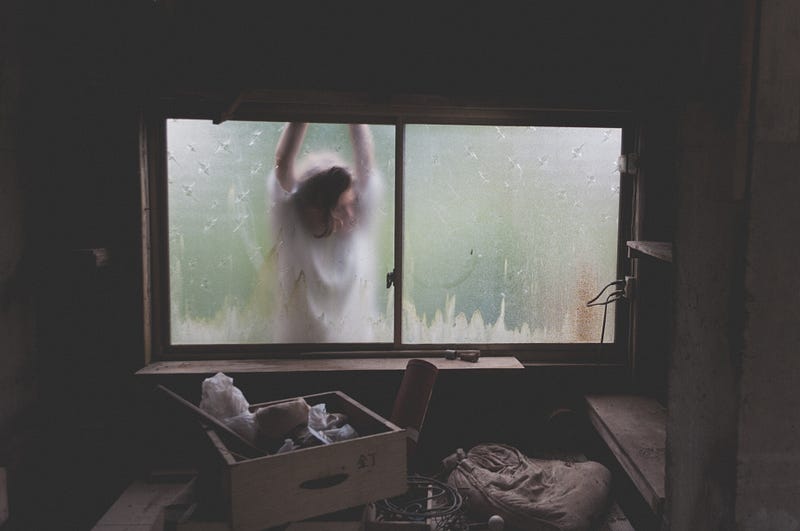
In my childhood home, the finished room in our otherwise dank and dirty basement was the strangest room in our house.
Our basement room had one window looking out onto the side of the house where my parents kept a series of barbecue grills sitting on concrete-tiled stones. So while the window afforded some view, it also afforded anyone on the outside an equal view right into our finished basement room — not a problem unless you wanted to hide Christmas bicycles from your children, and thought they wouldn’t be snooping around. Thinking two boys ages six and ten had anything like self-control or awareness about them.
The door from our breakfast room offered the most direct access to the basement room, via an old wooden staircase. I don’t remember why, but the door from the staircase to the finished basement room was always kept shut, as if someone needed to be kept out, as if someone might need privacy.
The room extended about twenty feet. At its entrance, you’d notice the second door, which was the original exterior door to this room, leading out and down two steps to the original back yard. It was two doors, actually: the wooden main door, and a screen door attached. When I was four years old, the left side of our house — the opposite side of this basement room — caught on fire. We lived at the Holiday Inn for the next month, while not only the burned part of our house was restored, but a new edition added: a new bedroom and bathroom for my parents, and a den. To add these three rooms, part of the original back yard had to be enclosed; thus, we had a door from our basement room that led to another dirt basement floor. What is it about doors leading to nowhere?
The third door to our finished basement room was an addition cut out in the mid 1970’s when my mother decided to open her own antique shop, Jo’s Antiques. She was carrying on a tradition started by her mother who owned antique shops in various locations across Bessemer for years.
What is it about doors leading to nowhere?
My brother reminded me recently that it was he and our neighbor, Frank Manzella, who cut out the third door and laid the new flooring in that basement room for Jo’s Antiques.
I had hopes that this room would become my teenage refuge — a place not only to escape my parents’ eyes and ears so that I could talk freely on the phone and listen to “my music,” but also one I might decorate in mod styles and use as my bedroom.
My refuge would have been perfect because in the back part of the room there was a private bathroom — just a toilet and a sink — but they worked fine, except on the occasion when that toilet overflowed, destroying my old and abandoned toys.
I keep thinking about this time in all its complicated avenues. We had two functioning bathrooms upstairs, so why would anyone go downstairs to use that basement toilet? With my brother and me at school, that left only my mother, my grandmother, and our maid Dissie Shepherd at home. Could all three have needed to use the bathroom at the same time? And given the dust, the rats, the normal load of spiders and roaches, why would anyone willingly traverse those steps in any non-emergency bathroom need?
My earliest memory of our finished basement room was my mother’s art studio. Every Saturday morning she faithfully watched Jon Gnagy’s “Learn to Draw” NBC TV show, and soon bought one of his beginner’s kits, full of charcoal pencils and sketch-pads. Mom’s sketches of old barns, and tables of wine bottles, cheese, and fruit seemed perfectly rendered to my four-year old eyes.
I enjoyed standing near my mother in her basement studio as she drew, but she didn’t get much enjoyment out of her youthful watcher.
“Don’t look over my shoulder,” she’d say, using an expression that I always equated with her headaches.
Maybe I was a headache back then, failing, as any child would, to understand that my mother both needed and wanted her space, her independence from the life above the basement. So for a short time, this basement space was entirely hers. I suppose that eventually, once-a-week art lessons became too infrequent to sustain any real momentum. When she abandoned the room, and my old toys, cards, and comics, took root there.
So perhaps the toilet overflowed rendering her studio unusable, or perhaps, giving up her space made her bitter, and when the junk down there grew too unwieldy, she got rid of everything. Everything except my Dad’s 78 RPM record collection, which gathered dust but sat on a closet shelf, just to the side of that toilet room. These survived the septic flood, I suppose, because they were kept above the fray. It’s all so hard to figure, this room and what it meant to us.
Questioning the fate of what happened in our finished, semi-secret basement room brings me back to the question of the room itself. Why was it built? For what purpose, or more importantly, for whose purpose?
That basement room existed long before either my brother or I was born, so what, if anything, necessitated being stored in this very strange, almost forgotten room?
Maybe you figured it out. Maybe I’ve known, too, for longer than I could admit. Or maybe it dawned on me only after I saw The Help. As a privileged white child growing up in the late 1950s and ’60s, I had no reason to question the social mores of my community. Maybe I noticed more things than my peers did. Maybe my memory is better than theirs. And maybe I didn’t want to solve the secret of this room.
My mother’s family employed maids long before I was born. The first was a woman named Mona Lee, who helped raise my mother. I don’t know her last name; I met her only when I was seven or eight, when Mom hired her while Dissie, who was our second maid, was sick or on her one-week yearly vacation to see her family in Uniontown.
A third woman, Georgia Roberts, cared for my brother and me on certain Saturday nights when my parents went out to dinner and a movie, and my grandmother was off playing bridge with her cronies. Georgia had ten children, including a girl my age named Ellen Terry, after my grandmother.
I loved each of these women, though Dissie was my favorite, She’d play Concentration and Monopoly with me while she ironed. We’d watch I Love Lucy and The Andy Griffith Show and the afternoon soaps in those days before I started school. How can I tell you how much I loved Dissie, how much like a second mother she was to me? How hugging her felt like finding sanctuary?
After the house fire, and after we added those three new rooms, the space within my childhood world opened. Even though we now had two upstairs bathrooms, there were moments when both were occupied, not a pleasant alternative for a little boy in need. Instead of politely knocking, I’d go barging in to these spaces, often catching Mom or Nanny sitting still or trying to get up as fast as they could.
And sometimes I’d catch Dissie, too.
I wasn’t trying to catch anybody. I just had to go, and even if one of those bathrooms were unoccupied, I had to get to the nearest one, because, as we all know, little boys usually hold their business past the safety time zone.
After the fire, Dissie used the upstairs bathroom — the older one in the hall off the breakfast room, but never the new one between my parents’ bedroom and the den. I never knew, or thought to consider, whether this was a rule imposed by my parents, or if Dissie decided this herself. It’s only now that I’ve considered the question.
Only now that, in the recesses of memory, I recall Georgia, and especially Mona Lee, descending those basement steps after our remodeling. Maybe I asked where they were going, and maybe they even said, “to my bathroom downstairs.” Maybe I didn’t ask but somehow knew. Life is full of such moments that both do and do not make a lot of sense.
I suppose that’s the bathroom Dissie used, too, before the remodeling. How did things change? Who said what to whom? I saw Dissie emerging from the upstairs bathroom so often, that I either forgot, or didn’t realize that this was anything outside of the norm.
One more thing links this room and all that dwelled there once or used it. Like all the toys I abandoned to its space and forgot about, I never saw Mona Lee or Georgia after the last time they sat for me.
I did see Dissie once after she no longer worked for us. I was married, and my wife and I saw her sitting on her front porch. We stopped, spoke for a while, and I hugged this woman I loved. She died a few years later, and though I felt it, I did nothing to mark the occasion of her passing. I stay in touch with her granddaughter now, all of this more than I did or can say about Georgia and Mona Lee who became castoffs from my world, or so it would seem from the way I unthinkingly let them go.
Twenty-three years ago, my parents sold their house to an African-American family. The entire neighborhood, in fact, changed from being all white through the 1970s to virtually all Black today.
I have not set foot inside my old house since the weekend I helped my parents move some of their more precious items to the new house across town, which was also predominantly white back then, and predominantly black today. They completed their move the following week while I was back home in South Carolina with my wife and young daughters, living in a house with a completely finished basement, which does have a full bath that we added after moving in.
But I wonder about the family who moved into my parents’ house. What did they think of the finished basement room, the door leading to nowhere? They would never know about the floor damage, all the art and antiques, comics and cards that formerly slept there. Would they understand about the secret toilet and why it was there? Would they remark its existence at all? And if they did understand, would this knowledge cause them to wince, to remember, to realize that where they now lived was like so many other places back in those old days — an upstairs/downstairs world where rights and privileges had a scent and a meaning all their own?
Sometimes I can’t put two and two together. Am I being naive? Am I dense? Or am I willfully refusing to see my own racism — something that others will see and recognize at first glance?
In the late 1980s, a few years before my parents moved, a black family moved next door to them. My parents were apprehensive, and when, at a Christmas Eve supper they reported this news to some good friends, I remember viewing the look of disgust on one of these friend’s faces. I felt horrible in that moment. There was our racism, front and center, unacknowledged and thus accepted by us all as if it were the natural and only attitude toward our new neighbors, our changed world. Yet, my horror at us didn’t cause me to look back into the history of our house and what happened in the name of race.
Another instance of my not looking and reflecting on what has lain apparent before me: since high school, I have read or watched Harper Lee’s classic To Kill a Mockingbird at least twelve times. Part of my doctoral dissertation was on the film and its screenwriter, Horton Foote, and I show it to my Southern Film class often. So I know the film especially well.
I’m certain, however, that it was only in the last viewings that I thought of what the Finch’s maid Calpurnia thought or did when Atticus first suggested and then basically told Calpurnia that, instead of going home to he family as usual that evening, she’ll have to spend the night with Jem and Scout while Atticus tries to protect Tom Robinson from being lynched.
It’s too easy for white people to get caught up in Atticus’s bravery, especially seen from a southern white man’s perspective. Calpurnia agrees to his demand with solemnity and understanding, and she does so quickly and without batting an eye. Given the period when the story was set — the American South in the 1930s — she had no choice but to comply with Atticus’s wishes. If she blinked, hesitated, or tried to negotiate, even as gentle a man as Atticus might reprimand her, remind her of her position. Her place.
And if she refused outright? If she weren’t fired on the spot, she’d lose her “place” in the Finch family. Likely, word would get out, and who in the white community would trust her again?
Of course, people get fired or lose their place all the time. What I didn’t consider while watching this film on so many occasions, though, was that Calpurnia, while loved by the Finch family, was treated as if her place with them was more important, more vital, and more real than her place with her husband and children. Atticus doesn’t ask Calpurnia if staying with them would be all right with her. He says that she better count on staying the night.
He more than implies that she has no choice in this matter.
This is bad enough, but given that white lynch mobs were roaming the streets of Maycomb, that a black man was on trial for allegedly raping a white woman, why didn’t the Finches, Harper Lee, or I understand and consider the human cost to this woman who was asked to sacrifice this night, not knowing what her own family was experiencing, or how they would survive it?
Or maybe we did consider it and concluded that the primary story, the one that mattered, was all-white.
In the film, we get only a glimpse of Calpurnia and the instant in which she decides to stay with the Finches on this night. That instant, though, opens into a life — one that I never bothered to peer into.
That I didn’t consider Calpurnia’s family life for so long speaks eloquently to my white privilege, my entitlement, and my place, just as it speaks to my lack of empathy for all that Dissie, Georgia, and Mona Lee must have felt and swallowed when asked or when expected to descend those basement stairs and relive themselves in the dankness and dust and sometimes rat-infested space below us in the 1950s and ’60s when above ground the world, even in the South, was changing.
I don’t know when Georgia and Mona Lee died. Dissie passed in 1995; my mother in 2018. Dissie’s daughter Nelle died a year ago. Her daughter, Juanita, and I are close friends now. We text regularly; we express our love for each other and each other’s family; and when I visit Bessemer, we have lunch together or spend time talking at her house. Juanita’s daughters and mine are Facebook friends. These relationships do not of themselves right old wrongs. But at least they’re real and they’re “now.”
And they’re definitely not hidden.
The sweetness I lived with these women — Dissie, Mona Lee, and Georgia — came to me through my privilege. While they toiled and cared for us in our home, surely their families experienced bitterness; surely they felt cheated by the time they lost with their wife and mother.
But this reality, like that basement room, lay tucked away in plain sight throughout the world I saw, was allowed to see, or chose not to see.
It’s time I open my eyes.
It’s time others like me to do the same.