avatarSantal Tech

Summary

The article discusses how contestant Michael Han quickly solved a math competition question involving the sum of a factorial series.

Abstract

The article recounts an impressive moment from the 2019 "Who Wants To Be A Mathematician" competition where Michael Han instantly answered a challenging question. The question involved finding the remainder when the sum of a factorial series is divided by 20. Han deduced the answer was "D" (13) by realizing that the sum of such a series would have a units digit of 3, and only 13 fit this criterion. The author explains the mathematical reasoning behind this insight, noting that after 5!, all factorial numbers end with a 0 due to the multiplication by 10 (from 5 x 2 = 10 within the factorial sequence). Therefore, the sum of any factorial series beyond 4! will always end in 3, which was the key to solving the problem swiftly.

Opinions

  • The author is impressed by the contestant's quick problem-solving skills.
  • The author uses a Python script to demonstrate the pattern in factorials, indicating a preference for computational tools to explore mathematical concepts.
  • The article suggests that understanding the properties of numbers, such as the effect of multiplying by 10, is crucial for solving problems efficiently.
  • The author encourages readers to follow their Medium profile for similar content, indicating a commitment to educating and engaging with an audience interested in mathematics and programming.
  • The author is open to topic suggestions from readers, showing a willingness to be responsive and interactive with their audience.

Solving a math competition question in a second

I was watching the final round of the 2019 “Who Wants To Be A Mathematician” competition.

This question came up and a contestant answered it one second after it appeared on the screen.
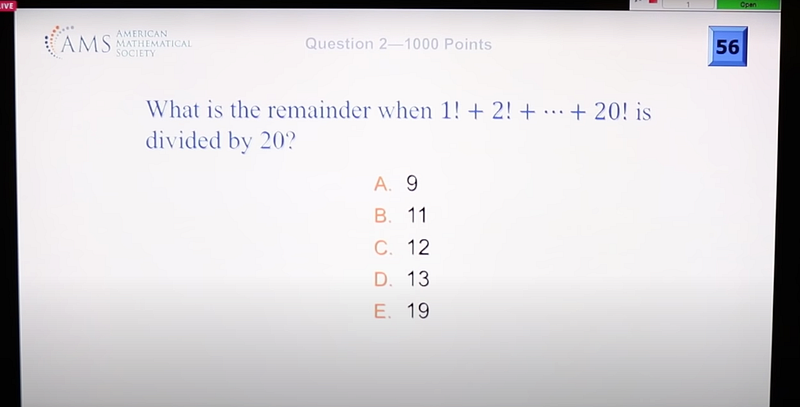
Who Wants to Be A Mathematician Final Round 2019

Can you figure out how he solved it?

The contestant, Michael Han, explained how he knew the answer was “D”: he knew that the sum of a “long” factorial series would have a units digit of 3, so dividing by 20 would leave a remainder with a units digit of 3, and 13 was the only option that met the criteria.

How did he know the sum of this factorial series would end in 3? Let’s dig into this a bit and see what the first few factorials are.

1! = 1

2! = 2

3! = 6

4! = 24

5! = 120

6! = 720

7! = 5040

and with my handy Python script, let’s generate the first 50…
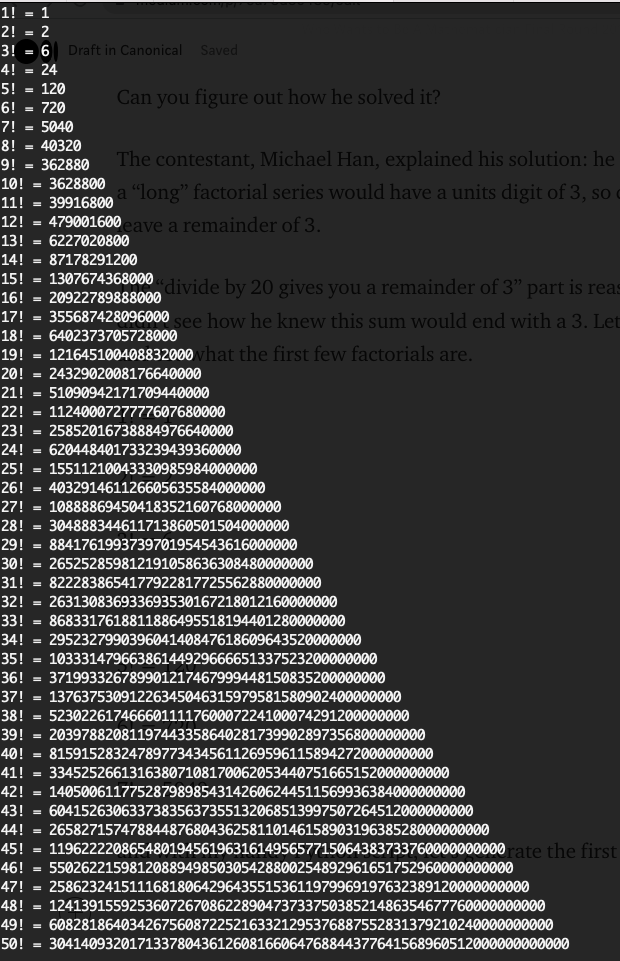
Interesting! We see that past 5!, all the numbers end with a 0. Why is this?

Well, what’s special about 5!? Note the appearance of 5 and 2; these two multiplied together gives us 10. So any other numbers in the factorial will always be multiplied by 10.

So now let’s look at the sum of 1! + 2! + 3! + 4!, which is 33 and has a units digit 3. Thus we know that every factorial sum past 4 will have a units digit of 3!

For more articles like this, follow me on Medium. Not a member yet? Join the community. Want more software engineering interview guides and coding question tips? Check out all of my writing organized by topic in this article.

If you have any requests for what I should write, please let me know!

Mathematics
Math
Computer Science
Education
Numbers
Recommended from ReadMedium