
This Book Should Be On Every Writer’s Shelf — A Must Read
Key takeaways from “On Writing Well” by William Zinsser
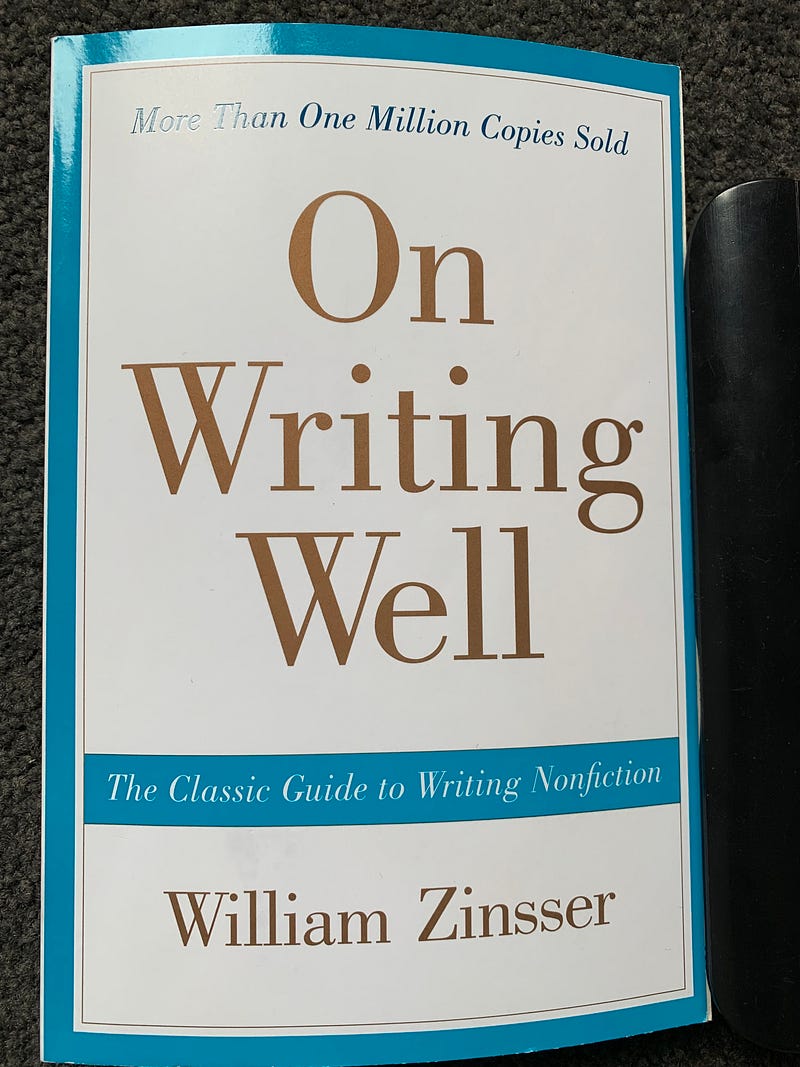
All non-fiction writers on Medium (or on any other writing platform) should read On Writing Well by William Zinsser improve their writing.
Principles
1. Each writer is different.
Every writer has their own way of describing the writing process. For some, writing may be easy while for others writing may be extremely difficult.
Some may believe that the words flowing out naturally should be kept on paper as it is while others believe in rewriting over and over.
Some may find inspiration to write every day and when they feel down or unhappy, they don’t mind skipping a day while others see writing as a job.
Irrespective, 2 of the most important qualities of writing are humanity and warmth.
Good writing has an aliveness that keeps the reader reading from one paragraph to the next and it’s not a question of gimmicks to “personalize” the author. Its a question of using the English language in a way that will achieve the greatest clarity and strength.
2. Aim for Simplicity
The secret of good writing is to strip every sentence to its cleanest components.
Remember that your reader is a busy person. They have a short attention span.
There are a lot of forces competing for your reader’s attention like TV, children, pets, video games, social media applications, email, sleep, and many others. By writing complex sentences, don’t give your reader one more reason to snooze in their chair while reading.
For each sentence check the below points:
- Will the reader be able to understand exactly what you are saying?
- Is your sentence shoddily constructed leading to a possibility that the reader could read it in several ways?
- Have you switched pronouns mid-sentence?
- Have you switched tenses making the readers lose track of who is talking or when the action took place?
- Have you used a new word without looking up its meaning?
If your sentences don’t make clear sense to your readers, they will move on.
Don’t make your readers work too hard or else they will look for one who is better at the craft.
Writers must constantly ask: what am I trying to say?
3. Remove Clutter
Clutter is the official language used by corporations to hide their mistakes.
Writing improves in direct ratio to the number of things we can keep out of it that shouldn’t be there. Remove the clutter as much as you can.
For e.g., the adjective “personal” doesn’t add anything valuable if used as in “personal friend”, “personal feeling”, “personal doctor” etc.
Watch out for any clutter in a sentence and remove it:
- Any prepositions appended to a verb (“Order up”)
- The adverb that carries the same meaning (“smile happily”)
- The adjective that states a known fact (“tall skyscraper”)
- Useless phrases like “a bit of”, “sort of” or “in a sense”.
- Is your sentence different from the previous ones or is it saying the same thing?
4. Be Yourself
The problem with writers is that they want to deliberately garnish their prose so much that they lose whatever it is that makes them unique.
Readers want the person who is talking to them to sound genuine.
Be Yourself. Don’t try to put airs in your prose.
Writers need to relax and have confidence, both of which are easy to say than done. Just one thing to remember is that some days will be better than others. Some days will go so badly that you may even think of giving up writing.
5. Write in 1st Person
Writers are at their most natural when they write in the first person.
As readers, we receive a lot of communication in the form of newspapers, magazines, and brochures from schools, museums, and libraries, which deliberately and rightly so, do not get written in the first person.
Even when you are not allowed to write “I”, think of “I” while you write, or write the first draft in the first person and then take the “I”’s out.
6. Write to Please Yourself
You are writing to primarily please yourself and if you go about it with enjoyment you will also entertain the readers who are worth writing for.
Writing with utmost care to keep your reader engaged by not making any technical mistakes is one thing. And that is absolutely necessary.
However, if the reader is not interested in the topic you have chosen, or doesn’t like what you are saying or how you are saying it then you don’t need to worry.
Work hard to master the tools. Simplify, prune, and strive for order.
7. Use Words Correctly
You’ll never make your mark as a writer unless you develop a respect for words and a curiosity about their shades of meaning that is almost obsessive.
Use new words with utmost caution. Understand their meaning and double-check if, with this new word, the sentence is still saying what you meant to say.
Form a habit of using a dictionary.
When you are using words and stringing them together, also check how they sound. Rhythm and alliteration are vital to every sentence.
Read your sentences aloud to see how they sound. You will begin to notice where the problem lies.
Hope you learned something new today!
If you enjoyed this story but aren’t a Medium member yet, consider joining by clicking on the link below. $5 a month will grant you full access to all stories and articles on the platform. There are many great writers who write on this platform.
Membership also supports the writers here. Should you sign up through my link, I’ll receive a small commission at no additional cost to you.