
A Mouse Tale
A life worth rescuing
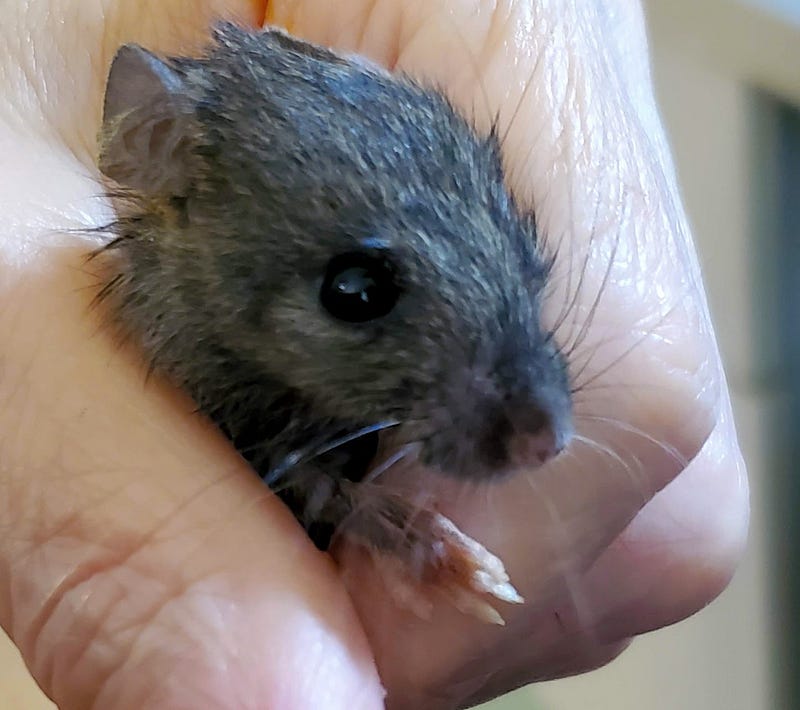
Thursday, July 15th, I was trimming palmettos. Palmettos grow like weeds. In fact, I consider them weeds but the builder of our townhome community regarded them as ornamental plants, liberally scattering clumps of them throughout our neighborhood. Maybe, in the early years, the landscapers kept the clumps trimmed and contained but our current clowns-pretending-to-be-gardeners never touch them. I live on a lake. I want to see the lake. So, I hack palmettos.
I finished the dreaded chore and was walking to our home when I stopped to pull weeds around the patio. Our clown-landscapers don’t deal with the real weeds either. Basically, all they do is ride lawn tractors, blow leaves, and get paid much more than they’re worth.
As I weeded, I heard a screechy mewing sound, like a kitten in the early stage of laryngitis. I followed the sound and found a tiny field mouse — aren’t they all tiny? — lying in the weeds at the corner of the patio. She (gender confirmed later) was immobile. Injured, I assumed, but I saw no wounds.
I picked her up and tried to lay her down on her feet, hoping she would scurry away. She fell to her side and flopped around and around, rolling in circles, unable to control her movements. I couldn’t leave her there to become a quick snack for a hawk or other predator.
And, so begins this mouse tale.
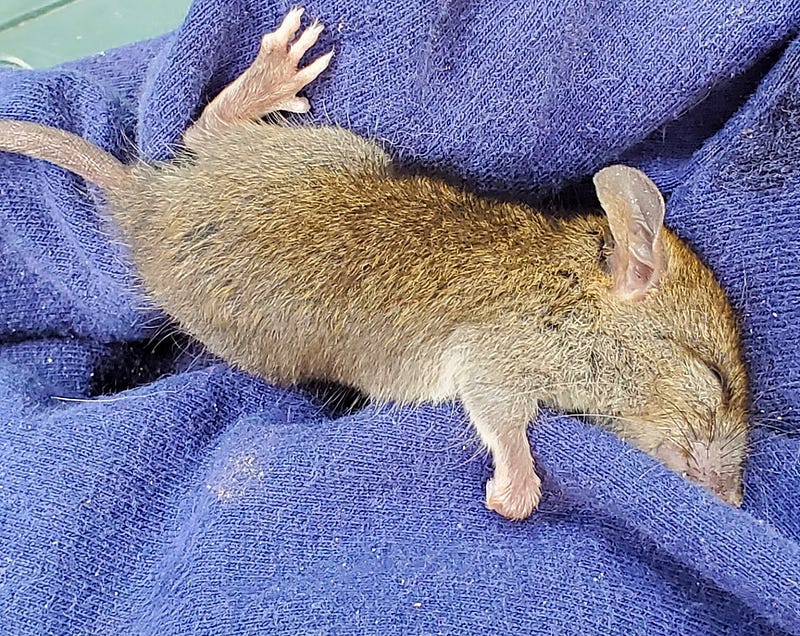
I retrieved one of the carry cases from our guinea pig days, lined it with an old t-shirt of Captain Argentina’s, and laid down the tiny mouse. She flopped about like a fish out of water until exhausted, she fell asleep.
I googled “food for an injured field mouse”. Then, cracked an egg, reserved the yolk, and used a Q-tip to feed my visitor. She sucked the yolk off the cotton ball top.
That was early afternoon. I didn’t expect her to live through the day. She did, so I fed her more egg yolk and went to bed. I checked her at 2 am. She was still alive. More egg yolk. Didn’t expect her to survive until morning. She did.
My vet used to take in injured wildlife but our moronic state passed a law that veterinarians can no longer treat or house wildlife, even those vets who are certified and licensed in wildlife rescue. But, where there’s a will, there’s a way. I named the mouse Javi and called to make an appointment for my “wild pet mouse”.
Javi spent the day at the clinic. X-rays revealed no broken bones. Dr. C guessed that Javi’s flopping and rolling were caused by trauma or a brain injury.
I gave her a dose of steroids. If they help, she’ll improve within 24 hours. If not, we need to consider euthanasia. Give her banana baby food tonight. Here’s a feeding syringe. She’ll get more from a syringe than a Q-tip.
Dr. C charged me . . . nothing. I love my vet.
When I was sick in April, my doctor suggested eating easily digestible banana baby food. It wasn’t easily digestible. It came up as fast as it went down. On the plus side, I still had an unopened bottle.
I set up a feeding schedule of every 4 to 5 hours, and Javi was delighted with her mashed bananas.
Twenty-four hours passed and Javi wasn’t better — maybe, slightly improved, but I truly believe she was simply adjusting to her disability.
She’s spunky, and I can’t give up on her.
Javi had no indicators of being in pain. Her life was worth saving.
Rather than returning her to the vet for euthanasia, I went to the pet store and purchased sweet timothy hay, mouse food pellets, and a little house shaped like a peanut.
I filled her habitat with hay and other organic materials, situated the peanut house in a corner, and scattered the pellets. Then, I gently laid her atop the hay. She quickly burrowed out of sight. Later, I saw her navigating around the hay, much like a spider on a web. The rough texture of the hay gave her something to grab, allowing movements that were impossible on solid surfaces.
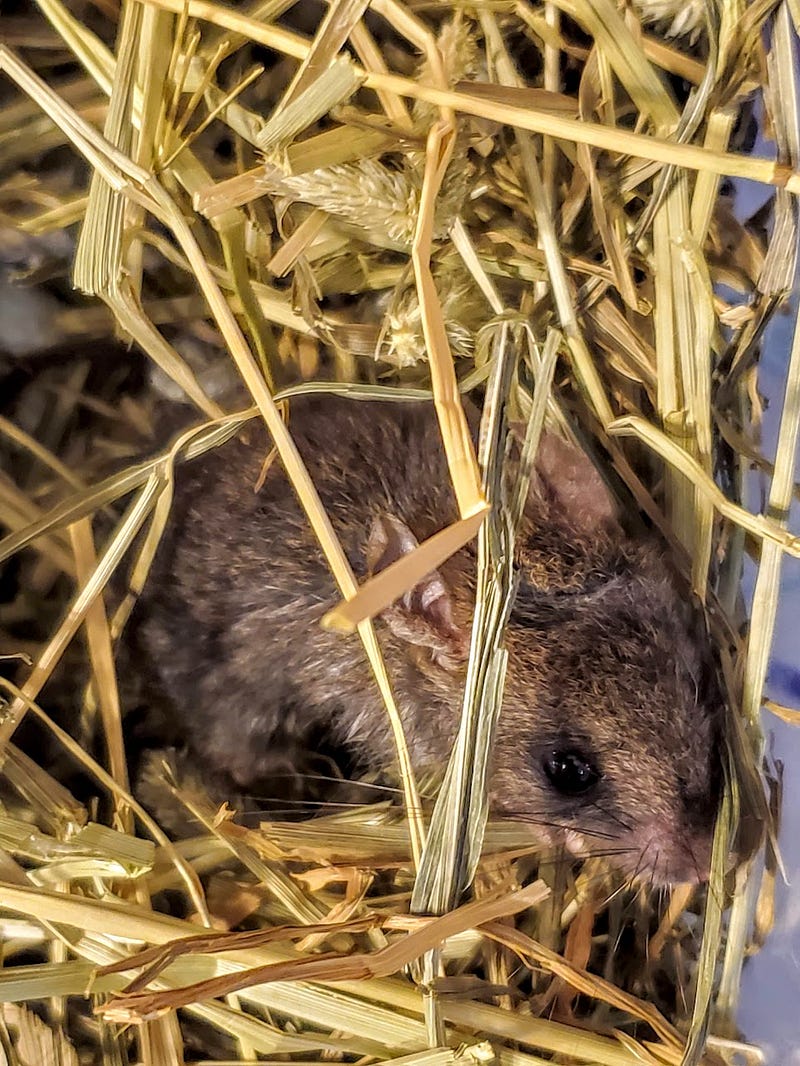
At night, when she’s more active, I secretly observe her activity. Her trauma or head injury left her with a weak left side.
Do mice have strokes?
Google says yes, but all the articles I found refer to strokes triggered in laboratory settings. I’m still not sure what could or would cause a stroke in a mouse in the wild — well, in the wilds of my suburban backyard.
Javi's right side is normal and she uses it to propel herself around the habitat, going wherever she wants to go. I watched her trying to eat the pellets but since she can’t stand and use both paws to feed herself, she gave up. When I feed her, she uses her right paw to control the syringe, occasionally adding her left paw, but it can’t grab as the right one can.
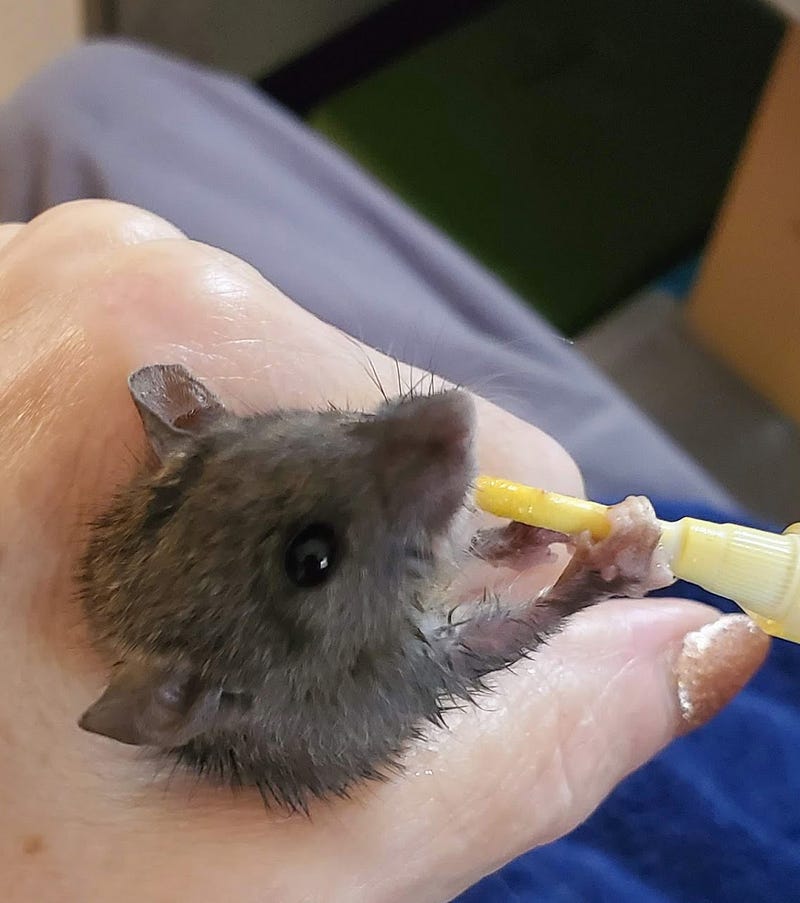
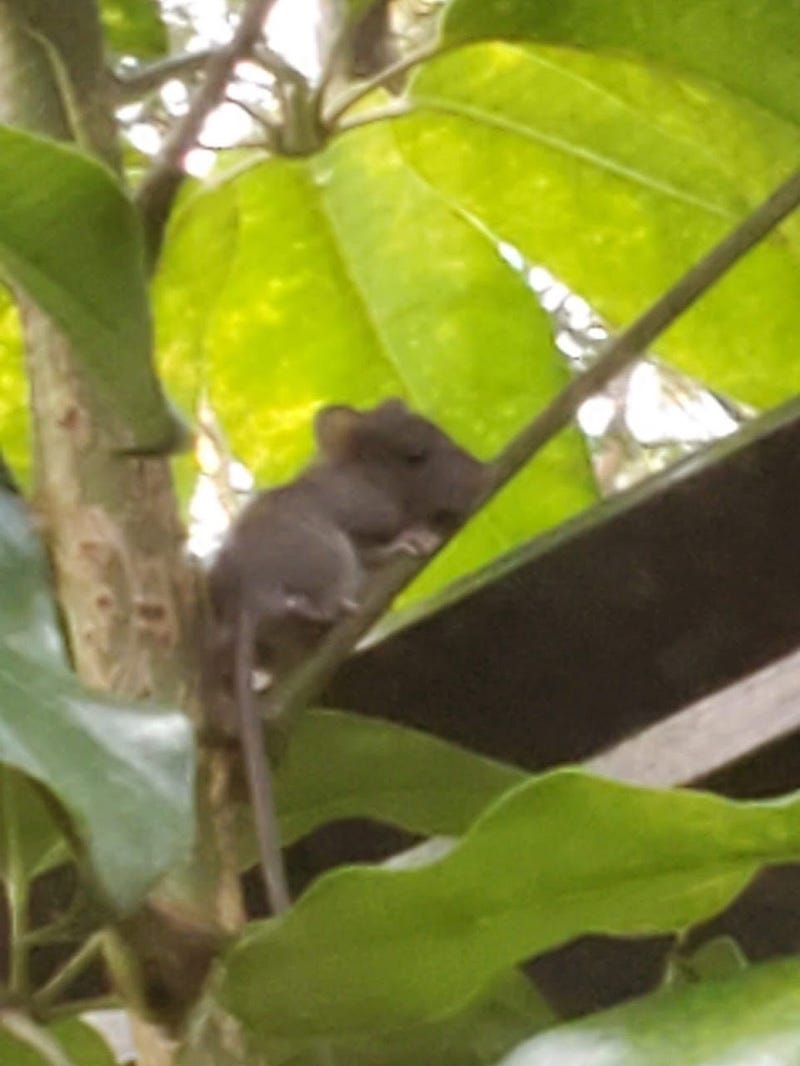
Even her left ear lays flat against her head rather than being upright like the ears of the mouse in this photo I took of what is certainly one of Javi’s relatives in a tree outside our screened porch. (Sorry for the poor quality photo — it was taken through a screen.)
The next morning, I bought more baby food in different flavors, and we settled into a feeding schedule of 7:30 am, 12:30 pm, 5:30 pm, 10:00 pm, and 3:00 am. Her appetite is good, and she lets me know what flavors she likes the best (pears & blueberries are number one, followed by apples, then bananas & strawberries). If she dislikes one, she turns her head to the side and refuses to open her mouth. The only one she hated was some sickly-green vegetable combination that I tasted, thinking it couldn’t be that bad. It was worse than bad. Any parent who feeds a baby that food should be charged with child abuse!
When Javi is full, she rapidly shakes her head from side to side, as if saying, I’m full — no more!
Javi needs water but can’t stand and drink from a regular water bottle. She also refuses water from the syringe. I solved the problem by watering down one of her favorite foods. She receives enough flavor to drink the whole syringe of mostly water.
On Tuesday, Dr. C texted me, expecting a reply that Javi was in mouse heaven. She was surprised to hear that Javi was not only alive but doing quite fine. She forwarded a link to an article about caring for a wild mouse and wished me well, adding that she’s available if needed.
When I cleaned out Javi’s habitat that afternoon, I noticed crumbs from the food pellets. She’d been eating them but how? The next day, I saw her lying on her side, nibbling away at a pellet that she stabilized by wedging into a corner. Sometimes when I feed her, she first spits out a deflated piece of corn. She sucks the insides out of the corn kernels!
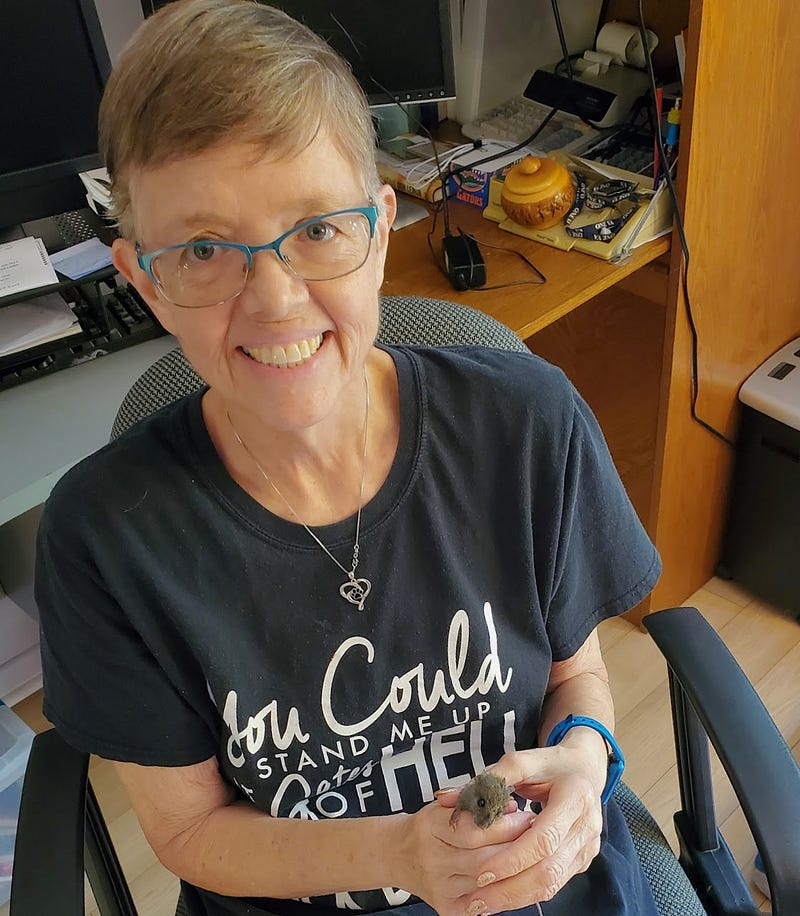
After eating and getting a sponge bath, Javi likes to crawl around my lap and chest. Sometimes, she falls asleep in my hand as I pet her.
Javi has been with me for eleven days. Not long in human time but very long in mouse time. In the wild, a field mouse that doesn’t become a meal for a predator can live 12 to 18 months. Since I have no idea how old Javi is or the effects of her injury on her life span, I can’t guess how long she might survive.
But, for now, Javi is alive and doing well. And, no matter how short or how long her remaining time might be, her life was worth saving.
© Dennett 2021
I’ve spent my life rescuing animals — domestic and wild. Last year, I had a crazy adventure with a polka-dotted wasp moth. You can read about it here:


