
A Message to All Tech Writers on Medium
I’m with you. And I had to say something.
I would rather connect my teeth to a three-phase mains outlet while being serenaded by Kenny G than run a content platform.
I have immense respect and admiration for those who do (run content platforms, that is — not listen to Kenny G). It’s the people behind services like YouTube, Medium, and Substack who make my business viable and, most importantly, profitable. They also provide creative outlets which mean the world to the kid in me who still just loves to be creative.
Tony Stubblebine is a great CEO. Ever since his appointment last year, he has been highly visible and I’ve engaged with him personally via comments threads on Medium and direct messages on other platforms.
This guy clearly cares. And, once again, I would not want his job. I’d be terrible at it.
But I’m a writer; a good writer who has poured his heart and soul into Medium. Tony and Medium need writers like myself.
And I’m pissed off.
If you’re reading this, my guess is that you’re pissed off, too.
What Medium means to me
I’ve built an audience of over 19,000 followers on Medium, encouraged nearly 100 people to join as members, published a successful eBook to help aspiring Medium writers, and run a nine-week live academy that was devoted to Medium (and which is still underway).
More importantly, I’ve been writing consistently on Medium for over three years delivering value to my Apple-centric audience. They don’t always agree with what I have to say, but my stories about the world’s most valuable tech company spark debate and have inspired others to contribute their own stories. They have also encouraged a metric tonne of external traffic through Medium’s doors via Google searches.
This year, Medium has changed both its curation system and Partner Program remuneration strategy. The former has gradually reduced my audience and its associated engagement to well under half of what it was. The latter has slashed my monthly earnings and turned Medium into a lottery in which I suddenly feel needlessly constrained as a tech writer.
I’ve never been one to stand on my soapbox and hurl eggs at ‘the machine’. But I need to say something.
I’ve aired my feelings about the Medium changes on Substack, and it has been the most popular post I’ve published on there to date.
Unfortunately, I can’t reach every Medium tech writer on Substack, which is why I’m publishing this story today.
The new Medium
I missed Medium Day. Not out of spite, but because I desperately needed some family time. If you attended, I genuinely hope it was insightful and enjoyable. My assumption is that Tony’s keynote will have been inspiring and full of proof that the recent changes have resulted in membership growth.
If that’s true, it’s wonderful news.
But at what cost?
You see, there’s an undercurrent of discontent among writers like myself that you simply won’t find unless you hunt through the comments sections of stories relating to these changes. The replies to my comment on Tony’s original post are a perfect example of this and a tough read if you work at Medium. In fact, they’re damning.
I’ve spent considerable time thinking about this and analysing the performance of my own Medium stories over the last couple of weeks, and I’ve come to a rather simple conclusion.
The New Medium is ALL about the Boost.
Medium will tell you that their goal is to only surface quality writing. Great! But the metrics they now use to measure quality relate to reading time, claps, and engagement in the comments section — and you’ll only get that stuff if your story is boosted.
It’s all a bit chicken and egg, isn’t it?
For those who aren’t aware, the Boost program replaces the previous curation method whereby stories would be given a leg-up by Medium staff. That human approach remains, but the rules for boosting stories have changed, and we now have ‘nominators’ who are non-Medium staff with the power to suggest stories for boosting. It has a good heart, but it is also ludicrously over-engineered and massively subjective.
Following the algorithmic changes, if your story isn’t boosted, its performance will be pitiful. If you’re lucky enough to receive a Boost, the impact on your stats is meteoric.
It is do-or-die — which is not a nice place to be as a professional writer.
I’ve experience this wild performance deficit myself. Check out my stats for the last 30 days:
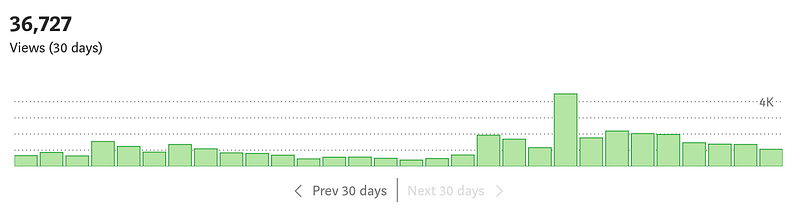
To put this in context, I used to average between 60–70K views every 30 days — a number that has dropped sharply over the last few months, despite my writing style and cadence remaining the same.
The spike you can see is due to two boosted stories. To date, they’ve accumulated nearly 19,000 views and earned $1,126 in revenue, collectively. Put simply, if I manage to get four or five stories boosted each month, my earnings will return to what they were before, if not considerably higher.
So, why am I moaning?
The boost lottery
I know how to run a content business — I do this full time. It requires the ability to ‘niche-down’, remain ultra consistent, build rock-solid processes, and create work that you’d want to consume yourself.
To aid this, you need a distribution platform that makes sense and offers some form of predictability. It’s only fair; they scratch your back, you scratch theirs. Everyone wins — particularly the audience.
Medium no longer makes sense. Nor is it predictable. And I haven’t received a decent back scratch from it for months.
I have no idea why those two stories were boosted (one even made it as a staff pick). They’re not my best work, they’re alarmingly similar (both chart my experience without an Apple Watch on my wrist), and I’ve written far better stuff that hasn’t been picked up by the boost team.
Here — see for yourself:
Therein lies the problem. This is, as I noted earlier, subjective. How on earth am I supposed to ‘get a feel for the boost’ (as Tony suggested I should) if it’s so unpredictable? What if it appears to be choosing my least favourite work?
Worse still, if you’re lucky enough to have a story boosted, you’re not given any form of feedback as to why. Even worse than that, if you’re a nominator and have a boost declined, you’re not told why.
If Medium is relying on the dopamine hit effect to keep writers coming back for more, it’s the wrong strategy.
It’s a mess.
Medium is nothing if not open — perhaps too open sometimes with its inner-workings — but that does at least mean we have clear guidance on how “real humans review stories for Boost”.
However, boiled down, they amount to nothing more than common sense. “We want original, well-written content, that delivers value to its intended audience,” is what Medium is essentially telling writers.
That’s it. And that’s all it should be — this game isn’t rocket science. That distilled sentence written by yours truly encapsulates everything content creators should be doing while simultaneously telling AI content to fuck off.
The problems begin to mount as soon as you introduce humans into the curation method. We all have bad days. We all forget stuff occasionally. No matter the rules, regulations, and beliefs to which we adhere, sometimes, we just fuck up.
We’re human after all, as two French house robots once told us.
I’m not at all comfortable with the success of my Medium stories lying at the hands of a bunch of people and their decisions on whether or not to hit the ‘Boost’ button. If I place myself in the shoes of a reader (of which I am — I pay for my Medium account and duly read like everyone else) it’s even worse. Why should my favourite authors only appear prominently in my feed if they’re lucky enough to hit the Boost jackpot? What if I wanted to read the story that wasn’t selected for a boost? Do I have to hunt it down?
I don’t have to do that on any other platform on which I consume content; it’s delivered straight to me and, more often than not, it is spot on — because it’s programmed by machines which never get out of the wrong side of the bed.
Looking in the mirror
I’m not arrogant enough to think that I share zero blame here. There is absolutely a chance that my writing has changed. Perhaps the topics on which I’m musing have become stale. Maybe I’m blind to the fact that I’ve become fatigued by Apple-centric content.
I’m willing to accept all of this. I’m also willing to accept that platforms and algorithms change. That’s why I’m not exiting Medium stage left to whinge about it while nursing a large brandy at the local pub soundtracked by Kenny G blowing elevator music through the jukebox on his sax.
As soon as I saw my earnings fall off a cliff and read Tony’s reasoning for the changes, I decided to experiment. Write less. Publish fewer review-based stories (even though my audience genuinely seemed to enjoy that stuff). Figure out what works, and what doesn’t work.
Make changes.
It’s early days — things may improve. Equally, for every writer that has suffered, there’s one who has received a sudden, sharp improvement in their fortunes. I’m genuinely delighted for those people, but as it stands, it feels like tech writers have been brutally shown the cold shoulder. We’re not alone, either; I’ve witnessed many writers complain of the disappearance of their audience and income across a number of niches.
I’m not writing this story for Medium. It isn’t an — admittedly mouldy and half eaten — carrot on a stick for Tony; it’s for you, my fellow writers.
This is an open platform, after all — it’s what has always made Medium so wonderful. As I tell my Medium Academy cohort members regularly, it’s a community as much as it is a place on which to publish your best work.
So, I’m going to sign off by handing it over to you. What has your experience been like as a writer (or reader) since the changes were implemented? Is it as bad, confusing, and frustrating as mine, or have you found success? Please get involved below.
We’re all in this together, folks.


