
Part One: Message in Time
Intertwining Realities
Foreword
The world, with its hierarchies of power in a variety of spheres, may have devalued and disregarded her, labeled her as a mere slip of a caramel-coloured girl. But, anyone who’d bothered to look a bit deeper, would have seen that from an early age, she had the heart of a warrior and the mind of a philosopher. The layers of repression, of oppression, of exploitation, buried her so deep. So, what made her claw her way out of the dark, deep silencing? What else but her love for her nieces and nephews, the innocents about to be chewed up and swallowed by the Muslim Matrix?
“kolokan olbaahr meatha lehkamin rabbee lanfeh albarah kabi thanfath valo jeeanah…”
What? Had my eyelids been stitched close? What were those rhythmic Arabic words…somewhere. Far…? Near…? In those twilight moments between dream state and awake, I had staccato images of people with their lips stitched shut, eyes blindfolded, chains on their feet… As I struggled to open my eyes, the life-sized faceless black blobs surrounding me, faded away.
I blinked into a groggy wakefulness, feeling heavy, my body full of a dull pain. In the huge expanse of the universe, I felt like a speck, lost and alone. Where the hell was I? I turned my head towards a sliver of light. Then I recognized the big beaks and delicate spindly legs of cranes amongst green bamboo stripes.
It was the attic room in my parent’s house! I recognized the cotton curtains decorated with cranes and fronds of foliage. The curtains were drawn close except for a bright chink of light in the middle. I lifted my head slowly, ever so slightly, and saw the reflection of my eight-year old nephew in the wardrobe mirror opposite. He was sitting cross-legged on the floor, by the foot of my bed, directly in the sliver of light. As he recited from a chapter of the Koran in Arabic, he swayed back and forth.
“kala filo ya iha…”
I groaned more loudly than I realised. Haroon jumped up and came to me.His words came out in a tumbled, excited rush, that made me smile.
“Are you alright, Auntie Hanna? I’m not supposed to be in your room, but I came to see you. You’ve been fast asleep since before I came home from school!”
“Hello Haroon. I’m so glad you are here. My head feels too heavy! Can you put a couple of cushions under?”
I closed my eyes again, so that he would not see them filling with tears. Haroon grabbed a couple of the cushions lying by the wall and after pushing them under my head, smoothed the edges, as if he was comforting them or rather, me.
“Thanks Sweety. Why don’t you finish your reciting”, I whispered, my voice apparently joining my mother’s at last.
Haroon sat back down and opened the single, bound chapter of the Koran he was reading. Every day, after school, he sat with my mother, and read a page. Then he had to go over it again, on his own. With his finger tracing each line of text, he continued reading aloud, rocking back and forth. He was copying how he’d seen his grandmother and his mother — my older sister, reading the Koran.
I recalled myself at his age — how eager I’d been to please, to achieve, to simply memorize, in the ways that the grown-ups had wanted me to. But there came a time when it wasn’t easy to pick up this baton of meaninglessness. It’s contrary to how our minds work. So there he sat, some twenty-two years on from my twelve year old self, who had protested being made to read the Koran without any understanding of the Arabic words. Now, this darling child, pulling his eyebrows down, tensed up with concentration, was following the Pakistani /Muslim heritage.
Does rocking back and forth, create a sense of movement? Jewish men at the Wailing Wall in Jerusalem do the same rocking movement… but unlike Jewish societies, there has been no actual growth, for centuries upon centuries, of Islamic cultures. Only each generation forever re-enacting the fossilized remains of a system that grew out of the brute scarcity of the desert, in which might always equated with right.
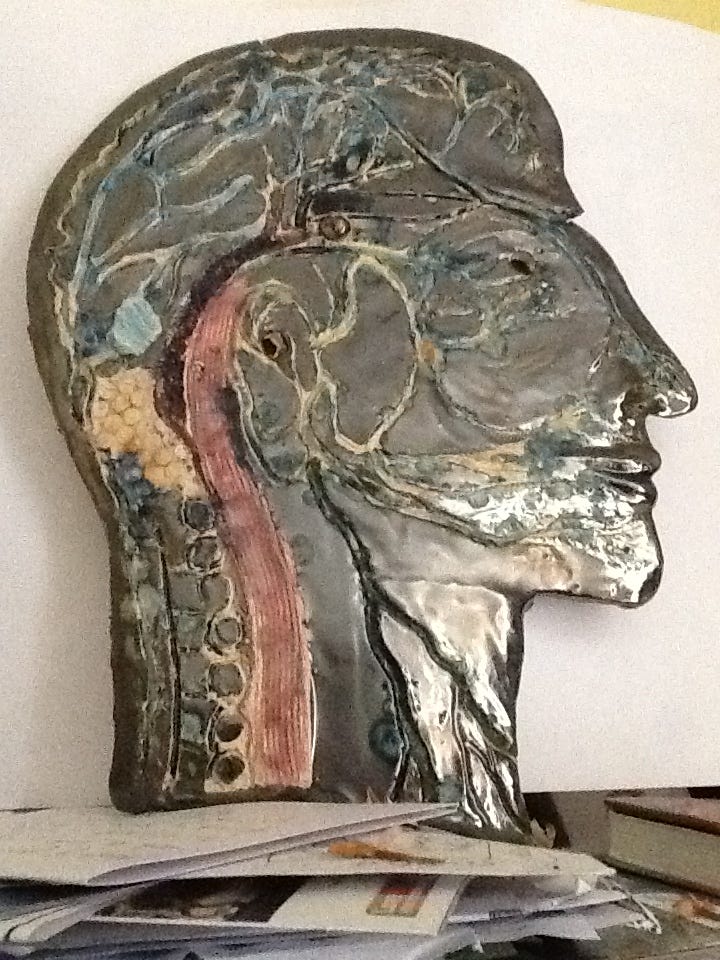
How many Pakistani-heritage people even read the Koran? It’s more like parroting! Must we all, keep on parroting sounds we have no understanding of? I needed to rest, but my mind could not relax. Since I’d got to my parents’ house, everything they did, left me on edge. The last straw breaking this camel’s back, was when my mother said I had to take the clay sculpture out of the house. It was the figure of a blindfolded woman on a pyre, representing the millions of women, burnt as witches in Europe over centuries that included the so called ‘Enlightenment’. All my mother cared about, was that, from the Muslim perspective (which must of necessity, be 100 percent correct, having a ‘graven image’ in the house was a big no no.)
How did it go, that poem by the blind Syrian poet, Al’ Ma’arri? I’d been writing it out several times. It was like a mantra that comforted me, that evening before I was admitted to hospital. My sense of astonishment reignited. Why had I never heard of this poet and philosopher born in AD 973? How idiotic that at school, we had to learn about such irrelevances as ‘Capability Brown, the landscape gardener for the English aristocracy in the 18th century. My history classes touched upon Napoleon, while music classes introduced us to Beethoven and Bach, but there was no space in the English school curriculum for anyone from African or Arabic lands. Just images of African women in grass skirts, standing beside mud huts. Or women in harems, veiled and lounging on sedans, seductively. For sure, nothing in my ‘education’, in the U.K, had even hinted to me that someone like Al Ma’arri could even have existed. And now, the same old diet of the safely irrelevant was being delivered to my nieces and nephews in their school.
To think that Al Ma’arri’s atheist and socialist thinking had preceded Nietzshe and Marx’s thinking by some 900 years! On top of that, Al’ Ma’arri had been vegetarian — like me! Eventually, his thinking evolved to the point where he became vegan, long before that word was even invented. He’d refused to touch milk, eggs, even honey, saying that to do so was a kind of theft! In his poetry, he’d poured scorn on all the ‘revealed’ religions. Now how did it go, that poem of his I’d copied out? Something about the prophets… Ah…
‘The Prophets too, among us come to
teach;
Are one with those, who from the pulpit
preach;
They pray and slay and pass away and
yet;
Our ills are as pebbles on the beach.’
Though some people might be stabbed by self-doubt, growing from a young age, in directions not validated by anyone else in the family, I confidently, followed my heart’s reason. But even so, discovering Al Ma’arri had been so heart-warming, even though he’d died nearly a millennia ago! Ridiculous! To feel so isolated! Did I really have to go that far back into Muslim/Arabic history, in order to find a sense of kinship?