
A Masterpiece
Lay Down Your Weary Tune
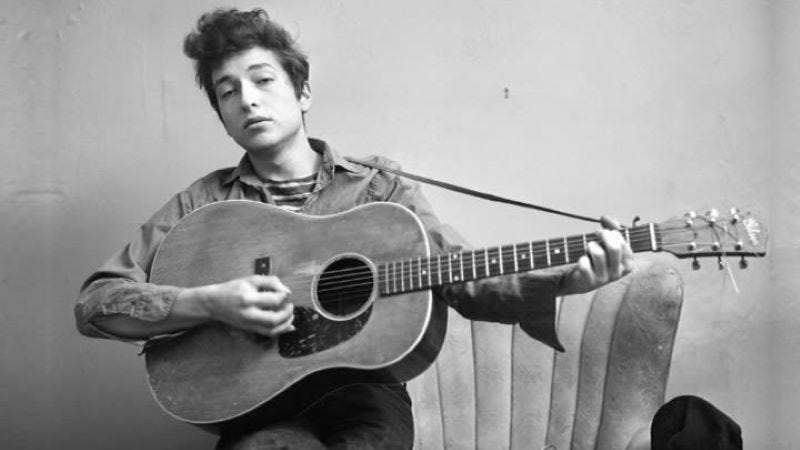
Lay Down Your Weary Tune — Surely this is Bob Dylan moved by angels
From his very first (1962) album “Bob Dylan” through (1966) “Blonde on Blonde” I not only admired Bob Dylan; I not only listen to all his records, constantly; I not only learned how to play his songs; I not only memorized his lyrics; I deified him.
To me, then a northern Sweden teenager, the U.S. phenomenon called Bob Dylan brought the remote, real, important outside world to my cold, snowy, and by comparison unimportant doorstep.
New York, to me just a step or two above myth and fable (though it was, it must be said (since I am Swedish), the town where Ingemar Johansson, on the 26th of June, 1959, scored a third-round knockout against Floyd Patterson in their first World Boxing Champion title bout — I, along with the rest of my country, was awake at two in the morning or thereabouts (on the 27th), to hear Arne Thorén deliver the play by play, or blow by blow rather, on Swedish radio), this mythical city and all its magic was sung into my northern universe by this nasal American who spoke for a generation, though he always denied this.
Later in life, I came to wonder if some of his songs were not actually amphetamine-induced streams (nay, rivers; nay, floods) of consciousness. Dylan’s close friend Bobby Neuwirth once said that “Like a Rolling Stone”, still a very long song, originally sported fifty-odd verses — that’s a flood that just kept on flooding.
Apropos of which, I have remained amazed all my life at how Dylan remembered all the words during live performances.
But fast forward some years and all was no longer well in my Dylan universe. A friend of mine had told me that Dylan had stolen “Blowin’ In the Wind” from some unknown upstate New York folkie (my friend also happened to be from upstate New York). I did not believe her when she told me, and I’m not sure I believe her now.
HOW-ever, I had found out that Dylan was not beyond helping himself to available non-Dylan fare and then serving it up as his creation.
Clearest case in point: the traditional “The Parting Glass” (to listen: see below) which Dylan lifted almost wholesale and recorded and released as “Restless Farewell” on his “The Times…” (to listen: see below) album. This is so clearly a rip-off that if History could sue, it would have filed its complaint ages ago, and won hands down.
But then, as if to make up for this and set everything right in my Dylan universe again, there’s “Lay Down Your Weary Tune” (to listen: see below).
This song, which actually never made it onto an official Dylan Album — it was an outtake from the “The Times They Are A-Changing” sessions — is such a magic pearl of a song that I can only conclude that Dylan was moved by angels.
Many others agree. The Byrds recorded it on their second album “Turn! Turn! Turn!” (to listen: see below) and Billy Bragg championed the song as well.
Dylan was 23 when he released “The Times…” but when you listen to “Lay Down Your Weary Tune” you are listening to a much older man, perhaps an immortal one.
Lay down your weary tune, lay down Lay down the song you strum And rest yourself ’neath the strength of strings No voice can hope to hum
Struck by the sounds before the sun I knew the night had gone The morning breeze like a bugle blew Against the drums of dawn
Hearing this, I’m hearing Rimbaud singing, I am hearing Rumi laughing. Unearthly. I’m listening to Robert Frost or Walt Whitman or Denise Levertov. I’m hearing the Nobel Prize committee giving serious thought to awarding Dylan that most coveted of all literary prizes. Oh, yeah, that’s right, they eventually did just that.
The ocean wild like an organ played The seaweed wove its strands The crashin’ waves like cymbals clashed Against the rocks and sands
I stood unwound beneath the skies And clouds unbound by laws The cryin’ rain like a trumpet sang And asked for no applause
Hearing this, I’m standing by my own Pacific Ocean shore and I can hear the organ play, I can see the seaweed weave their strands and the rolling waves of incoming tide horses crashing on the sand; and I wonder, how did he know?
The last of leaves fell from the trees And clung to a new love’s breast The branches bare like a banjo played To the winds that listened best I gazed down in the river’s mirror And watched its winding strum The water smooth ran like a hymn And like a harp did hum
I hear Robin Williamson’s “October Song” (Dylan, by the way, said he loved The Incredible Sting Band), I see Swedish October forests, and I can smell their sweet autumn decay settling in for their long, snow-covered slumber. And so he adds, by way of leave-taking the final round of refrain.
Lay down your weary tune, lay down Lay down the song you strum And rest yourself ’neath the strength of strings No voice can hope to hum
I was in my sixties when I decided to learn how to play this song. It was a labor of love performed by stiffening fingers and leaky memory. But I learned it and I played it, even recorded it (privately) as a tribute to the immortal Dylan.
And to this day I remain convinced that poetry is the language of the angels.
© Wolfstuff
To Listen:
Lay Down Your Weary Tune (Dylan)
Lay Down Your Weary Tune (Byrds)
P.S. If you like what you’ve read here and would like to contribute to the creative motion, as it were, you can do so via PayPal: here.


