
A Masterclass on Tension and Release
From Thomas Ha’s ‘Our Quiet Guests’ in “Three-Lobed Burning Eye”
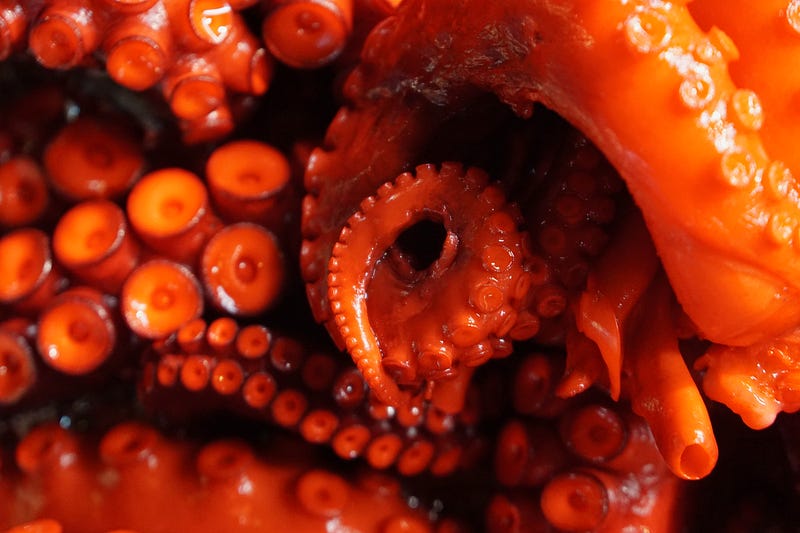
In less than 3,500 words Thomas Ha gives a master class in building tension and release.
He has “sharp” points of tension: obvious moments or events that trigger anxiety in the main character (MC), reader, or both. These cause “fuzzy” waves of tension: residual tension that arises in the wake of “sharp” tension. The MC tries to compensate by relieving the tension. (In this story the MC has more of a direct impact on alleviating tension, as opposed to in other works, where the author relieves tension by, for example, introducing comic relief, or changing to slower, quieter storyline.) Some of these are “sharp” actions in direct response to “sharp” moments of tension, while others are “fuzzy,” a bundle of passive actions meant to diffuse tension.
Read the story “Our Quiet Guests” by Thomas Ha from Three-Lobed Burning Eye before moving on.
Tension point #1 (sharp): The Quiet Guests arrive
The story opens with the arrival of unexpected guests. With clever foreshadowing we get the sense something is terribly wrong, despite the main character’s (MC’s) cheery disposition. While chatting with the guests he thinks of his son locked in a closet upstairs; he tries not to stare too long at the guests’ misshapen faces, their mismatched, ill-fitting suits. He recalls what his father told him: “don’t cross Our Quiet Guests.”
Tension point #1 (fuzzy)
The MC seems to have locked away his son for his own protection. We suspect this is the first part of a plant and payoff. With the memories of MC’s father’s warnings, we also lean in to the story wondering what happens if you cross the guests. That inherently plants a promise: the guests will be crossed. We want to know how: how strict are they?
Release #1 (fuzzy)
The MC tries to release tension by carrying on like a good host as if this visit is no different from any other acquaintance visiting. He keeps up a pleasant one-sided conversation, given the guests don’t speak at all.
Why? Because of the “Rules.” We never find out exactly what the Rules, but we can see what they require: appeasement, subservience, perfection.
Tension point #2 (sharp): Running Low on Sugar
Like a good host he makes them coffee, but he realizes they’re running low on sugar and cream. He worries this will irk the Quiet Guests.
Tension point #2 (fuzzy)
Intra-marital tension: The MC thinks of his wife as he blames her, in part, for not re-stocking the sugar and cream.
Internal tension: At the same time, he recognizes this is his fault, too. He wants to believe that if his wife were to drive home now, he would be the type of man to wave, yell, and urge her to back away from the house. But he acknowledges he’d most likely stay put like a good host and let her walk in on their Quiet Guests. He’s bitterly accepted that he’s not being the type of man he wants to be, someone more assertive.
World tension: The MC recounts how his wife has to drive all over town to find the one brand of sugar and cream they can “stomach” among the few options left. He hints at how there’s not many supermarkets left open, and that the ones that remain have few wares on their shelves. He grapples with memories of his grandpa gripping his arm, showing the young MC the scars he acquired by crossing his own Quiet Guests, back in his home country. By telling us it would be wise to chase his wife away if she were to come back home, the MC hints further at how terrifying the Quiet Guests can be. This builds on the tension of his son locked away in a closet upstairs.
Release #2 (fuzzy)
The MC chit-chats with the guests and makes do with what they have, trying not to let any anxiety or frustration show. He says, “If you wouldn’t mind telling me. How do you prefer to take your coffee, Messieurs? (emphasis added)” Note how overly polite he is, and how that first phrase is it’s own sentence.
Tension point #3 (sharp): Guests have been crossed
When the MC turns around with coffee, he finds the Guests’ shoes on the counter — he crossed them. But how? And what does he do about it now?
Tension #3 (fuzzy)
Internally, he starts to panic. He remembers his grandfather’s nails digging into his arm, warning him that the Guests may forgive one or two mistakes, but that every violation will be taken as an excuse to escalate. “So you must never, and I mean never, cross Our Quiet Guests,” he had warned.
If the narrator could at least know what he did wrong he could attempt to right it, but even if the Guests could talk, asking them might cross them more.
He allows himself to notice more unnerving details about the Guests:
The appendages were so pale and moist as to be nearly translucent, giving the impression that a dripping sac surrounded their extremities; and each toe, without the cap of a nail, swelled and stretched as it rubbed against floor, like the feelers of an insect sensing every texture and vibration. And the smell. Some god awful and unmistakable chemical odor emanated from those naked feet. Similar to chlorine from the community pool, but so foul that my eyes began to sting.
All of these grotesque details clue us into the fact that the Guests are not just odd, but undead. We’re shown so much and yet still know so little about who — or what — they are, and what they’re capable of. This builds tension, and even anxiety.
Release #3 (sharp)
The MC awkwardly explains he’ll just serve the coffee black, then proceeds to give them coffee, choosing to carry on as if nothing happened.
Notice that the character’s main strategy so far is to appease by not raising a fuss. On the one hand, he’s following the “Rules,” policies and procedures passed down by his grandfather, namely to never cross the Guests. But on the other, it might be an individual character tic, as he’s hinted at through his internal monologue. A third option might be cultural factors. Though the character’s heritage is never mentioned, we know that his grandfather is from an “old country,” and outside of the story, the author is of Korean descent. The way the main character behaves aligns with the model minority image, which psychologist Dr. Jenny Wang has noted mirrors a trauma response: if you can’t beat them, appease them. Instead of rocking the boat, fly under the radar and beat them with unnerving amounts of hard work.
Tension point #4 (sharp): Dropping the coffee mug
When the MC hands over the coffee mug, the mug drops to the floor and shatters.
Tension point #4 (fuzzy)
Even as he’s narrating the exact moment the mug dropped, the MC spins in confusion, swearing he couldn’t have made such a mistake, swearing the Guest couldn’t have opened his fingers just a little too wide exactly at the moment when he handed off the mug, because why would they do that?
We can see the narrator actively gaslighting himself. Part of him screams at him that the Guest opened his hand on purpose, making it look like the narrator dropped the mug and broke the Rules. This rebellious side of the narrator feels rightly indignant. The other side of him fights back with self-blame, as if it would violate the Rules for him to even think the Guests would set him up.
On the one hand, this sense of confusion further elevates our anxiety as we read, but it also clues us into something important: the MC has started fighting against himself. We see rising inner tension between the dutiful, scared Rule-follower he is and the rebellious man who wants to stand up for himself.
Release #4
I did the only thing I knew to do, what someone of my character does when faced with something too painful to bear: I groveled. Without dithering or qualification or smallest shred of dignity, I groveled.
Before the Guests act any further, before they even move, the narrator brings a knife to his own finger. He placates them: he knows how this works, because he’s from “one of the old families.” He’d seen his grandfather’s scars, the missing appendages.
He gives them his finger. It works. The Guests click in “feverish delight.” A tentacled-something emerges from one of their mouths and takes his offering. The narrator does what his grandfather instructed: offer more.
Mini-tension Point #5: Questioning the Rules
In recounting his grandfather’s advice, the narrator as a boy had asked “Why?” Why offer more? It didn’t seem fair.
It had been the only time, I think, that I’d ever questioned my grandfather’s ranting, at least openly and in such a firm manner. Even then it had felt so fundamentally imbalanced, the inherent asymmetry of the Rules.
He chooses to resolve this tension in the present by carrying on as normal, but as he cuts off more and more, we get more hints of him shifting, wanting to break the Rules.
Tension point #5 (sharp): Thump
In the middle of his offering, there’s a thump upstairs, right above their heads. The narrator tries to object, “No, I have more here to give.” But two of the Guests speed up the stairs to where his son hides in a closet, while the third remains behind to feast on his face.
Tension point #5 (fuzzy)
Tentacles and teeth reach into the narrator’s eyes as his son starts to scream for his father.
Release #5
The narrator can no longer resolve the rising tension by placating his Guests. All is lost: he’s being devoured, and soon his son would be, too. If he gives up, his wife would come home to their corpses and, with bad timing, the ever-hungry Guests.
As he lays dying, the narrator lets himself think it more openly: it’s not fair. Why did they have to follow the Rules? How arbitrary were they anyway? Following the Rules for safety was a false promise.
For once, there was no thought, no plan, no preconceived ideas of my actions or the outcome.
He stabs the creature in the foot, then goes upstairs to rescue his son.
Final Notes on Tension and Release
Throughout “Our Quiet Guests,” Ha uses key touch points (the Guests arrive, the shoes on the table, the thud upstairs) to raise tension. He shows us who the main character is by how he chooses to relieve this tension. Plot and character arcs are perfectly aligned so that as tension increases in the plot, so, too, does tension increase in the character. Ha also does a great job at showing the ripple effects of each individual point of tension. In these “fuzzy” moments of tension, he adds rich detail about the world (a little post-apocalyptic, with old countries that have already fallen) and the character’s relationship (with his wife).


