TRAVEL
A Marriage of Convenience in Cambodia
Notes from a trip to Angkor Wat in 1991
One piece of advice I’d been given about travelling in Southeast Asia was to always have a pack of cigarettes on hand. The offer of a cigarette went a long way towards greasing the wheels of bureaucracy and I expected a fair amount of grease would be needed for the next part of my journey. So, although I wasn’t a smoker, I bought two cartons of Marlboros in duty-free on my way into Vietnam.
I was keen to see Vietnam, but my ultimate destination was the ancient temple complex of Angkor Wat in Cambodia. This was tricky to get to in 1991, particularly for a shoestring traveller like myself, but I was determined.
Vietnam had invaded Cambodia in 1978 and ousted the Khmer Rouge who had taken over the country in 1975. In the three years they were in power, the Khmer Rouge killed between one-quarter and one-third of the total population of Cambodia.
They had continued to fight with the Vietnamese-backed government since then, but in 1991 the war was finally winding down.
Growing up in the ’70s and ’80s in Canada, Vietnam and Cambodia were regularly in the news. I became fascinated with the region — not just the wars and the genocide and the famine, but with the culture and history of the area. In particular, now that I was so close, I was desperate to visit the 12th-century temple complex Angkor Wat.
I went to the Cambodian embassy three days in a row and talked to the same man. Each time I would say “Bonjour Monsieur” and offer him a cigarette. He would say “Merci”, take two cigarettes out of the pack and offer one to me. I would shake my head. He would light one cigarette, put the other one behind his ear, then put the rest of the pack in a desk drawer.
I had made things difficult for myself as I wanted to go into the country overland rather than fly. The first two days, he told me he couldn’t help me — come back tomorrow. The third day he hemmed and hawed and said he had to make a phone call that I would have to pay for. “Ça peut-être cher, Monsieur,” he warned.
“Pas de problème,” I said, thinking how expensive could one phone call be?
Pretty expensive, it turned out. Sixty US dollars — about a week’s budget for me at the time.
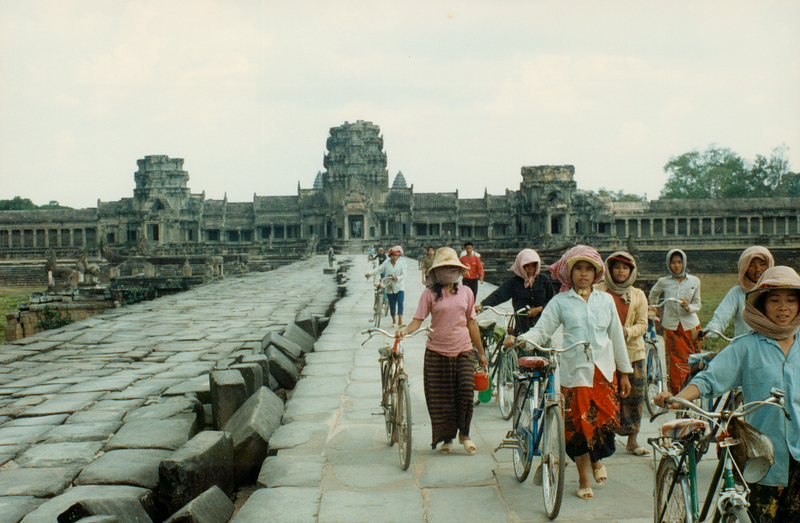
As part of the Visa package, I got a seat on an embassy mini-bus from Ho Chi Minh City to Phnom Penh. It was filled with aid workers and a couple of other backpackers, one of whom was a Swiss woman travelling solo. The countryside was flat and brown and empty. There were few motorised vehicles on the road — just the odd motorcycle, lots of bicycles, and lots of people walking.
At the time there was no bridge over the Mekong river in Cambodia. The only way across was a ferry at Neak Loeung. As we approached the river we saw where all the other cars were. There was a huge line of them mixed in with motorcycles, scooters, and bicycles all waiting for their chance to cross.
Our mini-bus drove past all of them in the oncoming lane. Once we got to the front of the line of traffic, we were waved onto the next ferry. The locals who had been waiting for hours to board accepted this as normal. I felt grateful and guilty about our special treatment. I was sure all of them had far better reasons for needing to cross this river than I did.
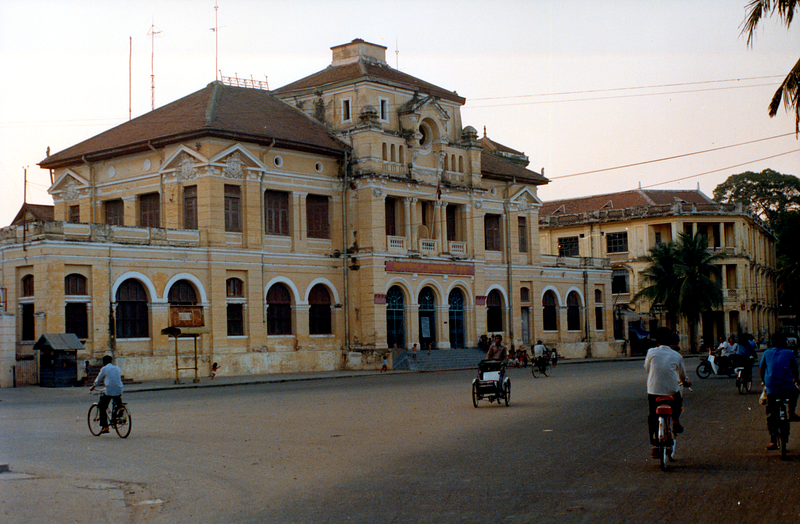
Phnom Penh was a stark contrast to the countryside. It was bustling and beautiful. There were broad boulevards with well-spaced trees and peach-coloured French colonial-style villas. Outside one of these was a group of young Cambodian men playing volleyball. They spoke no English, but did speak beautifully accented French.
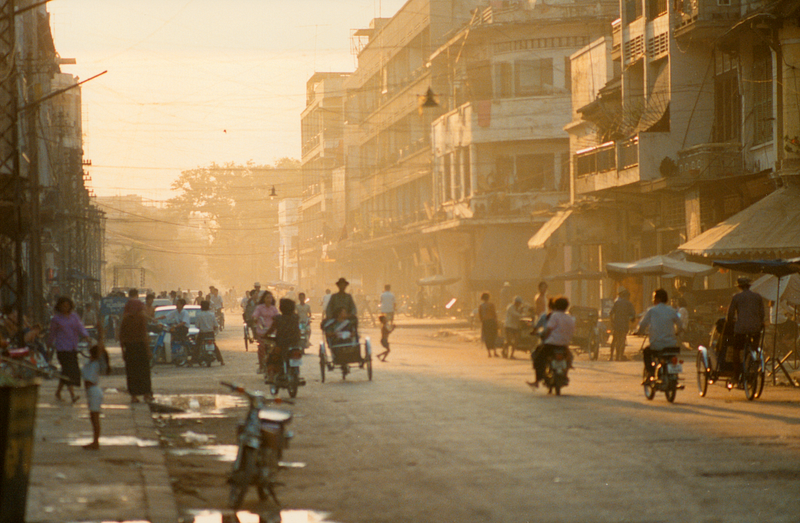
The central market was chaotic and busy. There were many amputees begging for food and change — no doubt a byproduct of the war that had been going on for the last 15 years. I found a shop that would exchange dollars for the local currency, but I underestimated how bad inflation had become. I changed fifty US dollars and got back a large shopping bag filled with packets of paper money. I felt a bit like a bank robber slinking back to my guest house with my loot.
I soon discovered that the only way to get to Angkor Wat was to book a holiday package from the official government travel agency. However, there was one little problem. These packages were only available to married couples.
Fortunately, the Swiss woman who had travelled with me from Ho Chi Minh City was staying in the same guest house and was also desperate to get to Angkor. I think her name was Brigitte. She’d been told the same story by the same travel agent.
We discussed our disappointment over dinner. She had a suggestion.
“There is one obvious solution,” she said. “We could get married. Not really married, of course, but we could pretend.”
It sounded like a good idea to me. We were both about the same age and there were very few Westerners around. Most people would probably assume we were a couple if we were together. Still, I was surprised. I knew this woman was brave. She wouldn’t have been travelling through Cambodia on her own if she wasn’t, but she had only known me for a few hours.
“Would you be okay with that?” I asked. “We’d probably have to share a room, maybe even a bed.”
“A room — no problem. A bed — it depends how big and how far away you stay.”
“I promise to stay as far away as possible. I’m willing to give it a go if you are. But if things work out between us and we decided to stick with the marriage thing, I want a big church wedding.”
She laughed. “Of course!”
The next day Brigitte and I went back and signed up for the holiday package. Our one concession to romance was that she held my arm as we entered the travel agency. They didn’t ask us for any proof of marriage despite the fact we’d both been in the day before as separate, single people.
The package was four nights and five days with all accommodation, meals, and flights paid for. It included access to a car and a driver and a local guide who we were told spoke French and English.
Brigitte and I were both shoestring travellers in our twenties. This was a standard of travel we were completely unused to. The cost was $50 US a day per person. Still, it was the only option available so we took it.
The flight to Siem Reap was interesting. Although the war was mostly a memory for the people of Phnom Penh, in the countryside there was still active fighting.
At a counter by the departure gate was a sign which read in Khmer, French, and English, “Leave all guns here!” Leaning against the counter were a number of AK47s, each with a little luggage tag.
The man in front of me when I went through security was wearing an army uniform. He had a pistol in a holster on his belt. He took it out and handed it to the security officer who checked it wasn’t loaded and handed it back to him.
While we were waiting for boarding to commence, the same officer came over to us and told us in French we needed to run when they opened the gate.
“Le vol est toujours surbooké,” he said. “Beaucoup des gens!”
Sure enough, as soon as they announced the flight and opened the gates, everyone made a mad dash for the plane. Brigitte and I each got a seat to ourselves, but others weren’t so lucky. A few people ended up sitting on their companion’s lap.
Apparently, standing during take-off and landing was not allowed, but as long as you could get the seatbelt around both of you, sitting on someone’s lap was perfectly fine.
While people were still finding seats, one of the stewards came aboard the plane with an armful of weapons. He unceremoniously dumped these in a cupboard next to the cockpit. Later, during takeoff, the door to the cupboard popped open and all the guns fell out into the passageway. Once the flight levelled off, he put them all away again and made sure the door was firmly closed this time.
We were met at the airport by our guide with the car and driver. It was all very glamorous, but a rather faded glamour. The car was ancient and tired, as was the driver. He drove at a very sedate pace, not much faster than walking.
The hotel had obviously once been very grand but was pocked with bullet holes and in need of repairs. Our room was huge with 12-foot ceilings and a beautiful view. It had two very basic twin beds in it, each with a sheet, a rough cotton blanket and some mosquito netting draped over them. It looked like my virtue would remain intact.
There was an extremely battered wooden desk against one wall and no other furniture. We did have a bathroom with a sink and a toilet but neither were connected to the plumbing.
Instead, we shared the one working bathroom on the floor with two other couples. That bathroom wasn’t really a communal bathroom. It just happened to be the only one in working order and was in another (empty) guest room.
The meals were held in what may have once been a ballroom or a large dining hall. It had three beautiful chandeliers hanging from the ceiling and ornate plasterwork in the corners. When it rained, water poured down the inside of one of the walls in a cascade. There were about a dozen of us in the hotel and we sat at a couple of large plywood tables covered with the same type of sheets that were on our beds.
The hotel was near the centre of the town of Siem Reap. Angkor Wat was about five km North of the town. The Khmer Rouge were still active in the area so we were forbidden to walk outside the town. Instead, we were driven to and from the temple complex each time we wanted to visit.
The temples were haphazardly guarded by young men carrying AK-47s. They didn’t wear any uniforms, just t-shirts, cotton trousers, and flip-flops. Every now and then we would hear gunfire. Our guide explained they were just shooting at birds and not to worry.
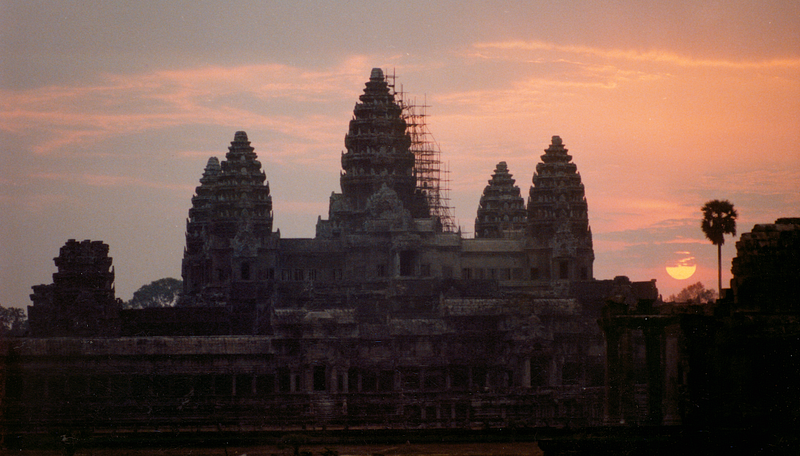
Angkor Wat was built in the 12th century as a Hindu temple dedicated to the God Vishnu, although over time it became more of a Buddhist site. It is the largest and best preserved of a number of ruins in the area. It consists of five sandstone towers which resemble lotus buds. There is a rectangular gallery encircling the towers. The walls of this are covered in bas-relief artwork. Surrounding the gallery is a moat almost 200m wide. It was the most beautiful and magical thing I had ever seen.
Nearby, another complex called Bayon Temple was far less well-preserved and had been taken over by massive banyan trees. This had its own special magic about it. It was like something out of Indiana Jones or Tomb Raider.
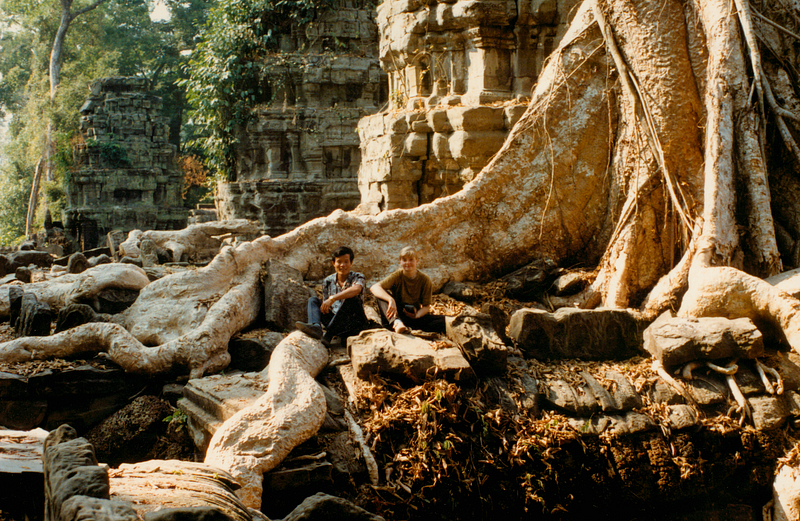
I can’t remember our guide’s name, but we became friendly over time. When we first met I think his English consisted of “Good-morning”, “Yes-please”, “No”, “Look”, and “Come-now”. We taught him a few more words like “Coffee” and “Thank you”. He taught us some Khmer — none of which I can remember.
On our last day at the temple, he beckoned us to follow him. “Come-now, yes-please.”
An Indian company was doing renovations on the temple at the time. There was scaffolding along one side of the central tower. He took me to this and started to climb. Brigitte stayed on the ground, but I followed him. We climbed to the top of the tower, about 200m above the ground.
I think it must have been a day off for the Indian workers as the only people on the scaffolding were the two of us and about half a dozen children that were treating it like a jungle gym. It was terrifying, but I couldn’t chicken out in front of my new friend and a bunch of little kids.
Once we reached the top, we sat on a small wooden platform and looked all around us. He bowed forward with his hands in a prayer position and said, “Thank you.” I wasn’t sure if he was thanking me or just thanking whatever God had brought us to this point.
I did the same — bowed my head and said “Thank you.”
After we had been sitting there for a while, he pointed to some smoke rising in the distance. “Battambang”, he said, “Khmer Rouge. Bad.”
What we were looking at was the Khmer Rouge shelling the town of Battambang about 80km away. It was a profound experience. I had a similar feeling to when the Embassy mini-bus had cut in front of all those hundreds of people waiting for the ferry. It was a realisation that your place in the world is largely a matter of luck.
I had been incredibly lucky to have been born when and where I was. I was incredibly lucky to have found a woman trusting and reckless enough to pretend to be a stranger’s wife. And I was incredibly lucky to have met this man who had led me to the top of an ancient temple.