
A Magical Theorem Was Undiscovered for Thousands of Years
And is still kept hidden from students - why?
A couple of nights ago I was lying in bed watching some lectures, reading some articles, and so on, and at some point, I decided what I thought to be a wise decision at the time, namely that I would only watch one more math video before going to sleep.
I had absolutely no clue that the video I picked would keep me sleepless for hours. Not because it was long, but because I was shocked that I had never heard about the beautiful mathematics it contained.
Now, I have a Master’s degree in mathematics and I was so in love with the field (I still am) that I spent all my optional courses on subjects within mathematics as well. That amounts to about 40 different university-level mathematical disciplines under my belt and yet I had never heard of this theorem… NEVER!
This must mean that almost no one teaches it.
What is even more strange is the fact that the result itself went undiscovered for more than 2500 years. Not because it was too hard to prove (which is often the case), but because no one had discovered the pattern.
The discovery
The mathematics involved is so simple that school kids would be able to understand it yet there’s so much we still don’t know about it. Despite the extremely simple mathematics involved, the underlying truth stayed hidden from ancient times until 1951 when a mathematician by the name of Alfred Moessner made a miracle discovery.
To explain the magic let’s start with something very simple yet very pretty. Consider the partial sums of the odd natural numbers i.e.
1 = 1, 1+3 = 4, 1+3+5 = 9, 1+3+5+7 = 16, 1+3+5+7+9 = 25.
Do you spot the pattern? What we get are our square numbers i.e. 1=1², 4=2², 9=3²,… So partial sums of odd numbers are squares! The ancient Greeks knew of this and they even provided a genius visual proof of this fact.
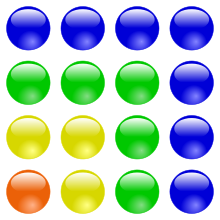
In the above image, the colored balls represent the first 4 odd numbers and we clearly see that the sum of the first odd numbers gives a square number.
What Moessner did was simple, he took this fact and looked at it from a slightly different perspective. In particular, he framed this fact a bit more constructively. Almost algorithmically. His construction of the above is the following:
Imagine starting with all the natural numbers: 1, 2, 3, 4, 5, 6, 7, 8, 9, 10,…
where the three dots mean “continue this pattern to infinity”. Then remove every second number. Then we get the odd numbers of course. So the new sequence of numbers is: 1, 3, 5, 7, 9, …
And take partial sums to get the squares 1, 4, 9,...
Well, yes we just saw that. But when we use this approach it is easier to generalize it (something we mathematicians like to do).
Now take all the natural numbers again but remove every third number to get the number sequence: 1, 2, 4, 5, 7, 8, 10, 11, 13,…
Take partial sums to get a new sequence: 1, 3, 7, 12, 19, 27, 37, 48, 61,…
Remove every second number to get: 1, 7, 19, 37, 61,…
Take partial sums again to get: 1, 8, 27, 64, 125,…
Do you recognize these numbers?… They are our cubes! 1=1³, 8=2³, 27=3³,…
This calculation can be structured in the following image:

This pattern continues. If we start by removing every n’th number from the natural numbers, take partial sums to form a new sequence, remove every n-1'th number from that sequence, and take partial sums, remove the n-2'th number, etc, we will eventually end up with the powers of n.
How come I had never heard of that? So simple. So beautiful.
But we are only just getting started because it turns out that there is much more to be found here. For example, if you remove other interesting sequences of numbers to begin with, what sequence will then be produced? Is there a general pattern?
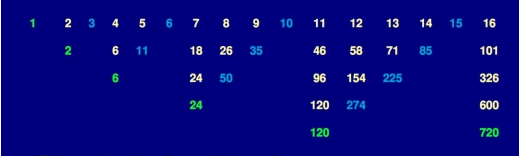
In the above image, the triangular numbers are removed from the natural numbers, forming small triangles of numbers. By deleting numbers in the same way as before for each sequence, these triangles end up in the numbers 1, 2, 6, 24, 120, … and these are the factorials i.e. 2 = 2⋅1, 6 = 3⋅2⋅1, 24 = 4⋅3⋅2⋅1, etc.
Note that the triangular numbers are numbers of the form 1+2+3+⋅⋅⋅+n and they are converted into numbers of the form 1⋅2⋅3⋅⋅⋅n. Coincidence? No.
Also note that if we remove numbers of the form n, 2n, 3n, 4n, … where n > 1, then the output will be 1^n, 2^n, 3^n, 4^n, … so there is some kind of exponential relationship between the input and output here. It seems that in general if we multiply each number in the input sequence by a number m, the elements in the output sequence will all become raised to the power m.
Experimenting
To test this idea, I wrote a program in Python able to output these sequences based on an input sequence of numbers to be removed. I even considered other operations than addition.
If some of you would like to look for other interesting findings, then I have included the small code snippet and an example here:
For example, it turns out that if you start by removing the square numbers i.e. numbers of the form n² from the natural numbers, then you get an output of 2, 12, 144, 2880, … these are numbers of the form n! (n+1)!
Conversely, if you remove the sequence 2, 6, 12, 20, 30, 42,… i.e. numbers of the form n(n+1), then you get the sequence 1, 4, 36, 576, 14400,… which are numbers on the form (n!)².
So it seems that there is some kind of dual relationship going on here. The ladder result is on the other hand no surprising given our previous discovery since numbers of the form n(n+1) are just the triangular numbers multiplied by 2.
By using the above program I was able to discover several other interesting relationships.
Some very interesting things I found include:
- If the input sequence is {2^k} = {1, 2, 4, 8, 16, 32, …} then the output sequence seems to be {3, 8, 60, 3456, 11612160,…} the number of independent sets in the binomial tree of order n.
- If we choose to remove the pentagonal numbers i.e. numbers of the form n(3n-1)/2 then we get a sequence of numbers of the form (n!)²(n+1)!
- If the input sequence is the tetrahedral numbers i.e. the sum of the first triangular numbers, then the output sequence is the superfactorials i.e. the product of the first factorials.
- If the input sequence is the square pyramidal numbers 1, 5, 14, 30, 55, 91, … then the output sequence consists of determinants of certain n×n matrices defined here.
I haven’t proven the above statements, but I certainly will give them a try. I just wanted to tell this story before doing anything else because this is so amazing and it deserves to be told.
Final remarks
I can’t really blame the ancient Greeks that they didn’t find a proof for the most general case because they didn’t even consider powers higher than the cubes. They thought of numbers as representing real geometrical shapes and didn’t work with more than 3 dimensions. However, they should have found the case n=3 where we start by removing every third number. The partial sums correspond to adding certain “shells” on a cube.
I can’t wait to dive a little deeper into this. I will try to find a simple proof of Moessner’s theorem even though I have read that it is actually not that easy to prove.
If you find any interesting outputs from Moessner’s procedure then please let me know about it.
Note that this procedure defines a function between sequences where the sequence of natural numbers maps to the empty sequence, the even numbers to the squares, etc.
It might be helpful to think of it in this way when studying it.
Thank you for reading.


