
A Loving Letter From the Left-Leaning White Trash to the Left-Drowning White Elites.
That’s right, folks. We do exist.
I guess I feel able to try my hand at this because I’m a bit of both.
Growing up in small-town, all-white rural Indiana within a conservative family (that has allowed me to explore every inch of the world, from actual places to trains of thought) has put me in an odd position: one of attachment to that nostalgic little town that I despised as a kid, and one of attachment to the abstract idea that I’m educated and cultured and, at the very least, not the norm. It’s a privileged and pretentious position to be in, maybe, but at least I’m aware of that.
For a while now, even before the culture wars that have gripped America as of late, I’ve felt that white liberals tend to simplify the racial, political, and socioeconomic they live in far too much. Just like the far-right from the heartland, it’s them against the world. And that’s coming from a self-described independent progressive who wants nothing more than a pragmatically progressive wave to sweep America, from the Bible belt outward. One that could, hypothetically, be founded in the Christianity that many in the middle of the country use as a backdrop for the politics they identify with now.
But I’m not here to talk about that. I’m here to defend — no, explain — the people I grew up around. The people who are written off as racist, uneducated rednecks by their fellow Americans. And you don’t have to listen, but remember that putting yourself in their shoes is a far better option than the alternative: name-calling, hate, and a deepening division rooted in a complete lack of understanding.
DEAR WHITE LIBERAL,
I encounter y’all daily, whether it’s in person, on social media, or in the New York Times. Let me be clear: the type of liberal you find on the coast is entirely different than the type of liberal you find in, say, the Midwest. Indiana. Ohio. Iowa. We tend to be a little more passively accepting of different opinions, while quite a bit less ready to take up a radical or revolutionary stance on some things. But all the same, we have those awkward conversations with family members who are of differing political opinions quite often and speak our minds frankly when doing so. Maybe we’re just hesitant to write off everybody we grew up around and love as dumb, uneducated racists.
See, when you think of people as individuals rather than sorting them into some imagined group, you see a lot more nuance. This letter comes out of love rather than chastisement. I want to see a leftist from Portland hug and understand a right-winger from Terre Haute.
If a life-long conservative from homogeneously white rural Indiana can sit back and listen to someone explain why systemic racism exists and subsequently change their minds on the matter, then y’all can hear why attacking people you have no idea about for voting for The No-Good Very Bad Orange Man may have gotten you in this rather precarious situation to begin with: one where right-wingers literally have no desire to listen to us anymore.
Once, I was sitting in a hostel in Sofia, Bulgaria. I happened to sit down by a young woman around my age from Portland, Oregon. We ate the bland but filling (and free) hostel-prepared dinner together and I opened a cartoonishly big bottle of cheap red wine, which I shared with her. Two glasses in, the conversation went to where it always seems to go when you meet someone while traveling and talk to them for more than 30 minutes: politics.
Lauren, as I’ll call her, asked me, as a more liberal person from a small town in a deeply red state, this question, word-for-word: “What was it like living around racist white trash your whole life?” I am not kidding.
After good conversation and back-and-forth storytelling, this was one of the first two ‘political’ questions she asked after she asked what my political affiliations were. Needless to say, if I had said I was a Republican, she probably would have grouped me in with the racist Hoosier rednecks. I was shocked, and here’s why:
There, right in front of me, was a young person from the most liberal, open city in America and she had already classified over half of the people in my home state as less-than-human, incapable of critical thought, incapable of love for anyone different than them, only capable of close-mindedness and hatred. She was from a city I had dreamt of moving to in high school. A magical place where everyone, regardless of race religion or sexual orientation, would be accepted. To her, my hometown was some sort of hate-filled wasteland, and nothing more.
My response, after giving her an amused look, was this: “Well, first off, I don’t think everyone who voted for Trump is racist. I think they didn’t like the alternative. In fact, they despised the alternative. Second, let me explain my hometown to you.”
Then, I did just that. I told her about the town I was raised in. At this point, a quiet guy, also our age, from Syracuse, New York had joined in the conversation–he’d heard a couple of Americans talking politics and felt obliged to take a seat at the table. He probably regretted it.
I went on to tell her about the poor whites. “My hometown was once written about in USA Today,” I said. “Do you know why? It was the poorest town in Indiana.
It’s 98% white. Half the town works in a factory. There’s a massive drug problem–meth while I was growing up, opiates now. While there’s not really a gun violence problem, there are plenty of mothers and fathers in jail for a long time because of drugs.
Now, I grew up in a middle-class household in a nice little cul-de-sac, going to a great, albeit filled with highly religious and conservative teachers, public elementary school. But my grandma, bless her heart, taught fourth grade for 30 years at the elementary in the middle of town. I remember taking Christmas presents to one of her students’ families one year because they couldn’t afford to buy them. I was shocked, at age 10, to see houses just a mile away from my own, with dirt floors. The family of 8 that we brought presents to lived in a one-room shack behind the park. We brought all these old, scratched-up toys to them, and they were ecstatic. Jumping around everywhere. I felt guilty, shocked, emotional. I was 10! I didn’t know what to make of it.
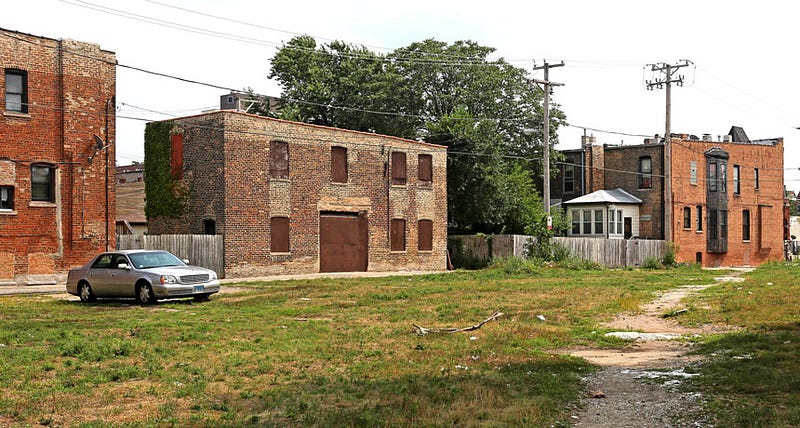
At least 20 more little shacks just like that one were lined up on either side of the little dirt road, a cul-de-sac of its own, a neighborhood tucked below all the other houses, hiding in plain sight. Actively hidden. Out-of-sight and out-of-mind. Away from even the eyes of the working class in town, who live paycheck-to-paycheck-to-welfare-check.”
So, I summed up, when you get a political candidate for the highest office in the land talking about fighting for the working class, making promises to save manufacturing and lower taxes and stop illegal immigration, no matter how empty or manipulative those promises may be, it’s fairly easy for me to see why my fellow White Trash would get behind said candidate. Especially when who he’s up against is the human embodiment of political establishment — a political establishment that has repetitively and consistently ignored the issues of the poorest segments of our population, just like they have conveniently ignored or attempted to brush under the rug the systemic problems plaguing the Black community, throughout our nation’s history.
Maybe why I’m so passionate about some sort of race reparations bill is because I’ve seen and lived in places that would be defined as food deserts, rife with crime, rife with drugs. Both black and white. I made up my mind on my own that people should have greater opportunities for upward mobility in this society.
But maybe this country needs something even more wide-reaching. Maybe we need a poverty reparations bill. Maybe we need to inject cash, like a shot of into the poorest communities in our country, the ones that have been left to fend for themselves for so long. America doesn’t favor Black or White. It favors Green. And that is why many Black communities, disproportionately poorer than white communities, are stuck in a cycle of poverty and crime. Some of America’s greatest artists, writers, musicians, inventors, and leaders come from our poorest communities. But so many from these communities are led into a life of crime or drugs, or a life reliant on getting a weekly paycheck from the factory. I’ve seen it with my own two eyes. It’s time to accept that although poverty disproportionately affects Black communities through institutional racism, it affects those poor white trash communities too. And we can’t ignore it or cast off their very real problems as simply the droning and bleating of racist rednecks.
Out of my entire response (at least 5 minutes of rambling), she responded to one little excerpt: the part about Hillary Clinton being a weak alternative for president.
“I hate those types of people, the Bernie Bros.”
“Bernie Bros?” I asked, truly unaware of who she was referencing.
“People who supported Bernie in the primaries, then switched to Trump when Hillary was nominated.”
“Ah. Yeah, I don’t really understand that either.”
I didn’t have much more to say. If that’s what she was going to pick out from my response, then I didn’t have much more to say. She was so deeply identified with her form of politics that she’d jumped from disparaging one segment of the political population — the “racist right-wing redneck” — to another, the “Bernie Bro.” My mind was numbed.
White Liberals, I call on you to show unrequited love to the racist rednecks in your life, whether they be on Facebook or your living room.
If they hate you, maybe just ignore them or try to inspire change. If they call you a Libtard, they may be an actual racist redneck. Forgive them, for they know not what they do. If they are willing to have a conversation with you and listen to your viewpoints, responding with disagreement but taking into account your arguments, then they’re not racist or sexist or xenophobic, they just have different beliefs than you. And that could be for any number of reasons. Not everyone grew up the same as you.
In the meantime, know this: young people all around this country are thinking differently than their parents and grandparents. We are open to and desire change. But we don’t get change by throwing large chunks of Americans into the rejected garbage can of humanity — written off as nothing more than Trash.
Sincerely,
Whatever Name You Want to Call Me