
A Love Letter to My Wife
In which I examine the science and magic of love and what goes into a successful romantic relationship
You walked in late, the last to arrive, in your librarian glasses and that radically conservative yet inexplicably sexy cranberry sweater, down those three steps into the lobby for the meet-and-greet of the week-long conference, and my life has never been the same.
I’m talking serious infatuation, with electricity running up and down my spine. The next morning — remember? — in a conference room of assigned seats, yours was miraculously next to mine. You were late, naturally. I am never late. I spent the next hour gazing at your right hand. You spent the hour gazing at my left forearm, I learned later, and the night before, you felt that same electrical charge when, for an ecstatic and agonizing few moments, we stood back-to-back, getting to know other people we’d just met, none of whom was the person we wanted to be talking to.
I don’t remember everything we talked about that week, but it was everything. It was like talking to an old, best friend. It was the magic of love.
Leaving the conference to fly back home was crushing. You reached out first (belated apology: my bad). Mere months later I quit my job and moved to Philly just to be with you. And somewhere in that whirlwind of ecstasy and exasperation, delight and annoyance, easy togetherness and wrenching time apart, we developed an affirmation that has gotten us through so much:
See you on the other side.
And so began this 25-year trek through joy, sadness, struggle and triumph, frustration and anger and all the other emotions and challenges of any good relationship. All along the way, I wanted to shout from the rooftops how wonderful our love was. But that was not our style. I guess we never imagined anyone else could grasp what we had, the over-the-top good fortune and the seeming unusualness of our love.
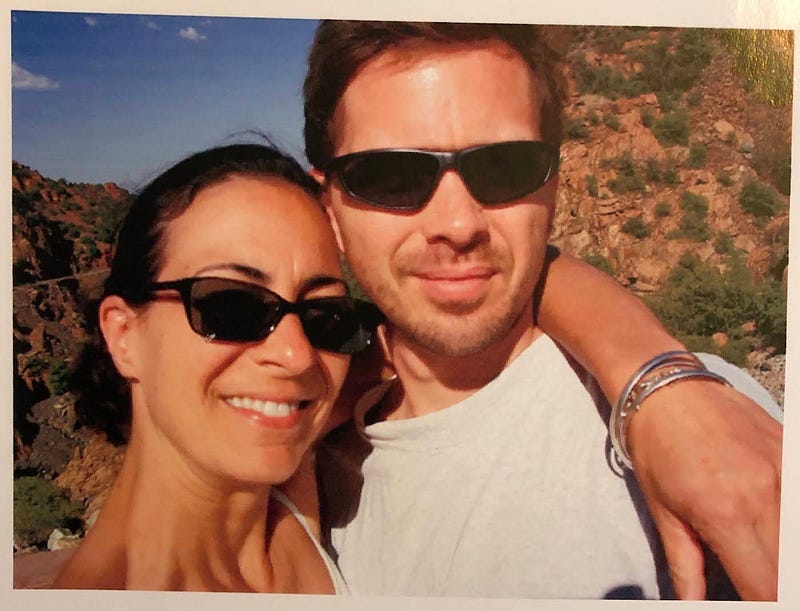
Since I’m a science writer, you know I’m going to try and explain the science of love now, at least the practical aspects that could help explain us, or that any struggling couple might take away and act upon. Sure enough, I’ve been researching it. Here’s but a glimpse:
Helen Fisher, PhD, author of Why We Love and an expert on the evolution of human sexuality, marriage, and more, offers a scientific explanation of romantic love that details different hormones that rage or wane with three separate aspects of a relationship. Grossly simplified, it goes like this:
- Lust: The basics of sexual desire. Evolution. Procreation. All that. testosterone and estrogen take over. Two humans just want to, you know.
- Attraction: You can be attracted to someone you lust over, and vice versa, but one can also exist without the other, Fisher explains. Dopamine and norepinephrine kick in during sex, but also when you’re with someone you love outside of romance.
- Attachment: In this stage, the brain releases vasopressin and oxytocin (sometimes called the cuddle hormone), signs of deeper, longer-lasting relationships that aren’t dependent on lust or attraction. You can safely enjoy these hormones among friends.
The biology of love is interesting, but not so tangible for me. It doesn’t describe how I really feel about you after all these years, or what makes us tick as a couple. I’ve got more science to explain below, but now I’m thinking it’s time to share our apparent secret sauce, the traits of whatever it is that keeps us gloriously tethered, bound in part by our pasts but more so by our amazing, wondrous present and the promise of another incredible tomorrow.
I’m still infatuated with you, my love. I don’t like the word lust, but I’ll defer to Fisher on that one. The electricity still flows when I notice you from across a room and you’re not looking at me and I want nothing more than to simply close the distance and be next to you. But it’s a damn good thing that the attraction and attachment settled in quickly way back then, because, well… struggles and sadness and frustration and anger and all the other emotions and challenges of any good relationship.
How many times did one of us want out, at least in a moment of relationship crisis, and yet be overcome with the hormones of attraction and attachment, if that’s what it was?
Still, there’s so much more to it, beyond any hormonal explanation. After brushing up on the science of love and marriage, I don’t profess to know the specific keys to a good romantic relationship in any universal sense, but I have a good idea how you and I have made it this far, not as if in some marathon that’s endured, but through a series of exciting sprints, challenging climbs, rocky descents and confounding chasms. We didn’t get here together because things were easy, nor because either of us is easy to get along with. I’m a pain in the ass. You’re a royal pain in the ass. I’m goal-oriented. You’re all about process. I’m fine with good enough. You’re a bit of a perfectionist. I’m always on time. You’re never on time.
So why do all aspects of our love last —from the infatuation to the deep-seated admiration and all the right hormones? How did we make it this far? How did we survive all those difficult times?
It sure as hell didn’t have anything to do with the little things, like opening doors or doing the dishes, nor any obligatory Valentine’s Day gifts or other made-up celebrations or ceremonies, right? I’m a lucky man that way — you’ve never expected flowers or jewelry or chocolates with horrid fillings nor forced dinners at overcrowded fancy restaurants.
I was so relieved that you were so relieved when you found out I don’t like birthday celebrations, and that we never had to waste time and money on the awkwardness of routine gift-giving. It’s not that we don’t do nice things for each other, just that it’s never based on some cultural expectation for when or what or how. I so appreciate that. I love our way. It maybe lacks some of the traditional binding glue of customs — and I don’t knock people who crave conventional shows of affection and friendship and caring — but the spontaneity in how we express what we mean to each other always feels real, never fabricated, special in its unexpectedness.
We have what might be considered an unconventional relationship, I don’t know. I think a lot of people imagine they don’t know “how to do it,” and they probably assume the lovey-dovey couples on social media have it all figured out. Either way, I imagine our way wouldn’t work for many people.
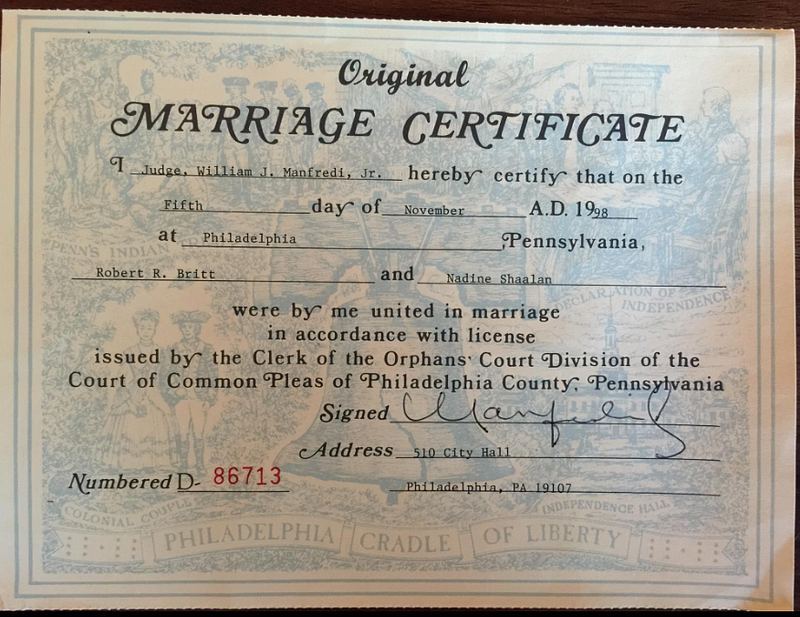
I mean, heck, we routinely forget our anniversary! Or, to be more accurate, we don’t worry about remembering to formally mark the clear, cool, sublime November day when I picked your kids up from school, you took an hour off work, and we met up at City Hall to get hitched. The ceremony (or lack of one — all of a minute or two) is forever etched in memory as a perfectly executed day in the life of a modern couple with all the modern pressures of work and family. Our day. Our way.
I also remember this past November, on the 8th, when you posted the following message on Facebook, along with a snapshot of our Marriage Certificate, which was certified (roughly) 25 years prior:
“Oh my god, Robert, we did it again. It was 3 days ago! Maybe we should just change it to Nov 8th! Here’s to us that we have never once remembered. And have never once been sad or angry about it. May we miss many, many more.”
It’s not that we don’t respect or revere our history together. Remember our first night alone together, under a full moon? Every full moon since has been an excuse to reach out and hold your hand, stop the world for a moment, reflect on the immense fortune of having been tossed together under such random circumstances, of having put the time and effort into getting to know each other, faults and all, and choosing to be together, and to stay the course. Of having no regrets.
Our marriage has never been perfect. Holy cow, we’ve been miffed plenty, perhaps argued more than necessary. We’ve each walked away in silence too many times. Sometimes we’ve needed to get clear the hell away from each other for an hour or a day. But separations never last. Space is good. For a little while. So while our Marriage Certificate is in one sense just a piece of paper, in hindsight I can say it might as well have been chiseled into granite.
We don’t stick together because we’re married. We’re married because we stick together.
A little aside I think will resonate with you: I asked Gail Post, PhD, a clinical psychologist and writer whose insightful stories I edit for Wise & Well, what she’s observed to be true about many successful romantic relationships. “While sometimes a bit of luck and good fortune seem like the glue that keeps couples together,” she said, “in my clinical practice, I have found that a strong dose of flexibility, tactfulness, kindness, openness to change, and reasonable expectations is essential, along with a commitment to stay together, despite hard times.”
I have not measured up in any of those categories all the time, as you well know. But we manage, and I humbly submit that you and I have both exhibited tremendous patience at times, boatloads of understanding and flexibility as we each navigate our insecurities. Thank you for bearing with me when I get all gloomy or selfish and appear to be sabotaging such a magical thing as our love.
The magic of love sounds way less magical when you hear it characterized by evolutionary psychologists, a trio of whom describe love as nature’s way of helping you make a quick decision on a partner who is good enough, rather than spending too much energy searching for the perfect mate. “Love’s magic exists to fulfill evolution’s bluntly practical aim of passing your genes on to future generations, rather than to lead to happiness or even an accurate perception of reality,” they write.
Well, I think there’s some truth to that, but I also think we did pretty damn good in finding perfect mates, evolutionary pressures be damned.
Beyond both science and magic, however, we learned without question that our relationship depends not just on experiencing good times, not just on being happy, but on successfully dealing with the tough times without treating each other like dirt. Science backs us up on that.
Groundbreaking couples research dating back to the 1970s, led by John Gottman, PhD, followed couples of various ages and gender pairings for as long as 20 years to investigate how and why their relationships endured or fell apart. Insights and methodologies from Gottman and his colleagues could predict with 80% to 90% accuracy whether couples would divorce, and the scientists could also predict whether couples would be happy or unhappy through time.
Here are some of the revelations from more than 50 years of this research on more than 40,000 couples who’ve been questioned in person, recorded on video, and had various aspect of their physiological reactions measured — from blood pressure and heart rate to skin temperature — during both routine and argumentative interactions with their partners:
- Some 69% of relationship problems are never resolved, in part because couples get stuck in their ways. Across three years of a relationship, 80% of the ways in which two people handle their conflicts didn’t change, suggesting their problems become perpetual.
- The degree of argumentation at the beginning of a conflict-oriented discussion, in the first three minutes, predicts 96% of the time whether a couple is at low or high risk for divorce.
- During times of conflict, the ratio of positive emotions (affection, humor and excitement) to negative emotions (disappointment, anger and hostility) in otherwise stable, happy relationships is a whopping 5:1. Relationships with a roughly equal balance of positive and negative emotions during conflict do not fare well in the marriage department.
Here’s my favorite gem from Gottman’s lab, perhaps as close as you’ll get to a scientifically proven key to a successful romantic relationship:
Happy, stable heterosexual marriages depend significantly on a man’s emotional intelligence, defined in this case as his ability to accept influence from his wife. That might sound like advice from a bygone era, but it’s just as true today. “In fact, research shows that same-sex couples are notably better at it than straight couples,” writes Kyle Benson, a researcher in Gottman’s Love Lab (yep, that’s what they call it). “Straight husbands can learn a lot from gay husbands, and they’d be wise to do so.”
Broadly, emotional intelligence is the ability of anyone to grasp and manage their own feelings in a productive manner. EQ, as it’s sometimes called, is an element of wisdom, and a key to success in any relationship, from romance to friendships to business. We could all use more EQ. You, my love, have a lot of EQ. I’m still working on it.
Communication, of course, is key to relationship survival, romantic or otherwise. Gottman and his colleagues identified four relationship destroyers they say successful couples learn to identify and surmount. Here are what they cheekily call the Four Horsemen (after the depiction of Biblical end times) and how to remedy them:
- Criticism: Seek instead to express a complaint or frustration in terms of how you feel, instead of pointing a finger and accusing your partner of causing your feelings.
- Contempt: Have a little respect and don’t demean or belittle your partner.
- Defensiveness: You will feel defensive. It’s natural. But have some EQ, and try not to make excuses or deflect criticism, which in effect blames your partner and escalates the conflict.
- Stonewalling: It’s natural to let frustration turn into silence. But when you stop responding — perhaps by pretending to be busy or simply tuning out — no rational discussion can happen. Instead, if you need time to gather your thoughts, be proactive and ask to take a break, rather than just walking away.
These ring so true to me! And if I may interpret a bit: Though it can be really difficult in the heat of the moment, we might try to simply apply the Golden Rule to these communication challenges. We’ve gotten better at this. I appreciate, for example, how you and I agreed a while back never to start a response with “but.” We communicate better when we leave that word out of our discussions.
Sure, we get angry, but as the Gottman team has deduced, it is not anger itself that ruins relationships, but how we deal with and express our anger. Their research has even found that my tendency to “go to bed angry” is not a terrible strategy. To test this, they interrupted couples in the middle of arguments and had them read magazines for a half-hour. When the couples got back together, they’d calmed down, and communication was more rational and respectful.
“Rather than seeing it as an inconvenience, taking a break when we feel ourselves getting overwhelmed during a fight has been helpful, even if that means sleeping on it,” explain the romantic couple David and Constantino Khalaf, who are Love Lab contributors and co-authors of Modern Kinship: A Queer Guide to Christian Marriage.
Reminder: If you’re going to sleep on it, let your partner know you just want to take a break, that you’re not ignoring the problem.
Ultimately, love’s magic boils down to three factors in successful relationships, especially during conflict, Gottman said in a TEDx talk:
- Trust
- Commitment
- Calmness
“The couples whose heart rates were lower, whose blood was flowing less rapidly, who weren’t sweating as much — those people actually seemed kind of boring, but they had great relationships,” he explained. “They were gentle with one another, not hostile. They reassured one another.”
This is good news for me. You have at times called me rather boring. Maybe that is why our marriage is so successful. Just kidding. Not kidding.
All this advice is easier to write and read about than to put into practice, as we’ve both learned, especially when the pressures of work and family and bills and health problems got to be too much and you (or I) just wanted to crawl into a hole or escape entirely.
Here again, science from other research efforts rings so true, especially how relationships often sag like an old horse in mid-life.
“One study on married couples in their 30s and 40s found that their marital quality declined over the course of a year, in terms of love, passion, satisfaction, intimacy and commitment,” Gary W. Lewandowski Jr., PhD, a relationship scientist and professor of psychology at Monmouth University, writes in The Conversation. “Too often, people shrug their shoulders and convince themselves this is just how it goes. Switching to relationship autopilot feels justifiable when you’re short on time, low on energy and must focus on other priorities like careers and kids.”
Lewandowski offers some helpful tips that you and I have definitely learned through experience:
- View boredom as a warning sign that the relationship needs a boost. Do something enjoyable together.
- Keep dating, engage in new and challenging activities, and never stop trying to recapture the magic.
- Focus on what’s good in the relationship, because zeroing in on your problems will only reinforce them.
I would add: Be patient. Mid-life can be hell. But responsibilities tend to ease with age and changing life circumstances, just as perspective and wisdom increase. We older folks are statistically happier. You and I have certainly enjoyed some of that later-in-life ease and joy. Problems don’t disappear, but we’re better at navigating treacherous waters more smoothly, eh?
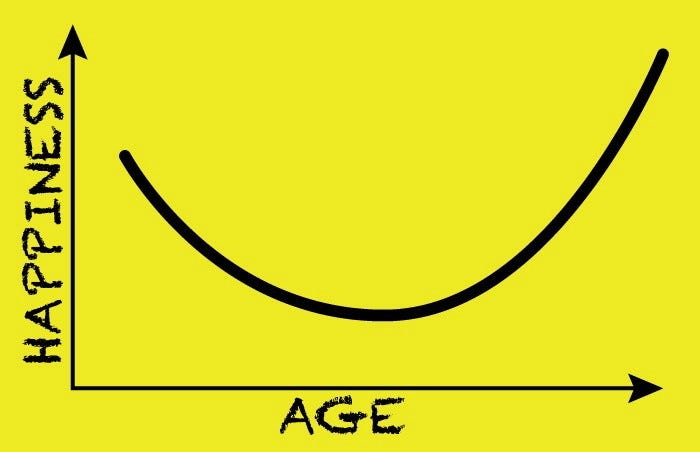
When I met your children, I fell in love with them immediately. Then we made a wonderful third child together. Life is so different now that they’re all grown up and moved away. A bit hollow at times. But we’re still married!
The kids are the great joys of my life. You’re not exactly disposable. But damn, those kids! They tested our patience often. Children can ruin a romantic relationship, and ours certainly got between us at times. But ultimately the joint effort of raising those three amazing humans made our marriage stronger. Sometimes they were the glue, or the distraction, that got us through the sadness and struggle, the frustration and anger and all the other emotions and challenges of any good relationship.
So with all this science of love in mind, I’ve come to understand some of the actions and reactions and mindsets that bound us irrevocably together from that moment of sheer happenstance, that love-at-first-sight instant that lingers like the scent of an immortal rose. Sure, we’ve learned to apply some duct tape and epoxy in rough patches, but now I’m able to grasp the serious foundational cement and rebar of our relationship, the footings that have held it all up across a quarter of a century.
I don’t deign to presume these cornerstones of our love are universal, but it’s time to go ahead and shout these virtues from the virtual rooftops.
Togetherness. We like being together. Usually. I cherish the times when we hike, travel, or work together, when we plan big and dream foolishly… together. Or when we just sit together at the end of the day. After all these years, you’re still my best friend. I love you deeply. I adore you. Sometimes you drive me mad.
Time apart. We’ve always respected each other’s need to do our own thing, whether professionally or at play or just when we need to get away. We give each other space, and we don’t try to “make each other happy” or solve every problem that pops up. We crave solitude, and our time alone actually pulls us together. It took years for us to manifest a feeling that was always in each of us: not to expect anyone else to be responsible for our own individual well-being. Lewandowski, the relationship scientist, would applaud us: “It’s easy for some people to play the self-sacrificing martyr in their romantic relationship,” he explains. “If this sounds like you, try to focus more on yourself. It doesn’t make you a bad person or a bad partner. When you’re psychologically healthy, your partner and your relationship also benefit.”
Mutual respect. I was amazed from the get-go by your accomplishments, your work ethic, your caring soul, and your differentness. You dance to a tune that wasn’t familiar to me, one that’s now a favorite. Yet sometimes I can only watch. My main groove is different. You’ve told me you don’t always understand me, but it seems you let the differences work in our favor, instead of pushing me away. We respect each others desires, proclivities, mistakes. We respect each other even when we don’t get each other. We complement each other in many endeavors. There’s an opposites-attract element to us, but I think it’s more about respect for differences than the differences themselves, and clearly we’re more alike than it sometimes seems. Interestingly, the most recent research on this finds that in more than 80% of 22 different human traits analyzed — from political leanings to substance use — partners were more likely to align than not. The scientists found no compelling evidence that opposites attract.
Modest expectations. Sometimes I expect too much from you. I always want you to lean on me, but as you’ve learned, my shoulder isn’t always there when you need it. I can be a total idiot, failing to be your rock when you need it most. But I try. We try. And we don’t expect to be walking on sunshine all the time. Life is hard, the philosophers tell us. We are often happy together, sometimes sad or angry or just, I don’t know, blah. We recognize this is all normal, and we don’t fight it. Happiness is not a state of being, Aristotle said, but a state of activity. Sonja Lyubomirsky, author of The How of Happiness, defines happiness as “the experience of joy, contentment, or positive well-being, combined with a sense that one’s life is good, meaningful, and worthwhile.” It’s not a 24/7/365 affair, happiness, but an often fleeting emotion to be grasped and savored whenever it presents. You make me happy beyond belief. Just not always. And that’s OK.
Apologies necessary. I learned that “Love means never having to say you’re sorry,” when Ali MacGraw said it to Ryan O’Neal in Love Story. I was a child, and it seemed so romantic. It’s total bullshit, of course. You and I have done stupid and hurtful things that we should feel apologetic over. Me especially. So while we all crave to hear the three words I love you from our partner, in the our worst moments, the hardest and most important two words are, simply, I’m sorry.
Science aside, here’s what I really wanted to say to you: I am so glad that we cherish and that we celebrate our love, but that we don’t force things to meet any cultural norms or expectations. We honor our relationship whenever and however the mood strikes. We lean into our love when great things happen, and when life gets hard.
We learned during the infancy of our union that joy and sadness come and go, struggle gives way to triumph, frustration and anger pass, and all the other emotions and challenges of any good relationship are normal, natural and necessary. We respect each other and allow a good degree of latitude to be who we are, rather than pining for some unrealistic, artificial version of what we demand or desire from a lover, a spouse, a best friend.
And when great change or challenge looms, positive or negative, exhilarating or terrifying, we trust the foundations of our love and reassure each other, whether hand-in-hand or separated by an ocean, with these simple words: See you on the other side.


