
Sharing A Long Walk…
The main medium of Richard Long’s landscape art is the land itself
After three previous nominations, Richard Long was awarded the 1989 Turner Prize. Unusually, the prize was given to him on the strength of his body of work to date, not for a single specific work. This reflects the context of his oeuvre that spans the globe in distance and could also be interpreted as spanning a timeline of geological epochs.
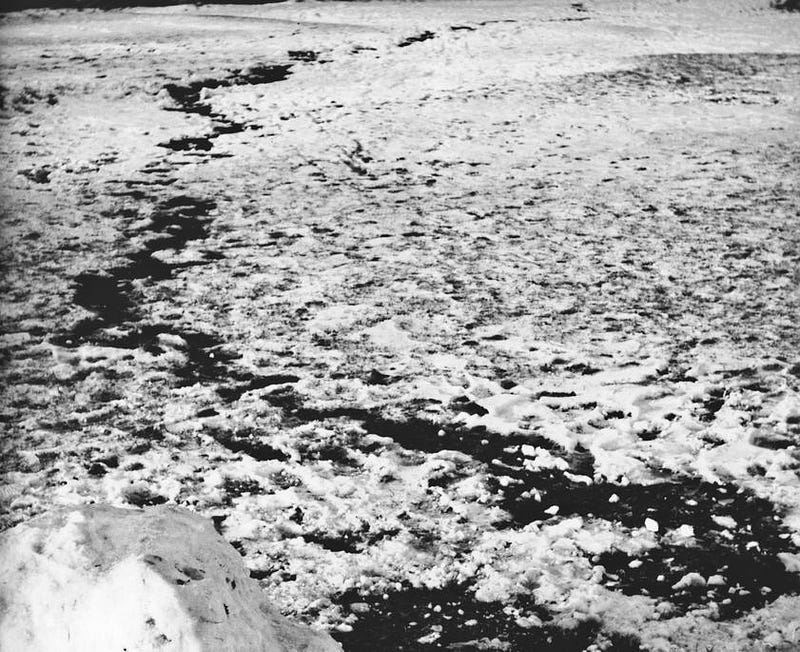
One of his earliest significant works was created in 1964, when he drew a meandering line across a field of snow by rolling a large snowball, creating a form common in nature — the sphere — whilst at the same time leaving behind it a negative form of bare earth that tracked his path. The negative space was physically represented in the accumulated snow as was the time and motion expended in its creation. Not only was this a physical response to the formal aspects of the land, its contours and textures, but also relied on seasonal and transient processes of precipitation… it was also a low impact intervention that wold leave little or no lasting trace in the environment itself…
Central to his work is the walk — a simple action of walking in the landscape, the path he follows making a conceptual drawing through time and space. He then records and expresses his responses to this interaction with his environment in various ways: photography, mapping, poetry, and by leaving markers along the route.
For example, for some walks he has followed a straight line drawn on a map of the terrain. Of course, a map is not the territory and the straight line was only so if viewed from directly above, the reality of the line walked would be a series of peaks and troughs, if viewed from ground level…
He sometimes arranges stones in situ and photographs this minimal intervention, leaving his sculptures in the environment in a similar way that pilgrims used to place marker cairns along ‘the way’. Sometimes, he records the route he took by drawing onto a map, with accompanying text that evoke a sensory experience encountered at marked points — sounds, smells, textures, temperatures, actions, and so on…
He has also produced text-only poems that record his personal responses and experience, framed and set out on the scale of landscape paintings, in simple typefaces of red, black or blue on white — sometimes on black or with a photographic background. With these poetic prose fragments, Long is gently engaging with a space and adding meaning, thus transforming space into place.
By using keywords, instead of showing us representations of the places or recordings of the sound, he encourages us to imagine the sound- and land- scapes by drawing upon our own similar experiences. We find ourselves in an imagined approximation, yet this recalled experience is truer than simply looking at a photograph or painted landscape. We are transported… to a place that now exists in three states. It is, or at least was, a real place that is now elsewhere. A ‘model’ was created in the mind of the artist and remains recorded in the substance of his memory. A third version is evoked in the imagination of the viewer.
Sometimes these ‘textworks’ are directly printed onto the walls of the exhibition space. These poetic ‘word-pictures’ are similar to the tanka form of linked, extended haiku. They evoke moments that have passed. The rain that approaches and blows over. The shriek of a buzzard. The chirp of songbirds. The rustle of wind among dry leaves. The crunch of frost underfoot.
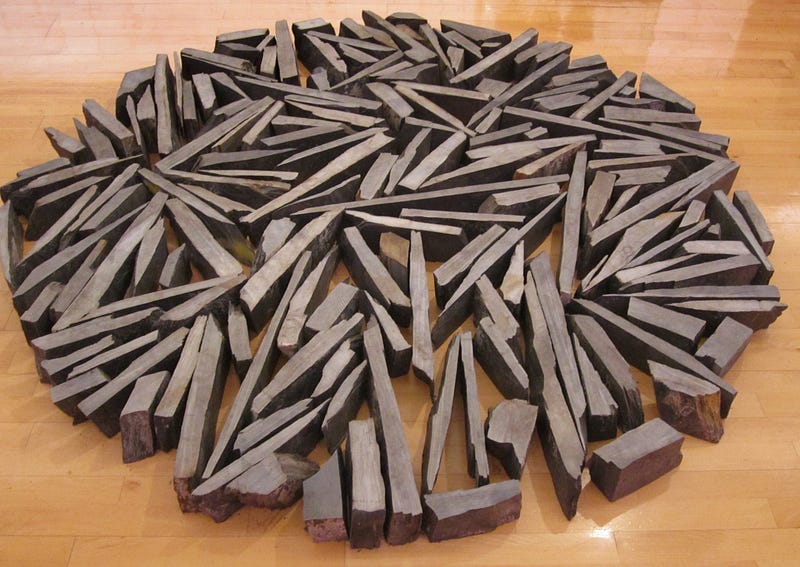

Long’s more ambitious works for gallery exhibitions have also involved re-locating tons of stone from a site and arranging them in simple circular or rectilinear forms on the gallery floor in direct response to the shape and dimensions of the room. To accompany these large works, he sometimes produces huge wall drawings using mud transported from rivers and lakes.
His use of the earth itself as a medium in landscape art and his repeated use of basic forms such as the hand-print, the circle, the meandering line and the square, show that he is rooted in Land Art and in many ways extends concepts instigated by Robert Smithson and the eARTh movement of the 1960s, particularly the idea of ‘site’ and ‘non-site’.
His use of unremarkable materials, to record his responses, places him in the tradition of Arte Povera. The major innovation Long brought to landscape art was to use the land itself as the medium and to use the human body as the drawing tool. The walk was both the experience and the response. The place was the sculpture. The intervention was the monument to the moment when the artistic presence intersected with the timeless existence. A uniquely human experience of a moment in an eternity — communicated via words, physical actions, topographic notations and photographs.
As with other works that can be broadly labelled ‘process art’ it’s often unclear when and where the art happened. It’s the documentation of the art that we can experience — artefacts generated in memoriam of combined moments. In this way he aligns himself with similar experiential works by artists like Joseph Beuys, exemplified by the seminal work known as ‘Coyote’.
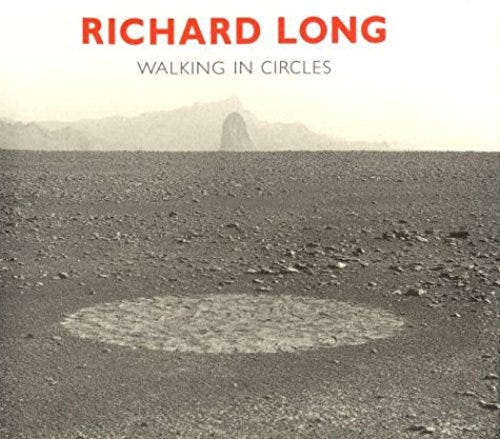
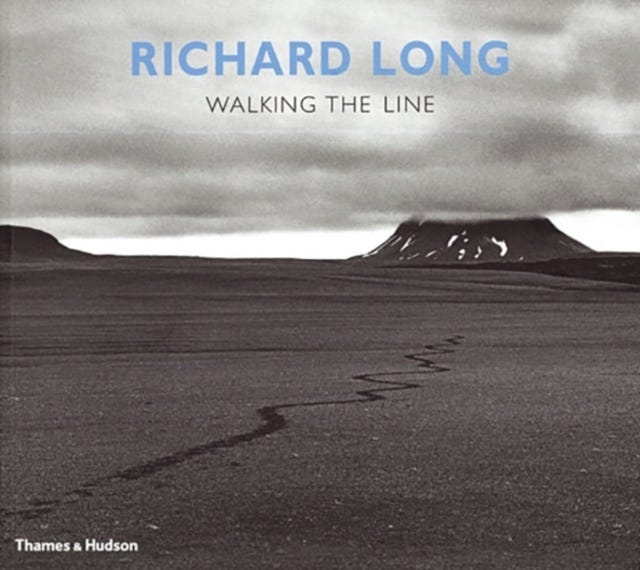
Two extensive catalogues of Richard Long’s body of work have been published, Walking in Circles (1991) and Walking the Line (2005), and in many ways these objects constitute — as much as any part of the process — the ‘finished’ documentation of ‘the work’. The experience of the art continues as we respond to the photographs and texts presented across their pages. We may then take that experience out and about with us. So, it continues to affect our new experiences of different places.
* All images are licensed or used here for educational purposes under fair usage policy.
A version of this article was first published in my book Evolution of Western Art (questing beast books, 2012)