
A Long-Awaited Walk By The Sea
Our Trip to Padre Island, National Seashore in Texas, U.S.A.
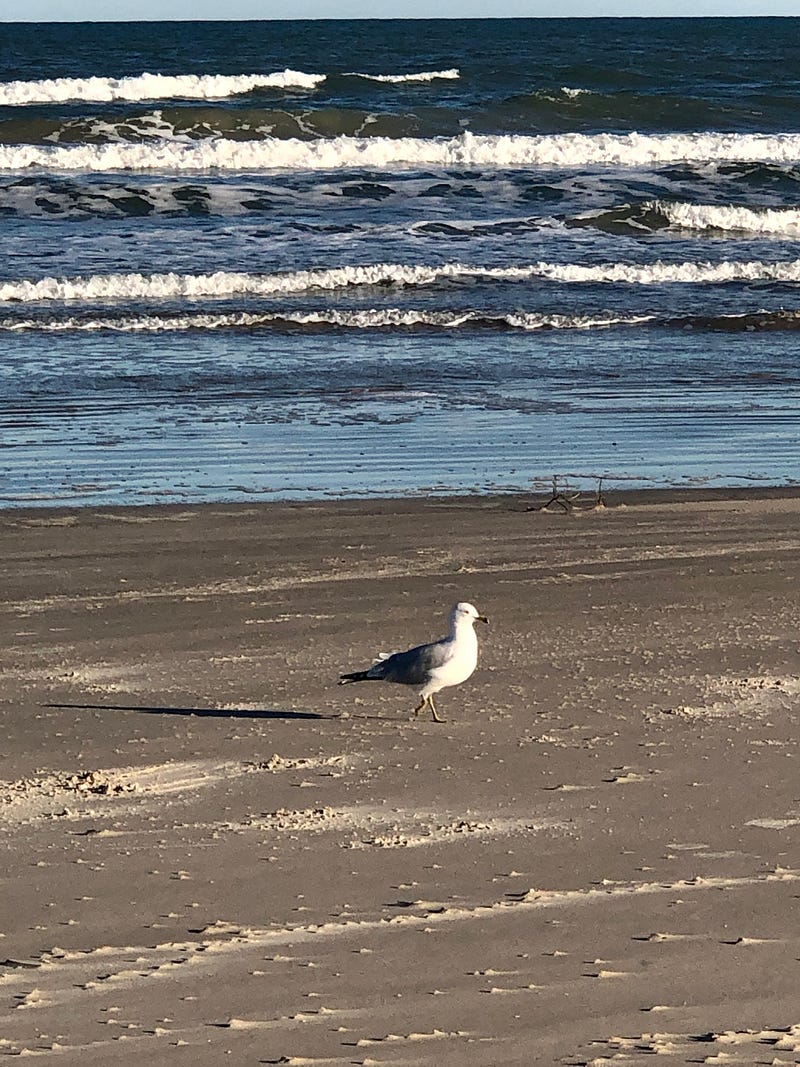
The sea breeze caressed my face and carried the briny smell of the beach deep, deep down. Perhaps even as deep as my very essence — my soul.
Though I grew up in the Sonoran Desert, I spent some critically important years helping friends finish their ferro-cement schooner and then sailed with them and my future husband from California through the Panama Canal into the Caribbean.
Though our marriage did not last, the pull that the sea has on me did. My wonderful husband of today, Rafe, understands this and has taken me several times to the glorious Texas beaches on Padre Island. There we camp and I roam the beach gathering shells, watching crabs and birds. And I take pictures, always lots of pictures to share and to remind me of the beautiful gift, which the ocean is to all of humanity and to me personally and to my soul.
The last trip we made before the COVID pandemic held a special significance as it fulfilled a birthday wish and acted as my present. So I roamed with extra abandon and joy.
As I gathered shells I also picked up trash, since I didn’t worry about any sort of infection. Stopping that habit has been especially difficult for me during this pandemic since it normally gives me one small way to give back, one little means of trying to help the environment, which blesses me with such beauty and enjoyment.
The ease with which I filled my trash bag rather startled me. A bit later I encountered another woman gathering trash and we began working together. She told me her name, Eleanore if I remember correctly, though my memory does not always prove true these days.
A lovely lady, Eleanore wore a blue bathing suit with an attractive shirt over it and water shoes of some sort. Her brown hair curled about her lovely face as she looked out from under a sun visor. Her curls danced in the breeze. I think she also is in her seventies, but living on the ocean has kept her skin from drying out as mine has done, so she looked younger.
Eleanore told me she picked up trash almost every day and the park rangers had come to recognize her. They told her to just leave her full bags up on the dunes just inland from the beach and they would pick them up in their dune vehicles and cart them off to dispose of them.
She had been away visiting her daughter, as I recall, and so there was a greater buildup of trash on the beach than she normally allowed to accumulate.
Fortunately, she had plenty of big black trash bags because together we soon filled a great many — about 12 I think. And that was just walking on about a half-mile of the beach! The amount of trash astounded and horrified me. The trash ranged from rotting food to broken glass to rusty cans to plastic of all shapes and sizes. It seems to me that the plastic was the overwhelming majority of the garbage we picked up.
All of this was on our National Seashore, a place that should be specially cared for and treasured. The frightening thing to me is that it probably receives more care than many of the world’s beaches.
According to the National Oceanic and Atmospheric Administration (NOAA) in their online article entitled A Guide to Plastic in the Ocean (last accessed 05/14/2021):
…scientists think about 8 million metric tons of plastic entered the ocean in 2010. That’s the weight of nearly 90 aircraft carriers, and the problem continues to grow.
Those figures are now eleven years old, so you can imagine how much worse it is by now. Since plastic does not decompose, the problem grows every day.
If you can stand the depressing truth, the Plastic In The Ocean Statistics 2020–2021 web article gives a number of horrifying statistics like the following:
More than 1 million seabirds and 100,000 marine animals die from plastic pollution every year.
100% of baby sea turtles have plastic in their stomachs.
There is now 5.25 trillion macro and micro pieces of plastic in our ocean & 46,000 pieces in every square mile of ocean, weighing up to 269,000 tonnes.
Every day around 8 million pieces of plastic makes their way into our oceans.
The Great Pacific Garbage Patch is around 1.6 million square kilometers — bigger than Texas.
And their list continues with many more horrifying statistics. I find all of this very depressing. It all reminds me of the verse from the Quran:
Disasters have spread throughout the land and sea, because of what the people have committed. He [God] thus lets them taste the consequences of some of their works, that they may return (to the right works). (Quran: The Final Testament - 30:41)
However, there are things we can do as individuals and working with others. NOAA recommends in their web article that we can do these two things:
- Reduce our use of plastics.
- Help in a marine cleanup. I suggest that we can also organize one. It amazed me how many people thanked me for picking up the trash and how many of them began to do the same when they saw someone else doing so.
We might also try to contact the vendors that we usually go to and ask them to work to reduce the amount of plastic they use and to recycle all the plastic they can. We can do the same with our friends, family and neighbors.
The Oceanic Society lists those and other ways of helping the situation in their web article 7 Ways To Reduce Ocean Plastic Pollution Today. They give other suggestions like recycling properly, supporting bans, and avoiding products containing the microbeads found in some toothpaste, facial and body scrubs, etc. They also give a list of products containing these tiny plastic particles that are so dangerous to the oceans of the world: products containing microbeads here. They are also dangerous to us because they are often associated with pesticides or other chemical contaminants that are dangerous to human life and the lives of other beings. The danger is great enough for some to recommend that seniors not use sea salt or eat marine fish.
Additionally, we readers can support publications here on Medium that are working to bring us information and support for our own conservation efforts. Here is a short list of the ones dealing with marine conservation, which I found by searching on Medium:
CLIMATE CONSCIOUS
Our Ocean, Our Future
Center for Biological Diversity
World Ocean Forum
We have been blessed with this glorious planet and its beautiful oceans. They help sustain our bodies, minds, and souls. Don’t we need to appreciate and work to keep those awesome blessings pure and safe for both this generation of humans and other creatures and those generations to come?