
AUTOBIOGRAPHY
A Little Tour Through One Gay Man’s Life
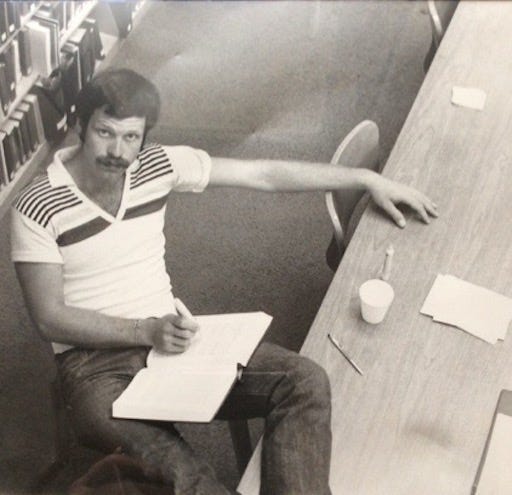
I’m new on Prism & Pen. This is my way of saying hello to Prism & Pen’s and Medium’s interested members. I hope it will be an entertaining and insightful introduction to a man who’s been on the planet a long time and has a chest full of adventures, triumphs, and defeats to relate.
Thanks for noticing. Steve Alexander ([email protected])
Some Biographic Facts:
I’m a retired attorney. (The lawyer is the short-tempered, surly, mealy-mouthed, little SOB on the other side.) I love the English language. I love writing. I was a word mercenary beating up horribly on horrible people. Society not only approved but also paid me well. Now, I’m engaged in using words to explain, portray, lobby, or cajole rather than as weapons.
I have a presence on Quora and a little blog here on Medium, One Gay Man’s Perspective.
Johns Hopkins University accepted me while I was still a high school junior. I wanted to be a doctor. I serendipitously discovered computer science in the second semester of my freshman year and switched majors. I graduated from Johns Hopkins in 1970 with a BES (major: operations research, minor computer science).
I worked for four years in Washington D.C. as a computer systems analyst/programmer.
In 1974, I entered Cornell University in a Ph.D. program in Operations Research but was unhappy. I left after a year for law school.
I was at Golden Gate University School of Law in San Francisco from 1975–’78. I was a writer for and an editor of the law review. I was president of the Moot Court Board and on the Admissions Committee. I taught a section of Appellate Advocacy in my second year.
In 1978, I passed the California Bar Exam, the first of four I would take and pass on the first try (the others being Pennsylvania, Arkansas, and Illinois). I spent a year in Fairbanks as a law clerk, eight years practicing law in Philadelphia, and five years in a firm headquartered in Fayetteville, Arkansas.
In 1992, a massive depression felled me. I spent twelve years in therapy trying to beat it.
In 2004, Alzheimer’s struck at my mother. I returned to Fayetteville (where she had retired in 1987) from San Diego to help my sister care for her. She died in 2009. I stayed here. My sister and I live together. But for the fact that she is an Ever-Trumper and I’m a Liberal(!) Democrat left of FDR, Sanders, and AOC, we get along beautifully. I just refuse to talk politics with her for fear of severing the filial bond.
Disclaimer
Covering 67 years (5 (Kevin and the Dog House) — 72 (Retirement, Wealth, and Dinosaurs)), the rest of this is lengthy. It’s an approximate sixteen-minute read.
If you’re disinclined to tackle it, read the section Three Score and Twelve Years Ago, then skip to the end and read the Retirement, Wealth, and Dinosaurs section. Scan the subtitles along the way. You’ll get the gist; you’ll save yourself fifteen minutes of your life that you will otherwise not get back.
To the rest of you, your interest gratifies me.
Three Score and Twelve Years Ago I’m a septuagenarian, a retired attorney. (A lawyer is the obnoxious, mealy-mouthed, surly SOB on the other side.) I’m a Baby Boomer, a child of the ’60s. Vietnam, free love, gay liberation, Peter, Paul, and Mary and Simon & Garfunkel are my heritage. I’m a dinosaur, … well, perhaps not; I still roam the Earth. I come before you a humble old man with not a little experience under his belt and many stories to tell.
Kevin and the Dog House
I knew at five that I was gay. That is to say, I vividly recall feelings and desires I had at five that I now know to have been homosexual in nature.
Most people believe that one cannot remember something that occurred that early. They have no such memories. They allow their subjective experience to fix their judgment of others who relate a contrary experience. They discount them.
So, discount me if you like when I tell you that I’ve always been gay, that I have a genuine memory of the time when, at five, I not only felt “that” way but also acted on it. Discount if you will, the true story of Kevin and the dog house that I relate to you in Five Years Old and Gay in Rural, Western Kansas. Or not.
From Premed to Computer Science in One Semester
I matriculated at Johns Hopkins University as a premed student, but switched in my freshman year, second semester to computer science and mathematics. It was for the best. I think sophomore-year Biochem wouldn’t have been all that agreeable.
After graduating in 1970, I moved to Washington, DC. I worked for four years as a computer systems analyst/programmer. For the last two years, I was an independent consultant. I had no fixed office. I ran the projects in my tennis whites from my bicycle and backpack. I was raking in cash but found the work unsatisfying.
It was in DC that I came out and quickly met my two first lovers, Michael and Tommy. For three years, we were an inseparable triad. Needing to find some other part of himself, Tommy ended that after ten years with Michael, the last three also with me. Michael and I spent the next year together until I made an elephantine mistake. I entered a Ph.D. program at Cornell. The manner in which I did it cost me Michael. A little bit of that story appears in Hello? Past? This is me calling Michael. The rest is yet to be told.
Attempted Suicide and Rod Serling at Cornell
On the way to Cornell, Michael and I toured New England. In a hotel in Boston, we saved a 13-year-old, pregnant girl from her attempted suicide.
I had a full course-load, a thesis to write, and a paid teaching assistantship in Finite Mathematics, which I had not taken at Johns Hopkins. I had to learn it as I taught it. I kept two chapters ahead of the current lesson, and all was well.
Although I was enrolled in the Engineering School, I took a wine-tasting course at the Hotel School. I audited a creative writing course at Ithaca College that Rod Serling was teaching. He was predictably fascinating.
I ran cross-country — six days a week, six miles a day, six-minute miles. I swam for an hour at lunchtime. I biked on Saturdays and Sundays. At 26, I was in the best condition of my life.
I found the local coed, nude, mixed gay/straight swimming hole. I met several Cornell luminaries and their families there plus a gay couple I later slept with in both meanings of the word.
I joined the Gay Students’ Union. We went around to the freshman houses. Standing before 100 of them at a time, we let them see two real, live homosexuals. We let them hear the timber of our voices and gauge our gait. We let them know that we were among them just as some would discover that they were among us.
We did the same for the Lions Club. The Lion Tamer arranged for us to come, but told none of the members who we were or why we were there. After lunch, to their surprise and discomfiture, we gave our little presentation. We took questions, which, at first, were made either reticently or with some hostility. But, the members became more interested. The inquiries became genuine and personal. After an hour and a half, the club president closed the meeting. Several members gathered round, asking us to stay longer.
On our way out, one Lion approached me. He told me that he had a gay, 17-year-old son. He said he had been angry and disappointed with his son. Having fathered a homosexual had made him feel like a failure. Looking directly into my eyes, he thanked me for helping him understand. He was going to talk with the boy and tell him that whatever his sexuality, it was OK. He would support him in coming out and coming to terms with being gay. A tear rolled down his cheek. We did a good thing that day.
I was unhappy at Cornell. My department chairman had lied to me, thinking that I would join him in his research once I was there. I wasn’t interested; I had my own to pursue. At the end of that first year, I did a hard, left dogleg to law school in San Francisco and found a calling.
Absorbed and Engrossed in Law School in San Francisco
I arrived in San Francisco in 1975, eager to start law school and more eager to launch myself into life in what was the gay Mecca of the U.S. in its heyday. Tyler — The Man I Met Naked on the Quaking Ground, and Came to Love tells one of the stories of my three years there. Another is The Hilarious Thing My Mother Said on Coming Out to Her.
In my second year, I had a teaching assistantship in Appellate Advocacy, an unprecedented accomplishment. I spent my last (third) year as an intern law clerk to a District Court judge in the Northern District of California, also unprecedented. I had responsibilities and privileges coextensive with the paid clerks. I took no classes that year but got 18 credits for independent studies. I was the Moot Court Board president, an editor of the law review, and a member of the admissions and orientation committees.
A Judgeship, My Narrowly Missed Murder, and My Saving a Life in Fairbanks
At the end of my third year, I had two offers for clerkships, one from the chief judge of the Alaska Superior Court based in Fairbanks, and one from a judge from Idaho sitting on the United States Ninth Circuit Court of Appeals. A Ninth Circuit clerkship was a rare, extraordinary opportunity. It had gravitas; it carried resume power. On paper at least, an Alaskan trial-court clerkship was inferior.
I had a dilemma, take the Ninth Circuit appellate opportunity or accept the less prestigious Alaska offer. I already knew how to research and write appeals but had no trial court experience. I wanted to be a litigator, so Alaska made sense. Besides, who wanted to live in Idaho?
In Fairbanks, the chief judge asked that I revamp the court’s motion practice. The court had a six-month backlog. He was anxious to tame the beast. I redesigned the system and, in two months, cleared the backlog while staying current with the incoming motions.
He soon appointed me the court’s standing divorce master.
Alaska had a no-fault divorce statute. Either party could get a divorce so long as it was uncontested. The statutory language was that a party need only show “irreconcilable differences that caused an irremediable breakdown in the marriage.” It was sufficient that one party appear and testify.
The magic words were “irreconcilable differences” and “irremediable breakdown.”
It was my duty as standing master to take testimony evidencing that the statutory requirement had been met.
Although legal representation was not required, most parties came with counsel whose invariable practice was to have the party stand up, say the magic words, and sit down.
On one occasion, a grizzled old man, a gold-miner type with unkempt white hair and scraggly beard, walked in with his lawyer. He was dressed in dirty, worn, and torn miner’s overalls that came to his chest and had straps over his shoulders. He wore yesterday’s shirt, well frayed at the collar and cuffs.
When it came time, the lawyer had the man stand to say the magic words. But the old man could not get them out. He stammered, stuttered, and sputtered over them while the lawyer prodded him in the ribs and whispered the words. I was certain that he had no inkling what the words meant. His tongue would not form them. It was no use.
I signaled to the lawyer to stop. I asked the man to tell me in his own words why he wanted a divorce.
“Because, if I have to sleep with the bitch one more night, I’m gonna kill her,” came the reply.
“That will do,” I told him. The gavel came down with me trying not to laugh.
After six months, my judge appointed me an acting District Court judge, that too being unprecedented. My duties were in addition to my law-clerk and standing-master appointments. There were several dozen criminal cases threatened with impending dismissal under Alaska’s strict speedy-trial rule. He assigned the other District Court judges exclusively to those trials. The rest of the court’s business he entrusted to me.
All this was an incredible professional growth experience. It could have happened nowhere else than in Alaska. I was elated at having declined the Ninth-Circuit clerkship.
That year in Alaska proved not only a professional growth opportunity but also an adventure.
I knew it would be cold, so, on the way up, I stopped in Seattle and bought an Eddie Bauer, heavyweight parka. It was down-filled. It had a hood and zippers and stays and drawstring ties around the face, wrists, waist, and mid-thigh hem. It was so big, thick, and heavy that, when I got in it all buttoned up, I had the look and mobility of a fire hydrant.
One day in early November, it was -5℉. I knew that because I had a thermometer calibrated to -40° sitting outside on the window sill. After scraping the ice off the inside of the windowpane, I saw that it read -5°. I figured that would be a day to wear my Eddie Bauer parka.
Crossing the courthouse parking lot, all sewn up in my down-filled, fire-hydrant parka, I met a litigator on his way to court. He looked at me, stopped short in his tracks, and smiled the broadest smile one could ever hope to see. The smile broke out into a wider grin; the grin morphed into a short, one-burst laugh before he stifled it. He said, “That’s cool, but … what are you going to do when it gets really cold?”
I thought he was joking. But, no, he was quite serious. In the third week of December, the mercury crawled into the thermometer’s bulb. It did not poke it’s nose out again until around the second week of February. For seven weeks, the air temperature was below 40 below. At its coldest, it was -60. Icicles formed on my mustache from the moisture in my breath as I exhaled. I carried full, arctic-survival gear in my car everywhere I went. If the car broke down even a half-mile (six blocks) from my apartment or the grocery store, I would die trying to walk the distance without the gear.
It was also pitch black 24/7. I came to understand why bears hibernate. In such cold and dark, all one wants to do is crawl under the electric blanket, assume the fetal position, turn the dial to nine, and not come out till May.
I had time on my hands despite all the work at court. I got a second job as the night and weekend manager of the racquetball club. I wanted to get lessons from the club pro, but couldn’t afford the membership or his fee. My judge knew the club owner. I prevailed upon him to prevail upon the owner to hire me. As an employee, I got free lessons. Playing every day, I progressed to the level of an A-minus professional player by the end of the year.
I volunteered three evenings a week for the crisis-intervention and suicide-prevention hotline. I narrowly escaped being murdered by the ex-husband of another volunteer he fatally shot before killing himself. Also, I saved an alcoholic’s life. He called the hotline from a phone in a bar. He was drunk. He told me that he was going to suicide by walking outside without protective clothing.
Although we weren’t supposed to get personally involved beyond the conversation, I could not let that happen. I called the police and told them the situation, but I did not know what bar it was. The officer asked what music was playing. When I told him, he said he knew where the man was. There was but one bar that played that music. The man had collapsed onto a snowbank in -30° cold. The policeman rescued him thanks to my disregarding the policy.
Practice in Philadelphia and the First Inkling I Was Getting Old
The second-in-command of a Philadelphia law firm, just then forming, headhunted me in June 1979, the end of my clerkship year. By the last week in September, I was a fledgling, genuine Philadelphia lawyer.
I was fortunate. Serendipity had taken me to the best place that I could have been for professional development. The firm was small, but thanks to the owner’s ability and reputation, garnered some of the biggest, most complex, and most important cases in Philadelphia. The litigation was advanced, visible, high-pressure, and stressful. I worked 3,000 to 3,500 billable hours (1.5 to 1.875 man years) a year. By my fifth year out of law school, I consistently bested lawyers seven or eight years out. The owner of a firm that once opposed us gave me the nickname “Trouble.” I kept getting his junior associate in hot water with the court.
For eight years, I never had the same type of case twice. Everything was new and adventuresome. One case had languished for three years in four lawyers’ hands. They were unable to find merit in it. Within a month, I developed three theories of liability and punitive damages against three defendants, Pepsi, Ford, and a truck body alteration company in Kansas City. It was the first million-dollar win I engineered. In another case, we sued the NFL in antitrust. We lost. In a third, I sued The Philadelphia Inquirer for tortious breach of contract, a notoriously difficult theory to win under. I won.
I operated at all ahead flank, 110% on the reactor, all the time. I thrived on, and thoroughly enjoyed it.
It was in Philadelphia that I had the first inkling I was getting old.
I regularly played racquetball at my club. In racquetball, one plays to 21; one has to win by at least 2 points. I was better than most.
One evening, I noticed a new fellow watching me through the glass back wall. As I left the court, he asked for a game. I said, “sure.” In our only game that evening, he beat me by 3. I wasn’t quite devastated, but it riled my competitive spirit.
We played for several weeks. I never beat him. Sometimes I came within 2 points. Mostly, it was 4 or 5. I went to the club pro.
“Doug, what’s wrong with my game,” I said.
“What do you mean,” he asked.
“My game is off,” I replied, “I need to know what I’m doing wrong. I can’t beat Jason.”
He gave me a curious look, the meaning of which soon became evident.
“How old are you,” he asked.
“Thirty-six,” I snapped as if that was germane to anything.
Doug snorted.
“Well, he’s 18. You’re never going to beat him.”
Ouch!
Wheat Fields, Cattle Ranches, Dairy Farms, and Litigation Galore
After eight years in Philadelphia, I accepted a position as the chief litigator in a boutique law firm headquartered in Fayetteville, Arkansas. We exclusively represented farmers being foreclosed upon by private and governmental lenders.
The practice was nearly as intensive as Philadelphia had been. At one point, I had litigations in 26 states, literally from Georgia to California, from Texas to North Dakota. The firm had its own plane. We flew to mega-cities and toy towns all across the country. I was gone from home for about two of every three months, always David against Goliath-type lenders and unsympathetic judges.
Run Over by a Train and Left Crumpled and Bleeding in Crisis
After five years of that, a monstrous and massively dark depression felled me. Onset was sudden. Wham! I felt as if I had been struck by a mile-long train with such momentum behind it that I laid like Humpty Dumpty irreparably in pieces and askew on the tracks.
All in all, I spent 13 years in both a physically debilitating and a life-threatening depression, in a world of mental and emotional devastation. The impulse to suicide was so great so many times. Once, I came as close to it as one can without pulling the trigger. Gun loaded, safety off, and in my hand. What stopped me were the thoughts of my sister’s lonely crying and of the mess I’d leave behind for people to clean up. Strange reasons to stay alive under those oppressive conditions, I thought. My psychiatrist told me, though, that often such reasons are why seriously suicidal people don’t go through with it.
Blessed Again by Fortune, or Perhaps Just Inattention
Though that experience was less than pleasant, I was fortunate in two respects.
First: I was 34 in 1982, hyper-sexed and versatile, often having been the receptive partner. That year, HIV appeared in Philadelphia. There was no treatment. HIV positive cases ineluctably advanced to AIDS and death, mostly within one to two years. I was certain that I was HIV positive and would be dead by my thirty-fifth birthday.
I bought the best medical insurance coverage I could, together with the best disability income insurance. I put COLA (cost of living adjustment) and “own-occupation” riders on the disability policy. (“Own occupation” meant that if I could not practice law because of a disability, I would be considered fully disabled even though I could work in other fields.) I bought a $500,000 life policy so that I would have something to leave my mother. I bought these before the insurance companies got wise and stopped insuring single men between 20 and 45.
I continued to work with no further thought given to my impending death. That was my nature.
Second: I’m what is called a long-term progressor. I stayed alive for 15 years after I should have died until the successful “three-drug cocktail” came along in 1997. By that time, though, my T-cells were less than 200/ml, which was diagnostic for AIDS. If the cocktail had been delayed one more year, I would be dead today.
Retirement, Wealth, and Dinosaurs
I kept the insurance policies less from planning than from inertia. Who knew that, a decade later, depression would leave me in need of the disability policy or that the riders would prove my salvation during a 13-year illness and the 16 years I’ve lived since? Because of them, I have a very comfortable retirement.
I’ve also been favored in that I have always had the opportunity to work with my mind. I have always loved doing what I was doing until I didn’t. Then, I found something better that I loved doing more.
Serendipity brought me all my many opportunities and salvation from the ravages of illnesses, both mental and physical. It brought me many men who came to love me. I broke all their hearts but one. It brought me five men whom I came to love so much. With one exception, they serially broke my heart. The exception died of AIDS 25 years ago, after a life of nine years together.
Sounds sad, doesn’t it? But, from my perspective looking at the whole canvas, it’s a damned fine watercolor.
All in all, it’s been a grand adventure, some severe stumbles and tumbles along the way notwithstanding. I am the man I am today because of them. I would have it no other way.
© Steve Alexander 2020