
A Little Girl and a Big Guitar
The musicians lounged on a wooden stage in the town square. The slow and quiet melody they played kept a gentle breeze going and prevented the sun from feeling too hot. The aromas of roasting meat and baking bread wafted from the windows of nearby homes; the musicians looked forward to the fine meal the people would provide for them that evening.
Their music kept the townspeople from being alarmed that the flute player had the head of a bull, or that the fiddler had purple skin, or that the musicians never visibly aged although they had been part of the town for hundreds of years.
Their music also kept the townspeople from refusing any demands the musicians might make of them, no matter how terrible. And it prevented the people from leaving town. Death offered the only hope of escape.
But today, a girl who nobody had ever seen before walked through the town square and approached the stage. She was very thin, with long black hair and pale skin. Her brown dress was somewhat too short for her and exposed her shins, and her bare feet were dirty.
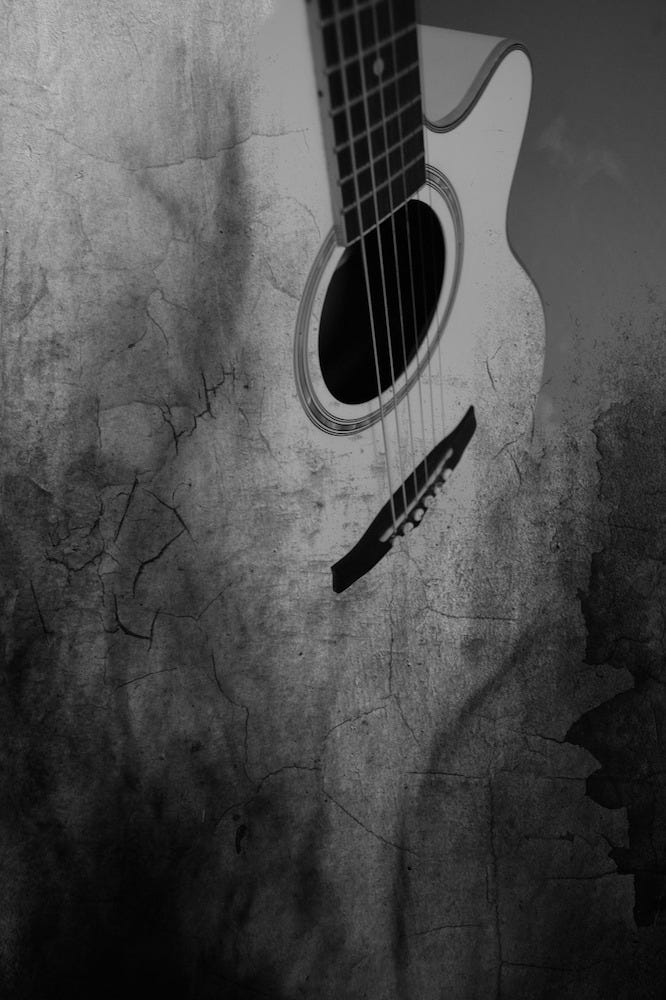
The scuffed guitar she carried was nearly as large as she was.
She stood at the foot of the stage and waited for the musicians to notice her. If she found the bullheaded fellow or the purple-skinned fiddler odd, she didn’t show it.
Their leader Markus, a man with thick black hair and a goatee, glanced down at her.
“What is it, child? We’re busy here.”
“I wish to duel you,” the girl said in a high, clear voice.
The musicians’ laughter rang out all over the town square. Passing townspeople heard the guffaws and stopped to watch the girl with anxious expressions. It was not unheard of for children who annoyed the musicians to go missing and never be seen again.
“Look, little girl,” Markus said in a very raspy voice. “We’re in a good mood today, so we’ll let this foolishness slide. Now go away, or we’ll make you sorry.”
The girl continued as if she hadn’t heard his warning. “You play your best song. I play my best song. The townspeople will decide who was better. If you win, I will do as you wish and leave. If I win, you leave this place and these people and never return.”
The bullheaded fellow, whose name was Gore, leaned over to get a closer look at her.
“Child, have you a death wish?” He had a low, rumbly voice.
“No,” she said.
More people gathered to watch the conversation, and they knew Gore’s question wasn’t an idle one. An old man approached the girl to attempt to talk sense into her. He removed his battered brown hat, bowed to her, and gave her his most serious look.
“My dear, this can’t end well for you. Stop this nonsense right now.”
The girl looked up at him with her brilliant green eyes.
“It isn’t nonsense, sir. And I’m not afraid of them. They should fear me.”
The musicians howled with laughter again, and this time some of the townspeople joined in.
“And why would we fear a little mouse fart like yourself?” Markus said.
If the insult bothered her, she didn’t show it. “Because I am the biggest mistake you ever made.”
The musicians looked around at each other, confused.
“Do I … know your mother, child?” Markus asked, rubbing the back of his neck. He noticed that the girl had the same jet black hair that he did.
“Yes, a long time ago. But it wasn’t the way you’re thinking.”
“Ah. Well, that’s a relief.” He chuckled. “This has been amusing, but we’re quite serious. Run along now.”
“I am also serious,” she said. “Why are you afraid to play against me?”
That angered the musicians, and the onlookers shrank back from the stage, sensing imminent danger.
“Ridiculous!” Gore snapped. “We’ve been playing together far longer than you’ve been alive, you little dirt speck.”
“Then you shouldn’t be afraid to accept my challenge.”
Markus had had enough. He stood up to his full height, which was impressive indeed, and glared down at the girl.
“Very well. We’ll play your silly little game, child. And remember: We gave you many chances to leave us alone.”
The girl returned his glare. “Remember that you had many more chances to leave this town.”
“Just for that impudence, we go first,” said a scowling Markus.
The musicians stood up, readied their instruments, and nodded to each other, knowing exactly what piece fit this occasion. They were brilliant performers who had played together for hundreds of years and could make the gods themselves weep. But the performance today had a very specific purpose; it was a series of messages to the watching townspeople.
The first act of the music sounded warm and whimsical, and the underlying message was “Isn’t this funny? The child thinks we’re indulging her.”
And then the music shifted into a minor key and grew distinctly menacing: “Those of you with delicate constitutions should leave the town square now.” A few of the spectators grew pale and hurried home.
The final act of their song was loud and forceful: Watch what happens to people who challenge us. Even little girls. Beware. Beware. They repeated the same chord progression, louder and faster. Beware. Beware. The remaining onlookers cowered and covered their faces. They had heard this music before, and they knew something terrible was about to happen.
But the little girl stood with her eyes closed, unmoved and unmoving. The musicians ended the piece with something of an anticlimactic finish and stared down at her, their mouths open.
“How are you still here?” Markus asked.
She opened her eyes. “Did you think I would run away from my own challenge?”
In fact, the musicians had expected the girl to catch fire and burn down to her bones during the last act of their song. When she did not, they looked at each other, all of them wearing the same expression: Concern.
The girl, who remained at the foot of the stage, turned to face the crowd.
“I will now play my own composition, inspired by my mother and my grandmother. I call it ‘The Big Mistake.’”
She tuned her guitar as she spoke.
“Thirteen years ago when I was born, my mother tricked these musicians who hold you in their thrall. Claiming I was stillborn, she gave me to my grandmother, who used magic to spirit me out of this town. My grandmother was both a powerful musician and a powerful sorceress, possibly the most formidable in all the land. She made this instrument for me.”
The girl finished tuning her guitar.
“And Grandmother liked to say that when sorcery and music are both performed well, they are almost indistinguishable.”
And with that, the child began to play.
The first chords were in a melancholy minor key and sounded like they were being played on the strings of a heart that was about to break. Onlookers grew teary-eyed. Gore himself let out an audible sniffle.
Sleeth, the purple-skinned fiddler, swatted at Gore’s arm, and Gore snorted and fixed him with a dark stare. “Do that again and I’ll gut you.” He brandished his horns to make his point.
“Shut it, you clods!” said Markus. “Look!”
The townspeople stared around at each other with dazed expressions, blinking as if they had awoken from a long nap.
“How is she doing this?” murmured Arron the drummer.
“It doesn’t matter,” Markus said. “It stops now.”
He began a low strumming on his guitar, and in a matter of seconds the sunshine and warmth outside were replaced by low, dark gray clouds that blew in on a chill wind.
Although the wind whipped the girl’s hair, she continued to play, and her music grew louder and stronger. Her green eyes flashed pure fury.
Gore played a quick and frantic tune on his flute, and a greater wind whipped up. Arron beat his drum in a steady rhythm, causing icy raindrops to fall over the town square. Some people put their arms over their heads and fled but many more of them remained, so entranced by the girl’s playing that they didn’t care about the sudden storm blasting them.
The girl continued playing even as freezing rain and wind lashed at her face. Markus found that his own guitar was becoming harder to play and when he looked down, he realized why: His hands were withered and bent with the advanced age he had enchanted away for so many years.
He heard Gore’s flute clatter to the stage and turned to see Gore slumped in his chair, quite dead.
“No!” Markus roared. He tried to make his hands do what he needed them to do to restore the enchantments and then send this brat back to whatever hell had spawned her.
Sleeth dropped his fiddle and attempted to flee, but his legs refused to carry him, as they were turning into ash. Arron the drummer was already blowing away on the heavy wind. Gore had completely disintegrated.
“Master!” Sleeth called to Markus. “Do something!”
But Markus could only watch as his own hands began crumbling into dust. He opened his mouth to shout one last desperate incantation at the child, and the remains of his tongue blew out of his mouth in a black cloud of soot.
As the girl played the last soaring, climbing notes of her song, rays of sunlight pierced the dark clouds. The rain and wind stopped, replaced by a warm, comforting breeze. The remains of the sorcerer musicians and their instruments continued to blow away until they were mere dust motes visible only in the sunbeams. The stage stood completely empty.
When the townspeople realized what had just happened, they exploded into a great roar of appreciation. Hands reached out to grab the child and raise her high, but she evaded them by running up on the stage.
“Child!” some of them called. “You must give us that guitar! It’s a miracle!”
The girl looked down at her guitar with a sad expression. And then she raised it over her head and brought it down on the stage over and over again, until she had smashed it into a pile of splintered wood and string.
Horrorstruck voices cried out as one: “Why?”
“That was my grandmother’s last wish. The instrument was very powerful and thus far too dangerous to keep around.”
And then a tall, thin, dark-haired man approached the stage. He was in tears as he looked up at the girl.
“You are the image of my late wife Miranda,” he said in a shaky voice. “She died thirteen years ago, not long after she convinced her mother to pose as a midwife and spirit our newborn daughter out of town.”
The girl, who had known that her father likely still lived in the town, smiled at last. She descended the steps and held out a hand to him. He took it in both of his, kissed his long-lost daughter on the forehead, and led her through the crowd to the home where he had lived alone since Miranda’s death.
The girl, whose grandmother had named her Keridwen, remained with her father. She agreed to perform music during holidays and festivals after much pleading from the townspeople. But she refused to combine her music with the sorcery she had learned at her grandmother’s knee. People were in charge of their own lives now, for better or for worse, she said.
Those who had witnessed the great musical battle between Keridwen and the musicians spoke of it forever after. And the town’s performers adopted the habit of smashing their guitars to bits on the stage at the end of an especially strong performance, a peculiar tradition that continues among some musicians to this very day.