
A list of Scrum Articles, Guides and books that have defined Scrum
Scrum then and now, part 4
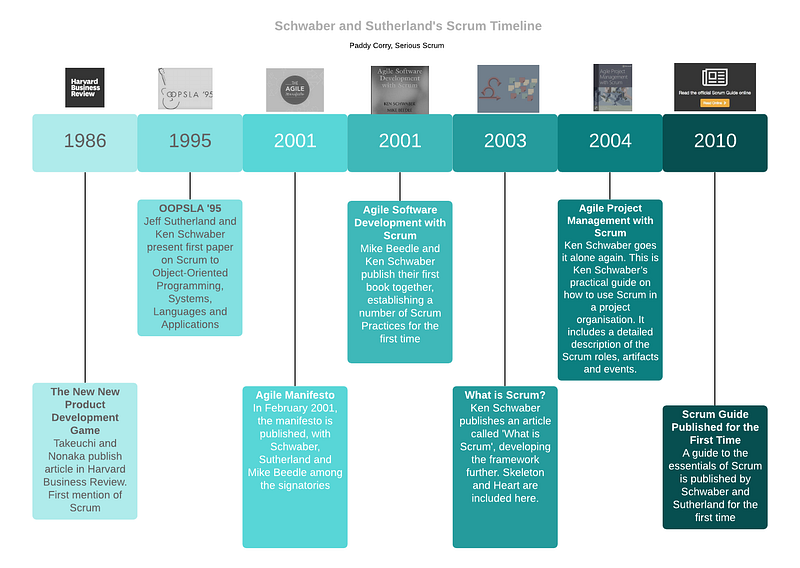
Scrum has been around for years. Jeff Sutherland and Ken Schwaber presented it to the world at OOPSLA in 1995. They based it on “The New New Product Development Game“ (1986) by Hirotaka Takeuchi and Ikujiro Nonaka. Many things have remained the same since then, 1995. Other things have evolved. With this series I aim to show you how radically Scrum has changed over the years. Through this I wish to achieve transparency on why certain ideas about Scrum materialised and help raise understanding on the current Scrum definition.
This article aims to give an overview of material that has given a presentation of Scrum through the years. If you know of additional material that is important to be mentioned as well, please let me know. I might decide to add it to the article.
The New New Product Development Game
Hirotaka Takeuchi and Ikujiro Nonaka introduced the term “Scrum” in their 1986 Harvard Business Review article. With “introduce” I mean they used the word for the first time in the context of Product Development:
“Moving the Scrum Downfield” — The New New Product Development Game
The article is referring to the game of Rugby. The term Scrum is used once.
“Companies are increasingly realizing that the old, sequential approach to developing new products simply won’t get the job done. Instead, companies in Japan and the United States are using a holistic method — as in rugby, the ball gets passed within the team as it moves as a unit up the field.” — The New New Product Development Game
OOPSLA paper
The next important document is the OOPSLA paper, which was presented at the OOPSLA 1995. OOPSLA stands for Object-Oriented Programming, Systems, Languages & Applications. OOPSLA 1995 was where Jeff Sutherland and Ken Schwaber introduced their adaptation of Scrum.
Agile Manifesto
The Manifesto for Agile Software development has to be part of this list. Scrum influenced this manifesto and the manifesto influenced Scrum. One key example is that Scrum introduced a new event in the years to come: the Retrospective:
“At regular intervals, the team reflects on how to become more effective, then tunes and adjusts its behavior accordingly.” — Principle of Manifesto for Agile Software development
First Scrum Book 2001
In 2001 Ken Schwaber and Mike Beedle published the book “Agile Software Development with Scrum”. This book established numerous Scrum practices and introduced the Scrum Master.
2003 article — What is Scrum?
The Scrum 2003 paper from Ken Schwaber can be considered as a next increment of the Scrum definition.
Agile Project Management with Scrum 2004
This book reads as a ‘how to use Scrum’, but it also explain the theory, the skeleton, the heart, the roles, the flow, and the artifacts of Scrum as is was defined in 2004.
First Scrum Guide 2010
The first Scrum Guide was published in 2010. The most recent version of the Scrum Guide, created by Jeff Sutherland and Ken Schwaber, has been the single source of truth about Scrum ever since.
Below is a link to a page where you can find all 6 versions of the Scrum Guide.
Scrum Guide revisions
Another useful link is the one to the Scrum Guide revisions. It gives a complete overview of all changes in the Scrum Guide from the first version to the last version.
Current Scrum Guide
The on-line version of the current Scrum Guide is here:
Scrum Guide improvement suggestions
Scrum evolves. This much is clear. There will be future changes. Anyone can suggest changes to the Scrum Guide. Below is where you can drop your ideas. It doesn’t mean that the ideas will make it into the Scrum Guide. This in the end is up to Jeff Sutherland and Ken Schwaber.
editor note: I received valuable feedback from Brad Appleton who pointed me to a 1998 paper that did define Scrum at the time. He also mentioned the Mike Cohn books. Based on this I decided to post a revised version of this article, which you can find here:
Thanks for reading. Feel free to bang that clap button. You can give up to 50 👏’s. Give it a try if you enjoy this article!
My twitter profile is https://twitter.com/WJAgeling

Do you want to publish in Serious Scrum? Connect with us on Slack to make it happen!

We run a Serious Scrum channel on Slack. You’re all invited. Feel free to reach out and connect with us on Slack to share your thoughts.