
Retro Rewind
A Link to the Past: The Game That Taught Me Gumption
Even a little girl can save the world
Retro Rewind is a weekly series that reconsiders pre-2000 pop culture. More here.I’m too busy these days to full-body dive into the newest big game, so there’s space in my mind to mull over the best games I ever played. What’s funny is how little I remember about certain games — even though I loved them, passionately if briefly — and have vivid, almost re-playable memories of others.
Legend of Zelda: A Link to the Past is perhaps the most unforgettable.
I’ve never played the sheer volume of games that I know many gamers do. For one thing, I’m a completionist; for another, I frequently replay games that I love. But it’s still astounding to me how clearly I can recall that first SNES Zelda game. Especially when I think about how many amazing and engrossing games I’ve played since.
There are many reasons why — including the fact the game is the quintessential RPG — but for me, travelling to Hyrule was a necessary step in escaping the confines of small-town, parochial thinking.
Zelda was a core lesson in the pleasures that come from pursuing a difficult goal worth attaining. It connects me to my childhood, but it was also an invaluable link in the chain that led to a wildly different future than my 11-year-old self had ever envisioned.
If I cast back a little further, I have fuzzy recollections of playing Duck Hunt and all three original Nintendo Super Marios. There was the occasional Street Fighter bout, Donkey Kong, and a race car game or two.
But it wasn’t until I picked up my uncle’s Nintendo controller one day in my grandparents’ basement and turned on the original Zelda that I felt ensnared. Enamoured.
I was awful. We didn’t have a system yet, so I had only played on occasion at the homes of friends when my turn came around. Yet I still remember the sound that the fairies made when they charged you up in their little health-giving pools. I still remember waiting impatiently for each screen to load as I wandered through the forest.
My sister and I started hoarding our allowances for an SNES console shortly thereafter. We each earned a generous $20 a month, which was a decent sum in 1991. It helped that we lived in the country, and the only ways to spend our money was on candy at the mom-and-pop shop down the lane or through the Sears Christmas catalogue, studiously researched and bookmarked each fall when it arrived.
My parents surely must have topped us up because the $200 system appeared under our tinsel-strewn tree six weeks after it launched here in North America. Along with it came Super Mario World, which was far more exciting and visually captivating than the originals. But what we really, really wanted to play was the yet-to-be-released Zelda, for which we had to wait another few months.
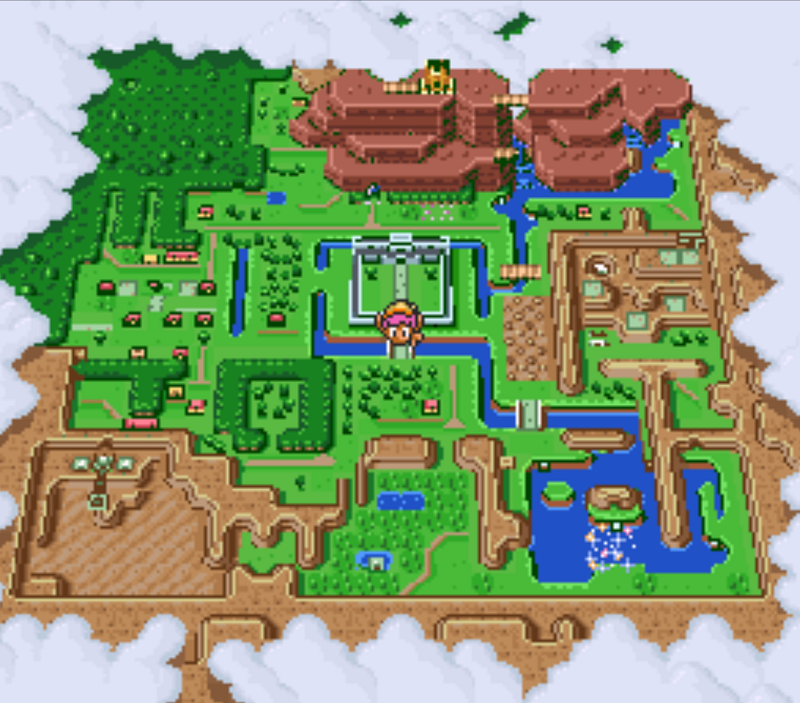
I remember opening the box, with its blocky grey game inside, vaguely shaped like an 8-track flipped on its side. It even came with a physical map that we could unfold into all its glory.
Admittedly, I have loved paper maps ever since; drawing my own has become one of my favourite parts of stepping into the role of Dungeon Master for our devoted crew of Pathfinder players.
Maps are magic — they tease, they hint, they reveal just enough to tempt you to explore. And they always have boundaries, tantalizing viewers to dream about what might lie beyond the edges. Hand me a map, and I can’t wait to run off the edge of the known world.
Our Zelda map would become so tattered with use over the next few months that soon it was virtually laminated with tape.
Remember what it was like, firing up a SNES game? You plugged the chunky cartridge in. You slid the purple rectangle to On.
A Link to the Past starts with a sense of urgency that few modern games can capture because their mechanics are too complex. It’s the middle of the night. It’s raining, and Link is awakened by a mysterious telepathic message — with a desperation akin to Princess Leia’s, Help me, Obi-Wan Kenobi — that calls you to hurry to Hyrule Castle.
Link’s uncle tells him to stay put as he ventures out into the night, but you promptly follow after, armed with nothing but a freaking lantern against the darkness.
I could still tell you what you need to get into most of the dungeons. If I thought for a minute, I could give solid advice on how to kill its many memorable bosses. Example:
- For Vitreous, the giant eyeball in the swamp dungeon a.k.a “Misery Mire,” be sure to avoid the slime because it slows you down. You can Hookshot out the little eyeballs and then defeat each one with your Master Sword. But watch out! The giant eyeball will race around the room at any moment.
There was no internet to turn to for advice if you got stuck. There were no “quest” markers on an overview map, so you had to listen carefully or guess expertly.
I was 11 and my sister, 8, so that first play-through, I got the controller — most of the time. She was happy to help, with the map spread out beside her, my co-pilot and cheerleader. The stingy cord meant that we sat on our perpetually frigid basement floor only a handful of feet from the big box tv. Which was fine because we probably couldn’t have determined the pixilated friends from foes had we sat further back, anyway.
Sometimes we just kept circling until we found what we needed: a single obstruction that blocked a new path forward or a boulder we could now lift with the Titan’s Mitt or a peg we could smash with the hammer. Maybe we missed a clue, so we would diligently go back and talk to the NPCs in Kakariko Village.
Instead of a massive map, Zelda was layered and deep. After you swept through the Light World, you did all over again, differently, in the Dark World. There were breadcrumbs, simple but clever. It was just hard enough that I felt triumphant every time I lept forward in the story.
I am far from alone in my love of this brilliant game. Hum the first few bars of the theme song in any room with another gamer over 30, and you’re almost certain to have them join in within seconds. Even the mini-game song is instantly recognizable.
And who doesn’t love the “treasure” sound, made more epic and melodic as the IP went on, but so perfectly celebratory in its core?
This is the sound I still hear at any small success, from finding lost keys to filling out my taxes. The only other game that still echoes in my head this way is the jingle at the end of a battle from the Final Fantasy series.
Although the game was originally released for SNES, its durable popularity means Nintendo has rereleased it on GameCube, Game Boy Advance, Wii, WiiU, Nintendo 3DS, and Switch, according to Zeldauniverse.net.
IGN ranks it as the all-time top Super Nintendo game with this exuberant praise:
The game embodies pure SNES perfection. Perhaps it’s the well-balanced enemies, the memorable bosses, or the brilliant light and dark world system that sets the game apart. Or maybe it’s the tight controls, perfected item system, or the glorious soundtrack. Whatever the reason, A Link to the Past remains our choice for the greatest game of possibly the greatest system of all time.
So the game is unarguably great. It left its indelible impression on (at least) two generations of gamers. What was it that made this game so special to me?
I’m certainly not the only one to love that Link is an androgynous character in an industry that loves to beef up its beefcakes and glam its girls. He’s Peter Pan-like in his childishness, though he still braves dark places and powerful enemies.
Even at 11, I felt the walls of my gender beginning to close in around me. We lived just outside a small religious town that gave me no outlet for my insatiable drive to explore, create, and strive. We had maybe four tv channels at the time, and I felt lucky if I managed to sneak in some She-Ra now and then.
I far preferred escaping to Narnia over reading the more popular Babysitters Club; the closest I got to “gender appropriate” books was the Little House on the Prairie series, which I scoured for survival strategies as I carefully made plans to run away and live in the woods.
I played pickup with the neighbourhood boys at the park, but the sports teams were split. The smallest girl on the soccer team, I got kicked out of a tournament in Grade 6 for playing too rough.
There weren’t a lot of games, as a girl, that I felt invited to play. If I wanted to go toe-to-toe in Street Fighter, there was Chun-Li and her badass whip kicks, but that was it. How was I supposed to flex my developing muscles in a way that left me feeling empowered?
Link left room for me to practice being myself, fiercely. I could be little as well as tough; if I tried my hardest, I could save the world.
Fighting is certainly a component of Zelda, but really the game is a series of well-designed puzzles, driven by narrative and comprehensible in its scope. It wasn’t out to scare or shock, but it did offer plenty of challenges.
Each little step led me forward. Each success felt like a genuine win and an encouragement to keep going. You’ve got this! You’re growing more skillful, more competent! It was the opposite of the Tetris experience, where things get harder until you quit or die.
By the time I was done, 12-year-old me knew that life was not going to be easy, but I could get somewhere worth getting if I just kept at it. And isn’t that something a 12-year-old girl — or a 40-year-old of any gender, for that matter — needs to know?
Something we all need to feel with our eyes and our ears and our ever-quickening thumbs?
I would never claim that I’ve been chasing a peak experience in all my gaming since. I’ve genuinely enjoyed so much about the evolution of games and game systems.
Over time, I’ve branched out into turn-based strategy, open-ended city-building, survival, and many other kinds of games. But that balanced sense of meeting a challenge, struggling to succeed, and feeling like you’ve overcome it — that I do look for in every game I stick with. That pleasure of perseverance.
The popularity of retro gaming means that I’m going to be able to share Zelda with my daughter when she’s old enough. It may or may not be her thing — it is 30 years old and only getting older — but I’m still anticipating the day when we pick up an SNES mini, and I get to watch her slide the little purple rectangle and see the screen light up.
I can’t wait to watch her fumble with the contoured grey controller, perfect for a child’s hands. I can’t wait to watch her struggle to hit the A & B, X & Y buttons and forget the bumpers on the top.
I can already see her face light up when she kills her first enemy or cuts a swath of grass to find the rupees hiding there. I can almost hear her recount with glee how she overcame the bad guys and rescued one of the maidens hidden away in the dungeon.
I hope she never feels the need to escape like I did, but if she does, Hyrule is still there, waiting to test her limits and expand her sense of just what the world has to offer.
A Link to the Past not only made me a gamer, it helped make me the woman I am today in countless ways: eager to face the next challenge. Ready to stare down the villains. Confident that, if I give it my all, I can accomplish whatever I chase down with my heart bar full-to-bursting.
It let me imagine — it let me practice — becoming adventuresome Odysseus and sailing off the edge of the known world and into everything that lay beyond the little girl that I was “supposed to” be.
We hope you enjoyed this edition of Retro Rewind! Come back next week as Ryan M. Danks gets nostalgic for Star Wars: The Phantom Menace. Check-out our schedule for upcoming columns!