
A Life-Shaping Experience
“Make it a good day!” What I told my children as I sent them off to school while they grew up.
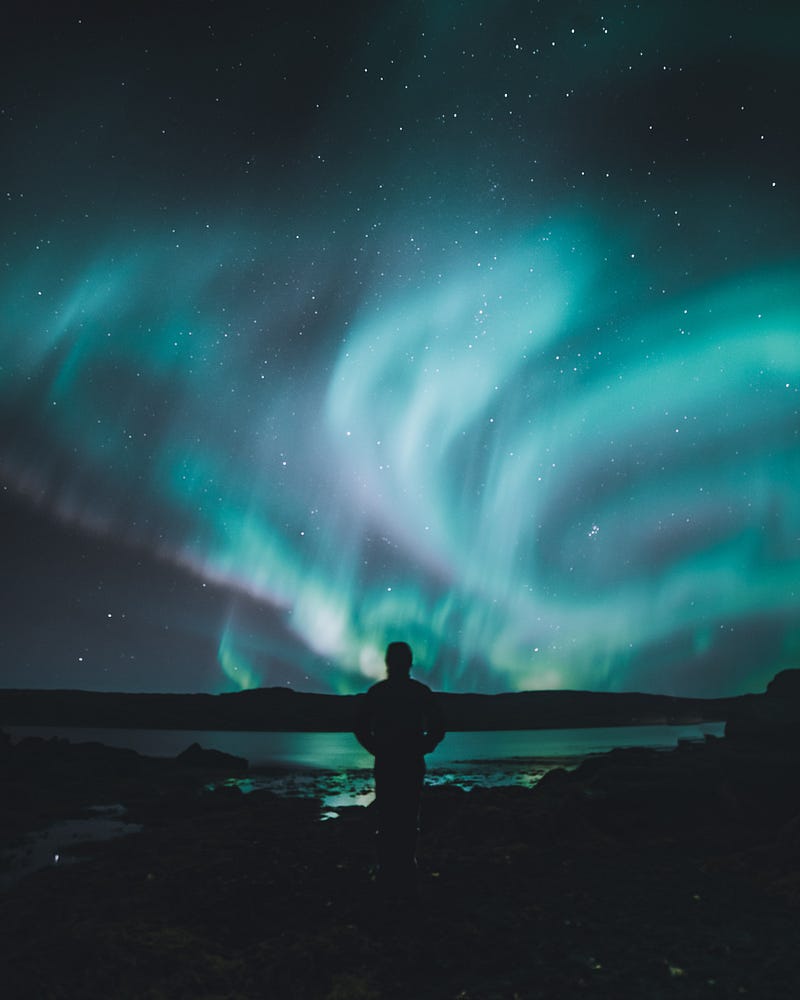
I said, “Make It,” because it is up to us and our mental health that does that. “You can be as happy as you make up your mind to be.” (Abraham Lincoln)
Over the years, many stories have been published about the “world’s worst stadium disaster.” All of them written as a report made to inform of something sensational and important in the world of soccer, to point out a man-made tragedy no one saw coming. None I know of have been written from a unique participant’s point of view.
Looking back at my life, I see so many lessons learned. However, one experience seems to be a benchmark of who I am and keeps me using my head rather than my emotions when I need to make big decisions. Everything I saw in the event seemed to be in slow motion at the time and in my mind. It had such an indelible effect; my mind can play that movie any time.
I turned 17 the day before when the worst Soccer Stadium Riot occurred in Lima, Peru, on May 24, 1964. I estimated it killed approximately 500 or more people (the “official toll” was 328). My number is simple math by multiplying the dead at my exit by the number of Iron Curtain doors the stadium had; I did not and do not know how many died in the battle that was fought with the police outside the stadium. So the total number will never be known.
My father had given me money for my birthday, so I could see Argentina play Peru in a qualifying round for the Tokyo Olympics football tournament; he asked me to take my two younger cousins with me.
We lived 40 miles from the stadium. When we got there, the only tickets available were on resale, and could not find three adjacent seat tickets. I bought two adjacent assigned seats at a good location. I took one in what was popularly called the “Dog Pound.” This was a simple wood bench at pitch level right behind a chicken coup fence where the police station sat with German Sheppard dogs for crowd control. Looking back from where I was, I could see my cousins; they were on the first row by a stairway, next to an exit tunnel on individual seats. The stadium was packed.
IMAGE USAGE — Note from the Author- the date of all the images in this post are from on or about May 1964. They will be 60 years old in 2024. The Berne Convention, of which Peru is a signatory, provides several avenues of usage; among them is the fact this post meets the intent of the “three-step test,” and as explained in the Wiki, “fair use,” one of the limitations to copyright intended to balance the interests of copyright holders with the public interest with the unique view of someone who lived through it.
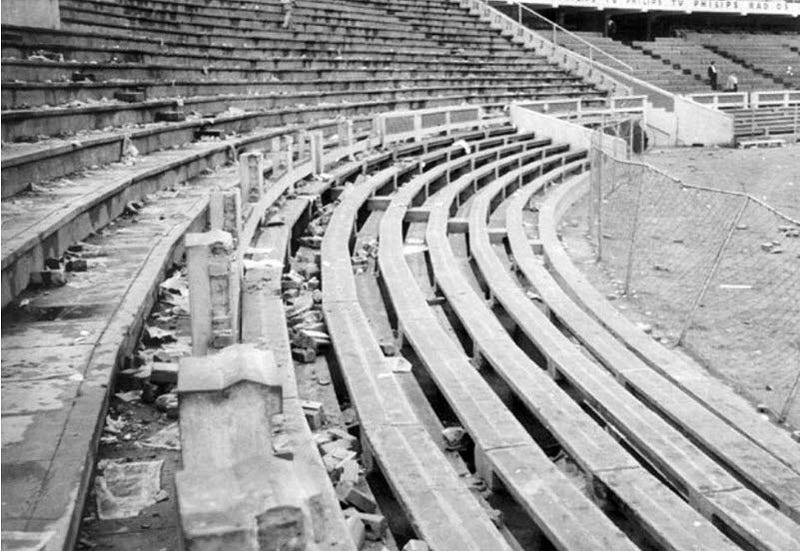
The game was a tough fight between two good teams. Still, we could all see the referee (who was from Uruguay- Like Ukraine was to Russia during the Soviet Union) was calling the game for Argentina, especially after Peru, coming from behind, scored, and the referee disallowed the goal — the crowd, which was restless before started calling out the ref. With lots of loud whistles and yells. At one blatant call by the ref. A guy jumped into the pitch and chased him to kick him. He never got there. The police got to him first. After they dragged the guy out and the game was about to resume.
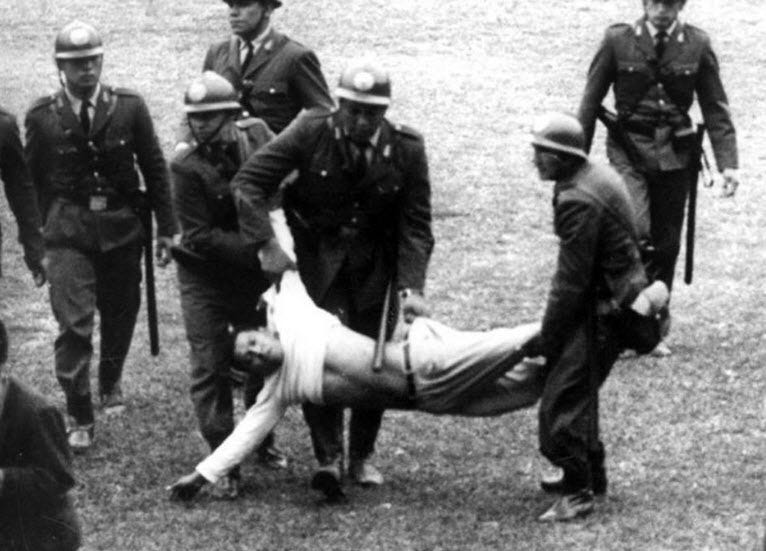
I looked back to check on my cousins; they were not there. I thought they had gone to the bathroom. A bit later, after another bad call, a second guy jumped into the pitch, and the ref. chase started again. This guy got to the ref and was jumping in the air to kick him in the head when a policeman that had caught up with him on a perpendicular trajectory hit him with all his might with the long leather-covered baton. I could see how the guy folded in half, legs up, arms up, and fell to the ground like a sack of potatoes and did not even move. The dogs were out on that one and attacked the guy on the ground, and the police did not pull them back. I watched, removing the guy from the pitch again; my cousins were still gone from their seats when I looked back.
The second attack was brutal, and the crowd, who until that point had limited itself to calling out the referee any way they could, exploded.
I had been sitting, hoping my cousins would return and the game would restart. They tried to restart, but the people in the stands started throwing beer bottles into the pitch. They started breaking the brick walkway retainers between sections and throwing bricks into the pitch when beer bottles ran out. The police with the German shepherd dogs could hardly control the dogs. They wanted to come through the fence and eat me. I could see their wild eyes and foam in their mouths. The dogs were furiously barking at me, wanting to come through the fence that separated us. At this point, I looked back for my cousins, but they were not there.
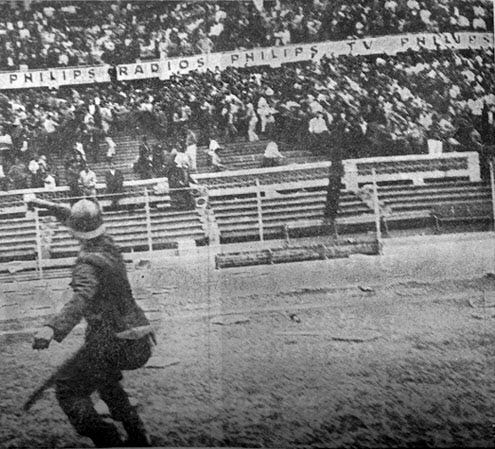
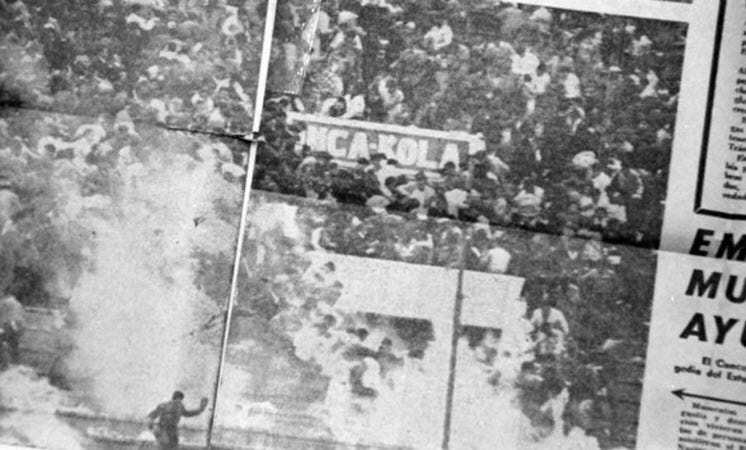
At this point, I saw tear gas exploding all over the stadium. Everybody jumped and ran to the tunnels. Rivers of people were cramming into the exit tunnels; mine was next to my cousins seats. There was a lot of pulling and pushing everywhere around the stadium to get into the tunnels. I thought my cousins had been gone by then and were sucked into our tunnel. I waited as long as possible but had to escape the dogs and went up near the tunnel entrance.
I assessed the conditions and decided to wait as long as possible because people looked compressed. At some point, rushed by the tear gas, I went into the melee near the middle; it seemed to move easier there. The river of people carried me, and as this happened, I could see shoes on the floor from earlier escapees. So every time I got stepped on from behind me, I pushed myself to the back to free my foot. The river of people carried me down the steps of the tunnel toward the exit; it was like a solid mass of people. The pressure was unbearable, so “I swam,” pulling myself shoulder to shoulder with the people towards a “U” bar I saw on the side and jumped behind it. I waited there until the last of the people went down.
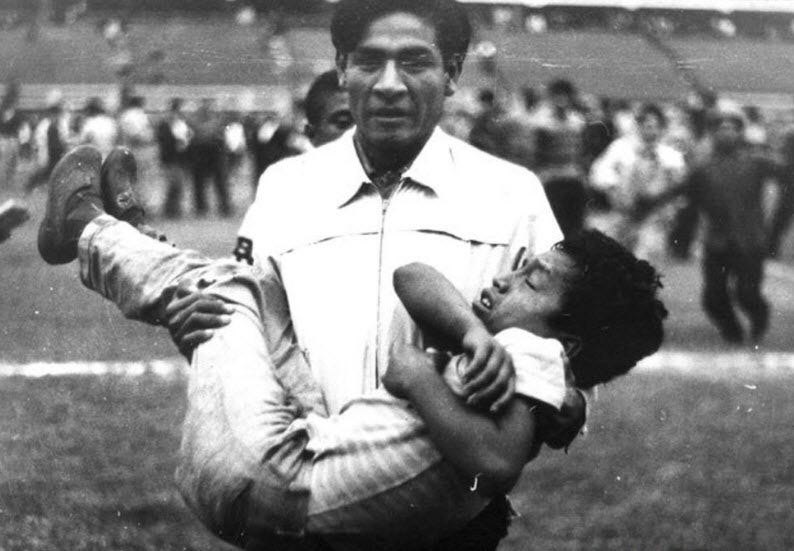
As I saw the last of the crowd, I left my safe haven and went back upstairs to look around to make sure my cousins were not there. As I looked around, I saw people trying to help somebody to breathe, but the kid looked purple; I thought, probably asthma, a popular disease of young people in Lima. Gas was everywhere, and the stadium looked empty; the pitch was full of debris. I started down to the gate, and on the right of the entrance was a woman’s bathroom; I went in, and it had men and women washing their faces. The Men’s room on the other side of the hallway was the same. No cousins anywhere.
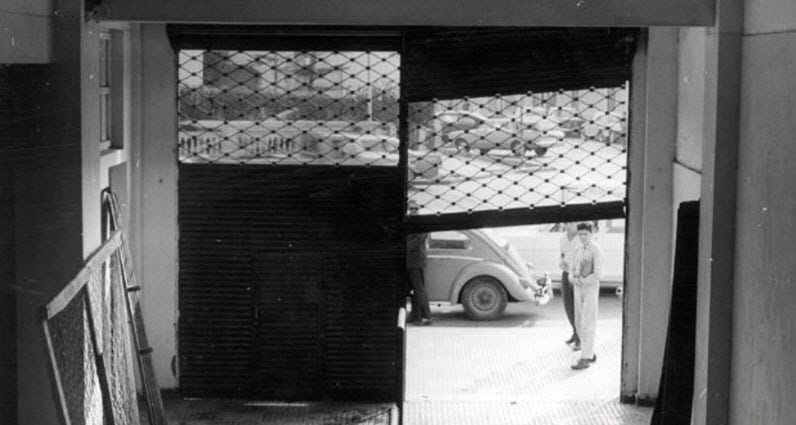
I went to the exit and saw the Corrugated Iron Curtain that was the stadium gate. It was “blown out” by the people’s pressure trying to escape the stadium. There, spread out like an open Chinese hand-folding fan their feet pointing to the door, were dead people face down, I estimated about 20 or more, lying outside the blown gate. The people pressure in the tunnel had blown the corrugated Iron Gate out of its continuous flanged hinges, and the “first people” that got there were all dead. I scanned through the dead, and my cousins were not there.
NOTE - afterward, based on the gate I was at and multiplying by the number of gates, I estimated that 500 to 600 people died exiting first from the stadium; however, there were more deaths outside by Police gunfire.
I walked beyond the dead, but escape was not possible. The people that now were outside the stadium were throwing rocks. They picked them up from the “Electric Tram” across the street from the stadium. It had a bed of rocks, and the rocks were thrown to the glass windows outside. Glass was coming down like it was raining knives outside the corridor between gates. There was a riot outside; they wanted the referee, and many wanted to battle the police.
NOTE — Peru has never had a “real” constitution. Like Bolivia (they have more Constitutions than Presidents), Peru has had many — all to suit whoever is in power. One of the things ALL of them have in common is that any and all guns and bullets are outlawed. So when people are facing the police, they know they are risking their lives. However, an enraged crowd does not care. However, the crowd wanted the Referee. This is why everybody was on the South side of the stadium. After a while, it was the police too. After the fact, I learned that at least one policeman watching the game in his uniform in the stands got thrown over the wall atop the stadium to his death.
I wanted to go to the park, across the street beyond the tram, to look for my cousins, but did not dare run while it was raining glass; also, there was the matter of the fence on the other side of the street to keep people (stadium drunks), from getting run over by the tram. The tram ran on a grade about three feet above the street in front of the stadium. Above the 3-foot concrete retaining wall was the wire fence, another five feet. Then, I saw what in Peru was called a “Rochabus,” a water cannon truck driving up towards me, spraying the crowd across the street. I figure the crowd would run away, and glass would stop falling. I waited for this to happen, and as the truck drove beyond me, the glass finally stopped falling. I ran crouching behind the truck as I could hear gunfire from the stadium’s south side. As soon as it died down, I jumped to the top of the parapet, and in one motion, to this day, I don’t know how it happened, I sprang to the top of the five-foot fence and fell to the other side.
At that moment, I heard what sounded like machine gun fire again. Thank God, in Peru, they gave us Military training in high school (this is because Peru has five borders). I knew what gunfire sounded like and how to make myself small while running, stopping behind trees when the gun went off again. While I was running, a guy three feet away and in front of me fell to the ground bleeding from the knee. His friends picked him up and ran off with him. By now, people were rioting at full blast; what looked like a tire store was in flames, and other stores were in flames. Thick smoke rose from it. I looked for my cousins for four hours until midnight, but no luck.
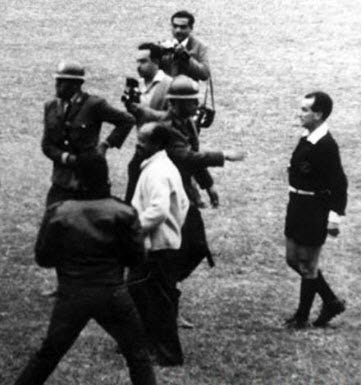
In those days, the refs were the law, and nobody would stand up to them. It was said then that he did not leave the stadium for two days.
The thought that my mother would kill me when I got home crossed my mind several times. But, watching the crowd get crazy like they were told me, looking was a futile effort. I had lost my cousins. I started walking towards downtown Lima where the Taxi line that went to my town parked. When I got to the Taxi line, The line monitor, who knew us, saw me and called me over. He told me my uncle had called to let me know my cousins were Okay with an aunt who lived near the stadium (something I had not considered). They got scared early in the turn of events, walked down the stairs, opened the one-man exit door, and went to their aunt’s house.
To read the story from a reporter’s point of view. Read the story written by the BBC reporter Piers Edwards, titled “Lima 1964: The World’s Worst Stadium Disaster,” on May 23, 2014, for the 50th Anniversary.
I did not realize at the time what I had done was of any value. This was buried in my subconscious. However, it became the basis by which I made many decisions in my life. My irreversible decision-making started then; the following March in 1965, I arrived in this country as an immigrant. Returning to the country my grandfather left behind when he went to Peru to build the railroads.
I do recognize the brain is a marvelous machine, and when something goes wrong, it can take over who you are. So what I say here has the embedded assumption of health. Without it, nothing else works.
Given that assumption, we ALL have a choice we make regarding emotions. We either control them, or they control us. The way I always saw it and see it is I am in charge. First, everything has a solution in life except death and taxes. I you accept this as “True,” then why panic? Or get upset? Instead, take a minute, “think it through,” decide, and act.
God gave us a brain, and it is up to us to use it.
I am not the sharpest knife in the drawer. However, actions count more than emotions. WHO you are is determined by what you “do,” not by what you “feel.”
Live and be happy — that is the best present you can give yourself every day.
Yoda:
“Careful you must be when sensing the future Anakin, the fear of loss is a path to the dark side.”


