
A Life Lesson in Perseverance
You don’t need to swing for the fences but you do have to keep swinging
I was a scrawny kid — not the strapping five-foot-eight, 138-pound hulk I am now — and I loved baseball, which was practically a religion in the Mickey Mantle-Willie Mays era of my youth. The St. Louis Cardinals were the closest major league team to my hometown — 400 miles away — but we followed the exploits of Stan “The Man” Musial, Red Schoendeist, and Enos “Country” Slaughter on the radio as though they were playing just down the road.
The summer after I turned eight, I tried out for Laurel, Mississippi’s Little League program. I caught every grounder and pop fly that was hit at me and smacked a couple of good line drives when I got my turn to bat, but I was not picked by any of the coaches. I guess I looked fragile. Bigger, brawnier boys with lesser skills became Orioles, Pirates, and White Sox.
When I was nine, I tried out again.
Again my parents got no phone call.
At ages ten, eleven, and twelve, the same thing. There were few slots to be filled.
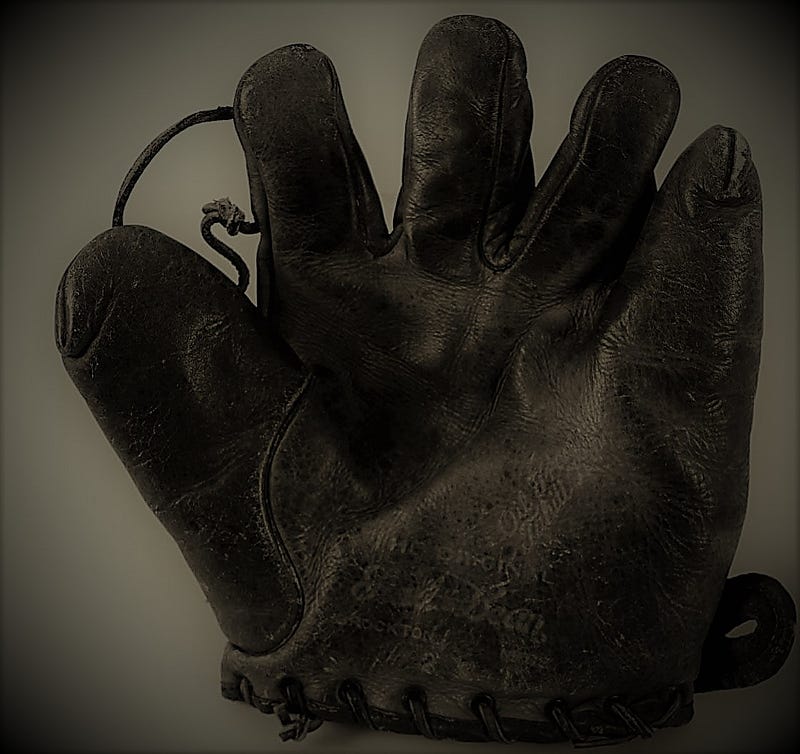
My first baseball glove was a gift from my Uncle Vernon. Daddy told me I should be deeply flattered because his oldest brother had been a really good player, making it all the way to a minor-league team in the Washington Senators farm system before an off-season work accident messed up his arm.
I was flattered, and I tried my best to ignore it when other boys teased me about the glove. It looked like something Ty Cobb had worn out and discarded, flat as a woolen mitten and not much better padded, with free-standing fingers you could wiggle, no lacing.
I eventually saved up enough to buy a nice little Sonnet infielder’s glove, with leather laces that kept the fingers together and a deep pocket that closed tight as a pit bull’s mouth. And I kept practicing, played unsupervised sandlot ball whenever I could, played on a Little League “farm” team on which my teammates, great guys, included a boy named Herschel who still had a limp from his bout with polio when he was younger and a kid named Ricky who had shot out his right eye with a BB gun.
When I tried out for a Babe Ruth League team when I turned thirteen, Melvin Thurber, a coach who lived in my neighborhood, picked me. Mr. Thurber pitched for the Masonite Aces, a team that played in a semi-pro factory league. He knew baseball inside and out. He had actually seen the Cardinals play in St. Louis. I was ecstatic. For the first time in my life, I had an actual uniform — grey flannel with CARDINALS across the chest — and a red cap with an “L” for Laurel.
We played our games and practiced on a red clay diamond encircled by the Laurel Motor Speedway, a dirt track at the county fairgrounds on which local hotrodders raced stock cars and souped-up jalopies on Friday nights. On summer days, the ball field was hot as a skillet, and we kids were bacon. Heat stroke was a bigger worry than bad-hop grounders or brush-off pitches.
I sharpened my infielder skills at practice, learned to hit a curve ball, and got brown as a berry, but at games, I sat on the bench. I didn’t get to play a single inning until the final game of the season when my team had the league pennant clinched.
Mr. Thurber sent me up to pinch hit late in the game with two men on base. The opposing pitcher, a hefty fifteen-year-old, mocked me by turning towards his outfielders and motioning them to move in closer.
Coaching from third base, Mr. Thurber gave me the sign to “take” the first pitch. The umpire called ball one. Mr. Thurber again flashed the “take” sign. I passed up a fastball down the middle. “Stee-rike!” the ump yelled.
I stepped out of the batter’s box and looked at Mr. Thurber. He went through a bunch of motions, wiping his hand across his chest, feeling his five o’clock shadow, before giving me the “hit away” sign.
The pitcher smirked at me, took his stretch, and aimed another fastball my way. I saw it fat as a cantaloupe and hit a line drive, a frozen rope, over the center fielder’s head. It bounced over the fence for a ground-rule double. I ran it out anyway, ran like a bad dog was chasing me, and slid into second base.
Bubba Jenkins, the Yankees’ shortstop, looked at me like I was a nitwit. “You don’t have to slide, it’s a ground-rule double.”
“I know that,” I said as I stood up dusting red clay from my uniform. “But I’ve been waiting a long time.”
The following summer, Laurel adopted a new baseball program, Dixie Boys, and everybody on every Babe Ruth team had to try out all over. The coach of the team of which I hit the double picked me. I got to start at shortstop, and I made the all-star team.
Never forget. Patience pays, whether you’re waiting for the right pitch or your turn.
Adapted from Noel Holston’s memoir, As I Die Laughing: Snapshots of a Southern Childhood, available on Amazon.com.