
ADVENTURE TRAVEL | KAYAKING | BAHAMAS
An Epic Kayaking Adventure — Part Three
Prepping to paddle across 23 nautical miles of open ocean!
This is part three of a kayaking adventure that I went on with an ex-boyfriend back in 2001/2002 when I was 24 years old. To start at the beginning, click below.
Well, we had seemingly done the impossible and got our kayak imported into the Bahamas. Despite being told a couple of different times by the customs officer that there was no camping allowed, we did it anyways. At that point, we really didn’t have an option.
After dropping our kayak off the dock in Nassau, we gleefully paddled away into the bliss of empty islands, turquoise water, and white sand beaches.
We had done it, and we were stoked!
What had been a hope of warm tropical weather, while we froze in southern Florida, had become a reality. We had months stretched out before us of nothing but fun in the sun.
According to Wikipedia:
The Bahamas consists of some 700 islands and 2,400 cays in total (of which 30 are inhabited).
We knew that there were unlimited possibilities for exploration out there.
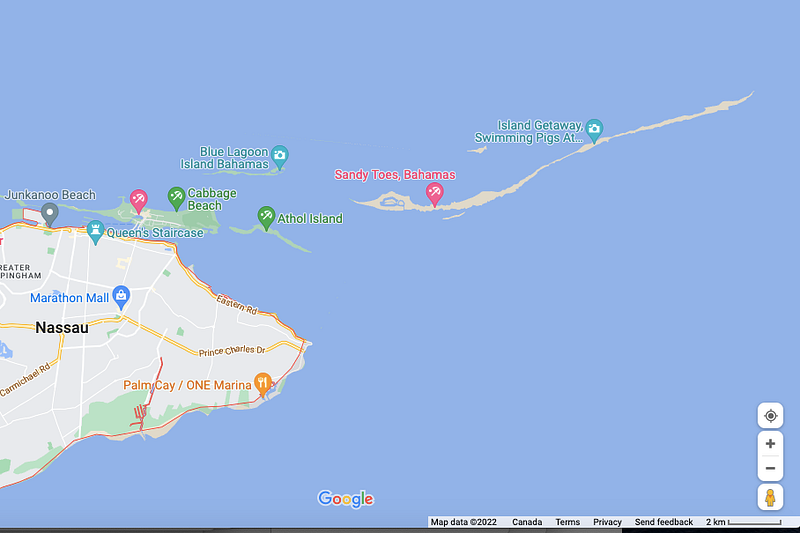
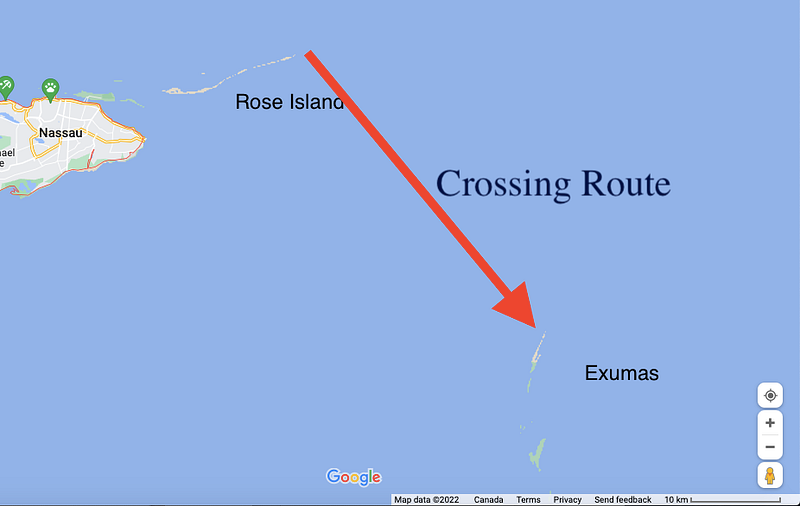
As you can see from the GoogleMaps image above, Nassau is surrounded by a few small islands (and many are too small for the map to show). At the time, all of these islands were unoccupied (with the exception of Paradise Island which houses the Atlantis Hotel and other resorts) and we were able to just paddle around them, and set up camp wherever we felt like it.
For the first month, we did just that and used Nassau as our restocking and provisioning point. We would paddle into the Nassau boat marina, tie our kayak up, then go shopping.
After doing this a few times, one of the security guards got curious about us. He wondered where our big boat was and assumed that we were just using the kayak to get from our real boat to the city and back.
When we told him what we were doing he was aghast. Despite the Bahamas being an island nation, many locals are petrified of the water. They fear sharks and other ocean-going creatures that may devour them in one bite. Plus many of them can’t swim, and drowning is actually a very common occurrence.
This guy actually started begging us not to go further. Especially when we told him that we were considering making a jump to another chain of islands to the southeast of us, The Exumas. It would require a 23-nautical mile (42.6km) open-ocean crossing, something that we thought long and hard about because it would get us to Georgetown and the place where Mike worked. (Remember our mission from part one!?)
He was so upset when we told him this. “Oh no, please don’t do that. I will read about your deaths in the paper and will feel so bad that I wasn’t able to stop you.” He begged.
We had a few laughs with some of the other locals who felt this way also. It was not an uncommon way of thinking.
In fact, he also wasn’t the only one who thought our kayak was just an accessory to our bigger boat.
One day we were set up on Athol Island when a Bahamas Coast Guard boat pulled up to the beach. Of course, we were nervous because we knew that we shouldn’t be camping.
We solemnly approached one of the men as he jumped off the bow of his boat and onto the beach, bracing ourselves for what was to come next.
“Where is your mother vessel?” He asked with a stern tone.
We were a bit dumbfounded and didn’t really know what to say. After putting together what he meant, my boyfriend said, “Oh, this is our mother vessel,” while pointing to the kayak.
The officer looked at it, then back at us with a very quizzical look. “But where do you sleep?”
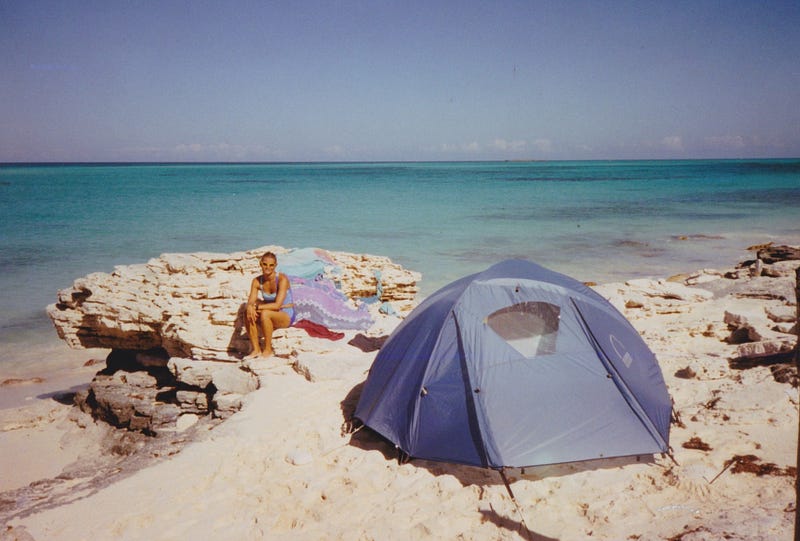
We pointed up the beach to our tent that was set up. “We sleep in there.” We told him.
“But how will you get back to Nassau?”
It was then that we had to pull out our paddles and demonstrate how we were able to maneuver the boat. He also wanted to know where we put all of our stuff, so we opened the compartments so he could see the space that they offered. After a few minutes of contemplation, and walking up to take a look at our camp, he concluded, “So, you don’t need our assistance then?”
“No, we are fine.” We both giggled.
We told him that we had a VHF radio if we got into problems, but that we were fine, for now.
He chuckled a bit and looked longingly out to the sea. I have no idea what he was thinking in those few moments but he finally let out a giggle and shook his head. “Okay, then, you kids have fun.”
“Thank you, we will.”
We let out a sigh of relief as he made his way back onto his boat and motored away from the beach. Apparently, the ‘no camping’ rules hadn’t been shared with the coast guard.
What a relief.
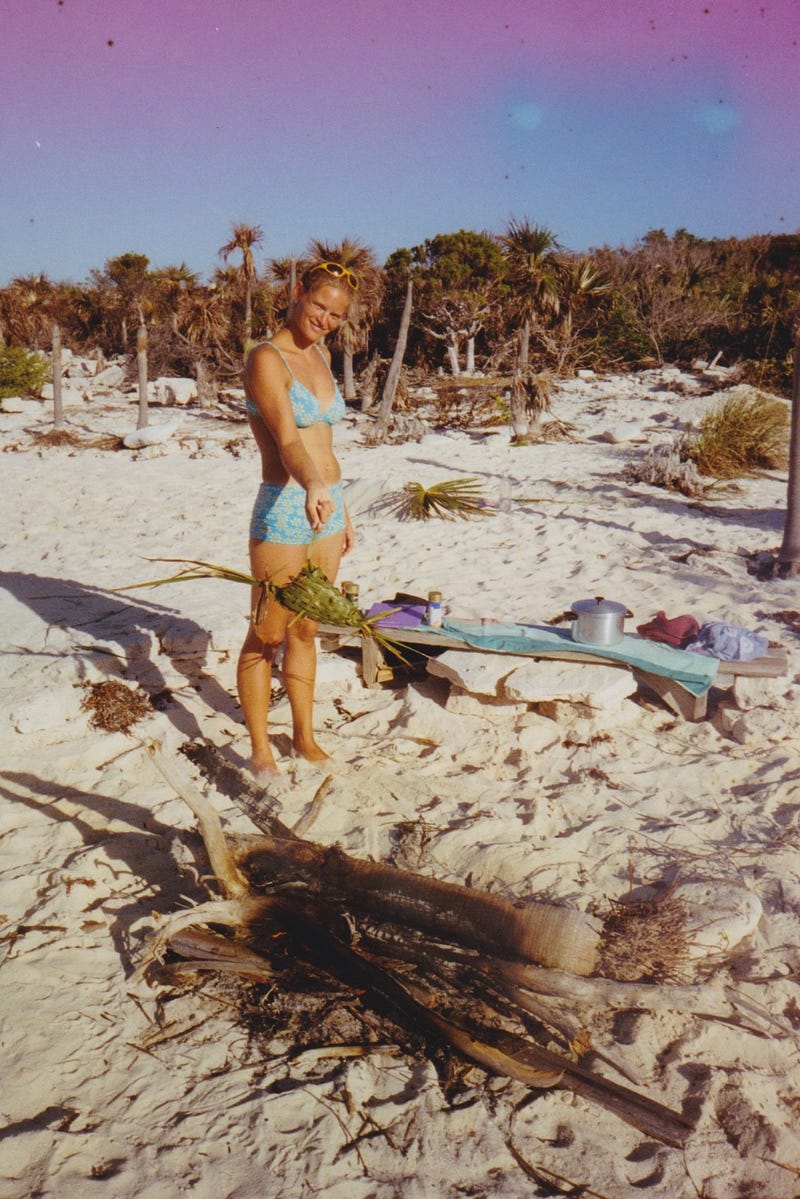
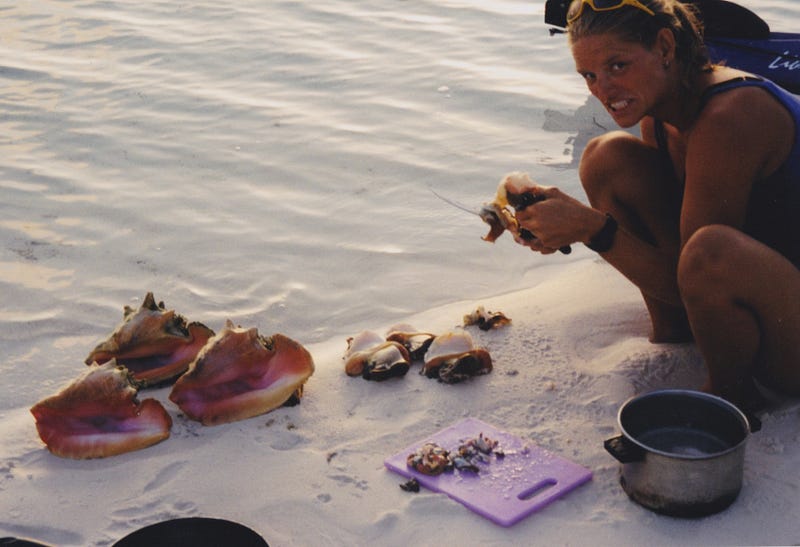
It was a blissful time. Our days were full of trying to get coconuts down from the trees, and my boyfriend went on daily hunting excursions in the ocean. We had purchased a sling spear while in Nassau one day, and he was catching lobster and fish almost daily.
We swam and snorkeled and went on small hiking excursions. Of course, the islands were small, so the hiking was limited, but we managed to fill our days. If we got bored in one spot, we would pack up and paddle to another. Over the course of a month, we got pretty familiar with these islands and had all of the good beaches mapped out.
After a while, we decided that we needed to make some decisions about getting to Georgetown. We were determined to find Mike and tell him that Frank from Key Largo said hi. Plus we had heard tales that the Exuma chain of islands is one of the more spectacular groups of islands in the country. With over 365 islands, we knew that there would be no shortage of places to camp.
Georgetown is the largest city of the Exuma chain of Islands with a population of just 1437 residents (current stats according to Wikipedia), and is located at the southern end. The whole chain is about 100km (60miles) long. We had done some inquiring in Nassau about how to get there and learned that there was a mailboat that we could likely get on that would take us and our kayak there.
But that didn’t sound adventurous at all.
Instead, we would regularly scour our chart book and consider all the scenarios in trying to make the jump in our kayak. The biggest problem was that the trade winds came from the direction that we would be paddling, and we knew that it would be a long haul, made even worse by paddling into the wind.
We knew physically that we could cover the distance. By now we had been paddling for over two months, almost daily and we had done some pretty long hops in the Everglades. The distance wasn’t really the problem, it was the wind and the currents.
The currents in the Bahamas can be intense! There were days when we would get caught in a current and our boat would be pushed straight sideways while we desperately would paddle straight on trying to come out of it. If we got caught in a current while making the crossing, we may have gotten pushed out in the middle of the Atlantic Ocean, never to be seen again.
However, we could see in our chart book that there were no notable currents through that section, and we could also see that some of the islands had fresh water cisterns marked on them. This meant that we would be able to find fresh water, which was certainly a concern of ours.
We carefully took all of this into consideration.
While in Nassau one day, I phoned my parents (on a pay phone) to tell them what we were considering. “That doesn’t sound like a good idea.” My dad warned us. “Anything could happen out there.”
“I know, but we have our radio if we get into a problem. We have already met the coast guard.” I joked.
I left the phone call with no definitive answer of what we would do. My poor parents, I can’t imagine what they were going through during all of this.
A couple of days later we were listening to the weather station on our VHF radio so we could get a sense of what the forecast was. It was then that we learned that a storm was coming in the next 3 days. For those that don’t know, when storms arrive on the water, the winds clock around and don’t necessarily come from one direction. In fact, there will be a good chunk of time, before the storm arrives, when the winds will be coming from the opposite direction to where they usually do. This meant that if we could time our crossing correctly, we would have winds pushing us along from behind, instead of us paddling into them.
This was a critical moment. We had been talking about doing this for a while now, and the timing seemed ideal.
We made the decision to go for it.
We paddled back into Nassau, stocked up on as many staples as we could (rice, crackers, canned fish, canned veggies etc.), filled our 3 5-gallon collapsable water jugs (2 of which went between our legs in our cockpits), and headed off to the eastern end of Rose Island.
From there we would see how things would proceed.
We made our way to a pretty cool spot with cliffs surrounding the beach. It was the highest point of the island we had seen thus far. The Bahamas are very low-lying. In fact, the highest point in the whole country is just 64m (210ft), but the average is much lower than that.
Because of this fact, we also knew that we would be paddling blind for most of our trip across. There is only so far that you can see land due to the curvature of the earth, especially when the land is so low, and we would also be directly on the water. So we spent a lot of time plotting our GPS course from our chart book. We had a handheld GPS where we could enter the coordinates of where we wanted to go, and it would direct us to our destination, but we also had a large mounted compass on the deck of the kayak. We used our chart book to calculate the compass heading that we needed to keep so that we had two points of reference in case we needed them.
We listened closely to the weather station on our radio each day and knew that our window was coming. One morning my boyfriend poked his head into the tent at about 5 am.
“It’s time.” He said.
He had been up listening to the forecast and the winds would now be directly behind us. We knew that we only had a 6–10 hour window before they would change, we needed to get going.
We quickly packed up all of our stuff, took a VERY deep breath, and pushed off. We had been mentally preparing ourselves for this day.
We were pumped on adrenalin, and we were ready!
To read the whole series:
Tagging some readers that have been reading about this journey so far: Anne Bonfert | Adrienne Beaumont 🇦🇺 | Gerald Sturgill | JoAnn Ryan | David Perlmutter | Allison Ditmer | Ryan Frawley | Sh*t Happens - Lost Girl Travel | Shawn Somerville | Katia | Reece Reid | Ronald Smit | Aura A. | Travis W. King | M T Sutphin Thanks for joining my journey!
Special thanks to Globetrotters for publishing this series as well!

Hi there, we are 2 Canadians, Jill and Chris from Artistic Voyages. We have been nomadic since 2017 living in numerous different countries, and experiencing the life and diversity of our planet on the ground and firsthand. We have now been on the African continent for over 2 years!
Subscribe to Medium through my referral link to get full access to my writing plus thousands of others! Plus sign up here to get my articles by email!
Join our adventure by hitting the links below!
Website | Instagram | Facebook | Twitter | Patreon| YouTube | Medium


