A Journey Home
Carl Sagan, James Bond & The Snow Leopard: Meditation on a Life Half-Lived
Santosh Pandipati, MD
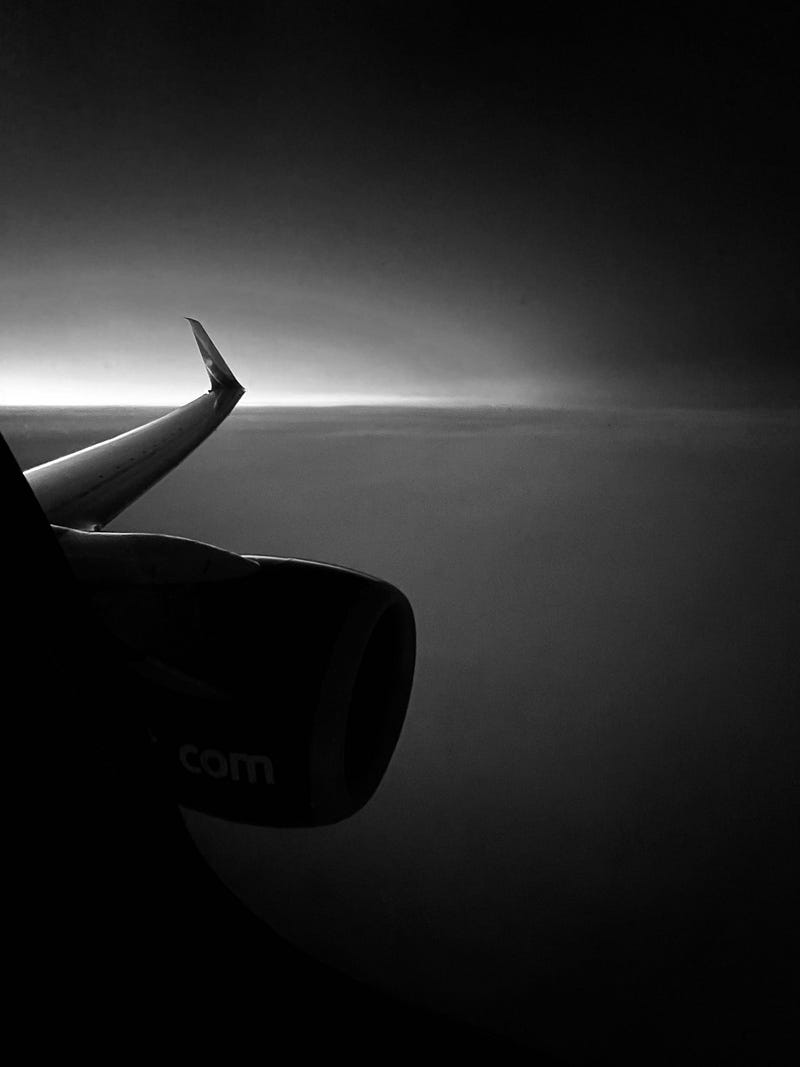
As I start writing this on one of the last days of 2021 I am hurtling five-hundred miles per hour, thirty-thousand feet in the air, backwards in time, towards my formative beginning. A beginning fraught with innocence uprooted. A beginning bruised by the early realization of dashed hopes. But these people from my beginning whom I am going to see now need me. My sister and I will be with our mother and father as physical and moral support while my mother undergoes surgery. It will be a reunion unmatched in nearly 3 decades. We will stay in a house I called home from elementary through junior high school. In a neighborhood I thought magical at a time, with woods and a nearby creek, neighbors with whom we were all friends, kids from all around who played in the cul-de-sac in front of our house, a friend down the street whose mother had a swing in the living room (now in retrospect likely for multiple purposes) and more Legos than any child ought rightfully have, with one particularly remarkable neighborhood 4th of July celebration deep in the heart of the 1980s (the quintessential American decade) complete with the best-tasting hot dogs I had ever had in my life as well as gloriously illegal fireworks — I am still haunted by these memories that spark in me a profound reverence for my childhood.
Upon arriving at my parents’ home I am struck by how little and yet simultaneously how much has truly changed. It’s one of those paradoxes of life I suppose. My parents are still loud, often yelling at each other for no legitimate cause, and my father’s frequent impatience with my mother, though perhaps now a bit mellowed in intensity, is largely unaltered from historical recollection. The house is cluttered with the detritus of a lifetime, my mother’s tchotchkes space-occupying various glass-encased closets, her collected tourist magnets metastasizing over the refrigerator doors revealing her prior visitations to various (some mediocre) locales, my father’s folders full of who-knows-what papers carefully segregated for eventual oblivion, various pictures of family hung up on many walls — some dating back six decades and some poised at a slant from a careless bump in some ancient time and then never righted, gaudy Victorian-style furniture filling up the living spaces, the dining table covered in a clear plastic sheeting fearing against any untoward splatter, closets full of saris that my mother never dons, cabinetry and countertops and doorjambs and corners of walls banged up by a lifetime of abuse without a lick of touch-up in over 2 decades, a cuckoo clock high up on the wall of a now-abandoned dining room insistently announcing the dawn of a new hour six minutes too soon before every hour. The yard, which had previously seemed so expansive, particularly when I was mowing the grass as a pubescent pre-teen in humid mid-Atlantic summers, now seems rather contracted and much less grand. I recall the time our neighbor planted baby pine trees bordering our respective yards, his justification being that eventually they would lead to desirable privacy in some not-too-distant future. Those neighbors have since departed, never having benefited from the growth of life that comes with the gift of time. Now those pines tower perhaps 40 feet in height, but in the bare of winter and with the bare of the sickly lower branches no privacy is truly achieved.
My father had kept a variety of papers, books, and photographs that my sister and I had accumulated over the years when we all lived together, as well as during times when we returned from school. Finally on the verge of retirement, turning 74 during my visit, he is now ready to purge the house of excess, or so he says. He requests that my sister and I sift through this material and retain what we desire. I am confronted by old photos of family gatherings and past crushes, stacks of one-sided letters and emails professing my love — pretty much always unrequited — to innumerable ill-chosen women of my past, my college transcripts and various ancient certificates of achievement that in the moment had meant a great deal, but have long since lost their luster. Out of these I keep some family photographs as well as a letter that had been sent to me the summer before I started college by my then-to-be freshman-year dormitory roommate. I am flooded with memories of a being and an existence I no longer truly relate with, of a time of painful growth and transition, but with which I have an affectionate continuity.
A couple days after my sister’s and my arrival we dropped my mother off for her surgery at a university hospital in Northwest D.C. In the midst of the COVID-19 pandemic only one of us could stay in surgical waiting, and since none of us could actually be with her from pre-surgery through surgery through post-surgery, we all chose to leave, opting for text message updates generously offered as an alternative. My mother seemed brave as she bid us all a temporary goodbye, eager for permanent resolution of her severe pain. My father, sister, and I then walked our way through part of the Mall, followed by the Potomac riverfront, then Georgetown, and finally returning to where we started. It was a walk we have never done as a family in all our time living in Maryland. I had forgotten how, even in winter, Washington D.C. could be so stunning. Our circular trek stretched over eight hours and across ten miles, broken up by lunch and perusals through a couple book stores. We had anticipated in advance that this would be the way the day would roll out, so my sister and I had pre-planned to pounce on my father for the opportunity to clarify our family history, and especially for his, for his internal contradictions are what have puzzled us the most over the years since we both left home.
Born in Southern India in the year of India’s independence from the British Monarchy, my father lived his childhood life in what was once a village populated by mud houses transected by only three roads. He would routinely skip school in 2nd grade until he was caught doing so by an elder brother who physically carried him to his classroom and instructed his teacher to not let my father out of his sight. This elder brother had himself gone missing previously, and after much sleuthing by my father’s family, had been discovered to have secretly enlisted in the Indian Army. With much difficulty they were somehow able to extract him from his service and restored him back to their village. In 8th grade my father joined his much elder brothers who had moved to a neighboring town to venture into clothing businesses, but had to repeat the grade due to a lack of English proficiency and lack of a second formal language. Somehow he viscerally understood then and there that to escape the doldrums of small town life, as well as eventual conscription and bondage into the family business that would unquestionably extinguish his vitality, he would need to redouble his efforts in his education.
Thereafter his life fundamentally changed. He went to open the family shop early every morning, worked for an hour or so, then ran to school, often arriving late to class. At lunch time he would rush to the shop to work for an hour or so and then race back to class, only to frantically return upon the end of the school day to work until the evening. Finally at 8 PM or later in the night he would be freed up to do his homework — often by candlelight as reliable electricity was no guarantee for his small town in the mid-1900s. He often escaped to a local park to study for his exams and to avoid the critiques of his family.
Despite his family’s aspersions towards his self-interest in education instead of the family business, he persevered to graduate high school and earn entrance into a local college with a full academic scholarship. He subsequently became the first college graduate in his family, having earned a bachelor’s degree in engineering. Along the way, he also managed to earn a master’s degree in Hindi. But all of this education was insufficient still for my quite-driven father. Though having been accepted to pursue an engineeering masters degree in America he was unable to afford the expense of travel, boarding, and tuition, and so had to abandon his intentions to venture to a far off land and push his education further.
Dejected, he confessed to purchasing a guitar with the intent to entertain people, meet girls, and find another way through life if further education remained out of reach. Why he exactly contemplated abandoning his hard-earned engineering degree seems to now be lost in the mists of time. He also sought out employment, and began working with the Indian Space Research Organization in Trivandrum, eventually being transferred to their offices in Bangalore. Having regained an interest in higher education through his work, he applied for a masters program at the Indian Institute of Science, founded well before IIT in Bangalore, and prestigious way beyond his original vision. Given his real-world work experience, his IISc advisors encouraged him to pursue a PhD program instead, to which he readily agreed. And while working for ISRO, through a friend of his, he met my mother — a beautiful woman seven years his junior, raised in considerably better economic circumstances, but who hadn’t completed high school and had no apparent drive for education nor personal advancement beyond marriage to an eligible bachelor. In entering a matrimonial with my father she seemingly achieved life fulfillment earlier than most, and at a fairly young age. Given the radically different upbringing and education levels, they remain an intellectually mismatched couple symbiotically intertwined to this day.
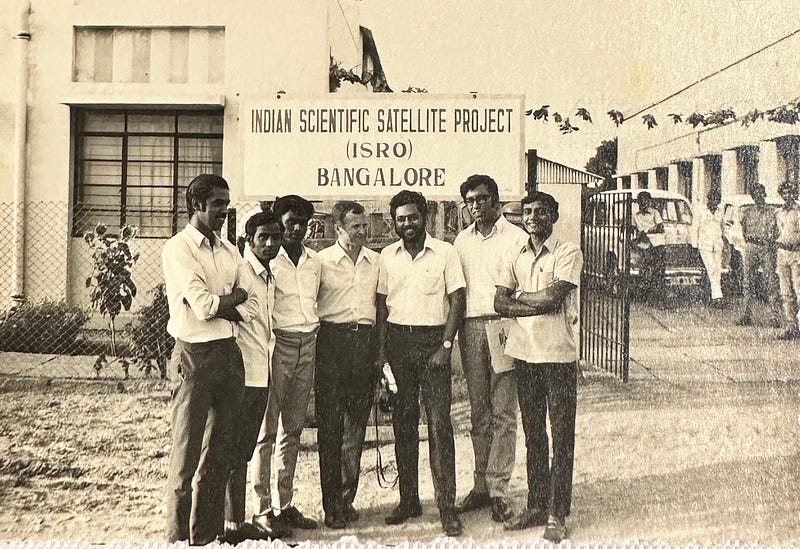
Upon starting a PhD program my father abandoned the study of Hindi literature, abandoned his desire to learn the guitar, and plunged headfirst into electrical engineering with a determined resolve. He was sent to Toulouse, France for 6 months to work with the French space agency, and my mother joined him for a few months. It was their first taste of being in a much larger universe than they had ever experienced before. In this way, my father became a crucial member of the design team for India’s first satellite. Not stopping upon completion of his PhD, he applied for a postdoctoral fellowship in America, and with his experience and publication background, he was readily accepted to CalTech. He arrived in Pasadena in the early spring of 1979, and a few months later, on borrowed money, my mother and I followed suit to join him in the New World.
My father regaled my sister and me with much of this history over lunch. He finally started to become a real human being, full of nuance and depth. His personality, which had been forged from struggle and angst and passion, started to make sense, while also pleasantly surprising us. It will go down as one of the most enjoyable, most important, and most special lunches of my life.
My memories of Southern California and the CalTech campus are limited, but quite fond. My parents were adoring, we were eager tourists in exploring the beautiful parks and coy ponds, Hollywood and Beverly Hills, living a block from the Rose Bowl Parade, getting caught up in the fact that here we were seemingly in the center of what the world knew America to be. And the three of us were cozily tight-knit. We purchased a small television on which my father introduced me to Carl Sagan via his marvelous documentary, Cosmos. I can’t say I intellectually grasped the depth of the series at such a young age, but even then I felt the depth of its implied spirituality in terms of the innately human connection to a much larger universe. It was a good life.
And so we thrived, moving from California to Illinois to Maryland, with my sister arriving along the way. She remains to this day a dear friend and confidante, a physician-scientist whom I admire deeply.
In Maryland, as a child, nerd-dom secured its roots firmly into my being, with my first straight “A” report card erupting onto the scene in 5th grade. My parents were visibly pleased, the positive reinforcement thrilling to me after years of receiving recurrent negative tones of anger and disappointment from bringing home even a single “B”. Nevertheless, my father’s satisfaction with my grades was always tinged with a bitter and angry aftertaste of “what more can my son do?” Frequently compared to my nerd compatriots, I was often accused of lacking in my drive to seek out greater intellectual challenges outside the four walls of school.
This initial externally imposed discipline gradually seeped into my psyche, becoming internally absorbed. The reward was palpable, with each quiz or test result “A”, each project or assignment “A”, and each straight “A” report card coming like a hit of a drug. It became a game to calculate how badly I would have to perform on the next test to see how secure my “A” in the class was. Often I could get a “D” on a final exam and still skate by with an “A” for the final class grade. Needless to say, I never got lower than an “A” on my final exams. With grades like these I felt rich and admittedly superior to others, though I never said as much. I participated in additional afterschool activities that were always aimed at securing my status at the highest levels of the school nerd clique.
All of this academic success came at a cost of course. Always awkward, burdened with thick old-man glasses and unruly hair, facial acne, an inability to dress fashionably both due to a lack of inherent sensibility and a lack of financial willingness by my parents, I navigated through junior high school and high school with difficulty. Bullied, taunted, and isolated, I became reclusive, but all the while raged with hormones, craving physicality as well as emotional romance with anyone of the female sex who was remotely fetching. Needless to say, my one-sided love remained unrequited, exacerbated by the sappy sentimentality of 80s radio pop-rock.
This pathetic state of affairs continued well into high school, all the while with little parental understanding of my internal angst. I retreated dual-fold: intellectually back into the roots planted in the childhood dreamscape of Pasadena — reading Carl Sagan’s Cosmos and diving into general readings on cosmology, quantum physics, and astronomy; and spiritually into my Indian philosophical heritage, embracing Hindu texts that my parents had kept on my room’s bookshelf merely for lack of any other place of storage. In the stars, and in the fundamental nature of the universe, I found solace; in the sacred texts from a grand and noble ancient civilization of which I was a direct descendant I found strength and self-centeredness. I fancied a study of cosmology and a lifetime of pondering the most important, intriguing, and perplexing mysteries of existence.
Alas, my newfound personal career passion hit head-first into reality. Upon announcing my deep-seated desire to grapple with unraveling the enigmatic origins of the universe as an astrophysicist, my father (now in retrospect not altogether surprisingly) took a firm objection and admonished me to seek a profession more stable and — according to him — more practical. No sir, there was to be no romance nor flights of fancy in the decision. Carl Sagan was to be set aside, and I was to become a doctor. Doing so was a means to various ends: financial security, job security, assurance of societal status, hypothetical freedom from modern life’s many perceived sufferings.
Not only was becoming a physician the only acceptable outcome for me, but the path to achieve this outcome was to be foreshortened, trimmed down to the bare prerequisite essentials, as there was no perceived justification for the expense that came with a full undergraduate experience, well-rounded individual be-damned. I was duly instructed to apply for accelerated medical programs, and furthermore, it would be the only means by which my college education would be paid for — astrophysics was fully out of the question. Out of fear of debt and fear of my father I relented to his insistence, setting aside my heart and proceeding headlong into convincing everyone that I wanted to be a physician. I did a damn good job at it, having earned acceptance into nearly every program I applied for.
During this time I recall a good friend of mine asking if I wanted to see Dead Poets Society with him. I knew nothing of the movie beforehand, but I was excited at the prospect of having a fun afternoon. I was not expecting to experience such a seismic perturbation to my core. I cried during the movie, especially upon Neil’s death. My friend, being somewhat puzzled, inquired as to why. At a loss for words, I feebly explained that the film was far more personal than I had expected it to be — there was no easy way to express my sense of entrapment.
Only one combined program stood out to me, a seven year curriculum with the first three undergraduate years focused on a true liberal arts foundation ostensibly to make more well-rounded and humanistic physicians. It was at a top public university with guaranteed acceptance to its connected medical school that consistently ranks annually to this day among the top 10 in the US. The program only accepted 10 out-of-state students from nearly a thousand applicants. And I got in. It was more expensive and further away than most of the other programs. My father protested, but I was firm: I had done his bidding, worked myself to my bones, gotten into the best combined program, and now I had a path I could somewhat justify to myself. If this is what my father wanted me to do, then this was how I wanted it to be done.
I was angry to my core, frustrated at my lack of agency, romantically flustered, ready to leave home, and ready to reinvent myself. Thankfully my father relented to my demands, and so I departed to the school and program of my choice, though not for the career education I truly would have selected for myself. I returned to stay with them for only one summer thereafter, and apart from a trip to Europe and India that they paid for, I did not live with them again for any extended period of time. In my final few months of living with them the summer between high school and college I recall my parents questioning — almost rhetorically for themselves — why was their son perpetually seething with rage just under his skin?
In undergrad and medical school I found new challenges and new grade-driven goals. I took advantage of the resources of my undergraduate university, taking Sanskrit for all 3 years, courses on Buddhism and astronomy, while my top-notch combined program exposed me to mandatory courses on philosophy, medical ethics, and human sexuality. I jumped over every academic hurdle, started running, wearing contact lenses, getting my hair under better control, and achieving the academic prestige of getting into Phi Beta Kappa. But on other fronts I continued to struggle. I tried to date women as best as I could, tried to gain popularity among some crowd somewhere, striving to squeeze additional solace through self-stimulated fervor in a Hindu faith that seemingly returned less and less, all the while trying desperately and faring rather unsuccessfully in playing catch-up to my peers in human romantic and sexual relations. These were dark times replete with suicidal ideation emanating from a foreboding sense of Sisyphean futility.
And yet somehow the days passed, undergrad was finished, and medical school arrived and new challenges distracted me from my inner tempest. It was the hardest studying I had ever done in my life. I was surrounded by ultra-competitive students, some of whom were abandoning entire prior careers due to a newfound calling to medicine. I aimed to excel even these diehards — at least as many of them as I could. I honored many courses and rotations, and obtained admission to the prestigious Alpha Omega Alpha medical honor society.
I encountered tremendous role models along the way. However, at the same time, never before had I met such egregiously arrogant adults, drunk with ego and uncaring of trangressed feelings amongst their victims, be they trainees, colleagues, or even occasionally their patients. I was often reminded of my very own bullies of yore. These were supposed to be the people given the delicate task of training the next generation of physicians who would then have to go forth and care for humanity. One wonders what impressions they were making upon those susceptible individuals who were foolishly willing to forsake compassion and instead emulate their temerity and bravado; what legacies were these educators truly leaving in their wake?
Despite all of my outward academic success, even in medical school my father had tried to influence my direction. He admitted that he would not feel “relaxed” until he knew I was out of training and into practice — beyond residency. So he wanted to ensure that I chose my medical specialty wisely. Having a distant uncle who was financially successful as an ophthalmologist in a small town in Kansas, my father pressured me to go into the same specialty. It’s lucrative, there is the opportunity to do medical charity work for the blind in India, I can make a name for myself — and on and on it went. Of course, he had no idea of the sheer level of commitment and sacrifice just being a physician had on an individual, but was a reality I was quickly coming to understand as some clinical rotations demanded 100+ hours of work per week. As he was paying for my education I suppose he felt he had a say in what I did with his money. Needless to say, here was one more instance of imperious control that did nothing to abate a lifetime of seething anger aimed at my parents.
Dismissing my father’s pressures, and despite brief dalliances with physical medicine/rehabilitative medicine and cardiology, I finally settled on maternal-fetal medicine — MFM — as a specialty career. While there are no guarantees, there seem to always be second chances in MFM. The challenge of caring for two patients simultaneously, where the condition of one affects the other in an infinitely recursive loop, is otherwise unparalleled in the human lifespan and seemingly beyond the reach of the male contingent of the species. The pathophysiology was absolutely fascinating. Barring any rare exceptions, pregnant mothers were universally wonderful to work with. And as far as practicing the field, there were a wide range of tasks to do, from ultrasounds to consultations to surgeries, allowing one to dabble in multiple areas of medicine simultaneously. While medicine was not my profession of choice, MFM gave me the opportunity to sample it all perpetually and to stave off intellectual indifference and premature ennui, for I feared I would not last in a more restrictive or single-tasked specialty.
I have strived to excel at caring for pregnant women and their unborn in precarious situations. In addition to being personally moved on innumerable occasions at human tragedy and triumph through my profession, I would say I have done a rather decent and rather high quality job in practicing the art of medicine. I have had many patients express tremendous gratitude for my care, and I take their lives as seriously as if they are those of my loved ones. I have learned so much from my patients over the past 2 decades of being a physician, being rewarded by becoming an integral part of their lives for brief episodes of time. And I have been a medical director for MFM at a local hospital for the past decade and I have become a leader of sorts locally and within my company.
For us human beings, our physical condition is the prerequisite for our emotional, mental, and spiritual conditions. But Western medicine has primarily concerned itself with the physical, to the neglect, and often to the direct harm, of the others. Over the past two years I have even been working on a project to leverage technology to revolutionize how women receive prenatal care in a more responsive and holistic manner. I have reignited a passion for educating doctors and patients on the perils of climate change to reproductive health. And so I have embraced as best as I can the opportunities afforded to me by my profession, the sole path allowed to me by my father.
It comes not altogether surprisingly that all this time I have been preoccupied with a nagging feeling that I have been working to fulfill someone else’s expectations; indeed, that I continue to work for my father more than for me. I am more clearly comprehending that the cessation of my angst will come not through any further devotion to my work as a physician than I am already providing. And so, even now, I remain restless.
I have struggled to maintain balance in my life — I have hung on to some attitudes and beliefs for far too long, and much to my detriment. It was when I relaxed my intentions and focused on bettering myself that I found my gorgeous wife-to-be, the mother-to-be of my three children, a life partner who in many ways is so much wiser than me. Over the past decade I have re-embraced my philosophical heritage, but this time my realization that it was Hinduism’s reform movement — Buddhism —and truly more so the kernel of Buddha’s insight into mindfulness — that really set me on a path to meditative practice and provided me a framework to begin to comprehend my inner torment.
Now, despite my battered milieu of distant memory resurrected and reincarnated once again on this trip, I have noticed that my internal nature upon my arrival here has so far been unprecedented. On previous visitations I had quickly reverted to my primordial state of animosity and rage. There was a time when visceral anger at being ensconced in this bubble universe would erupt without regulation, followed by inner rationalization of my emotional outburst. How could I be any different I would ask myself — I was dealing with tracks hammered down firmly into my psyche. But now, somehow, I have sublimated into a different being in the presence of my ancient home and my aging parents. Perhaps because I have come to an understanding of sorts as my father retold his story to me and my sister as we walked all those hours and all those miles?
My father was running away from his upbringing and his family’s will — all the while imposing his own will on his children. How then to reconcile his confession that at one point if he were not able to get into a Masters or PhD program that his fallback position would be playing the guitar since that would be a way to enjoy life, entertain others, and possibly score points with the female sex? How then to reconcile the man who earned a masters degree in Hindi out of interest and out of a desire to escape the doldrums of his small town life with the man who effectively forced his son to go to medical school? How then to reconcile the man who drowned his free spirit in his drive to prove himself better than everyone else, but in the process also imposed his iron will on his first-born child? How to reconcile that this same man is now as gentle as a lamb, and completely oblivious of his past emotional aggressions, who is deeply loving of his children, progressive in sociopolitical thought, and viscerally kind? The paradoxes of my father are perhaps as inscrutable as the paradoxes of existence itself.
I turn the proverbial mirror upon myself to examine my own reflection: am I not in many ways this same man trapped in the circumstances of a younger form? What is one supposed to do when the father they had harbored so much resentment against turns out, decades later, to simply be a paper tiger? That when expecting resistance none is encountered? And yet is a man who doesn’t seem to acknowledge insight into the pain he inflicted decades prior, lost in a forgotten time for him, but frozen in his son’s memory like prehistoric insects hardened in amber? It is only now, so many years hence, that I realize I have been fighting a ghost — a conception that has doggedly hung on like a severed hand that is still clenched around my neck, but no longer connected to the body that it was once a part of. And so, this time, I am different. I am not reacting. I am observing. I have more insight into internal emotions welling up, but I sense no anger. At the risk of assigning accomplishment to something that should not require validation, I wonder if my paltry efforts at mindfulness meditation are now favorably manifesting?
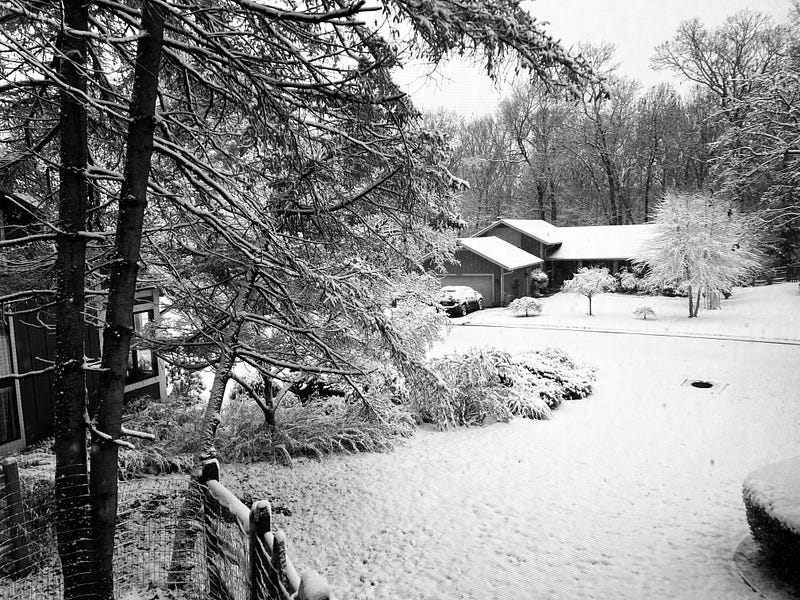
As I finish writing this essay at the dawn of a New Year, and as I take leave of my parents and beloved sister, I depart not with anger nor regret, but rather with pensive melancholy. Brought together without the extended family of in-laws and my parents’ grandchildren due to the unique constraints imposed by the COVID-19 pandemic, as well as a need to focus on my mother’s surgery and recovery, it has just been me, my sister, and my parents, now married for 47 years, who have huddled together. Never again will our nuclear family reunite as we have just done. For one glorious week my parents have had an opportunity to reenact a life they have not lived in 30 years. The last time I left this arrangement, I had left as a bitter and angry teenager, eager to escape not only perceived, but truly oppressive bonds, not truly knowing my parents, nor my sister who is 7 years my junior and almost an afterthought at the time (but has since become a dear friend). This time as I leave I reflect both on the good times we have had as a family together in decades past — now ethereal wisps of memory — as well as on the week that has just transpired and seems just as ephemeral as the togetherness of so long ago.
My parents are visibly aging, but they have also evolved. More open to humor, to criticism, and to acceptance, partial as it may be. There is no sense of apology from them for what they put me (and my sister) through. But somehow it doesn’t seem to matter any longer. My anger towards them has disintegrated. Due to their forcing I am now a respected and successful physician; I met my wife-to-be and true life companion during my medical training; and now I am fortunate to have the love and support of a beautiful family of my own. It easily could have been worse.
Thankfully my mother recovered well from her surgery. We spent the immediate post-surgical days relaxing in each other’s company, eating our meals together as in our homey days of past, my mother having thoughtfully prepared numerous dishes beforehand, a labor of love that had cut through her pain better than any analgesic. After dinner we watched movies together and discussed the possible messages being conveyed by their writers and directors and cinematographers. We talked about how best my mother should continue to recover after my sister and I had departed. And we talked about how wonderful of a gift our time together had been. At one moment my mother cried with my sister while I was in another room, but not out of earshot, despondent at the impermanence of the moment, saddened at facing the imminent loneliness that would once again descend upon her and my father.
We each traverse a path that we alone must take, either due to external uncontrollable forces, or due to inner, often unfathomable, motivations. We each have a story arc of development, with a beginning, a middle, and an end. Reflecting on our personal trajectory, we can sometimes see clearly through parted clouds the path we have taken and the path that we must take. I was reminded of this after recently re-reading Peter Matthiessen’s legendary book, my most favorite book, The Snow Leopard, for which he won The National Book Award. Following the death of his beloved wife, he leaves behind his family on a personal quest to quiet his being through an invited trek in the Himalayas on a scientific expedition to track blue sheep, to possibly sight the mysteriously elusive snow leopard, and for Matthiessen, to seek refuge at the Crystal Monastery, as he and his deceased wife were students of Zen Buddhism. Through this journey, as he re-discovers the fundamental absurdity of life, he comes to understand that we can all find immanence in the here and now of our lives. Echoing Matthiessen, as I find myself in the middle of my life and as I look back upon my own story arc, I understand of myself that it all really could never have been any different.
Which, perhaps oddly enough, brings me to James Bond. I have seen all the Bond films — growing up it was a family tradition to watch these movies together. We eagerly rented the VHS tapes and watched them serially and chronologically from Dr. No onwards to the latest, and would always go to the movies to catch the newest release. I would invariably fall head over heels for the latest Bond Girl, imagining my life to one day evolve into debonair acts of heroism coupled with the love of gorgeous women. Even now, whenever a new Bond film is released, evoked within me is a deep reverie of more innocent times past, when my mother and father were young and more vital, when the greatest fear I had was an upcoming test or what I would say to a one-sided crush the next time I would see her.
More than any previously, the Daniel Craig films have impacted me rather profoundly. For the first time in the movie franchise, Bond has a real back story. A deeply flawed and tortured man, without much insight into his motivations for what he did and how he did it, he was inhuman in innumerable ways — a tough character to initially empathize with, no doubt. But over the course of his films Daniel Craig’s character gradually re-connects with the humanity we are all born into, but all too frequently forget. Craig does this with a deftness that can go almost unrecognized amidst the glitz and glam and explosions, but his spiritual evolution is unmistakably present. With this backdrop, I had been eagerly anticipating the release of No Time To Die as I knew it would be his last foray as Bond.
I saw the movie on my birthday; a truly marvelous send off for Daniel Craig. The film was much more emotional than my wife and I were expecting in a fundamentally good and haunting way. The story arc was completed, Craig’s Bond discovered through sacrifice the meaning of being human, that in ending his, other’s lives could truly begin. I am sad to see Daniel Craig go as I doubt I will ever care as much for a 007 actor as I have for him. What I would give to just have a drink and a conversation with this singular gentleman, if only to tell him how this movie re-connected me to my own humanity. For I too have a story arc of a tortured past with disrupted connections to humanity, though my arc is as yet incomplete, and clearly not as tragic. But we all carry our pain, as it has come to define us, hone us, and guide us over time. And so I wonder, in what way will the remainder of my own life’s story arc transpire?
As with many people later in their lives, I have been more expansive in my worries as of late. We face so many challenges as a human species. It is doubtful we will survive all of them, be they the ones we are confronting now, or due to unforeseen calamities of an essentially unending future thrown at us by our very own universe. Recently I have been spending more of my time doing my best to educate humanity of its follies pertaining to the climate crisis, now one of the most deadly of all threats to our species. But I am also truly understanding that as individual human beings just as we face so many physical challenges — whether they be from climate change or diseased hearts — we also each face so many inner challenges that affect us daily, and will accompany us to our temporal ends. It is clear to me now, as I come to the conclusion of my trip, that my parents have had their own challenges. As they, like all of us, stumbled through life they acted as best as they knew how. There was no possible way to do it perfectly, to completely avoid bruises along the way, nor at the heart of it all, to really truly do it any other way.
We can occasionally glimpse looming high up in the skies, seemingly floating on clouds above all other challenges, the mountain peak that is our ultimate test: how do we reconcile the absurdity of our finite being with the apparent infinity we emerged from, and to which we will return? Is it not a profound spiritual realization to know — to truly know — that we are not actually apart from a greater existence, albeit during the finitude of our respective lives we seem to readily forget this deep truth? How to reconcile our impermanence with our conception of this infinity? We are but mere rearrangements of matter and energy, weakly ascribed to forms by our mental constructs, that on greater scrutiny, crumble apart as dry sand. As Matthiessen writes near the end of his own journey in The Snow Leopard:
“Feeling silly and quite suddenly exhausted, I sit down on the bed and begin to laugh, but I might just as easily weep. In the gaunt, brown face in the mirror — unseen since late September — the blue eyes in a monkish skull seem eerily clear, but this is the face of a man I do not know.”
And so another year has come and gone, and a New Year is upon us. I realize I have likely already crossed the halfway point of my existence. I see the cresting of my own life, and I now understand that I am a pattern in form, a coalescence of various energies that have intertwined and briefly given rise to an impression of a self, only to dissolve, dissipate, and reassemble in time into other forms in an infinite cosmic dance of benign and delightful absurdity and reimagination. I have no ultimate control, and yet…
I have now firsthand witnessed the frailty of my mother recovering from major surgery, as well as the aging and mellowing of my father who peripherally alluded to his own mortality, betraying a sense of vulnerability as he drove me to the airport early morning on a frigid and gray January day of a New Year, six days after my mother’s operation. We talked about his practical concerns about him and my mother growing old, about where they might move to in the coming years, and how they might want to spend the final phase of their lives.
We pulled up to the airport terminal, and as I walked away from him to re-enter back into my own life, to return to the life of the family I had left behind a week prior and 3000 miles away, I realized how deep my affection was for both this man, my father, and the woman for whose sake this trip took place — his wife, my mother.
As I traversed the threshold of sliding glass doors and as they shut closed behind me, it dawned on me that I had fully left my upbringing behind; that this had been no mere trip, but rather the completion of a journey. The nuclear family I grew up with, though re-enacted for the past week as in a play — in “suspended reality” as my sister had described it — was truly no more, and really never will be again; having existed for a time, it had now vaporized, just as dissipated clouds after a summer storm. My parents’ grief at losing their children to lives of their own is no less a shared fate for me, my wife, and for all of us. Now, at the end, as I depart, I am beginning to comprehend my parent’s pain and joy, to have compassion for them, and to finally and truly love them.
How to make sense of this perpetual, ever repeating loss, besides smiling, acknowledging it is so, and accepting it as such? As with Carl Sagan and Daniel Craig and Peter Matthiessen, myself, my mother, father, sister, wife, and children, these forms flower from the ether, they flourish for a mere instant of cosmic time, and then they depart. Alas, such is the way with all things it seems, for how could it truly be any different? And with that we have no other choice, nor any other inevitability, than to make peace.