
‘A’ is for Apple … Part One: Legends
The Apple … From Creation to Modern Computer Coding!
The apple features in many world stories. And over the ages, the apple-image has taken on quite a significance:
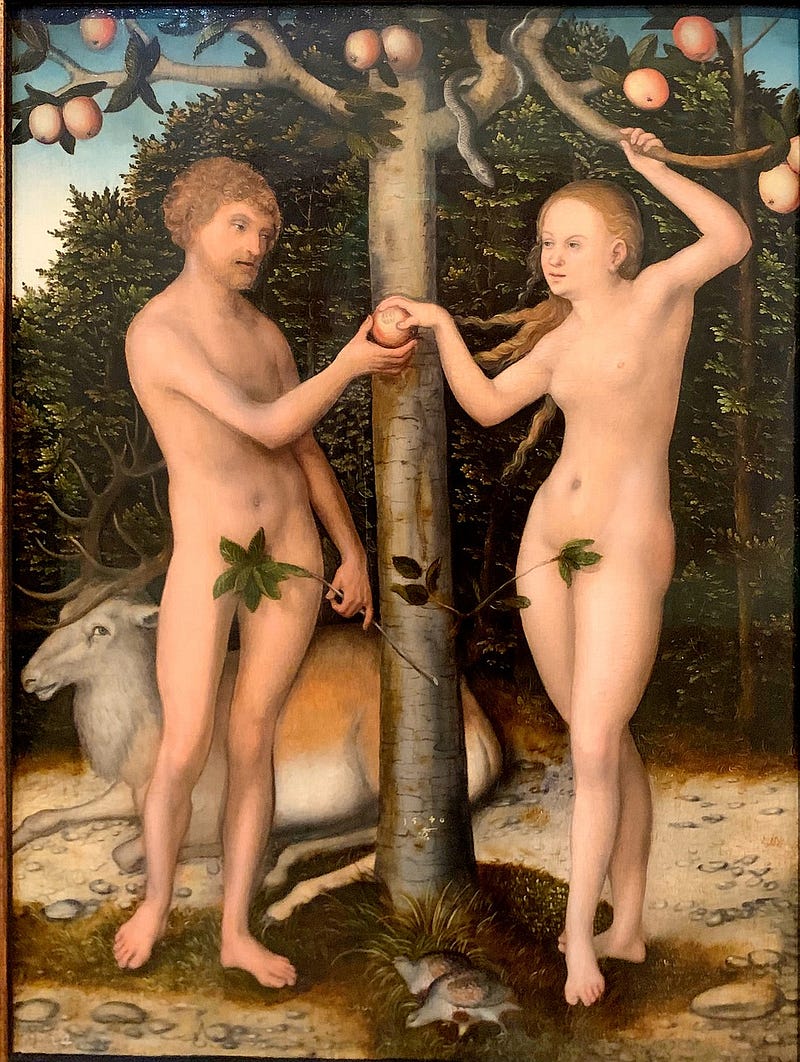
Let’s deal with the religious bit first … not that you have to believe it, but because it’s a fascinating story:
The Garden of Eden and The Tree of Knowledge:
In the book of Genesis, the first book of the bible, God is said to have created Adam, the first man, and in Chapter 2:(8–10) we read that God planted a garden (The Garden of Eden) that had at its centre The Tree of Knowledge.
God said to Adam:
“You may eat the fruit of any tree in the garden except the tree that gives the knowledge of what is good and what is bad. You must not eat the fruit of that tree” … Gen 2:16
Note: Over time The Tree of Knowledge has been interpreted (rightly or wrongly) as The Apple Tree, and thus, the forbidden fruit is often ‘seen’ as an Apple. — — (hence the artistic interpretation in the picture a-top this article) — —
In Gen 3:(1-6) we read how Eve (created by God as Adam’s companion), was told by a serpent (snake) that it was OK to eat the fruit, and she ate one. Then, she persuaded Adam to eat one too, and he did. Note: this act of disobeying God is often referred to as ‘Original Sin’
Now here’s the best bit … for me ... ‘The Blame Game!’ .. where the blame is passed along. It’s that human element … the tendency to blame others:
When God realises that Adam has eaten the fruit, he says to him:
“Did you eat the fruit that I told you not to eat?” Adam replies: “The woman you put here with me gave me the fruit”. God then asks Eve “why?”, and she answers God by saying: “The snake tricked me into eating it !” … The Blame Game:(Gen 3:8–13)
(Note: I have written a more detailed Adam & Eve story titled: ‘I’m Planning to Rewrite The Bible’ … you can read it with this link.)
And now …moving on … to another ‘apple legend’ story:
Come away, come away with William Tell:
The composer Gioachino Rossini composed The William Tell Overture, an overture to the opera ‘William Tell’ which premiered in 1829 and was the last of the 39 operas that he helped to craft. (The Milwaukee Symphony Orchestra play the overture in this YouTube clip )
But did you know that the tune was given words for it’s use as the intro-song for a 1958 British TV series called The Adventures of William Tell. That series was a swashbuckler adventure, and showed the exploits of William Tell, a folk hero of Switzerland (something like the Robin Hood of England). It is said that he was active in the early 14th century.
Tell is a central figure in Swiss national heritage stories. He was important as a symbol during the formative stage of modern Switzerland in the 19th century, known as the period of Restoration and Regeneration.
The Legend of Tell:
Albrecht Gessler, the newly appointed ‘chief overlord’ of Altdorf, Switzerland raised a pole under the village linden tree, hung his hat on top of it, and demanded that all the townsfolk bow before it.
It is said that Tell visited Altdorf on 18 Nov 1307, with his young son Walter. He passed by the hat, but publicly refused to bow to it, and was consequently arrested. Gessler was intrigued by Tell’s famed marksmanship, but resentful of his defiance, so he devised a cruel punishment: Tell and his son were both to be executed; however, he could redeem his life if he could shoot an apple off the head of Walter in a single attempt.
Drum roll please … (drrr drrr drrr drrr drrr)… he did it! … Tell split the apple with the first bolt from his crossbow.
Tells’ folk-lore fame and hero-hood was greatly reinforced after these events !
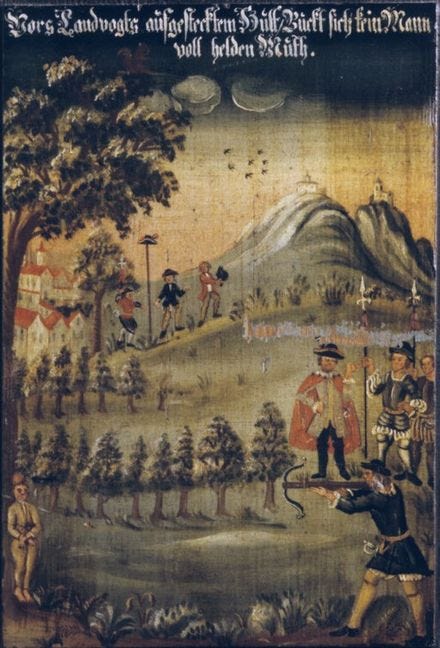

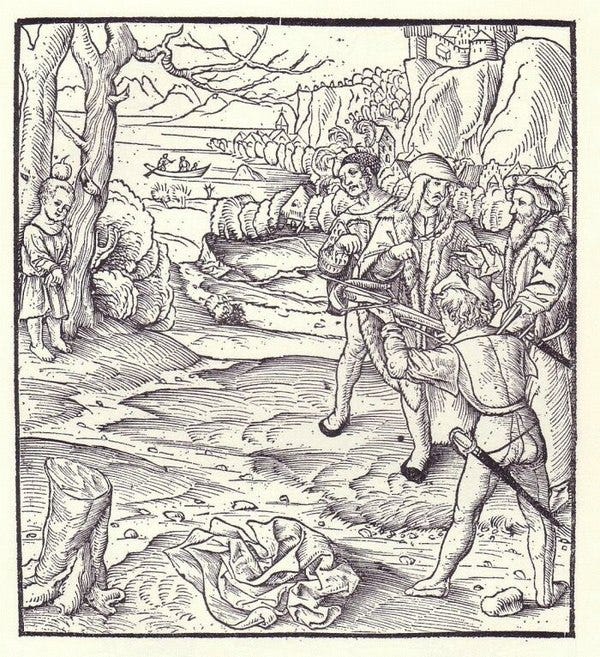
Wikipedia records the following information:
Gessler noticed that Tell had removed two crossbow bolts from his quiver, so he asked why. Tell was reluctant to answer, but Gessler promised that he would not kill him. When he replied that, had he killed his son, he would have killed Gessler with the second bolt, Gessler was furious, and ordered Tell to be bound, saying that he had promised to spare his life, but that he would imprison him for the remainder of his life.
The folk-story continued: Whilst Tell was being carried in Gessler’s boat across Lake Lucerne to the dungeon in the castle at Küssnacht, a storm broke, and the guards were afraid that their boat would sink. They begged Gessler to remove Tell’s shackles so that he could take the helm and save them. Gessler gave in, but Tell steered the boat to a rocky place and leaped out.
Tell ran cross-country to Küssnacht with Gessler in pursuit, and when he caught up with Tell, Tell used his second crossbow bolt to assassinate Gessler. Tell’s act sparked a rebellion, that lead to the formation of the Old Swiss Confederacy … Wikipedia.
The words of the William Tell song
(sung in the TV series to the tune of the overture):
Come away, come away with William Tell Come away to the land we love so well What a day, what a day, when the apple fell For Tell and Switzerland !
Note: This article of mine is Part One of my mini series: ’A’ Is For Apple. Part Two has now been written and can be accessed with the link below. It briefly re-visits the garden of Eden, but then transports us to the modern world of computers and artificial intelligence, where apple-eating is illustrated by a marvellous cartoon. The link: ‘A’ Is for Apple … Part Two.
*******************************
“ ‘A’ is for Apple … Part One: Legends” * written by Fred: writer on Medium * * * * * © Fred Ogden 2022 * * * * *

* * * (Feel free to share it on social media if that’s your scene) * * *
You can also Clap & Comment (via icons at top or bottom of this article)
******************************************
NAVIGATION PANEL: TO EVERYTHING FRED: (clickable links)
- All You Need to Know About Fred (including an Index to Fred’s Stories)
- New Index to ALL Fred’s Story Collections
- Get Fred’s new stories delivered to your email inbox … There’s no charge
- Fred’s Email: [email protected]
******************************************
- Follow Fred on Medium: 👉 Fred’s Follow-button (top of all his stories), and he’ll click YOUR ‘follow’ button if he finds your stories appealing.


