A Humbling Journey Through the Gospel of Thomas
Deciphering Sayings Five and Six

In this third article of our series, we continue our exploration into the Gospel of Thomas, an ancient collection of 114 sayings attributed to Jesus. Discovered in 1945 near Nag Hammadi, Egypt, this gospel is a part of the Nag Hammadi library, standing out as a significant text in early Christian literature. Unlike the canonical Gospels, it focuses exclusively on the sayings of Jesus, offering a unique and often mystical perspective on his teachings.
The Gospel of Thomas is particularly noteworthy for its emphasis on direct and personal spiritual knowledge (gnosis). It diverges from traditional narratives found in other New Testament texts, providing a distinctive view into early Christian thought.
In my methodological approach to the Gospel of Thomas, I have adopted a rather unusual strategy. I examine the sayings in pairs and in reverse order. This approach is not just a structural choice but a deliberate effort to delve deeper into the text’s layers of meaning.
Examining the sayings in pairs allows for comparative analysis, by observing how adjacent teachings complement or contrast each other. This juxtaposition often reveals interconnected themes or opposing ideas that may not be immediately apparent when sayings are considered in isolation.
Reading the sayings of the Gospel of Thomas in reverse order brings fresh perspectives by focusing our limited attention span on different aspects of the text. This approach disrupts linear thinking, highlights often-overlooked elements, and encourages deeper contemplation, leading to a more nuanced understanding of the teachings.
Continuing our journey through the Gospel of Thomas, we arrive at Saying Six, which presents a dialogue between Jesus and his disciples.
His disciples said to him, “Do you want us to fast? And how should we pray? Should we make donations? And what food should we avoid?”
Jesus said, “Don’t lie, and don’t do what you hate, because everything is revealed in the sight of heaven; for there’s nothing hidden that won’t be revealed, and nothing covered up that will stay secret.” (Gospel of Thomas 6)
The disciples are inquiring about the traditional acts of piety such as fasting, prayer, making donations, and dietary restrictions. These questions reflect the customary religious practices of the time and seek guidance on how to live a pious life.
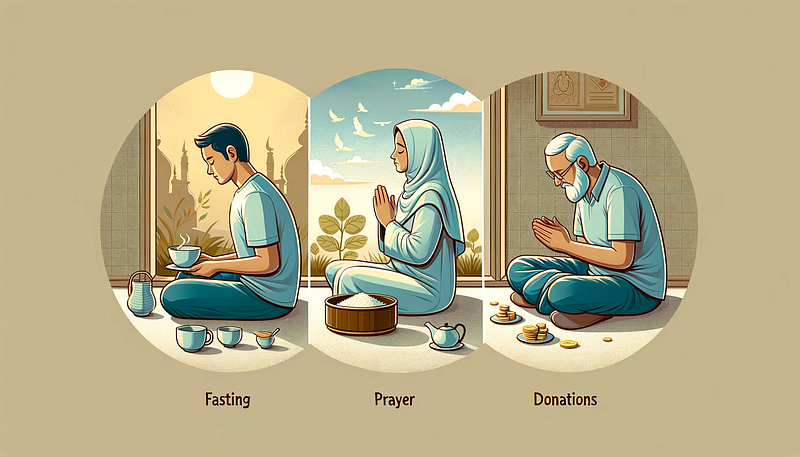
Jesus’ response, however, shifts the focus from external religious practices to the integrity and authenticity of one’s actions and thoughts. He emphasizes honesty and living in a way that is true to oneself, suggesting that these internal virtues are more crucial than external religious observances. His advice, “Don’t lie, and don’t do what you hate,” can be interpreted as a call to genuine living, aligning one’s actions with their true feelings and beliefs.
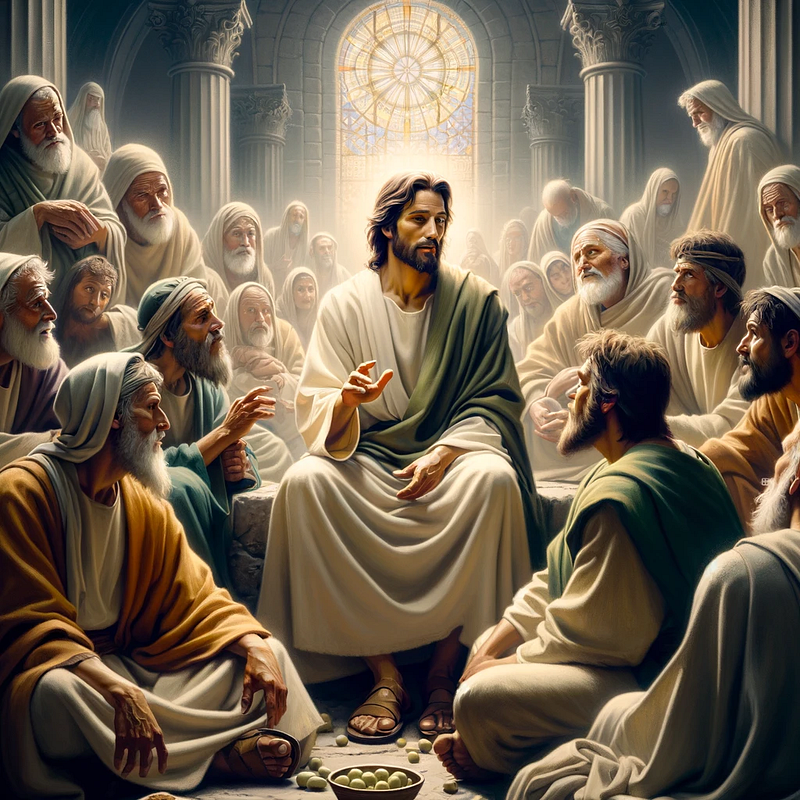
The statement, “because everything is revealed in the sight of heaven; for there’s nothing hidden that won’t be revealed, and nothing covered up that will stay secret,” underscores the belief that all actions, whether visible or hidden, are known to the divine. This can be seen as an encouragement to live righteously, not just in outward appearances but in the heart and mind, where true character is formed.
Overall, this passage reflects a central theme in many spiritual traditions, where the focus is on the sincerity of one’s inner life and moral integrity, rather than just adherence to ritualistic practices. It suggests that true spirituality is reflected in how one lives their everyday life, in honesty and alignment with one’s true self.
Next, we will explore Saying Five, continuing our quest to uncover the layered meanings within these mysterious teachings.
Jesus said, “Know what’s in front of your face, and what’s hidden from you will be revealed to you, because there’s nothing hidden that won’t be revealed.” (Gospel of Thomas Saying 5)
This saying emphasizes the importance of awareness and the pursuit of truth. It suggests that understanding and acknowledging the realities of our immediate experience is crucial in uncovering deeper truths. The phrase “Know what’s in front of your face” can be interpreted as an encouragement to be fully present and conscious of our current life situations, surroundings, and experiences.
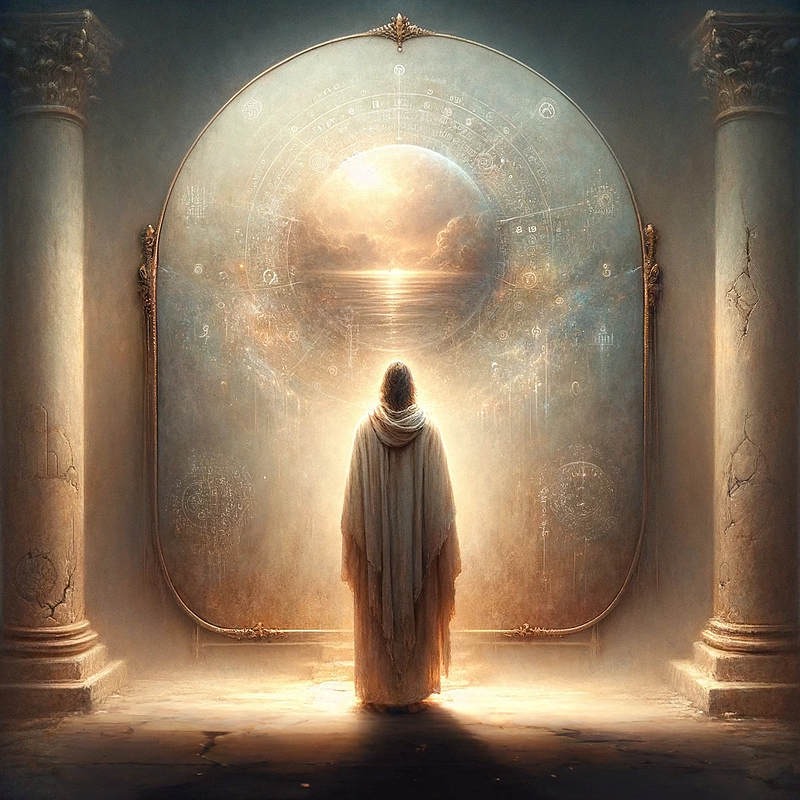
The latter part of the saying, “and what’s hidden from you will be revealed to you, because there’s nothing hidden that won’t be revealed,” speaks to the concept that deeper truths and knowledge, though they may seem concealed, will eventually come to light. This could be understood in a spiritual context, implying that a deeper understanding of the divine or the truth about existence will be revealed to those who earnestly seek it and are attentive to their immediate reality.
Overall, this saying from the Gospel of Thomas underscores a central theme in many spiritual teachings: the pursuit of truth begins with an acute awareness of the present moment and the understanding that deeper insights and revelations are a natural result of sincere and mindful living.
We now turn to the secret meaning hidden within the text. And here I will admit that I have dreaded this moment. These two sayings have perplexed me for years. Try as I might, I could not find the secret meaning.
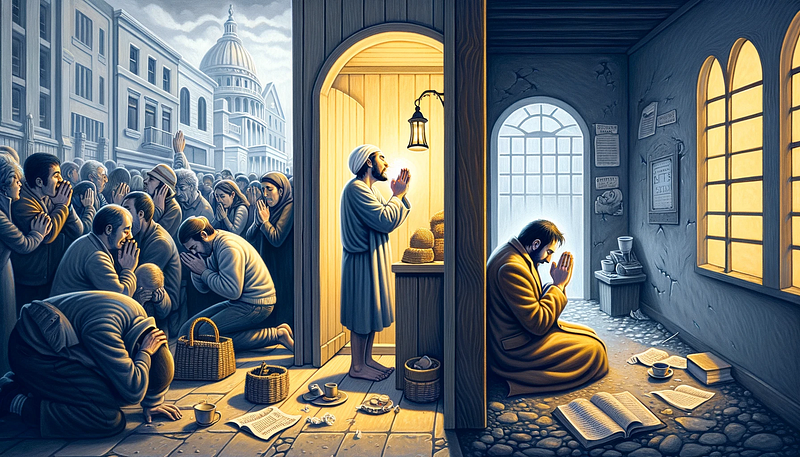
Not that I haven’t made some progress. I have identified two key types of revelation addressed in these sayings. The first type involves the critique of public displays of piety:
5 “Whenever you pray, do not be like the hypocrites, because they love to pray while standing in synagogues and on street corners so that people can see them. Truly I say to you, they have their reward. 6 But whenever you pray, go into your room, close the door, and pray to your Father in secret. And your Father, who sees in secret, will reward you. (Mat 6:5–6 NET)
This corresponds to Saying Six.
The second type of revelation relates to the concept of hiding one’s inner light or illumination:
21 He also said to them, “A lamp isn’t brought to be put under a basket or under a bed, is it? Isn’t it to be placed on a lampstand? 22 For nothing is hidden except to be revealed, and nothing concealed except to be brought to light. (Mar 4:21–22 NET)


This corresponds to Saying Five. So what? That doesn’t bring us any closer to any sort of secret meaning. As I said, I have worked on these sayings on and off for years, hoping that some new clue would present itself.
But then I had the idea of just throwing myself into an attempt to work through the sayings in sequential order, in the hope that the process would inspire me to arrive at the correct answer.

It has led to something, however. I eventually noticed that Saying Fourteen answers all of the questions raised in the first section of Saying Six.
His disciples said to him, “Do you want us to fast? And how should we pray? Should we make donations? And what food should we avoid?” … (Gospel of Thomas Saying 6)
Saying Six asks the questions and then Saying Fourteen answers them:
Jesus said to them, “If you fast, you’ll bring guilt upon yourselves; and if you pray, you’ll be condemned; and if you make donations, you’ll harm your spirits.
“If they welcome you when you enter any land and go around in the countryside, heal those who are sick among them and eat whatever they give you, because it’s not what goes into your mouth that will defile you. What comes out of your mouth is what will defile you.” (Gospel of Thomas Saying 14)
That’s when I realized that the original answer from Saying Six doesn’t answer the questions that are asked.
His disciples said to him, “Do you want us to fast? And how should we pray? Should we make donations? And what food should we avoid?”
Jesus said, “Don’t lie, and don’t do what you hate, because everything is revealed in the sight of heaven; for there’s nothing hidden that won’t be revealed, and nothing covered up that will stay secret.” (Gospel of Thomas 6)
In Saying Six, Jesus isn’t answering the questions about fasting, praying, giving alms, and eating unclean food. He explicitly answers those questions in Saying Fourteen. In Saying Six, he is answering an entirely different unknown question.
Let’s look and Sayings Six and Five together, with the answered questions removed:
Jesus said, “Don’t lie, and don’t do what you hate, because everything is revealed in the sight of heaven; for there’s nothing hidden that won’t be revealed, and nothing covered up that will stay secret.” (Gospel of Thomas 6)
And
Jesus said, “Know what’s in front of your face, and what’s hidden from you will be revealed to you, because there’s nothing hidden that won’t be revealed.” (Gospel of Thomas Saying 5)
By recognizing what is before my face, I should be able to recreate the question that Saying Six answers.
That is where I found myself as I began to write this article. Grappling with this unknown question in a final attempt to crack the encryption employed in these sayings.
Eventually, I realized that I wasn’t going to find the answer. It was forever beyond my reach. I had failed.

The question for me then became: what exactly should I reveal to you, the readers? How should I present this lack of a satisfactory solution? Should I use some subtle wordplay to imply that I had discovered the secret and solved it, or should I imply that each of us must discover our own solution? Or perhaps I should come up with some New Age formulation constructed around an apt metaphor that seems to explain everything while explaining nothing?
Simply put, my choices were to admit the truth, lie, or spin some bullshit.
And then I realized with shock that this was precisely the question that Jesus answered in Saying Six.
What exactly should I reveal to the readers? How should I present this lack of a satisfactory solution?
Jesus said, “Don’t lie, and don’t do what you hate, because everything is revealed in the sight of heaven; for there’s nothing hidden that won’t be revealed, and nothing covered up that will stay secret.”
Brilliant!
The unknown question is a question about how to communicate your failure to discover the unknown question.
This pair of sayings can only be solved by seekers admitting to themselves that they are unable to solve it. It's a riddle of the most devious design.
Wrapping up this dive into Sayings Five and Six from the Gospel of Thomas, let’s review the findings. Even on their surface, these sayings aren’t just about doing the right thing, they dig deep into the essence of being genuine with ourselves and others. Saying Six isn’t just telling us to be honest, it’s a nudge to align what we do with what we believe at our core. Meanwhile, Saying Five is a wake-up call to stay sharp and present, reminding us that truth-seeking starts right in front of our noses.
Tackling these sayings in reverse and as a duo opens up a whole new world of insights. Like cracking a mystical code and moving beyond the words to the heart of their meaning. This isn’t your run-of-the-mill scripture study, it’s a journey through the human soul.
The biggest lesson here is about facing our own intellectual and spiritual limits. It’s about admitting when we’re stumped and finding strength in that humility. This isn’t failure. It’s a profound part of the journey.

So, what we’ve got here isn’t just an intellectual exercise. It’s a deep, spiritual odyssey that challenges us to question, reflect, and grow. The Gospel of Thomas, with all its cryptic wisdom, keeps pushing us to explore these inner depths. It’s a wild, enlightening ride that reminds us the search for truth is never just about finding clear-cut answers, but about the journey we take to get there.
In my next article in this series, we will be examining Sayings Seven and Eight:
Jesus said, “Blessed is the lion that’s eaten by a human and then becomes human, but how awful for the human who’s eaten by a lion, and the lion becomes human.” (Gospel of Thomas Saying 7)
And
He said, “The human being is like a wise fisher who cast a net into the sea and drew it up from the sea full of little fish. Among them the wise fisher found a fine large fish and cast all the little fish back down into the sea, easily choosing the large fish. Anyone who has ears to hear should hear!” (Gospel of Thomas Saying 8)
A heartfelt acknowledgment to these faithful readers: