
What Should I Write About? Here Are My “Go To” Sources
A “How To” Guide for Academics (and More) to Find Timely Topics to Write About
People often ask me, “where do you find all your ideas to write about?” In this article, I provide readers with all my best sources that inform and direct my writing today.

Introduction: Changing the Orientation of Academic Research and Writing
As an academic, we are trained to write in one, singular way. That is aiming for academic journal publications, as these are — or at least have been — the only publications that count! We are taught early on in our graduate programs that it might take months, even years, to successfully publish just a single article in a prestigious academic journal! And publication in such top-tier journals in your respective field only likely comes after rounds of reviews, revisions, and resubmissions, typically with nameless, faceless reviewers on your article.
Now if you ask anyone in academia about the academic journal writing process, you will typically hear a response that has some less-than-academic 4-letter words describing just how frustrating, inefficient, and even unfair the academic publishing process is at present! With almost every journal review process, no matter the field of study, the level of the journal, and however many coauthors one might have on a project, the submission and review process is a highly inefficient one, filled with lots of aggravation and anxiety and with hours and hours of wasted time and effort as one tries to gain that elusive final acceptance of your work!
And to complicate matters even more, today there is mass confusion as to what constitutes a proper academic journal, as the academic publishing has been flooded with new entrants from all over the globe seeking to make money by offering academics the opportunity to publish in journals that may be nothing more than a money making venture, preying especially on academics who, you guessed it, are willing to spend money to advance their careers by gaining publication in some form of academic journal! While it may come as a surprise to many outside of the halls of academia, it is quite commonplace for even prestigious and quite reputable journals to charge authors publication fees — sometimes in the several hundred to even a thousand or more dollars — just for the privilege of publishing one’s work with them even after what can be an arduous and time consuming review and resubmission process (and even sometimes, several rounds of this!). And let’s not even talk about academic conferences where one pays simply to present one’s work! Simply put, the dissemination of academic research work is — in essence — a “pay to play” game that is akin to what has been outright banned in the music industry for many years, with much room for both reputable and disreputable operators to make large amounts of money off academics seeking to build both their reputations — and their job security and marketability — in the process.
Thus, both my knowledge of how academic publishing “works” in large part today, along with my positive and personal-brand building experiences writing more “popular press” articles over the past few years, has totally changed my orientation to academic writing. Now, my first option is to find a topic that appeals to me to write about, from the perspective of being a strategic management professor and business consultant. Then, I simply proceed to write an article about that subject that will appear not in a matter of months or even years, but in days or even hours! And with my positive experience from writing such non-academic journal articles (in terms of exposure and opportunities that come from writing in places where real people actually read — and share — the articles!), I’ve now become a strong advocate for other academics to join me and take the same course with their writing and research:
Now I am not urging academics to totally abandon writing for academic journals and even presenting at academic conferences. In most of the tenure and job evaluation systems found in colleges and universities everywhere today, that is simply not possible! Yes, “publish or perish” is still very real in 2022! And even at more teaching-oriented institutions, such as my own, publishing academic journal articles is still a job requirement. Thus, the pressure is always there for faculty members to aim for such publications, simply as a matter of job security, even for us tenured folks “of a certain age.” And yes, in the academic job market, one’s publications are one’s currency, as search committees will value hiring someone with not just a good record of academic journal articles, but with an active and ongoing research agenda that promises more of them to come in the future!
What I have found however is that writing relatively quick articles, aimed at a mass audience and published on sites such as Medium and Vocal (both of which I highly recommend as outlets for your work in this vein), will actually help spur your research and writing for academic journals as well. Indeed, I have published a number of academic journal articles in recent years that began with one of these “quick-hit” articles on these sites. And so I take what is perhaps still a minority view in the higher education world today, seeing that writing for the popular press is not just good at helping to build up your profile and perhaps lead to other opportunities (such as speaking, networking, writing invited articles, and even yes, paid consulting opportunities), but ultimately, doing so will help spur your own writing for academic journals as well! And so I see these two different kinds of writing being not just complementary, but to use that overworked management consulting term, they are truly synergistic activities!
However, for many of my colleagues in the world of academia, regardless of their field, they face a common dilemma in beginning to reorient their thinking to write for the popular press. This is found in the simple question that I hear time and time again when speaking with them individually and/or in small groups or giving talks on how to write and publish such articles to faculty and student groups: Where do you get your ideas — which in translation means, where can I best find subjects to write about?
The purpose of this article then is simply to address this question, as I seek to reach all of my academic colleagues who wish to begin writing for the popular press — along with really anyone wanting to find subjects to write such articles about in places where, yes, real people will actually read — and even seek out — your work! And thus this article seeks to provide my colleagues — from graduate students to the most senior faculty members — in one place, the sources I find best in providing me with topics, news stories, current events, and even research findings upon which I currently base my writing for these popular press outlets. My hope is that many of you will use this article as a resource as you begin working on writing for the popular press! In it, we will review how to best make use of the following sources on information on the Web for finding ideas to write about:
- Data Analysis/Marketing Research Companies
- News Sites — and YouTube
- Google Alerts
- Newsletters.

Data Analysis/Marketing Research Companies
As a management professor and consultant, the bulk of my writing and research is founded on current and emerging topics and trends in the worlds of business and technology. And so my first choice for finding subjects to write about (with good good data/resources for you to make use of in your articles) are the websites and social media feeds of a number of data analytics/marketing research companies. Such companies include the following firms (and I provide a sample of their data/graphics for you to see just how good a resource each of these can be for your research and writing!).
- You can see CivicScience’s most recent research here.
- Follow CivicScience on Twitter at https://twitter.com/CivicScience.
- Follow CivicScience on LinkedIn at https://www.linkedin.com/company/civicscience/.
- You can see CB Insights’ latest research here and view their infographics here.
- Follow CB Insights on Twitter at https://twitter.com/CBinsights.
- Follow CB Insights on LinkedIn at https://www.linkedin.com/company/cb-insights/.
- You can see Marketing Charts’ latest research/findings are right there on their homepage here.
- Follow Marketing Charts on Twitter at https://twitter.com/marketingcharts.
- Follow Marketing Charts on LinkedIn at https://www.linkedin.com/company/marketing-charts/.
- You can see Morning Consult’s latest news and analysis here.
- Follow Morning Consult on Twitter at https://twitter.com/MorningConsult.
- Follow Morning Consult on LinkedIn at https://www.linkedin.com/company/morning-consult.
- You can see eMarketer’s latest articles and navigate their research by subject area here.
- Follow eMarketer on Twitter at https://twitter.com/eMarketer.
- Follow eMarketer on LinkedIn at https://www.linkedin.com/company/emarketer-inc/.
- You can see Gallup’s latest articles and navigate their research by subject area here.
- Follow Gallup on Twitter at https://twitter.com/Gallup.
- Follow Gallup on LinkedIn at https://www.linkedin.com/company/gallup/.
- You can view Newzoo’s latest articles and infographics on the gaming industry on their site.
- Follow Newzoo on Twitter at https://twitter.com/NewzooHQ.
- Follow Newzoo on LinkedIn at https://www.linkedin.com/company/newzoo/.
- You can see Statista’s daily infographics and their accompanying discussion/research on the topics here.
- Follow Statista on Twitter at https://twitter.com/StatistaCharts.
- Follow Statista on LinkedIn at https://www.linkedin.com/company/statista/.
- YouGov provides a wealth of articles, trackers, ratings and polls on a wide variety of topics in business and much more. You can view all of their current research here.
- Follow YouGov America on Twitter at https://twitter.com/YouGovAmerica.
- Follow YouGov on LinkedIn at https://www.linkedin.com/company/yougov/.
News Sites — and YouTube
If one follows the news at all today (and one would really have to be living under a rock without Internet to not see, hear, and read the news of the day in our present environment), one knows that even if it really isn’t all the “breaking news” as the headline and alerts play stories up to be, we are in the “golden age” of news — where everything happening everywhere in the world is instantly at your fingertips! Yet, information overload is a very real problem today, and even if you want to keep up with all the breaking news and developments in areas of interest to you — and your research and writing, the task can be overwhelming (not to mention depressing, given the general hyperbolic tone and content of the news today)! In fact, with all the news that is “pushed” to us — on social media, on television, in emails and just in the ambient noise of our busy lives (everywhere from our car radio to McDonald’s and everywhere in between), one can become lost in — literally — a virtual sea of information.
So, how do you take the “news of the day” and make use of it to find “things” pertinent to what you are most interested about for your research and writing? My strategy is this: Don’t go to news sites on the Web! Doing so can lead you to spend far more time actually scrolling through and looking for — and then reading (not a bad thing, generally, but in this case it can be) — both articles that their algorithm feeds to you and articles that are genuinely of interest to you!
What my preferred strategy is is to simply go to YouTube and subscribe to the channels of various news sites that publish videos of their news stories! Nowadays, almost all (but not all) news organizations will indeed publish most of their video content not just on their own websites, but on YouTube as well. The questions that only you can figure out however is whether they do so on a timely basis and whether they publish videos on YouTube that are actually relevant to you and your research interests. And more specifically, what I found most useful is to regularly go to (and subscribe if you wish) the more targeted video channels of news organizations. As a business professor, my use of YouTube Channels for major news organizations is as follows:
For instance, rather than accessing the NBC News channel on YouTube (https://www.youtube.com/c/NBCNews), as I am primarily interested in business news stories, I concentrate on the following NBC-affiliated channels focused on business topics specifically:
- CNBC: https://www.youtube.com/user/cnbc
- CNBC Make It: https://www.youtube.com/channel/UCH5_L3ytGbBziX0CLuYdQ1Q
- CNBC Prime: https://www.youtube.com/user/CNBCtv and
- CNBC International: https://www.youtube.com/user/CNBCInternational.
In the same way, I generally bypass the CNN channel on YouTube (https://www.youtube.com/user/CNN), and go to CNN Business channel (https://www.youtube.com/user/CNNMoney) instead. Likewise, rather than going to the FOX News channel on the video site (https://www.youtube.com/c/FoxNews), I choose to rely on the Fox Business YouTube channel (https://www.youtube.com/user/FoxBusinessNetwork). While some, but not nearly all, of the business content is cross-posted to the general news organizations’ YouTube channels, their business outlets post far more (in sheer numbers) and far more relevant content to those of you, like myself, interested in a wide variety of business topics.
Additionally, I have found that major business news periodicals, in addition to having their own very good websites, archive a good amount of video content on their YouTube channels. My “go to’s” on YouTube for the video content that they share include:
- Forbes: https://www.youtube.com/c/Forbes
- Bloomberg: https://www.youtube.com/channel/UCIALMKvObZNtJ6AmdCLP7Lg
- The Wall Street Journal: https://www.youtube.com/c/wsj
- Fast Company: https://www.youtube.com/c/FastCompany
- Inc Magazine: https://www.youtube.com/c/incmagazine
And do note, that most of these business news outlets offer even more specific channels, tailored to tech, women in business, money, startups, etc., which you may well find even more of interest to you, given your particular interest area in business. Furthermore, if your area of interest is in the sciences, in media, in popular culture, etc., you may well find that both general news sites and field-specific news sites will offer channels even more finely tuned to your interests, so do go exploring on YouTube to see how you can make these sites — and subscriptions to them for new content relevant to you — can work to give you a constant flow of new ideas and subjects about which to write.
Now, on a final note in regards to using YouTube as a source of great ideas, I have a tip that does run counter to some of what I said previously. While I generally eschew “general” news sites, I have found very specific “storytelling” sites of major news organizations — namely the TV networks — to be very helpful in providing content that not only stirs my interest in topics, but the audiences that I write for as well. To that end, let me suggest that you subscribe to the following YouTube channels, as they each provide their take on “stories” that can become the beginnings of your own stories for writing and researching. The key is that these popular shows do “tell the story” — and do so in a concise manner. As such, these videos not only might get you thinking and researching on a topic of interest to you, but also serve as nice “introductory” or “summary” videos for your audience:
- NBC’s Today Show: https://www.youtube.com/c/TODAY
- CBS’ CBS Mornings: https://www.youtube.com/c/CBSMornings
- CBS Sunday Morning: https://www.youtube.com/user/CBSSundayMorning
- ABC’s Good Morning America: https://www.youtube.com/c/GMA
- PBS’ “NewsHour”: https://www.youtube.com/c/PBSNewsHour
- CBS’ “60 Minutes”: https://www.youtube.com/c/60minutes.

Google Alerts
Yes, Google is the default search engine for most of us. However, did you know that there is a free and easy way to let Google do much of the “virtual leg work” the work for you? Google Alerts will provide all the latest research on any topic that you choose to follow — even yourself — right to your email inbox! To set up your first Google Alert, simply go to https://www.google.com/alerts and enter the topic that you wish to follow…

Then, you have options as to the frequency and “depth” of coverage that Google will provide you with on this topic…
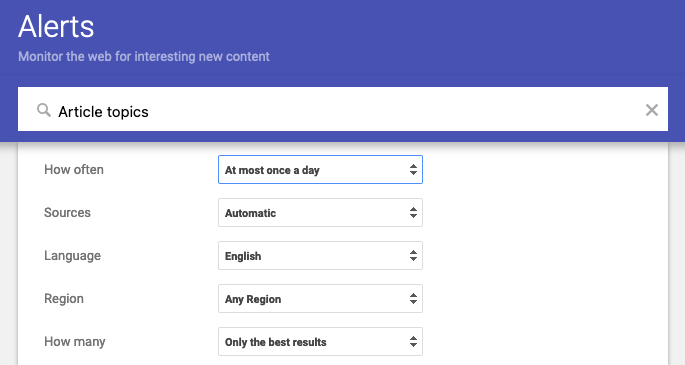
If you want to get everything published on the Web anywhere in the world instantly on the topic you choose, you can do that and receive emails anytime anything is published on that particular subject. If you want to get a daily or weekly digest on the topic you wish to follow (which really, in practicality, is the most viable option to not have your inbox filled with Google Alerts!), then you simply choose that frequency under the “How often” drop-down menu. In the same way, you can specify what types of sources, what language a source is published in, and from where in the world specifically (or alternatively, the whole world) you desire to have Google “push” content to you on the subject you wish to follow more closely.
Over the past couple of years since I began with my “popular press first” writing strategy, I have made use of Google Alerts extensively to bring me ideas about which to write. I would caution you not to follow a whole lot of topics in this manner, as very quickly, your inbox can become overflowing — and overwhelming. However, if you target a few specific topics (I currently have Google Alerts on 5 topics + myself), you will find that having content pushed to you very helpful, as a daily and/or weekly compendium of relevant new articles, analyses, videos, etc. on the subjects you find interesting can spur your thinking on specific subtopics and new developments that just might make for great subjects for you to research and write on.

Newsletters
As a final source of ideas for your research and writing, I would suggest that you subscribe to newsletters — from sources that you find helpful to whatever your field/areas of interest might be. Maybe it is a periodical, a newspaper, a journal, a TV station, a company that you find of interest — every organization seems to offer a newsletter today! You can too, as both Medium and Vocal allow for individuals to subscribe (for free) to a newsletter of your publications — which can further further your reach! I would urge you to subscribe to newsletters that would seem to be of interest to you, but judiciously manage your subscriptions so that your email inbox does not get overwhelmed! Do manage the frequency of your newsletters (an option many organizations do today), and do not hesitate to hit “unsubscribe” to any (and all) newsletter that don’t seem to be “pushing” articles that are of particular interest and relevance to you. However, if you are looking for a good “general interest” site to begin subscribing to, let me suggest StudyFinds, which publishes summary findings of the latest scientific research across any number of fields. Even beyond finding topics about which to research and write, their newsletter pushes very interesting, timely content to you that can inform not just your writing, but your teaching and even your conversations with colleagues, family and friends!

Conclusion
In the end, I hope that this article will provide you with the motivation, the resources, and yes, a little reoriented thinking about how to go about doing your writing and research. For me, this strategy has worked very well — exceedingly well! Writing on both the Medium and Vocal platforms has enabled me to write on a more consistent basis than ever before in my career, as I generally try and write one article each week for these popular press outlets (when “life” cooperates, that is!). And while creators on these two platforms do make some money from their works, the main benefits of doing so come from the exposure that you gain by doing so. And as I stated previously, I also have had a number of refereed articles “morph” out of topics about which I originally wrote such relatively quick pieces about for the popular press.
So in the end, the synergy “works” for me, and you can view my complete current vita here. And by no means are Medium and Vocal the only sites that you can use, as many creators today have begun working on platforms including Substack and Meta’s new creator platform, Bulletin. I hope that you will take my ideas and adapt them to your field and your interests and find a way to make writing for people who will actually read, share, and respond to your work a “first choice” for your research and writing work!
Join Me in Writing on Medium
Want to begin your own writing journey? Want to better build your personal brand by publishing articles you create? Consider joining me in writing on Medium today and use this link: https://davidwyld.medium.com/membership. In doing so, you will help support my writing as I receive a portion of your Medium membership fee (and then you can recruit new members and earn yourself!). Based on my experience, you can quickly grow an audience for your writing, build a following, gain more exposure for your work, and yes, earn real money for what you write! Join Medium today by clicking the link below:
About David Wyld
David Wyld ([email protected]) is a Professor of Strategic Management at Southeastern Louisiana University in Hammond, Louisiana. He is a management consultant, researcher/writer, publisher, executive educator, and experienced expert witness. You can view all of his work at https://authory.com/DavidWyld.
Social Media Links to David Wyld: