numbers are more shocking than I can remember. This heatwave has not just beaten previous records; they were smashed by margins that are hard to believe. For instance, Warsaw, Poland, broke the record by a shocking 5.1°Celsius. Nighttime temperatures in Poland were near tropical levels at 19°Celsius.</p><p id="5b63">The year 2023 started for Europe with an unprecedented heatwave where records were broken by record margins over an extensive area. Brace for impact since you will experience more extreme weather in the future, precisely as scientists have predicted for decades.</p><p id="a3aa">I read some of the usual tweets on Twitter saying that this is just warm weather unrelated to climate change. One of these self-proclaimed experts explained that the recent extreme cold in the U.S. had balanced out the current heat in Europe, so there was no change to worry about.</p><p id="e982">I wish they were right, but unfortunately, there is much reason for concern, and their tweets are not helpful since they create confusion, which may be their professional intention, or it is just ignorance.</p><p id="0b93">Scientists need a bit more time since they first study the facts, but my best guess is that they will likely be able to attribute these extreme events to climate change in a couple of weeks. Attribution is a fast-growing climate science field aiming to identify the “fingerprint” of climate change on extreme weather events.</p><p id="f031">A recent example of such a study has just been presented by the World Weather Attribution service. The scientists focussed on a large area centered around the central-northern part of Argentina that experienced record-breaking temperatures during two consecutive heatwaves in late November and early December 2022. They concluded that climate change made this area’s record-breaking early-season heat about 60 times more likely.</p><p id="5655">Looking at the extremes in the first days of 2023 in Europe, I’m interested in their assessment of the impact of climate change on what we are experiencing now.</p><p id="a33e">Facts matter, and so does science, so let’s wait for their study and ignore falsely reassuring tweets of those who know better.</p><p id="a61b"><b>If you find articles like this valuable and want to support my work, consider <a href="https://medium.com/@Alex_Verbeek/membership">signing up to Medium</a>. It’s $5 a month, giving y
Options
ou unlimited access to all my articles AND all stories on Medium.</b></p><p id="dfb4"><b>If you sign up using <a href="https://medium.com/@Alex_Verbeek/membership">my link</a>, I’ll earn a small commission, at no additional cost to you.</b></p><div id="6692" class="link-block">
<a href="https://medium.com/@Alex_Verbeek/membership">
<div>
<div>
<h2>Join Medium with my referral link - Alexander Verbeek</h2>
<div><h3>Read every story from Alexander Verbeek (and thousands of other writers on Medium). Your membership fee directly…</h3></div>
<div><p>medium.com</p></div>
</div>
<div>
<div style="background-image: url(https://miro.readmedium.com/v2/resize:fit:320/0*f_gpXHWNmoEgLP7a)"></div>
</div>
</div>
</a>
</div><div id="625b" class="link-block">
<a href="https://readmedium.com/how-2023-new-years-intentions-are-an-inspiring-road-map-to-a-fairer-greener-and-more-peaceful-f8f624fd3c98">
<div>
<div>
<h2>How 2023 New Year’s intentions are an inspiring road map to a fairer, greener, and more peaceful…</h2>
<div><h3>On the last day of 2022, I asked my followers on Twitter and Mastodon two questions.</h3></div>
<div><p>medium.com</p></div>
</div>
<div>
<div style="background-image: url(https://miro.readmedium.com/v2/resize:fit:320/1*J5zfMonKknSWzziN1gtMxg.jpeg)"></div>
</div>
</div>
</a>
</div><div id="b2fe" class="link-block">
<a href="https://readmedium.com/why-im-still-on-twitter-even-after-starting-a-successful-mastodon-account-9ca9fb097962">
<div>
<div>
<h2>Why I’m still on Twitter, even after starting a successful Mastodon account</h2>
<div><h3>Another day on Elon Musk’s Twitter, and another day I fear the social media platform will soon become unusable as a…</h3></div>
<div><p>medium.com</p></div>
</div>
<div>
<div style="background-image: url(https://miro.readmedium.com/v2/resize:fit:320/1*KQw2wdmOx74FJp9f-yEjZg.jpeg)"></div>
</div>
</div>
</a>
</div></article></body>
A hot start for Europe in 2023, where previous heat records for January have been smashed in many countries.
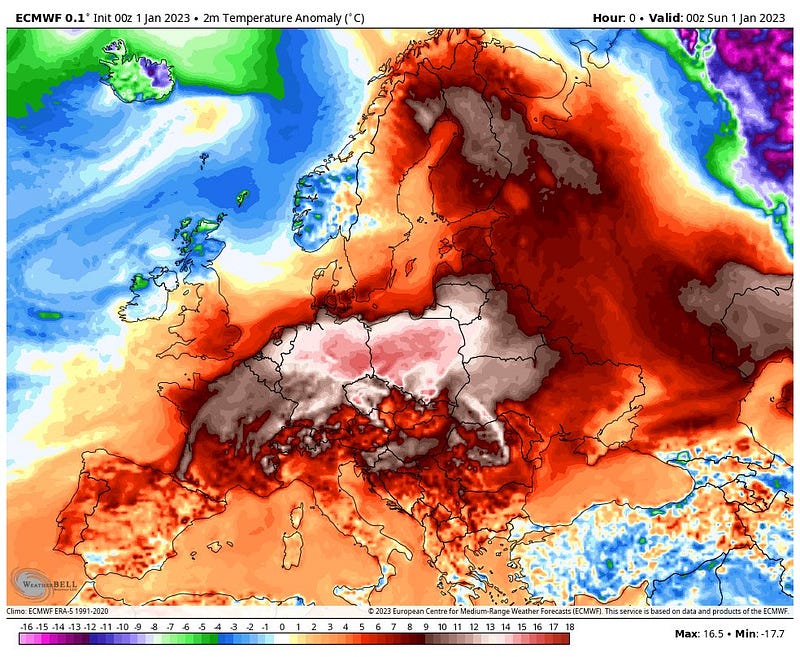
ECMWF data of January 1, 2023 (source: ECMWF)
If the first days of the new year are any indication of what this year will bring to our planet, we should brace for impact. I’m in Europe, where many countries have been struck by an unprecedented heatwave. If this had occurred in August, it would have been disastrous, but it gets much less attention in wintertime.
However, looking for examples of extreme weather becoming more powerful, look no further than the extreme cold in large parts of North America in late December, followed by the extremely high temperatures in Europe.
At least seven countries started the first day of 2023 with their warmest January weather on record. My country, the Netherlands, was one of these; the temperature
hit 16.9 Celsius (62.4 degrees Fahrenheit). I don’t recall ever having watched the traditional fireworks out in the street at midnight on New Year’s Eve without wearing a coat. And just a few hours later, hundreds of weather records had been broken all over Europe.
Usually, extreme weather gets maximum media attention when there are dramatic photos and videos of destroyed houses, floods, and refugees. By lacking this footage, the British press tries to impress their readers with pictures of ski slopes without snow and stories of disappointed tourists in the Alps.
But although the drama is this time less easily visualized, the numbers are more shocking than I can remember. This heatwave has not just beaten previous records; they were smashed by margins that are hard to believe. For instance, Warsaw, Poland, broke the record by a shocking 5.1°Celsius. Nighttime temperatures in Poland were near tropical levels at 19°Celsius.
The year 2023 started for Europe with an unprecedented heatwave where records were broken by record margins over an extensive area. Brace for impact since you will experience more extreme weather in the future, precisely as scientists have predicted for decades.
I read some of the usual tweets on Twitter saying that this is just warm weather unrelated to climate change. One of these self-proclaimed experts explained that the recent extreme cold in the U.S. had balanced out the current heat in Europe, so there was no change to worry about.
I wish they were right, but unfortunately, there is much reason for concern, and their tweets are not helpful since they create confusion, which may be their professional intention, or it is just ignorance.
Scientists need a bit more time since they first study the facts, but my best guess is that they will likely be able to attribute these extreme events to climate change in a couple of weeks. Attribution is a fast-growing climate science field aiming to identify the “fingerprint” of climate change on extreme weather events.
A recent example of such a study has just been presented by the World Weather Attribution service. The scientists focussed on a large area centered around the central-northern part of Argentina that experienced record-breaking temperatures during two consecutive heatwaves in late November and early December 2022. They concluded that climate change made this area’s record-breaking early-season heat about 60 times more likely.
Looking at the extremes in the first days of 2023 in Europe, I’m interested in their assessment of the impact of climate change on what we are experiencing now.
Facts matter, and so does science, so let’s wait for their study and ignore falsely reassuring tweets of those who know better.
If you find articles like this valuable and want to support my work, consider signing up to Medium. It’s $5 a month, giving you unlimited access to all my articles AND all stories on Medium.
If you sign up using my link, I’ll earn a small commission, at no additional cost to you.