
A Homeless Person is Camping in My Neighborhood. Why is This a Police Matter?
I held the phone, hesitating, wondering who to call
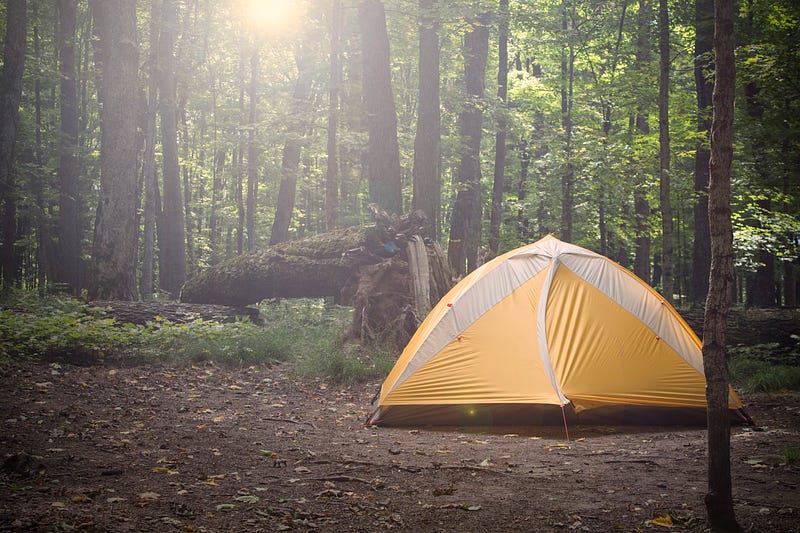
My husband and I walk our dog on a riverside path every morning around the same time. We’re lucky to have this open space right next to our house. I had an early appointment, so we were out early one morning. My husband noticed a tent tucked under a large overgrown tree. It was well hidden in the undergrowth, but it’s bright yellow color was hard to hide.
He approached and found someone breaking camp and packing up. “You can’t camp there,” he shouted.
The person waved their hand and said, “Sorry, can’t hear you.” Then, they hustled to finish packing up.
Homeless people had camped in this spot before. It is a pretty choice spot. It is on state conservation and recreation land that runs along a middle-class neighborhood filled with single and dual family homes. There are few busy roads nearby, but after 9 pm, the neighborhood is quiet, settled in for the night. Under this big tree, there is a flat area surrounded by bushes. It is a perfect place to set up camp undetected get a good night’s sleep.
Young adults have crashed out there, probably sleeping off a bender. Once, someone stayed there undetected until we found their sleeping bag and a few items under the tree. It seemed like they’d been there for weeks. The spot has also served as a place for drug users and alcoholics. We never caught anyone in the middle of the act, but the trash and paraphernalia spoke for itself.
Our neighborhood is safe, and this activity was sporadic. It was more of a nuisance than a threat or a cause for concern. Still, my neighbors and I preferred it weren’t happening in our proverbial backyard. So, we’ve reported the activity through the police non-emergency line.
This time felt different.
The tent camper appeared at the intersection of great social upheaval across the country. Deaths due to the Coronavirus had surpassed 100,000 in the United States. More than 40 Million people had applied for unemployment. And protests over police brutality following the murder of George Floyd were spreading nationwide, including in my own state and city.
“I don’t think we should call the police,” my husband said. I agreed. It just felt wrong.
With calls to defund the police echoing in my head, a jumble of thoughts ran through my head. Why is homelessness a police matter? How will an armed officer help this person? Ticketing or arresting this person won’t improve this person’s life; it will make it worse. Even if the cops just asked them to leave, it might get this “problem” out of my sight, but it doesn’t improve their situation.
As I said, I had called the police in the past. That was the automatic, knee-jerk reaction to this situation. I would see a person camping under the tree and think, “That’s illegal.” And I’d call the police. I’d never dial 911 for something like this — I reserved that for “is someone going to die” emergencies. But I did call the non-emergency line nonetheless. My default response is born out of habit, out of never questioning IF or WHY this was a police matter.
What brought the camper?
Although others have camped in this spot, it is hardly a recreational camping location. It is, after all, a neighborhood.
I don’t know if camping in my neighborhood is illegal, but according to the report “No Safe Place: The Criminalization of Homelessness in U.S. Cities” by The National Law Center on Homelessness and Poverty, “34% of cities have city-wide bans on camping. This represents a 60% increase in such laws since 2011.”
These kinds of laws are explicitly designed to criminalize homelessness. In other words, treating homelessness as a crime means cities are less interested in helping homeless people or preventing homelessness and more about ticketing, fining, and jailing homeless people. Or at the very least, the law and police enforcement is used as a tool for shooing the homeless off, so they are someone else’s problem.
The bright yellow tent looked like it was only lightly used. The camper quickly packed up their site, hoping to leave before the neighborhood was fully awake and bustling. The campsite was neat, and no litter was left behind. I can only assume the person quietly pitched their tent after dark to avoid detection.
Given the devastation the Coronavirus has done to the economy, I could think of a myriad of reasons the camper might be newly homeless. I thought about the day I drove by the local food pantry and saw cars lined up along the street waiting to get in. That scene prompted me to buy a bag full of pantry staples — pasta, mac-n-cheese, beans, rice, and tuna — each time I went shopping to donate to the neighborhood food pantry. The economic crisis exacerbated both housing insecurity and food insecurity no only for the poorest among us but across the middle class as well.
And the thought of calling the police on someone forced to secretly sleep in the bushes because a virus destroyed any economic security they might have had seemed heartless and cruel.
Furthermore, I thought about how an encounter with the police might not end well. Until now, I’ve intentionally been vague about the camper’s gender and race. I didn’t want seed any preconceived biases. But as I grappled with whether to call the police, I realized that as a black man, the camper was at a higher risk of having a deadly, harmful, or at the very least, intimidating interaction with the police.
While recent events partially influenced my concerns about police brutality, statistics confirm them. According to a 2016 study by Roland G. Fryer, Jr or the Harvard University Department of Economics, “In the raw data, blacks are 21.3 percent more likely to be involved in an interaction with police in which at least a weapon is drawn than whites, and the difference is statistically significant.”
Who ya gonna call?
I held my mobile phone in my hand and stared at it blankly, “If we don’t call the police, who do we call?”
I was dumbfounded. At first, I considered calling no one. The tent was packed up and gone. I figured if our camper’s goal was to remain undetected, the cover was blown, and he wouldn’t likely be back anytime soon.
To be honest, I didn’t want a homeless man pitching a tent in my neighborhood. Yeah, basically, I am saying, “Not in my backyard.” I didn’t want to criminalize him. I didn’t want him to return. But I also wanted my city to offer resources for homelessness. And if this man was seeking help, I wanted him to get it.
If I had called the police, would the officer have referred him to shelter? Would he have offered him a hot meal and a cup of coffee then given him information on local food pantries? Would he have asked what the city could do to help him through the economic crisis? Would he have asked if he needs help with alcoholism or substance abuse? Would he have offered to take him to a COVID test site since homeless people are at high risk for contracting and dying from the disease?
I posed these questions to a local police chief but hadn’t received any answers, so I only have my past observations to go on. The best-case scenario is that the officer tells the camper to leave and not come back. Escalating from there, he might ticket him, which only exacerbates the economic hardships facing the man and may require him to appear in court. If the encounter gets confrontational, it could result in an arrest, injuries, or at the extreme, death.
Yes, the most likely outcome is the camper is told to leave. But, even the smallest potential of an escalating deadly conflict in my backyard does not make me feel safe. And that scenario is only possible when an armed officer shows up.
I would much rather have a social worker reach out to this man and ask all those questions above. I would much rather let the camper have his dignity and leave with options for helping himself.
A common retort is to instead turn the camper into a menace by escalating the potential danger he posed. The argument goes that a social worker is not safe, and only an armed police officer can respond to this situation. A list of scary “what if” scenarios are used to justify the need for a uniformed, armed, authority to show up and intimidate the homeless.
“What if he is armed and dangerous?” “What if he is hopped up on drugs?” “What if he is mentally unstable?” “What if he is a serial murderer, rapist, kidnapper, terrorist, or something worse?” The dark parts of their mind conjure up the many ways approaching a man camping under a tree might destroy the fabric of society. Furthermore, the only thing standing between the peaceful neighborhood and certain destruction is an armed police officer.
I would have no idea if the man were any of those things. From my perspective, he wanted to pack up his tent and leave for the day. He might have also hoped to remain inconspicuous enough that he could revisit this choice camping spot undetected.
I may be naive, but it made no sense to have an armed police officer come. The man was already skedaddling, which is probably what the officer would have made him do anyway. So, calling enforced what was already happening and only could serve to escalate the moment.
So, who do I call?
I quickly googled “homeless shelter +mycity.” I didn’t come up with anything. I called the local community center. I hoped they might have a suggestion for a shelter or city office to call, but there was no answer. The shut down sent most of the staff home to work. I left a message asking for suggestions but didn’t hear back. Although they were collecting food and paper supplies to distribute to those in need, homelessness was not their mission.
I scrolled through the city’s website, looking for an office to call. I finally settled on the Office of Community Development. By now, the camper had packed up and disappeared, but I still wanted to find a resource. I wanted to know what my city offered to help someone in need rather than criminalize him.
The director kindly thanked me for not calling the police. She was glad I had chosen not to escalate the situation, but her office didn’t handle this kind of stuff.
“He’s gone, and I don’t think he will be back, at least for a while,” I told her. She asked me to call her back if he returned, and she would have an answer for me. I thanked her for the effort.
After I hung up, I looked at my city’s published budget. Then, I joined the local defund the police movement, so next time, I have someone to call who will ask a camper the right questions.
Kimi is a recovering corporate engineer figuring out what’s next. She is a Boston area freelance writer with work featured in HerStry, For Women Who Roar, Snapdragon: A Journal of Art and Healing, The MOON Magazine, Backroads, and Culture. Follow her at NoReturnTicket.kceridon.com or as [at]WordsbyKimi on Facebook, Twitter, Instagram.