
UFO DOCUMENTS
A History of Denial
Declassified documents from official sources highlight the legitimate issue of UFO cover up and offers unique insight into differing internal attitudes on the subject.
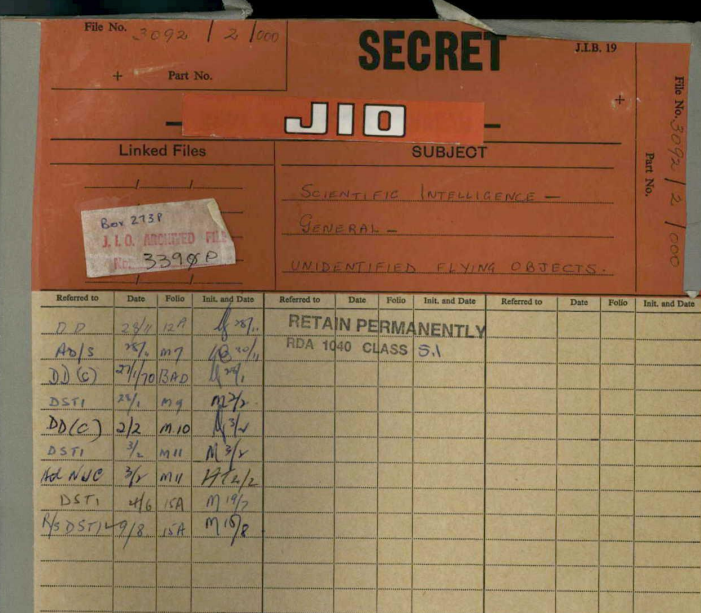
These documents were declassified years ago and cover correspondences of the Australian military on the UFO subject with emphasis on the historical background within the US. Below is an excerpt from the documents in text format for easy searching. Bolded sentences are added for emphasis.
DEPARTMENT OF DEFENSE JOINT INTELLIGENCE ORGANIZATION MINUTE PAPER
Subject: SCIENTIFIC AND INTELLIGENCE ASPECTS OF THE UFO PROBLEM
The two documents attached are intended to focus on aspects of the UFO problem that have tended to remain hidden. The report dealing with the US attitude has been compiled from official reports and statements made by the CIA, US Air Force, Congressional Hearings and Project Blue Book records. The second document deals with evidence for weapon systems used by UFO’s. This evidence has been culled from computerised records collected by Dr Vallee incollaboration with Dr Hynek at North-Western University and represents only a fraction of world-wide reports dealing with the same weapon systems. Australia has had its share of this kind of reporting.
2. Intelligence aspects include assessment of real from false reporting, capabilities of propulsion methods and possible weapons used, motivation of operations (harmful or not, defensive, offensive, scientific etc.) for both short- term and long-term and whether there are more effective ways to detect these operations or defend them if necessary.
(O.H. TURNER)
27th May 1971- Hd. Nuclear Branch
SUMMARY
The early analyses of UFO reports by USAF intelligence indicated that real phenomena were being reported which had flight characteristics so far in advance of U.S. aircraft that only an extra-terrestial origin could be envisaged. A government agency, which later events indicated to be the CIA Office of Scientific Intelligence (OSI), studied the UFO reports with the intention of determining the UFO propulsion methods. At that time, OSI was responsible for intelligence on foreign research and development in nuclear and missile matters.
2. The CIA became alarmed at the cverloading of military communications during the mass sightings of 1952 and considered the possibility that the USSR may take advantage of such a situation. As a result, OSI acting through the Robertson-panel meeting of mid-January 1953, persuaded the USAF to use Project BLUE BOOK as a means of publicly “debunking” UFO’s, and at a later stage to allocate funds for the Avro advanced “saucer” aircraft and the launching of a crash programme into anti-gravity power. To initiate such programnes decades ahead of normal scientific development would indicate that the U.S. Government acknowledged the existence of advanced “aircraft” which presumably used a gravity-control method of propulsion. An additional motivation could have been the fear that the USSR would achieve this goal before the U.S.
3. By erecting a facade of ridicule, the U.S. hoped to allay public alarm, reduce the possibility of the Soviet taking advantage of UFO mass sightings for either psychological or actual warfare purposes, and act as a cover for the real U.S. programme of developing vehicles that emulate UFO performances. The RAAF together with many other countries of the world give credence only to the USAF public facade and appear to have uncritically accepted the associated information. This information has been widely discredited by retiring U.S. service personnel formerly engaged on UFO investigations, as well as by scientists and private citizens.
4. The conclusions of the Condon report conflict with its own contents and has been discredited by many reputable scientists including the UFO scientific consultant to the USAF. In accordance with the recommendations of the Condon report, Project BLUE BOOK was terminated, but presumably this would have little effect on the main programme.
5. It would appear wrong for Australia to remain ignorant cf the true situation. We lack an intelligence viewpoint thut can assess the nature and possible consequences of the problem, a scientific viewpoint that could derive scientifically valid data from the reports and a public relations viewpoint that can honestly satisfy public interest. To overcome these deficiencies in the Australian investigation of UFO’s, it would seem that a strong case exists for the acceptance of the RAAF suggestion that another government department assume responsibility for the investigation and analysis of UFO reports.
U.S. OFFICIAL ATTITUDE TO U.F.O’s
In June of 1947 the Air Technical Intelligence Centre (ATIC) near Dayton, Ohio, assumed a respensibility to investigate the initial reports of ‘flying saucers’. Within a month it was considered that the phenomena were real and probably of Soviet origin. By the end of the year, when ATIC was officially authorized to investigate under the project code name of SIGN and with a high priority, most of the investigators were focussing on an inter-planetary rather than a Soviet origin. These opinions were crystailized into a written estimate that was sent to the Pentagon in September 1948. When the interplanetary conclusions were rejected on the grounds of insufficient hard evidence, a reaction set in at ATIC against trying to unravel the UFO problem.
2. In February 1949, ATIC personnel on Project SIGN were replaced with new personnel to form Project GRUDGE. A definite attempt was made during 1949 to use Project GRUDGE to destroy any acceptance of UFO’s. The motives for this are not clear: possibly Air Force embarrassment at being incapable of controlling the situation and/or a fear of national panic prompted USAF to try and remove the problem by denying its existence. Another possible motive may have been to provide a breathing space for another “investigative agency” to reach some conclusion; the agency had been assisting ATIC through 1948 and, contrary to official USAF policy, was maintaining a high level of interest during 1949. This governmental agency was not the FBI, and had rocket, nuclear and intelligence experts; their purpose was to study UFO reports in an effort to gather design data on interplanetary spaceships. In the light of later developments, this agency was almost certainly the CIA.
3. Project GRUDGE failed to eliminate the UFO problem. UFO reports in 1949 actually exceeded the number in 1948, and several people who had gained access to earlier official reports were able to contradict the USAF. Journalists generally felt that GRUDGE reporting represented a cover to a more serious knowledge. Eventually, USAF intelligence decided that a fresh approach to the problem was necessary. Between September 1951 and the establishment of Project BLUE BOOK in March 1952, UFO investigation regained adequate financial and administrative support to once again analyse the collected data. Project BLUE BOOK was able to process the data from 3,200 reports into a form suitable for their consuitants to be able to use IBM card-sorting machines.
4. The summer of 1952 saw a more than twenty-fold rise in the normal rate of reporting and included the two extensive July sightings involving Washington D.C. This marked increase in sightings had diverse effects. A component of USAF intelligence considered that UFO’s were interplanetary spaceships which were about to make closer contact. To prepare the public for this possibility, 41 previously classified reports were released for publication between August 1952 end February 1953. These reports contradicted the earlier official USAF policy of dismissing the reports as mis-identifications etc. On the other hand, the CIA regarded the summer UFO activity as a threat to national security mainly because the resulting crowded communications and defence forces involvement lessened the level of national alertness against possible enemy ettuack.
5. A scientific panel chaired by H.P. Robertson was convened by the Office of Scientific Intelligence of CIA during mid-January 1953 for the purpose of recommending future action on the UFO problem. Briefings were made both by CIA and USAF. ATIC personnel showed the then classified two movie films of UFO’s and the early results of statistical analysis of 3,200 reports. Because of the vital issues involved, the panel felt restricted to recommending that the investigation be continued, but with increased personnel and equipment. The USAF responded promptly with an instruction to comply with these recommendations.
6. The CIA, however, in a report dated 16 February 1953 showed a preference to publicly abandon the investigation whilst intensifying the collection of data. By September 1953 the CIA position had been largely achieved with Project BLUE BOOK reduced from a staff of ten qualified personnel operating at a top secret level to a virtually inactive project involving one airman. The investigating component had been transferred to the 4602nd Air Inteiligence Service Squadron which was trained in rapid intelligence procurement and reported to Air Defence Command and USAF Intelligence Washington rather than BLUE BOOK. Direct access between the 4602nd AISS and all USAF units was authorized by AFR 200–2 whereas previously this privilege had been given to BLUE BOOK. Although only the airman (first-class) remained in September 1943, BLUE BOOK was later built up to one officer, one sergeant, one secretary, and a part-time consultant Dr J. Allen Hynek, staying at about this level until it was closed down in December 1969. During this time BLUE BOOK served mainly as a means of supplying unclassified summaries of UFO identifications ‘to the public, and did not form a vital link in collection or Serious analysis.
7. Control of public awareness of the UFO situation was tightened by the issuing of JANAP 146 in 1953 which prohibited service personnel from discussing UFO’s by threatening defaulters with up to 10 years gaol and up to a $10,000 fine. When service personnel resigned or retired, however, it was possible to reveal USAF attitudes o~ opinions even if actual data was still restricted. In this way many Intelligence Officers associated with the UFO problem, including Major D. Fournet who was BLUE BOOK Project Officer at the Pentagon until late 1952, Captain E. Ruppelt who headed Project GRUDGE and Project BLUE BOOK until September 1953 and Admiral Hillenkoetter who directed CIA from its inception until October 1950, on retiring from the services, all publicly stated that the U.S. Government knew UFO’s were extra-terrestial but was withholding this fact from the public.
8. When the National Investigation Committee on Aerial Phenomena (NICAP) was formed in 1956 to counter the publicly suppressed USAF investigation of UFO’s, the first Chairman was Admiral D.S. Fahrney who had directed the Navy’s guided missile programme from its inception. Apart from Admiral Hillenkoetter, Major Keyhoe and Major Fournet, other Directors have included Rear Admiral H.B. Knowles, General A. Wedemeyer and Col J.J. Bryan (who was a special assistant to the Secretary of the Air Force). To reduce the effect of these and similar defections from official policy after retirement, the revised JANAP 146E, passed in 1960, made it an offence under the Espionage Act if data on UFO’s were revealed.
9. The change in style of USAF reporting before and after the Robertson panel meeting is clearly indicated in the Project BLUE BOOK Special Report №14. The body of the report prepered between March 1952 and early 1953, although biased in favour of a natural explanation for UFO’s, nevertheless showed mathematically that the evidence favoured an explanation that was scientifically unknown. This section of the 316 page report was not released to the public other than as a copy to be consulted, assuming the reader knew of its existence. Public distribution was made, however, of a so called “summary” which in fact did not summarise, nor scarcely allude to the 1947–52 data, but concentrated on 1953–55 reporting which was clearly designed to reduce the residual unknowns to an insignificant number, no matter how senseless the identification became.
10. Within the body of the difficult-to-obtain report there is an interesting diagram. The product of the estimated observer reliability and the report reliability became the sighting reliability. The percentage of reports that had to be registered as “unknown” (i.e. incapable of being even approximately identified as a known object) increased as the sighting reliability improved. Conversely, the percentage listed as “insufficient information” decreased with improving reliability.
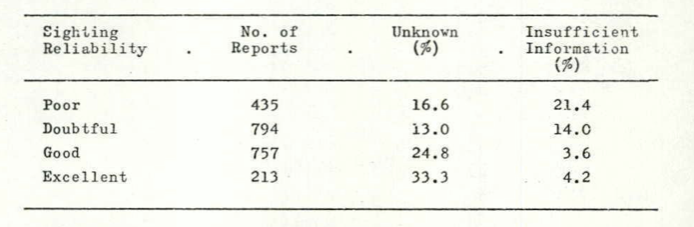
11. Throughout the years of the UFO phenomenon, there has been a persistent form of official pronouncements which state that the percentage of unknowns would be reduced if more data were available. The above table contradicts that statement. Reports of excellent reliability generally stem from astronomers, pilots, scientists, surveyors, meteorologists, radar operators etc. complete with instrumented values and accurately detailed accounts. The introduction of good reliable reporting prevents the ready prosaic interpretation. In all probability the overall average percentage of unknowns (19.7%) would have been substantially increased if the data had been more reliable.
12. Project BLUE BOOK consultants statistically tested the unknown object population to determine the likelihood that it was Similar to the population of identified objects and found that the probability was less than one in 10^28 (i. using the American system, the odds were ten thousand trillion trillion to one against the unknowns being the same as the knowns). Since the consultants had arbitrarily called all green fireballs and short duration (i.e. less than five seconds) night-time sightings as ‘known astronomical objects’ there was an undue preponderance in that category. Hence, assuming that no astronomical objects were left in the unknowns, the statistical tests were repeated with astronomical identifications removed. The odds were reduced to ten trillion trillion to one. The analysts could not find a way to reduce those odds sufficiently further to warrant additional testing, and irrationally considered the results to be “inconclusive”.
13. While PROJECT BLUE BOOK endeavoured to reduce the official number of unknowns — in 1957 they claimed only 14 out of 1,006 sightings remained unidentified — the covert programme expanded considerably. The government agency (almost certainly CIA) that had been collecting data on UFO performance and propulsion methods during 1948–52 presumably influenced U.S. governmental funding of certain advanced projects. One project was the Canadian Avro saucer. A drawing of this saucer released in October 1955, showed a typical flying disc as described in many UFO reports. The Secretary of the Air Force, D.A. Quarles, appeared moderately confident that such a vehicle would be successfully developed by the U.S.
14. A more astounding decision on the part of the U.S. Government was to allocate considerable funds to investigate gravity and a means of controlling gravity. Despite the fact that science had not attained a level of competence to deal with either gravity or anti-gravity problems and the only theory that might be applicable was Einstein’s Unified Field Theory which was still incomplete at the time of his death, the U.S. chose to support six universities and government agencies in an all-out drive to conquer the problem. It is significant that at this time the current theories on UFO propulsion were a mixture of gravity control and electro-magnetic propulsion.
15. During 1955, because insufficient staff could be recruited for the project, recourse was made to an urgent appeal for theoretical physicists and mathematicians from AERE Harwell, U.K. The six Gravity Research Centres being established were at the Institute for Advanced Study (Princeton, N.J.), Princeton University, University of Indiana, Purdue University Research Foundation, University of North Carolina and the Massachusetts Institute of Technology through the (Roger Babson) Gravity Research Institute (New Boston N.H.). The latter institute is a non-profit organization founded in 1949 with George M. Rideout as President. It was believed that to make a gravity motor, a gravity differential was required which necessitated the discovery of an iusulator, deflector or absorber of gravity. By 1955, 485 essays had been written on this subject and awards totaling $10,800 made for original contributions.
16. The scientists involved included Teller from University of California, Cppenheimer and F.J. Dyson of the Institute of Advanced Studies, J.A. Wheeler -and Richard Arnowitt of Princeton, Vaclay Hlavaty of University of Indiana (who had worked with Einstein in Prague) and Stanley Deser. The objective was to control gravity. During 1955 the following firms entered into gravity and/or electromagnetic programmes: jenn L. Martin Aviation Co. (specifically Dr B. Heirn from Goettingen University and Dr P. Jordan from Hamburg University), Convair of San Diego, Bell Aircraft of Buffalo, Sikorsky Division, Lear Inc. of Santa Monica, Clarke Electronics of Palm Springs, California, and Sperry Gyroscope Division of Great Neck, Long Island, N.Y.
17. Such an intensive onslaught on the gravity enigma was entirely irrational from the standpoint of conventional science, and can only be rationalized within the context of a firm belief that UFO’s were real and that the intelligences behind them knew how to control gravity. The drive to harness this power before the USSR could do so would be a strong incentive for the U.S. Government to fully support an anti-gravity programme. By 1966, 46 separate projects of this nature were being financially supported, 33 of which were under the supervision of the U.S. Air Force. Although details of most of these projects have been kept classified it would appear that generally they have not been successful. Work on gravitational waves by J. Weber and his associates under USAF Cambridge Research Laboratory jurisdiction has been reported fairly extensively since 1966.
18. During August of 1965 Project BLUE BOOK received 262 reports which was about six times the average number for a month and was twice any previous month since November 1957. On 28 September 1965 Maj. Gen. LeBailly, Director of Information, formally requested the Air Force Scientific Advisory Board to review Project BLUE BOOK. The review suggested that the limited Project BLUE BOOK staff and the official investigating officers did not possess the technical competence to properly identify the phenomena and that university teams should be appointed to investigate selected sightings. This conclusion was supported by the House Armed Services Committee which met on April 5th 1966 in the shadow of a public furore consequent to the USAF identifying the well-publicised Michigan sightings as being swamp gas. The Colarado University was selected for the task and Dr Edward U. Condon appointed to lead the project with an initial allocation of $313,000 later raised to $525,000.
19. The Colorado project became discredited when Dr Condon stated publicly on 25th January 1967 that “my attitude right now is that there’s nothing to it, but I’m not supposed to reach a conclusion for another year”. The revealing of a memorandum outlining a method to trick the public, combined with a general dissatisfaction at Condon’s biassed attitude, led to the dismissal and resignation of most of the staff after most of the investigations had been made but not completely written up. The final report of 905 pages lacked coherence. Condon’s conclusions were at variance with individual staff conclusions, although only Condon’s conclusions were publicised. As a result of the Condon report, USAF closed down Project BLUE BOOK shortly before the American Association for the Advancement of Science held a special meeting to counter-act the effect of the Condon report. The Chairman of the Special Committee, Dr Thornton Page, was one of the signatories to the Robertson report.
20. Dr J. Allen Hynek, scientific consultant to Project Blue Book 1948–69, began his association with a conviction that all sightings could be conventionally explained. Even though doubts grew in his mind, he found himself obliged to support official USAF public policy. Since 1966, however, he has become more outspoken against the USAF attitude and has assisted to convene both congressional hearings and scientific symposia on the subject. Although initially supporting the Condon Committee he became disillusioned and critical of it with the passage of time. It is quite clear that Dr Hynek along with many other reputable scientists do not accept the USAF explanation of misidentification, hysteria or hoax.
RAAF ATTITUDE TO UFO’s
The Directorate of Air Force Intelligence is the component of the RAAF that is responsible for the analysis of all official reporting of Unidentified Flying Objects. At no stage has there been more than one part-time officer allocated to this task. Initial investigation of reports is often undertaken by a part-time investigator from near-by air bases. The RAAF admits that its interests lie solely in the area of air defence and it lacks both interest and competence to consider the scientific aspects. A 1957 request for the Scientific Intelligence section of JIB to accept UFO responsibility was rejected by JIB. In 1968, the Department of Air stated that it intended “to take up further the question of Commonwealth departments, e.g. Defence, Supply, Education and Science, Prime Minister’s Department etc. to see whether some other Commonwealth Agency is better placed to assume responsibility for Unidentified Flying Objects. At the same time we would maintain our interest in the matter and work with any other Commonwealth agency who is considered to be more appropriate as a co-ordinating agency for the Commonwealth as a whole”. There does not appear tohave been any fulfillment of this intention to seek Commonwealth assistance.
2. In support of the RAAF’s admission of scientific disinterest, an identification list of all sightings made between 1960 and 1965 contains 15 identifications of Venus, not one of which is valid. In every case Venus was in a totally different part of the sky or not even above the horizon. Out of 37 meteor identifications, only 9 could possibly be meteors and even several of those cases would be doubtful. This off-hand unscientific attitude to identification did not escape the notice of the press or various scientists.
3. In general, the RAAF attitude has been guided by the USAF public releases which were aimed at allaying public interest by denying the reality of UFO’s. Consequently, most of the Australian reports were given identifications without a great concern for rational correlation. Most investigators and collectors regarded their UFO tasks as an intrusion into their more legitimate tasks. As a result, there has been a negligible scientific analysis of the data and most opinions expressed by DAFI have been largely a reflection of the USAF public attitude. With the present reduced staff of DAFI it is unlikely that UFO reports will receive any treatment beyond filing.
4. If Australia is to follow the U.S. lead, instead of following the public USAF attitude, it would be preferable to follow the USAF/CIA role of concentrating on gaining a knowledge of the power sources involved. However, it may be preferable to act independently of the U.S. and initiate a programme that is scientifically sound and intellectually honest towards unravelling the UFO mystery. In such a venture, it may be worthwhile working somewhat closer to the public than is usual in the U.S. and U.K.
IF YOU ENJOY MY WORK PLEASE FOLLOW ME ON MEDIUM
You don’t have to join Medium to read my work, but if you do join use the link below.


