avatarSuntonu Bhadra

Free AI web copilot to create summaries, insights and extended knowledge, download it at here

6061

Abstract

as Muslin was expensive because of its sheerness and the skill-set required to create. Fashion historian Suan Greene indicated that Muslin’s name might come from the French word ‘<i>mousse</i>,’ which means ‘<i>foam</i>.’ (<a href="https://www.livehistoryindia.com/living-history/2019/07/05/the-romance-of-indian-muslin">Source</a><a href="https://www.livehistoryindia.com/living-history/2019/07/05/the-romance-of-indian-muslin%29">)</a></p><p id="f679"><b>Earliest History of the thread</b></p><p id="a8c5">The clothing is believed to be a part of the weaving heritage for <i>the Indus civilization</i>, especially from Bengal. Historian Fernand Brudel illustrated that along with the Muslin; ancient Indus became proficient in cotton textiles, which spread as an export commodity to the roman empire. Chanakya’s <i>Arthashastra</i> (dated back in the 4th century BC) mentioned the name of Muslin for the first time in history.</p><p id="3e92" type="7">“Thy bride might as well clothe herself with a garment of the wind as stand forth publicly naked under her clouds of muslin.” — First-century C.E. Roman author Petronius.</p><p id="c003">Muslin was sought by merchants of the Roman empire and subsequently reached other parts of Europe. Muslin was prized highly by the Romans, who usually bought the material from Deccan (Dhaka, Bangladesh) and South India, and also introduced the clothing to Europe. (<a href="http://en.banglapedia.org/index.php?title=Muslin">Source</a>)</p><p id="c554">The Dhakai Muslin (the Muslin created in Decca) used to be sold in Greece around the 2nd century BC to be used for clothing their Goddesses. An ancient Tibetan book called ‘<i>Kulbha</i>’ describes a priestess who was called names and criticized highly because of wearing the <i>Jhuna Malmal (a kind of Muslin cloth)</i>. (<a href="https://myorganicbd.com/muslin-history-origin-production-and-types/">Source</a>)</p><p id="d1c3"><b>Middle ages</b></p><p id="5280">It expanded more in the middle ages with the growth of sea-line silk roads for an easier route to the Indian continent.</p><p id="f7ac" type="7">As per the quotes of textile historian John and Felicity, “it was the east coast, and especially the Ganges Valley [that] offered the finest qualities.”</p><p id="4624">As Arab merchants came to dominate the trade market around the 8th century, they started trading huge volumes of cotton products to Basra, Baghdad, Makkah, Java, and China. Muslin was a pricy material, mentioned by the 14th-century traveler Ibn Battuta. When Delhi Sultanate sent gifts to Yuan emperor of China, he sent four types of Muslin, named ‘Bayrami,’ ‘Salahiyya,’ ‘Shirinbaf,’ and ‘Shanbaf.’ (<a href="http://ir.amu.ac.in/12045/1/T10799.pdf">Source</a>)</p><p id="c1b3"><b>Mughal era</b></p><p id="a2f6">Muslin became a part of the Mughal apparatus of power, with the inclusion of Persian-derived motifs like buti and embroidery and the aesthetic framework of different muslin types. Famous Persian poetry contents were often used to highlight Muslin’s variety.</p><p id="4364" type="7">It was famous to people as ‘Dhaka ka molmol’ because of the Dhakai weavers’ skill-set and specialty.</p><p id="649f">Mughal emperor Akbar was prominent in promoting cultures and heritage from different parts of the Mughal emperor. His army general in Bengal, Islam Khan, re-casted Dhaka as Bengal’s capital, and Muslin was started to be made exclusively for the imperial households.</p><figure id="2065"><img src="https://cdn-images-1.readmedium.com/v2/resize:fit:800/1*dqedYVUw2IYNA4chLiJrvA.jpeg"><figcaption>Idealized Portrait of the Mughal Empress Nur Jahan (1577–1645) (Picture Source: <a href="https://en.wikipedia.org/wiki/File:Idealized_Portrait_of_the_Mughal_Empress_Nur_Jahan_(1577-1645)%3F_LACMA_M.81.271.7.jpg">Wikimedia Commons</a>)</figcaption></figure><p id="5de5">Mughal Empress Nur Jahan made it more famous by using Muslin inside the Mughal Harem.</p><p id="5042" type="7">There is a story of Zeb-un-Nisa, a daughter of the Mughal Emperor Aurangzeb, where the emperor scolded her for appearing in a transparent dress in the emperor’s court. She answered that her attire consisted of seven separate layers of Muslin, which was that sheer and not prevalent in the eyes. (Source)</p><p id="17ee">A 16th century English traveler Ralph Fitch discovered Muslin in <i>Sonargaon</i> (considered as Muslin capital of the then world), which supported the fact that <i>Mughal Bengal</i> was the foremost muslin exporter in the world during that time. (<a href="https://www.midraar.com/blogs/news/7682549-the-early-history-of-jamdani">Source</a>)</p><p id="562a"><b>The last golden era</b></p><p id="bd0b">The next and the last spark of Muslin was seen when the European merchants started trading in India from the 16th century and exported (from the continent) to European cities. The cotton industry boomed in the Indian continent, where Bengal took the lion’s share because of the Muslin trade. It went onto the French royal court and later in regency-era Britain.</p><blockquote id="3c47"><p>Empress Josephine Bonaparte was covered with a semi-sheer muslin cloth in one of her famous paintings. French aristocrats were the leading luxury league in Europe, driving with refined clothing options like Muslin, especially made fame by Queen Mary Antoinette and Empress Josephine Bonaparte.</p></blockquote><p id="a78e">Muslin made it to the American continent by the late 17 century, which quickly became popular for weddings and party dresses.</p><p id="5479">Muslin was showcased at the great exhibition of London in 1851. In 1875, when the Prince of Wales Edward VII came to Bengal for a visit, he was presented with 30 yards of delicate Muslin clothing, <b><i>weighted only 10 grams a yard</i></b>.</p><figure id="c80d"><img src="https://cdn-images-1.readmedium.com/v2/resize:fit:800/1*lkDgzNriwlus2FRWEgXJFA.jpeg"><figcaption></figcaption></figure><figure id="1087"><img src="https://cdn-images-1.readmedium.com/v2/resize:fit:800/1*9wxSFloSZN5ZObZBgJAHxA.jpeg"><figcaption>On the left

Options

: by François Gérard, ‘Portrait of Josephine’ (picture courtesy: <a href="https://bn.wikipedia.org/wiki/%E0%A6%9A%E0%A6%BF%E0%A6%A4%E0%A7%8D%E0%A6%B0:Fran%C3%A7ois_G%C3%A9rard_-_Portrait_of_Josephine_-_WGA08595.jpg">Wikimedia Commons</a>), on the right: by Élisabeth Louise Vigée Le Brun, ‘Marie Antoinette in a Muslin dress’ (picture courtesy: <a href="https://en.wikipedia.org/wiki/File:MA-Lebrun.jpg">Wikimedia Commons</a>)</figcaption></figure><p id="5da5"><b>Decline era</b></p><p id="068e">Between 1757 to 1800, the British East India Company seized the power of the Indian subcontinent. They started to squeeze the productivity of the weavers and farmers to trade Muslin to Europe. Meanwhile, the industrial revolution took place, which required more consumers for the industries to grow. The textile industry in Manchester was booming, and factory-produced mass-product ‘Muslin’ like clothing materials were placed on Lancashire power-looms cotton mills.</p><p id="51da">Britain started to apply heavy taxes, tariffs, and duties (75% export tax); along with that, Britain produced cotton products were flooded in all around the world. British traders monopolized the clothing industry through different means and squeezed out the other competitive forces from the market.</p><blockquote id="616a"><p>Bengal handloom workers found it difficult to continue their livelihood with the heavy burden of costs and moved to other occupations, eventually dried up the skilled labor on the field, causing further decline. That caused the eventual death of the legendary fine Muslin in Bengal.</p></blockquote><p id="21a7">Along with that, there were several feminine around the Bengal part of that period, which made it difficult to emphasize the cotton industry. People started to engage in more agricultural farming to cover up the food-gaps, which caused many of the handloom-experts and weavers to move to the agriculture profession.</p><p id="0d4e">‘Phuti karpas,’ the main element of Muslin, became extinct, which were only produced around the bank of the rivers, Meghna and Brahmaputra (in the current day Bangladesh) because of the dire agricultural production need around that time. (<a href="https://www.livehistoryindia.com/living-history/2019/07/05/the-romance-of-indian-muslin">Source</a>)</p><p id="2c85" type="7">Only the Bengal jamdani (known as figured Muslin) survived because of its distinct style (abstract motifs, floral patterns of the loom) and continual practice in certain areas. ‘Jam’ meant flowers, and ‘Dani’ meant a container, thus forming a flower vase of sorts. Jamdani Muslin is a part of UNESCO’s Masterpieces of the Oral and Intangible Heritage of Humanity. (UNESCO link)</p><p id="1591"><b>Revival projects</b></p><figure id="d203"><img src="https://cdn-images-1.readmedium.com/v2/resize:fit:800/1*qDrAVD9y4-9YW7aJJIMK9w.jpeg"><figcaption>Image by Piers Brown, ‘Weaving’ (image courtesy: <a href="https://en.wikipedia.org/wiki/File:Weaving_(3995374324).jpg">Wikimedia Commons</a>)</figcaption></figure><p id="c55f">Although Muslin was almost a lost trend, however some parts of Bangladesh and West Bengal part of India are trying to revive the heritage. Governments are trying to support the weavers by sponsoring their looms and weaving elements.</p><ul><li>Recently, the Bangladesh Government has obtained a certificate to include the heritage of Muslin under the Geographical Indicator (GI) from WIPO (World Intellectual Property Organization. (<a href="https://bangladeshpost.net/posts/reviving-muslin-for-export-13918">Source</a><a href="https://bangladeshpost.net/posts/reviving-muslin-for-export-13918)">)</a></li><li><b>‘Muslin yarn technology and Muslin cloth recovery’ project</b> undertaken by Bangladesh Government; the estimated initial cost of $2 million. The project will cover three major parts, such as: restoring the technique through intensive research, experimental production of muslin yarn and cloth, and, thirdly, identify necessary infrastructural changes to incorporate. (<a href="https://bangladeshpost.net/posts/reviving-muslin-for-export-13918">Source</a><a href="https://bangladeshpost.net/posts/reviving-muslin-for-export-13918)">)</a></li><li><b>Project Plantation</b> is formulated to revive and grow the ‘phuti carpus’ in a specific riverine arena of Bangladesh, a project by Bengal Muslin. (<a href="https://www.thedailystar.net/lifestyle/special-feature/reviving-muslin-1339270">Source</a>)</li><li><b>Project Muslin</b> by West Bengal Khadi & Grameen Shilpo Porishod, creating infrastructure, training of the weavers, and research on the looms and clothing. (<a href="https://www.wbkvib.org.in/index.php/khadi-d/project-muslin">Source</a><a href="https://www.wbkvib.org.in/index.php/khadi-d/project-muslin)">)</a></li></ul><p id="3ef3">Although the name Muslin is now used for some generic materials used for households, the actual Muslin is completely different and requires effort from the respective Governments and interested organizations. It is an almost lost heritage of Bengal; however, as the efforts are in place to revive the yarns close to the past glory, the world might once again see the ancient thread as abundance in the coming days.</p><p id="bf69"><b>I’m crossing my fingers!</b></p><h2 id="5566">Other Sources used</h2><ul><li><a href="https://www.aramcoworld.com/Articles/May-2016/Our-Story-of-Dhaka-Muslin">AramcoWorld</a>.</li><li><a href="https://www.lexico.com/definition/muslin">Lexico Definition</a>.</li><li><a href="https://www.parinita.co.in/pages/muslin">Parinita</a>.</li><li><a href="https://archive.org/details/asketchtopograp00taylgoog/page/n13/mode/2up">Archieve.Org</a>.</li><li><a href="https://en.wikipedia.org/wiki/Muslin">Wikipedia</a>.</li><li><a href="https://www.beichengjiu.com/en/Culture/384613.html">Beichengjiu</a>.</li><li><a href="https://www.scribd.com/doc/153939408/Muslin-Fabric">Scribd</a>.</li><li><a href="https://www.thedailystar.net/lifestyle/special-feature/the-muslin-story-187216">The Daily Star</a>.</li></ul></article></body>

A Historical Journey Of Muslin Pride

sharing tales of the golden heritage from ancient Bengal, which were a part of Roman, French, and English Aristocrats in different ages
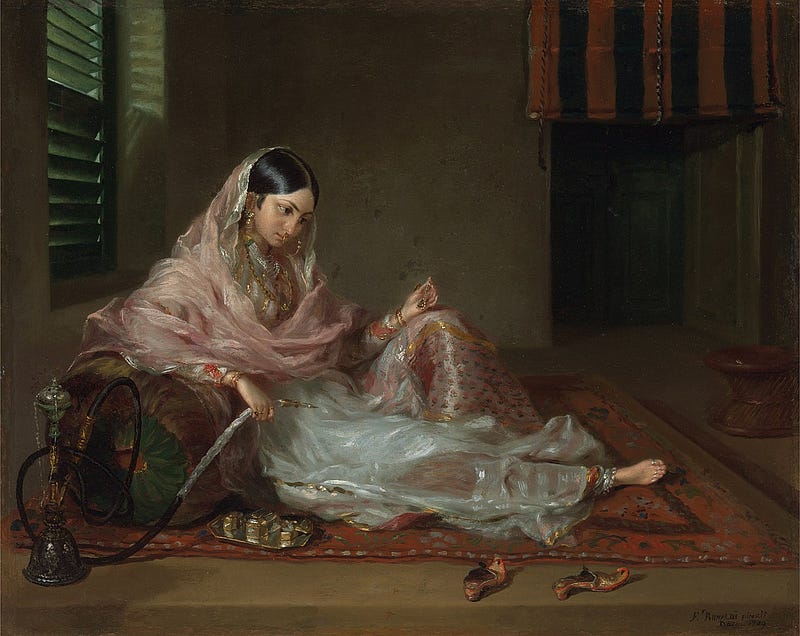
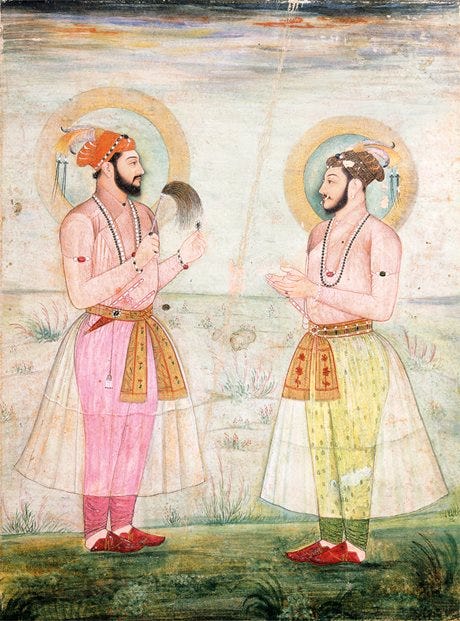
On the left: by Francesco Renaldi, An Indian Girl with a Hookah (image courtesy: Wikimedia Commons), on the right: Muslin men (image courtesy: Wikimedia Commons)

As part of my cultural and historical aspects of ancient Bengal, this is the first installment on a material renowned to the world’s aristocrats and emperors for several thousand years. They had used this material to showcase the elegance and beauty of gorgeousness. Muslin (মসলিন), a pride of ancient Bengal, which was so translucent, so soft, derived the notion that it was made out of the air or contained the air’s vapor.

What is Muslin?

It is a plain weave cotton fabric, almost transparent, silky, ultra-light, and glossy material, and required intensive labor work, skills, and patience.

‘A hundred yards of it pass through the eye of the needle, so fine is its texture, and yet the point of the steel needle can’t pierce through it easily. It is so transparent and light-weight that it looks as if one is in no dress at all but has smeared the body with pure water.’- 14th-century Sufi poet and scholar Amir Khusrau (in Nihayatul-Kamaak, ‘The Height of Wonders). (Quote Link)

Thread-counts that mattered.

A minimum cotton thread-count requires to be adhered to and incorporated to create a muslin cloth. Minimum 100 by 100 thread-count fine loom cotton is called Muslin (expert opinions vary in this case). However, Muslin is not silk (many people confuse Muslin with it).

The best Muslin prepared today contains around 300 by 300 count cotton. However, the tale was, Bengal weavers could weave Muslin with 600 by 600 thread-count, with the best ones (created for royals) came with 1000 by 1000 thread-count in its prime time. (Source Link)

Muslin yarn types

Muslin threads were both soft-natured in feel but strong to hold the clothing’s integrity, with artistic fabrics. The best of the Muslin was called ‘Mulmul Khas’ or ‘Malmal Shahi’ (or king’s Muslin). The other kinds were:

  • Jhuna (used by native dancers),
  • Rang (of transparent and net-like texture),
  • Abirawan (fancifully compared with running water),
  • Khasa (remarkable quality, subtle or elegant),
  • Shabnam (morning dew)
  • Alaballee (very fine),
  • Tanzib (adorning the body),
  • Nayansukh (pleasing to the eye),
  • Buddankhas (a special sort of cloth),
  • Sherbund (used for turbans),
  • Kumees (used for making shirts),
  • Doorea (striped),
  • Charkona (chequered cloth),
  • Jamdani (figured cloth) etc. (Source Link)

Muslin’s typical creation process looked like the following.
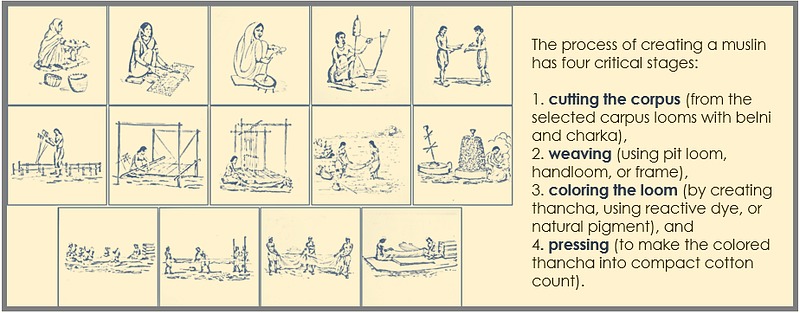
Courtesy of Bangladesh National Museum, online picture: Dhaka Tribune

As you can imagine, to create a superior product like the previous refined Muslin itself might have involved a more delicate process and skill-set that might be in the dust of time.

Muslin: The name origin

European traders gave the name from the Iraq city, Mosul, which they believed was the center and root for the clothing. On the journey notes of Marco Polo (named: The Travel), he wrote the trading of the pieces around Mosul during his journey on the area. (Source)

The name might also come from ‘Machilipatnam’ (in Andhra Pradesh, India), one of the trading centers for the Arab merchants during the earlier days. However, it might have been confused with the other famous traded item, Calico (a courser textile than Muslin), usually traded from Calicut, Malabar coast, India. (Source)

However, the fabric was created and further distributed to the west, not from Mosul, but the ancient Bengal area (present-day Bangladesh). It went to different regions, and French royals and aristocrats used the clothing to showcase their elegance and royalty. In French (mousseline), the meaning was ‘cloth of silk and gold,’ as Muslin was expensive because of its sheerness and the skill-set required to create. Fashion historian Suan Greene indicated that Muslin’s name might come from the French word ‘mousse,’ which means ‘foam.’ (Source)

Earliest History of the thread

The clothing is believed to be a part of the weaving heritage for the Indus civilization, especially from Bengal. Historian Fernand Brudel illustrated that along with the Muslin; ancient Indus became proficient in cotton textiles, which spread as an export commodity to the roman empire. Chanakya’s Arthashastra (dated back in the 4th century BC) mentioned the name of Muslin for the first time in history.

“Thy bride might as well clothe herself with a garment of the wind as stand forth publicly naked under her clouds of muslin.” — First-century C.E. Roman author Petronius.

Muslin was sought by merchants of the Roman empire and subsequently reached other parts of Europe. Muslin was prized highly by the Romans, who usually bought the material from Deccan (Dhaka, Bangladesh) and South India, and also introduced the clothing to Europe. (Source)

The Dhakai Muslin (the Muslin created in Decca) used to be sold in Greece around the 2nd century BC to be used for clothing their Goddesses. An ancient Tibetan book called ‘Kulbha’ describes a priestess who was called names and criticized highly because of wearing the Jhuna Malmal (a kind of Muslin cloth). (Source)

Middle ages

It expanded more in the middle ages with the growth of sea-line silk roads for an easier route to the Indian continent.

As per the quotes of textile historian John and Felicity, “it was the east coast, and especially the Ganges Valley [that] offered the finest qualities.”

As Arab merchants came to dominate the trade market around the 8th century, they started trading huge volumes of cotton products to Basra, Baghdad, Makkah, Java, and China. Muslin was a pricy material, mentioned by the 14th-century traveler Ibn Battuta. When Delhi Sultanate sent gifts to Yuan emperor of China, he sent four types of Muslin, named ‘Bayrami,’ ‘Salahiyya,’ ‘Shirinbaf,’ and ‘Shanbaf.’ (Source)

Mughal era

Muslin became a part of the Mughal apparatus of power, with the inclusion of Persian-derived motifs like buti and embroidery and the aesthetic framework of different muslin types. Famous Persian poetry contents were often used to highlight Muslin’s variety.

It was famous to people as ‘Dhaka ka molmol’ because of the Dhakai weavers’ skill-set and specialty.

Mughal emperor Akbar was prominent in promoting cultures and heritage from different parts of the Mughal emperor. His army general in Bengal, Islam Khan, re-casted Dhaka as Bengal’s capital, and Muslin was started to be made exclusively for the imperial households.
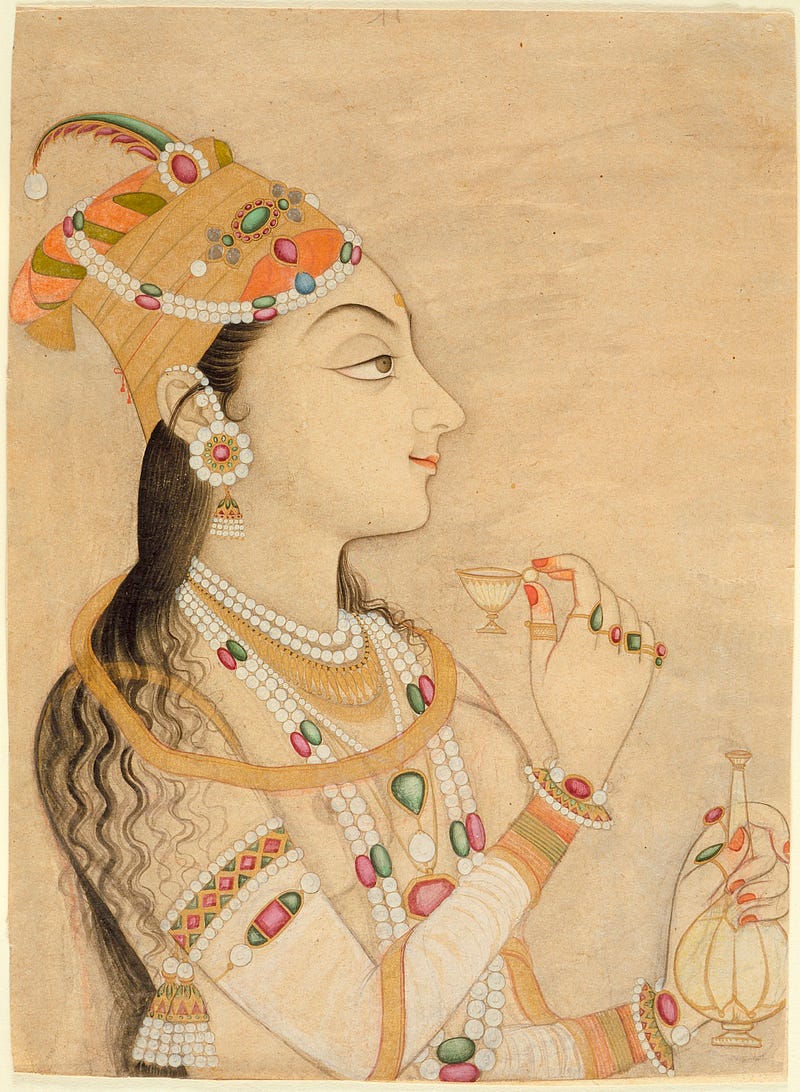
Idealized Portrait of the Mughal Empress Nur Jahan (1577–1645) (Picture Source: Wikimedia Commons)

Mughal Empress Nur Jahan made it more famous by using Muslin inside the Mughal Harem.

There is a story of Zeb-un-Nisa, a daughter of the Mughal Emperor Aurangzeb, where the emperor scolded her for appearing in a transparent dress in the emperor’s court. She answered that her attire consisted of seven separate layers of Muslin, which was that sheer and not prevalent in the eyes. (Source)

A 16th century English traveler Ralph Fitch discovered Muslin in Sonargaon (considered as Muslin capital of the then world), which supported the fact that Mughal Bengal was the foremost muslin exporter in the world during that time. (Source)

The last golden era

The next and the last spark of Muslin was seen when the European merchants started trading in India from the 16th century and exported (from the continent) to European cities. The cotton industry boomed in the Indian continent, where Bengal took the lion’s share because of the Muslin trade. It went onto the French royal court and later in regency-era Britain.

Empress Josephine Bonaparte was covered with a semi-sheer muslin cloth in one of her famous paintings. French aristocrats were the leading luxury league in Europe, driving with refined clothing options like Muslin, especially made fame by Queen Mary Antoinette and Empress Josephine Bonaparte.

Muslin made it to the American continent by the late 17 century, which quickly became popular for weddings and party dresses.

Muslin was showcased at the great exhibition of London in 1851. In 1875, when the Prince of Wales Edward VII came to Bengal for a visit, he was presented with 30 yards of delicate Muslin clothing, weighted only 10 grams a yard.
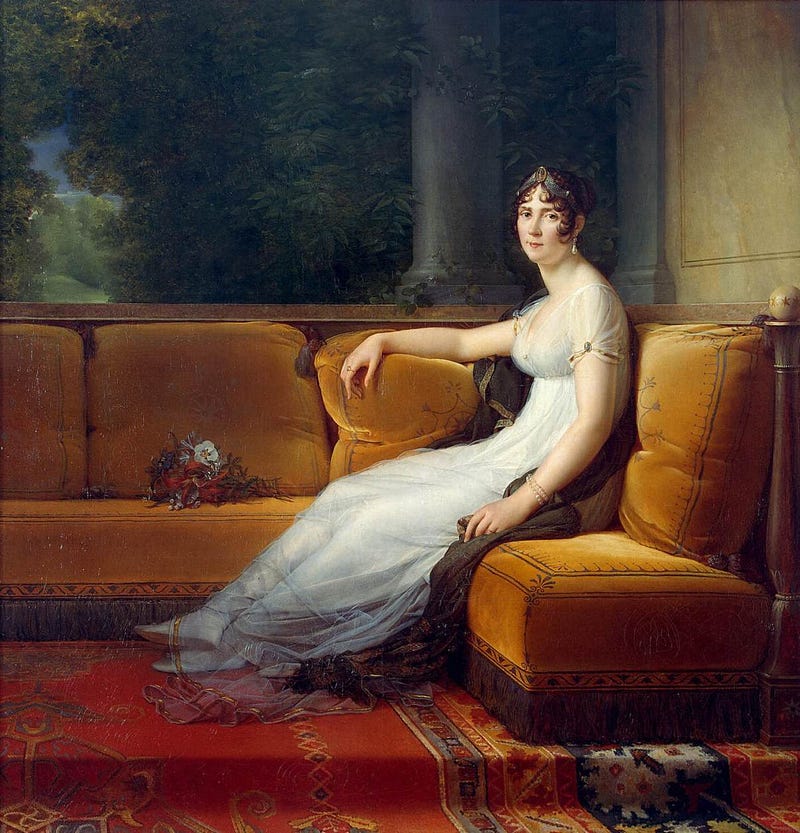
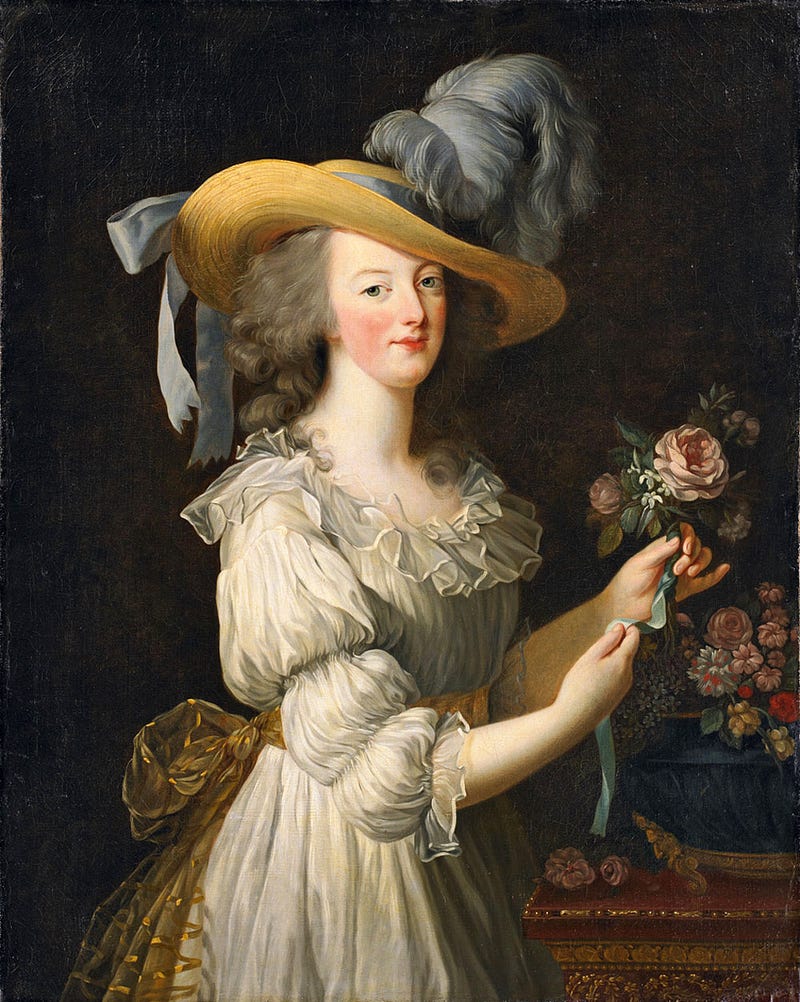
On the left: by François Gérard, ‘Portrait of Josephine’ (picture courtesy: Wikimedia Commons), on the right: by Élisabeth Louise Vigée Le Brun, ‘Marie Antoinette in a Muslin dress’ (picture courtesy: Wikimedia Commons)

Decline era

Between 1757 to 1800, the British East India Company seized the power of the Indian subcontinent. They started to squeeze the productivity of the weavers and farmers to trade Muslin to Europe. Meanwhile, the industrial revolution took place, which required more consumers for the industries to grow. The textile industry in Manchester was booming, and factory-produced mass-product ‘Muslin’ like clothing materials were placed on Lancashire power-looms cotton mills.

Britain started to apply heavy taxes, tariffs, and duties (75% export tax); along with that, Britain produced cotton products were flooded in all around the world. British traders monopolized the clothing industry through different means and squeezed out the other competitive forces from the market.

Bengal handloom workers found it difficult to continue their livelihood with the heavy burden of costs and moved to other occupations, eventually dried up the skilled labor on the field, causing further decline. That caused the eventual death of the legendary fine Muslin in Bengal.

Along with that, there were several feminine around the Bengal part of that period, which made it difficult to emphasize the cotton industry. People started to engage in more agricultural farming to cover up the food-gaps, which caused many of the handloom-experts and weavers to move to the agriculture profession.

‘Phuti karpas,’ the main element of Muslin, became extinct, which were only produced around the bank of the rivers, Meghna and Brahmaputra (in the current day Bangladesh) because of the dire agricultural production need around that time. (Source)

Only the Bengal jamdani (known as figured Muslin) survived because of its distinct style (abstract motifs, floral patterns of the loom) and continual practice in certain areas. ‘Jam’ meant flowers, and ‘Dani’ meant a container, thus forming a flower vase of sorts. Jamdani Muslin is a part of UNESCO’s Masterpieces of the Oral and Intangible Heritage of Humanity. (UNESCO link)

Revival projects
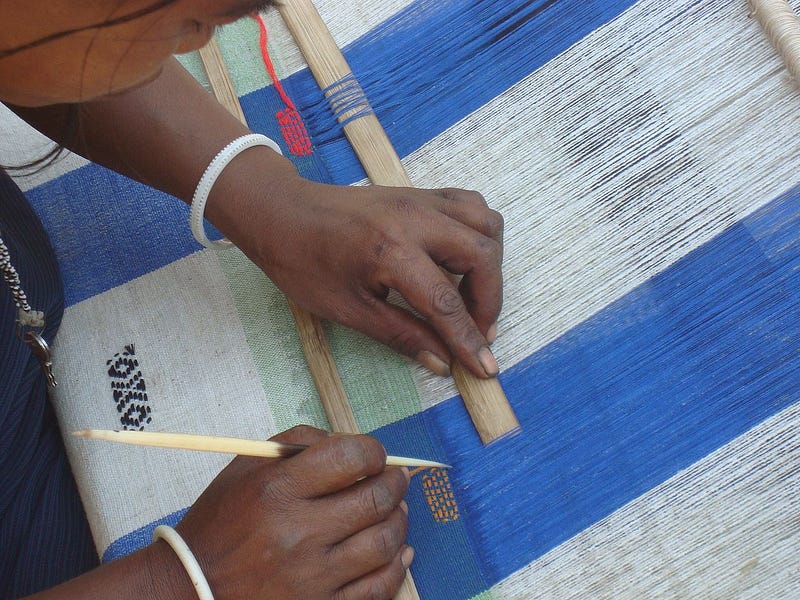
Image by Piers Brown, ‘Weaving’ (image courtesy: Wikimedia Commons)

Although Muslin was almost a lost trend, however some parts of Bangladesh and West Bengal part of India are trying to revive the heritage. Governments are trying to support the weavers by sponsoring their looms and weaving elements.

  • Recently, the Bangladesh Government has obtained a certificate to include the heritage of Muslin under the Geographical Indicator (GI) from WIPO (World Intellectual Property Organization. (Source)
  • ‘Muslin yarn technology and Muslin cloth recovery’ project undertaken by Bangladesh Government; the estimated initial cost of $2 million. The project will cover three major parts, such as: restoring the technique through intensive research, experimental production of muslin yarn and cloth, and, thirdly, identify necessary infrastructural changes to incorporate. (Source)
  • Project Plantation is formulated to revive and grow the ‘phuti carpus’ in a specific riverine arena of Bangladesh, a project by Bengal Muslin. (Source)
  • Project Muslin by West Bengal Khadi & Grameen Shilpo Porishod, creating infrastructure, training of the weavers, and research on the looms and clothing. (Source)

Although the name Muslin is now used for some generic materials used for households, the actual Muslin is completely different and requires effort from the respective Governments and interested organizations. It is an almost lost heritage of Bengal; however, as the efforts are in place to revive the yarns close to the past glory, the world might once again see the ancient thread as abundance in the coming days.

I’m crossing my fingers!

Other Sources used

Muslin
Fashion
Clothing
Heritage
History
Recommended from ReadMedium