
A Heartfelt Tribute to Akira Toriyama’s Worldwide Legacy
Remembering the remarkable work of one of the greatest manga artists of all time
Akira Toriyama is known worldwide as the author of Dragon Ball and an influential artist with a highly recognizable style. On March 1st, 2024, he passed away unexpectedly from an acute subdural hematoma. At the age of 68, he was still actively working.
The news of his death was announced one week later after a private funeral ceremony had already been held. Fellow manga (Japanese comic) authors and fans around the globe were shocked and saddened.
Though manga is decidedly Japanese, Toriyama’s work has a worldwide reach. This is exemplified by, for example, a tweet by French President Macron and coverage by the BBC regarding his passing.
As a European, I was first exposed to Dragon Ball in the early 2000s. This was a critical time for me, as I was just entering high school, and the show was something my classmates bonded over.
By sharing my experience and reflecting on Toriyama’s influence in general, I hope to illuminate his contributions to modern culture and pay tribute to this great author.
Unfortunately, copyright concerns prevent me from sharing Toriyama´s artwork in the article. Therefore, I encourage you to purchase his work or look for examples online.
Comedic Beginnings
Toriyama grew up in the 1950s and 60s, citing the manga Astro Boy and Disney’s One Hundred And One Dalmatians as early influences on his interest in manga, art, and animation.
Dragon Ball would much later contain a small homage to Disney’s Cinderella, with characters Bibidi, Babidi, and Boo named after the iconic song from the movie.
Though Toriyama grew up drawing, he worked in advertising for three years before calling it quits. Partially for financial reasons, he entered the manga industry in his early 20s.
His first published work was Wonder Island, which appeared in the publication Weekly Shōnen Jump in 1978. Though not particularly successful, Toriyama learned a lot over the next few years.
Dr. Slump (1980–1984) would be his first big hit. This gag manga featured an eccentric professor and his super-powered robot, named Arale. It received an anime (animated) adaptation, and Arale would later appear in a few crossovers with Dragon Ball.
Though his later work is more known for its action and drama, Toriyama’s sense of humor remained fundamental to his work and attitude. He wasn’t one to shy away from puns or clever character naming and stuck to his guns as an author.
This can be seen in the personal notes he shared alongside his publications, often disparaging himself for his forgetfulness and laziness.
While he was a rather private and humble person, those who worked with him appreciated his laid-back nature and the laughs they shared. In this sense, he remained true to himself throughout his career, and it’s helpful to understand where he got his start.
After a few more minor publications, Toriyama started developing a shonen manga dealing with martial arts. This culminated in Dragon Ball, running from 1984 to 1995.
Dragon Ball
Following from Dr. Slump, Dragon Ball, initially loosely based on the Chinese novel Journey to the West, also started as a comedy. The premise of the first story arc is that the tech-savvy girl Bulma is in search of the 7 Dragon Balls, said to be able to grant any wish.
She meets the freakishly strong boy Son Goku, who lives alone on a mountain, and he joins her on her quest. Throughout the series, Goku trains in martial arts, enters tournaments, and grows up to become an adult with his own family.
Though the manga is named Dragon Ball from start to finish, the anime adaptation transitions into Dragon Ball Z at the point where Goku finds out he belongs to an alien race, the Saiyans.
Around this point, the series becomes more serious in tone and adds space and, later, time travel to the mix.
From his early beginnings, Toriyama has had an extremely recognizable style. Unlike many other 1980s manga, his style was initially quite rounded, likely due to his background in comedy. As the tone of Dragon Ball matured, the art style became more angular.
Toriyama had a knack for clearly depicting chaotic fights within the limitations of black-and-white still images. You can always tell what’s going on, adding to the reader's excitement.
The manga's success spiraled into a whole franchise, including merchandise, video games, anime-only films, and follow-up series. Although Toriyama was not always actively involved, he often provided original character designs.
The recent Dragon Ball Super releases drew him back into the fray, providing overall plot outlines and guidance to the manga illustrator. Later in 2024, the anime Dragon Ball DAIMA will be released, something Toriyama provided the story and designs for.
Unfortunately, his involvement in new Dragon Ball material is now cut short by his untimely death.
Shōnen Standards
Shōnen (Japanese for “boy”) is a genre aimed at adolescent boys. To this day, it is the most popular category in the market, with its actual readership transcending age and gender.
The genre counts many of today’s most popular manga and anime among it, with well-known examples including One Piece, Naruto, and Demon Slayer.
At its core, you can find the narrative convention of the hero’s journey; a hero goes on an adventure, faces a crisis, and changes in the process. Though it did not invent the hero’s journey, Dragon Ball has shaped the shōnen genre in various ways.
The trope of the spiky-haired protagonist is largely inspired by Goku, with Toriyama designing the same style of characters for Japanese RPGs Chrono Trigger and the Dragon Quest series.
Thematically, Dragon Ball focuses on friendships, rivalries, courage, and perseverance. There is a clear sense of good versus evil and working hard to overcome obstacles. These themes are in the DNA of the shōnen genre.
Narratively, Dragon Ball works with segmented story arcs, often culminating in a confrontation with the villain on duty. This structure is still employed often, as it allows for a repeat of the hero’s journey within the same long-running story.
As a more visually striking example, Goku and his friends gain power-ups and transformations, most iconically the Super Saiyan form, where the hair of the character turns from black to gold.
This was partially born out of Toriyama’s laziness, as the hair in the Super Saiyan transformation would not need to be inked in the black-and-white manga panels.
Regardless, transformations would go on to become a staple of the shōnen genre. They also provide great merchandising opportunities, as you have multiple forms of the same characters.
Being aware of the above, it is easy to see where modern series draw inspiration from Dragon Ball; many prominent authors have gone on record to pay homage to Toriyama.
Anime in the West
Whatever your experience with or opinion of Dragon Ball, there is no overstating how much Toriyama paved the way for anime in the West through this creation.
A whole generation was introduced to Dragon Ball Z through Cartoon Network in the US and Europe. The series picks up in the more action-packed part, and its themes of perseverance through hardships and the overall coolness of the characters prove universal.
This particularly resonated with teenagers, who go through a lot of changes and could sometimes use a bit of courage and inspiration.
The series typically aired dubbed outside of Japan, which likely helped ease audiences into it. This did come with some unfortunate censorship and replacement of the musical score in the early prominent English-language dubs.
The dubbed episodes were later re-released with more respect for the original, and the American voice actors, in particular, have garnered a fan following.
Case in point, the “It’s Over 9000!” meme was taken from an English dub, referring to the so-called “power level” of Goku. As a bit of trivia, it was actually “8000” in the original language.
For many viewers, Dragon Ball normalized Japanese animation and evoked interest in what else was on offer. Though it varied by country, it gradually opened the doors for other anime to be released in some form internationally as well.
This was before the advent of streaming and the globalization of entertainment, so you would have to turn to peer-to-peer file sharing for anything your local TV channels did not provide.
The international success in turn kept Dragon Ball relevant, and the franchise now reaps the benefits of the doors it originally opened.
In the 1990s and early 2000s, it was hard to imagine there would be new Dragon Ball movies, let alone that you could see them in cinemas worldwide.
Closing on a Personal Note
I discovered Dragon Ball and, by extension, anime when I was around 12. At the time I had already seen the Pokémon series and some other shows that turned out to be anime, dubbed in my native language. It wasn’t until Dragon Ball that I realized there was a whole segment of entertainment out there that clicked with me.
In my high school, excitement was shared over the new episodes, especially if you had some advanced knowledge of what was to come from the internet. Those more dedicated also dabbled in trading cards and other merchandise.
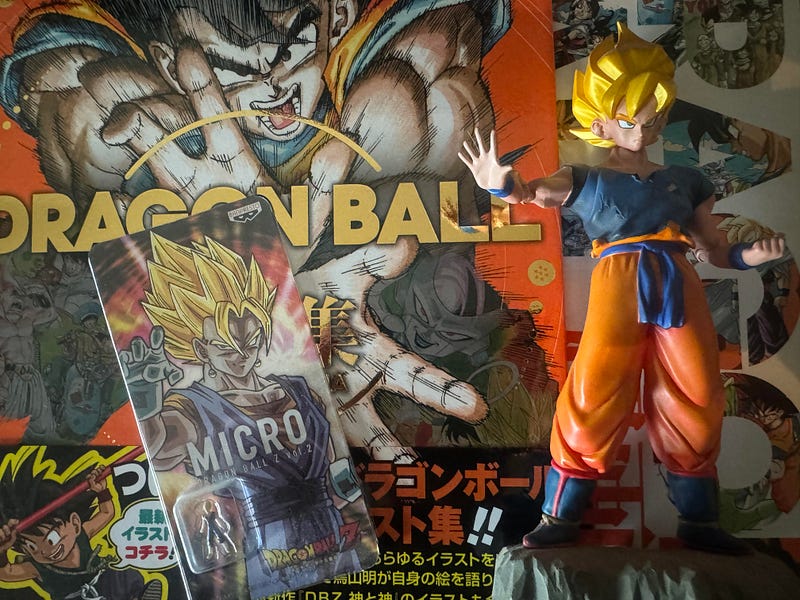
To this day, I have Dragon Ball figures on display in my home office. I revisit the franchise from time to time, whether through old material or a new release.
Though I am no doubt nostalgic for what I enjoyed in my formative years, I believe it holds up well and is still evolving alongside the media it’s dominant in; those being manga, anime, and video games.
It saddens me that Toriyama will not be around anymore to help shape and witness the next steps of his creation. With Kentaro Miura of Berserk fame passing away in 2021, it is the second time that a personal favorite author of mine has been taken away from actively creating.
My condolences to those Akira Toriyama left behind. May he rest in peace.
Thank you for reading my story.


