
A Guide to Database System Selection.
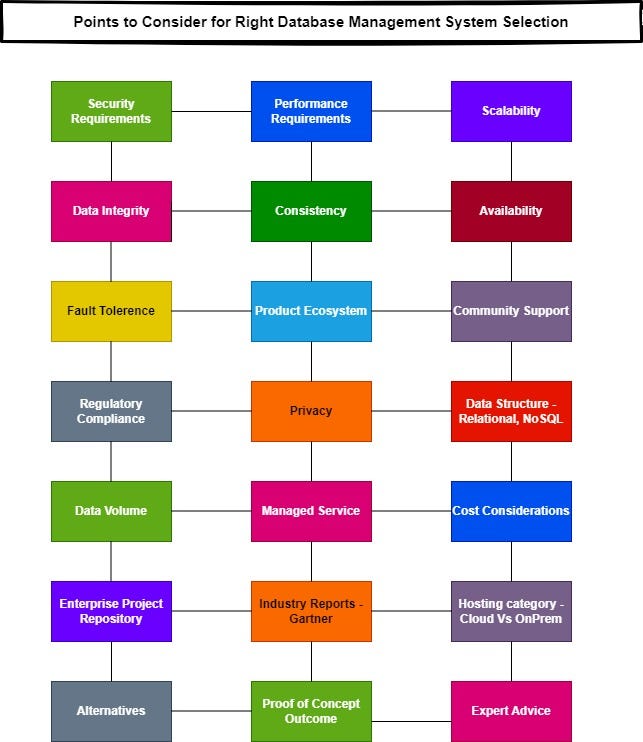
Introduction: Choosing the right database system is a critical decision that can significantly impact the success of your project. With a wide array of options available, it’s essential to evaluate your requirements and consider various factors to make an informed choice. Selecting the right database system requires careful consideration of various factors. Here are some key steps and factors to consider when choosing a database system:
1. Define your requirements: Start by clearly defining your project requirements. Consider factors such as data volume, expected workload, performance needs, data model complexity, scalability, security, and any specific features or functionalities you require. Understanding your project’s needs will help narrow down the options.
2. Data model and structure: Consider the structure and nature of your data. If your data has a well-defined schema and requires complex relationships and transactions, a relational database may be suitable. For unstructured or semi-structured data, a NoSQL or document-oriented database might be a better fit.
3. Performance and scalability: Evaluate the expected workload and performance requirements of your application. Consider factors such as read/write ratios, concurrency, latency requirements, and expected data growth. Ensure that the database system can handle the anticipated workload and scale effectively as your data and user base grow.
4. Data integrity and consistency: Determine the level of data integrity and consistency required for your project. If maintaining strict ACID (Atomicity, Consistency, Isolation, Durability) properties is critical, a relational database with strong transactional support may be necessary. If eventual consistency or flexible schemas are acceptable, NoSQL databases can be considered.
5. Availability and fault tolerance: Assess the need for high availability and fault tolerance. If your application requires continuous uptime and automatic failover, consider database systems that offer features like replication, clustering, or distributed architectures to ensure data availability and fault tolerance.
6. Security and compliance: Evaluate your security and compliance requirements. Consider features such as authentication, authorization, encryption, and auditing. If your project involves sensitive data or needs to comply with specific regulations (e.g., GDPR, HIPAA), ensure the database system provides the necessary security features and meets the required compliance standards.
7. Ecosystem and community support: Consider the ecosystem and community support around the database system. Look for an active user community, available documentation, online resources, and developer support. A robust ecosystem can provide valuable assistance, resources, and a community of experts to help you with challenges or future enhancements.
8. Cost considerations: Assess the total cost of ownership (TCO) for the database system. Consider factors such as licensing costs, hardware requirements, maintenance, support, and any additional tools or services needed. Evaluate the long-term costs and ensure the chosen database system aligns with your budget.
9. Evaluate alternatives and conduct proof of concept (POC): Shortlist a few database systems that appear to meet your requirements and conduct a proof of concept (POC). Test the selected databases with sample workloads and use cases to evaluate their performance, ease of use, and compatibility with your project.
10. Seek expert advice: If you’re uncertain or have complex requirements, consider seeking advice from experts or consulting database professionals who can provide guidance tailored to your specific needs.
11. Enterprise Repository: Study previous project experiences from the enterprise repository. Lessons learned, Challenges, success stories can be used to provision database system for the new project.
Conclusion: Selecting the right database system is a crucial step in ensuring the success of your project. By defining your requirements, considering factors such as data model, performance, scalability, security, and ecosystem support, and conducting evaluations and POCs, you can make an informed decision. Remember to consider the unique needs of your project and seek expert advice when needed. With careful consideration, you can choose a database system that empowers your project to thrive.