A Guide To Human Projectors
hint: it’s all about them
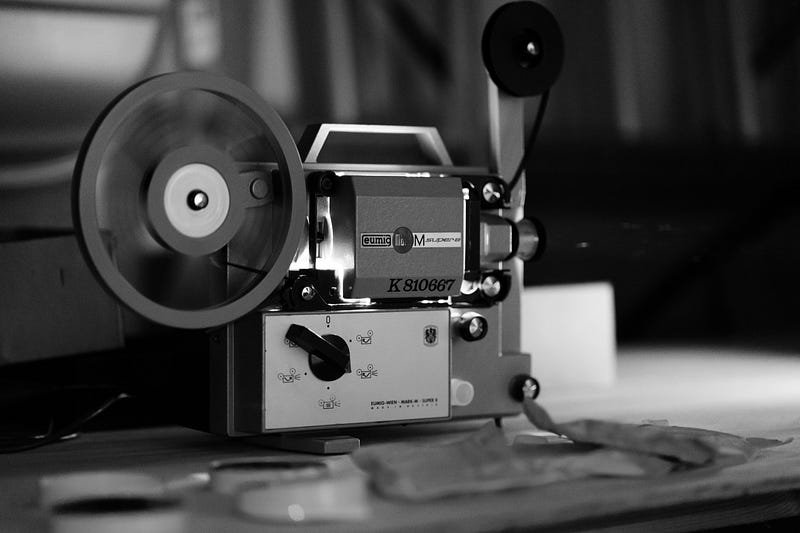
Projectors — be it a person or video equipment — project material out onto a surface — projections that come from inside.
In the case of equipment projectors, one puts in a film, slides, or some other external material, and that material is projected out onto a surface.
Aside
We now use projectors to aim all sorts of images onto the sides of buildings, walls, rocks, and more — it’s kind of fun. Far more fun than when I was a kid and video projectors were used for film reels at home and in movie theaters. When I teaching, I learned to use them because you had to show your own films in classrooms. I also recall film — in movie theatres and in school — spooling onto the floor. A break was then called as the operator [often moi] tried to carefully collect the fallen film and get it back on the spool so the movie could resume. [not fun]
People who project work the same way — with one difference — they take what is inside them and put it out there — onto other people or groups, not onto walls or mountainsides. Except in the case of some human projectors — they put their projections onto businesses, countries, most anything that they choose to put it on.
In my realm of psychology, we say “they project all over the place.”

Ego defenses
We all have egos — even if you don’t like or believe in Freud, you have an ego — with whatever label you chose to use! And you take care of it; massage it, relish in it — protect it! Like a peacock showing off its plumage.
We all protect our egos, it is a normal part of us — which is why we all engage in certain behaviors known as ego defense mechanisms.
Projection, denial, repression, regression, rationalization, displacement, reaction formation, sublimation are all ego defense mechanisms. I have a Ph.D. in Psychology. I have taught classes where egos and defenses are a major topic — but that’s not for here — it’s too involved for this article.
A defense mechanism is just what it says — it’s a psychological mechanism one uses to defend one’s own ego. These mechanisms are considered normal parts of human behavior.

What one is defending oneself against are those impulses or thoughts in one’s self that one does not like.
It’s the things you do, or think, that you know are unacceptable — so instead of saying: “mea culpa, I’m doing something wrong and I can fix it” — the projector says “see that person over there they’re doing all these wrong things” — it’s not me — I am perfect.
Projection
Projection is a way of trying to not admit that one has certain thoughts in one’s head by saying “others” have/do it. A common example is people who are obsessed with other people’s sex lives — that they try to control other people’s sex lives.
It doesn’t take a psychologist to be aware that the problem about sex exists in the head of the obsessor— they fear losing control of their own sexual feelings and they will not admit this. So they work hard to control everyone else’s sexual impulses — hoping that by doing that they will control their own.
This projection most all of us learn before evet taking a psychology class! It’s so common, we read about it in the news these days.
Current projections in the news
There are so many projectors and projections taking place these days that I am only listing a few. Hopefully, readers will add more in the responses.

Voting by mail leads to widespread fraud
Projectors saying this would themselves try to sabotage a mail vote — this class of projectors is so afraid of not controlling how people vote, they say “others” want to create fraudulent votes.
Voting by mail is fine. I live in Oregon and we vote by mail. It’s safe, secure, easy to do — and we get 3 weeks from getting our ballots to returning them — sufficient time to reflect and vote.
Name-calling, i.e. you’re a loser, rude, ugly, etc.
The projectors call many people names because the projector fears they themselves are a loser and fears others will see it. They think by name-calling they will be seen as strong and the person they are labeling as weak. They think we can’t see the truth about the name-caller.
You’re doing this because you don’t like me
This could be an accurate projection when put onto a number of people. True, they may not like you — but mostly they are doing their jobs and your feelings about them are irrelevant.
You name-call so much, it gets tiresome — and it’s more likely they don’t respect you — and that bothers you so much that you project even more.
You do not like those people to whom you say this, and your behaviors show us this is your ego defense —
you do not like yourself!
Your ego is very fragile and it needs constant defending.

Distorting the self-image
And sometimes, in my personal take, the projector looks into a mirror and projects their own distorted version of that image.
This is not the same as saying affirmations and working on bettering yourself. It’s projecting based on fear of exposure.
Here are some self-distortions….
I am a genius
Projectors say this because they fear they are not smart. Geniuses don’t say they are geniuses and smart people know they are smart and just go about doing their smart stuff.
I know everything
These projectors have a deep fear of people discovering that they, the projector, know very little. About anything!
I hire the best
The projector saying this is not being truthful — they actually fear being outshone by a smart competent underling. Projectors with this distorted image tend to hire “yes people.” And fire those who do not admire the distorted image.
Projection, like all defense mechanisms, is a normal part of our being. Most of us use a variety of defense mechanisms and use them in healthy ways. They allow us to function more-or-less normally in society as we interact with a variety of people in a variety of situations.
And if we recognize our own defense mechanisms, we can learn from them as they can help us self-reflect and self-correct — to learn, and grow.