
MARKETING AND CHURN
A guide to customer retention
Understand the fundamentals, have a strategy built on revenue growth and customer focus, utilize analytics and automate operations, and be targeted and agile in your execution.
Often, acquiring new customers or stimulating immediate sales is appealing, while keeping that customer is an afterthought. However, because acquiring a customer is almost always the single most expensive action a business takes, and because a customer is the most important asset a business has where every customer represents future value for a business, it’s crucial to retain customers and build long-lasting relationships.
The term customer loyalty should not imply that it’s up to the customer to be loyal to your business or that when a customer or client stops doing business with you, it’s because they’re disloyal. But in reality, loyalty is a symptom of a cause, our retention efforts. Without retention efforts, either accidentally or purposefully, customers cannot have loyalty. Loyalty is a feeling, the emotional bond that customers have towards a business. Loyal customers are often not swayed by pricing or a mistake in the delivery of products and or services. But if a business doesn’t have the right retention efforts in place, it’s almost impossible to create loyalty. Therefore:
Retention is the culmination of actions and efforts that lead to customer loyalty and the company bears its responsbility
If the sales and marketing staff of a business only talk about promotion or ad campaigns, then they’re only doing half of their jobs. Intentional lack of retention efforts translates to opportunities lost to competitors, the chance to upsell or cross-sell, and increased loss of customers that were gained so expensively. However, Retention efforts will lead to happier customers who spend more money and close more deals.
Retention isn’t difficult, but it needs a process, and a system in place. To realize whether you need a retention program, answer the following questions:
- Do you expect your customers to be loyal?
- Are you doing enough to create this loyalty?

Building a successful customer retention program
The customer Lifetime-Value (LTV)
The customer lifetime value is an important insight because it allows a business to know exactly how much it can spend to get a customer, keep them, and what that customer is worth over time. But to calculate this number, there are two challenges:
- Every business needs to determine what their specific lifetime is. For example, for one business, a customer may buy its offering on average for two years, while for another, this could be 15 years. A business needs to have a good estimate of when customers should be buying, and if they haven’t. This information will better equip one to know the difference between a customer retained and a customer lost.
- There is no such thing as an average customer. It can be dangerous to lump customers into a big amorphous blob. Customers need to be segmented, and for each segment, depending on their demographics and psychographics, the lifetime value should be different, therefore, retention efforts need to take these differences into account.
When the above two challenges above are defined, you take the total profit of a client over the lifetime of buying from a business and subtract all the sales, marketing, and service delivery costs from that client; this number will be the customer's lifetime value. There are other more complex methods of calculation depending on the business and revenue models of your business. Take caution that calculating the customer lifetime value, need not get overly complex, as just having a general idea of the customer lifetime value is better than knowing nothing at all.
Building meaningful communication
A business’s ability to retain a customer has almost everything to do with how meaningful a relationship it builds with its customers and this will only be achieved through maximized personalized communication in a world of increasing automation due to cost-cutting efforts. Simply put, retention efforts must be meaningful, memorable, and personal. This is where many companies fail such as by sending “Dear Valued Customer” in an email opener without mentioning their name or using recordings that say “your call is important to us” while the wait is more than an hour, or “your feedback is appreciated” while no one reaches out after you’ve provided the feedback.
To improve customer retention and build a meaningful relationship with customers, there are two simple action steps:
- Assess all the customer touchpoints once the prospect becomes a customer. Make an inventory of everything that happens and ask, “Are we truly doing enough to make those touchpoints meaningful, memorable, and personal?” and “What can be done to improve the customer experience and make it more meaningful?”
- Use the red pen/green pen test. Assess your communication with prospects and customers such as sales calls, customer service calls, website copy, social media, e-mails to prospective clients, RFPs, etc., and review them using a red pen and a green pen. Anytime you use language such as “I”, “we”, or “our”, or anytime you’re speaking in a way that’s beneficial to you, but not the customer, circle it with a red pen. Then, look for areas where you used language that’s beneficial to the customer such as “you” or “your” and mark them as green. If there are more red marks than green ones, then you need to change your communication pattern as successful marketing efforts need to be focused on what’s in it for the customer. Unfortunately, businesses tend to spend more time talking about themselves versus what they can do for the customer.
Remember that customers want to be talked with and not talked to. If you can talk with them, you can make that relationship meaningful, memorable, and personal.
Be a consistent communicator
The readership of the New York Times or The Wall Street Journal relies on the consistency that these papers will deliver content every morning. And this is the case with customer retention also: consistency over quantity.
In a world full of noise and content marketing, one of the most amazing things you can do to improve customer retention is to be consistent. The more consistent you are in following up and maintaining relationships with your customers, the more likely they are to do business with you again. Too many businesses look for that next big promotion hoping to bring customers back when customers will eventually get conditioned to all marketing efforts. But if you don’t stick around, customers will eventually forget you.
Too many companies are inconsistent, in that they blog one week, and then miss three after that or send a newsletter to customers one month, and then it doesn’t get done for another six more. This is quite frankly one of the most simple ways to improve customer retention, and on the flip side, one of the most likely ways to destroy it if you aren’t consistent.
To become consistent, you need to have a plan. Think about one piece of communication that goes out regularly to your clients or one that you want to add to this list. Once you’ve decided what you’re going to send, pick a date and a time, define who is responsible for what, and make sure that piece goes out no matter what, and commit to doing it for at least three months. If you can show up regularly and consistently each week, it’ll go a long way with your current and prospective customers.
Customer loss/attrition prevention
A business is like a bucket with lots of holes under a faucet of water and no matter how much the faucet is on, it’s always going to be leaking — you will lose customers. If the faucet is on full blast, then you’re probably not going to notice the leaks too much and if the faucet is completely off, you’re going to have an empty bucket pretty soon. What happens most often is that the water from the faucet is varying and sometimes you’ll notice the leaks more than others. The more water in your bucket, the more customers in your business.
Now, if you have almost no control over the flow of water from the faucet the only way you can change the amount of water in your bucket is by plugging its holes, and the more holes you plug, the more water stays in, regardless of how heavily it’s flowing. We live in a world obsessed with marketing and customer acquisition, but a business usually has more control over keeping its customers through retention efforts.
Holes in the bucket or the reasons why customers leave are many. Some common ones include: customers are confused, they don’t feel at home after doing business, their expectations aren’t met, they may feel slighted, insulted, uncomfortable, they have unvoiced concerns or worries that haven’t been addressed, they may have less than 100% confidence in your products or services, Or maybe they don’t hear from you soon enough after their first purchase. No matter the reason, you need to understand why you’re losing customers and the easiest way to do this is to routinely solicit feedback from customers through, for example, regular surveys and emails or random daily customer calls. The point is to be in touch and continually ask, “How can we better serve you?”, in the hope of figuring out where the business’ holes are and working to improve them.
So regularly learn from your customers and continuously improve. Talk to lost customers, current customers, and past customers. Review your reviews in customer feedback. Look for patterns or the indication of holes in the bucket, and work at plugging those holes.
Retention and revenue growth
Have a strategy
A retention strategy is a plan or a process designed to help a business retain customers after the first sale — simple. While most companies don’t think beyond the initial sale, successful businesses carefully develop and continually refine their customer retention strategies. Three steps will help a business build and develop an effective retention strategy:
- Develop a customer retention mindset. A customer is never likely to come back to you on their own. Getting a customer back is about what you do throughout the entire customer experience. Before, during, and after the sale. Retention needs to be treated as a profit center that needs systems and processes just like sales and marketing.
- Know what you can spend to keep the customer. If the customer is worth $500 over a lifetime and has a problem, solve it by spending money and that’s why it’s vital to know a customer’s value and what you can spend to maintain and service the customer.
- Understand your positioning in the marketplace. To develop a retention strategy, you need to consider how you’re presenting yourself in your sales and marketing efforts. So if you claim to have the most incredible service, your service better live up to that. For example, if you claim that, “we keep working until you’re satisfied,” you better be prepared to live up to it.
To get started, map out how often and when you’ll get in contact with your customers. For example, you plan to contact your top 10% of customers every 45 days, and no single customer will go more than 90 days without a 15–30-minute personal phone call. In this strategy
- No client who has purchased from the company will go more than 90 days without at least a 15-minute phone call, and preferably a 30-minute in-person meeting with the sales rep.
- The plan segments customers and prioritizes them based on their value, providing more resources to those who generate more value.
Segment customers and find a focus
To successfully incorporate a retention strategy into a business, you’ve got to identify the most valuable customers and how you’re going to focus your retention dollars on them. There generally are four categories of customers.
- The most valuable customers. In terms of overall spending, or even overall goodwill such as referrals, word of mouth, or becoming an advocate for the business. Depends on the business’s needs at that moment in time.
- The potentially valuable customers. These customers don’t have a lot of value right now, but they have or are showing potential to become more valuable.
- The valueless customers. These customers were valuable in the past, but they’re showing little to no future promise, perhaps no longer doing business with you.
- The one-off customers. There is no future promise with this segment. For whatever reason, this is likely to be a one-time transaction.
Understanding these customer categories is key to unlocking data-driven customer retention plans whereby instead of building a retention strategy that’s reliant on spending equal dollars on every customer, you’ll be spending retention dollars on those who are likely to do business with you again or those who are likely to be more valuable in the future and waste less money on those who are unlikely to do business with you again. There’s no such thing as an average customer.
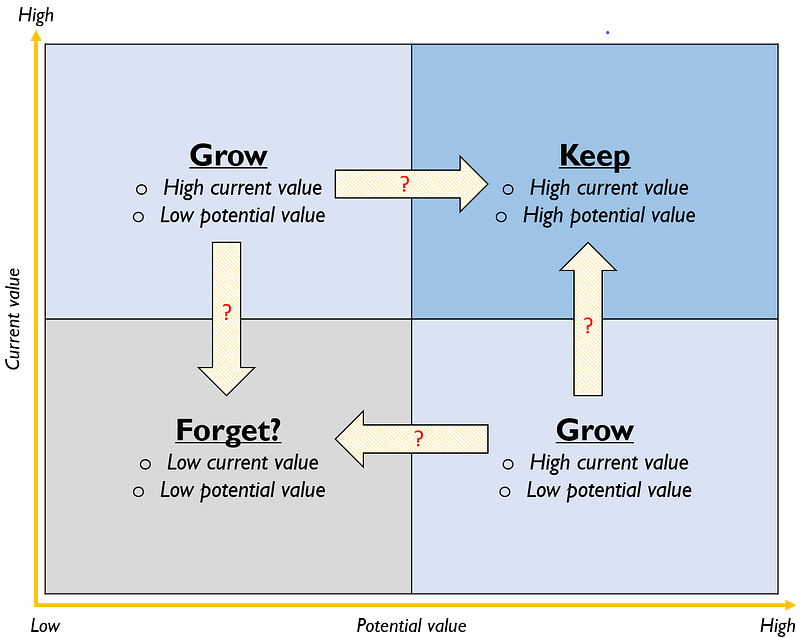
Looking at the chart above, the goal is to do whatever it takes to keep moving customers into the upper right quadrant, the loyal and most valuable customers, which have both high current value and high potential value. The majority of a business’ retention efforts should be spent on customers that fall into the top left and bottom right quadrants. What every business needs to do is figure out how to identify and categorize its customers into these buckets, which can be done through data it acquires through CRM and customer management tools such as SalesForce.
Without an understanding of where customers are, nearly everyone gets the same treatment and you’re likely to waste marketing dollars for not much of an ROI. The key is to realize that every customer falls into one of these four categories and a business needs to more effectively focus on the customers it’s most likely to retain and the customers that show future potential.
Leverage customer data to make informed decisions
A few years ago, the owner of a small local restaurant came to me and explained that while they were busy, the business wasn’t growing. So I asked them about their customer database and I asked them about their retention efforts. What I found was they were nonexistent. So we created a very simple system for capturing customers’ names and information. In just four short years later, they had over 6000 thousand customers on file. Those customers have gone on to become the lifeblood of this business and of course, they expanded beyond just names and emails to capture some of the data we’re going to talk about now.
All businesses need to capture at least two very specific types of data to engage in customer retention:
- Demographic data, who they are, where they live, how do you reach them, their phone, their email address
- Purchase behavior data, which is more important for the discussion on retention, entails information such as when was the customer’s last date of purchase, what they bought, and how much they spent.
In the world of business recency, frequency, and monetary value, or the RFM model, is commonly used to segment and weigh customers. The real value of the RFM model comes when you merge all of these parts to form one key indicator. For example, your data might indicate a customer who typically purchases from you twice a month, that’s her frequency and who specifically just purchased from you three days ago, that’s her recency and who spent more than she usually spends with you on each purchase, that’s monetary value.
The RFM is a powerful model to measure and devise retention efforts and through the simple act of collecting customer information, a business can make informed decisions on an individualized basis and take appropriate actions in ways that are meaningful, memorable, and personal. Even if their behavior shows that their buying frequency is changing and perhaps they’re getting ready to start doing business with a competitor, you’re able to put the right types of messages right in front of them and hopefully, you can keep them.
Look for behavior change patterns
Suppose a customer has purchased from your business every month for the past six months and suddenly, two months go by with no activity. But then, the customer comes back, makes another purchase, perhaps even two, and then another four months go by and suddenly the customer is gone. If you had been paying close attention to the customer’s behavior, you would have noticed that the customer was showing signs that something had changed in their purchasing patterns. So make it a point to watch for behavioral changes amongst your customers. Odds are if you can recognize behavior changes from one customer, it’s likely those changes will apply to many customers.
Your next step is to be proactive and do something about it. For example, instead of waiting for the customer to defect to one of your competitors or to stop doing business with you, reach out. Be proactive and start by asking the customer whether they are experiencing any problems with the business’ offerings. And many tools these days allow us to automate the process. For example, most online shopping carts have abandoned cart features that allow us to automate the process of emailing a customer who put something in the cart but did not buy.
The beauty of this approach is you don’t need a list of suggestion questions or a giant retention manual to win back the lost customer. You simply need to proactively start a conversation to learn what’s going on. More often than not, the act of proactively reaching out to your customers is enough to bring them back as the number one cause for attrition is that people get busy or even fall out of the habit of doing business with you as everyone has a lot of stuff going on in their lives. The last thing they do every day is wake up wondering how they can give your business more money.
Resurrect lost customers
A customer reactivation campaign is when you’re reactivating a customer who was once a customer but is no longer one. Making the reactivation of lost customers as part of ongoing retention efforts might be the single fastest way to generate short-term profits in any business. Existing customers are a business’s best and most valuable customers. The next best customers preexisting ones or the ones who were previously customers but no longer are. There are three simple steps to running a reactivation campaign:
1. Identify lost customers: Review customer files and see who isn’t buying anymore or who didn’t purchase the last time they were expected to. Once you have that list, review it to ensure you know why those customers left and didn’t buy from you when they should have. 90% of your success or failure is going to be directly linked to the relationship you had with those customers when they were still a customer.
2. Develop an approach and launch a reactivation campaign: while some large consumer businesses might start with an automated marketing campaign due to the scale of their initiative, it’s always best to start with a customized and personalized campaign. Try to make phone calls, then emails, and then finish off with sending them letters
3. Track results: here, you will need a CRM or an Excel file to keep notes on customers because if a customer comes back after the first phone call, you don’t want them to get another call or another email three weeks later.

Fundamentals to success
Automation
There are generally two ways we can use automation in referral efforts:
- Automated marketing. It’s programmed, happens 24/7, and is a powerful tool within the customer retention toolbox. For example, sending a welcome or happy birthday email. Again, rather than building mass-oriented communication templates, it would be best to develop customized solutions based on the customer segment archetype and AI tools. In other words, engage customers in meaningful conversations.
- Customer analytics. Here the purpose is to use customers’ behavioral data to understand when we need to take action. For example, let’s suppose customer A should have purchased last week, based on their customer lifecycle profile, and didn’t and we get notified through automated reporting. Such tools give us a wonderful opportunity to be proactive and take action. Or for example, customer B almost always spends $100 per transaction, but on their last three transactions, they only spent $10. We could create an automation that would alert this behavior change.
Having these reports provides us with credible data and an appropriate reason to take action. The underlying assumption here is that past and current behavior are the best predictors of future behavior. Automation should be used as a tool to be proactive in retention efforts.
The appropriate reason and time
While consistency is more valuable than quantity, and recency and frequency are the crucial underpinnings of customer retention, we must also appropriate reasons to contact customers. There always needs to be an appropriate reason and an appropriate time for communication. Otherwise, it will damage our ability to build loyalty and meaningful relationships with customers. Communicating with customers with the right message and at the right time can feel like a phone call from a friend.
Customers want to be acknowledged and appreciated, to be recognized for their business, and that they are valued for it. Therefore, we need to think of communication reasons carefully and strategically. For example, it may be inappropriate to reach out for a testimonial the day after a product is delivered, but it does make a lot of sense to get in touch right away and ensure that the customer understands the product and does not need any additional services. This would be an appropriate time with an appropriate reason.
Customers don’t want to hear from you if it’s an inappropriate contact at an inappropriate time, but they’ll always welcome a contact that’s beneficial to them. The bottom line is that it’s always appropriate when it’s not self-serving.

Execute: retention in action
Dedicate resources
While large corporations have resources to address their retention efforts, in the case of a startup, every day, the retention team or even all employees need to engage in three simple tasks related to customer retention. This could be three new client calls, reaching out to three lost clients, sending three handwritten notes, or sending three unexpected gifts to top clients. All of which should take an average of 15 minutes to complete. You might be thinking, this seems pretty simplistic and it is but this is where you take advantage of the power of compound growth. If we can get an entire division or an entire company engaged in these daily tasks, the results can be incredible. Just make sure to record logs and collected data for future analytics and assessment for further action.
Make phone calls to 3-high-value customers
Pick three of your best clients based on total revenue and call them. Review the client to understand the last time they purchased and what they purchased. Review the last time someone else spoke to them. Spend time conducting a quick Google search to see if there’s anything about them in the news. Remember, this call is all about putting the customer’s interests ahead of yours. If you call them to pitch your latest offering, then you’re doing it wrong.
The language can be as follows: “Hi, X, it’s Y over at company Z. How are you? Do you have a minute or two to talk? Great! Listen, the reason for my call today is that I just wanted to call and thank you for all the great business you’ve given us over the years. You’ve been such a good client to us and we just want to say thank you and ask if there’s anything else we can do for you.”
Don’t send an email. Your customers need to hear from you. They need to understand that you care and that you appreciate them and the telephone is the single best tool for these conversations. Below are a few examples of the ways we can communicate with customers.
Send 3 handwritten notes
We live in a world where every day there are new ways to communicate with clients including through social media. But we seldom receive a handwritten note. Try sending handwritten notes to your customers and the number one reason to do this is that you’ll instantly stand out from the rest of your competitors as it shows you truly care because you took the time to do something almost no one else is doing and it costs almost nothing.
Target new clients
The problem with a lot of current subscription-based websites and platforms is that they forget that telephones still exist as they tend to not call clients which can cost a business hundreds of thousands of dollars. This is why it is important to call brand-new customers. The conversation can go as follows:
“X, it’s Y over at Z. How are you? Do you have two minutes to talk? Great, I just wanted to call you and thank you for your business. I see we delivered your first shipment last week and I’m just calling to check in to make sure that everything was delivered as promised.”
Customer retention is up to the business. Great products and services will only take a business so far. It’s a business’s actions that drive retention and create customer loyalty which is a symptom or a feeling that we create through our retention efforts. A business exists to serve a customer, to continuously add value, to care for them, and to develop a relationship. A customer votes with their time, their attention, and their wallet, and it’s up to you to earn it.
Hope you enjoyed reading this article! :)
If so, then:
- Follow me on Medium
- Become a Medium Member
- Subscribe to hear more
- Let’s connect on LinkedIn