
A guide for those who lead open organizations- “Disruption is existential”:
Open source initiatives are very common. Can Open Leadership be an outcome of this? I read the Open Organization Leaders Guide (The Open Organization Leaders Manual) book and the I shared my notes and thoughts I have received.
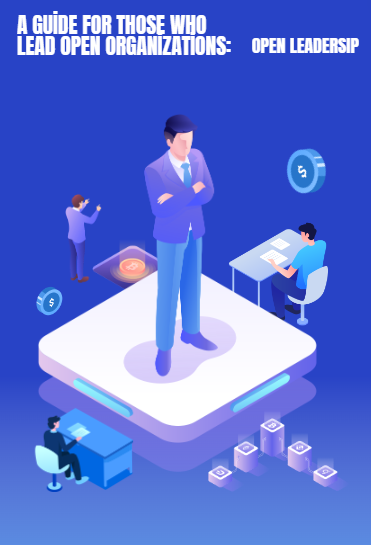
In the book, which has gathered the opinions of experts in many different competencies, they try to explain the phenomenon they call “Open Leader”, the previous one in the plot. The goal is to create innovative/innovative and engaged teams here in the context of open organization.
Bryan Behrenshausen, one of the authors of opensource.com, takes the lead-free concept of organization. Nowadays, it expresses concepts such as open office and paperless office, how much solution they have been, how much targeted has been achieved with the open office with paperless office is an open topic for discussion. When the concept of organization is treated as a collection of relationships, it emerges as the basic leadership ability to direct these relationships and to direct those relationships. Leaders, as a general definition, determine a subject as a collective priority in any given time period and ensure that this issue is concluded or success is achieved.
The leader here is actually the person who provides the sustainability of the relationship collection that I just mentioned when I say “collections of leadership” with this point of view, that is, the organization that is responsible for this is the leadership institution. Organizations that do not have such a leadership or leadership approach cannot be organizations or maintain the ambition to be an organization.
Nowadays, scholars in many sectors (pundit) today’s leadership concept in the relations related to organizations in the whole, formal and end-to-end specific and sharp roles instead of different and multiple points to show and do business; that is, it should be at the point of self-development and training at the point of execution, writer says.
According to the principles of open organization, today’s sense of leadership must be reorganized. In fact, many different experts in the book, although they are in different areas of expertise in these subjects, convey similar comments about it, I found it quite informative. I definitely suggest you read it.
In the book, there is a saying called “Disruption is exential”, emphasis is made on the fact that decay is an existential phenomenon, and many things are told about change and transformation. “Disruption” is not only a subject that comes up in the design of an organization today, it is also an important issue in how we express ourselves and how we define ourselves.
In these days when technology and especially post-Pandem digitalization are more in our lives as products and services, this concept of disruption as leaders and organizations is seriously challenging organizations, accordingly, it is forced to take existentially decisions and initiatives for institutions and their related work. Even this may not be enough, because with today’s changing market conditions, they have to implement them quickly and make decisions very quickly.
Expecting results can be deadly in order to advance in our business.Let’s observe a result, let’s go in control. Or am I do not wait until we take everyone with us, especially one who is condemned to lose approaches such as observing and anticipating. Unfortunately, these are the perspectives that will lose where fast business is so much in our lives. There is no chance to wait or predict in this new period.
The concept of digitalization, which is right here in front of us all, is emerging as one of the sources of this concept of “disruption”. The new insights and arguments that come with digitalization are reshaping organizational management and the work of the organization. The issue of “lead” being reshaped.
Timing, especially from being fast, is a significant risk point for today’s leaders. I think what exists can be considered positive in terms of lovingly going fast from the comfort zones that surround us at the expense of adapting to that change.
In market dynamics, customer experience, arguments are constantly varied and shaped, while fast, what should be the top priorities of today’s leader?
Take the Digital Transformation (DX) side and evaluate its existential impact on people, even in every human way. Once you have set priorities on this issue, shaping the organization and business accordingly can get an answer:). That is, quickly change the organization, quickly bring in teams of new requirements-compliant abilities/competencies. According to the new need, it is necessary to change the issues of business conduct and leadership. So we need to change the culture, and what I understand is that cultural change comes and goes again:)
As with any change in this change, changing the culture is the most challenging subject. In every organization, leading societies accept change, but today it is much more difficult and challenging to “execute” because the “best practice” we have at this point is no longer useful, old models do not work and will not work. Here in the book, the new game brings new rules. So in the past, when you move a service to IT, you would not touch many applications, you would open the door and move the service in its new environment, but in the micro service architecture, that is, the modernization point of the application, the code is now suitable for the new micro service architecture it needs to be brought.
This brings you to think in much more detail carefully and with different arguments. New terminology goes into the business DevOps, CI/CD, SRE etc…So you can’t just recover it with a platform exchange. Mindset, organization, culture change is also needed, in the book, how to set up a setup in the most appropriate way and gives advice and suggestions on this subject.
Open principles and the eventual open organization are important for DX efforts to succeed and for success to remain sustainable.
It is important that open principles come to life, are accepted, are included in working life, clear principles can be summarized in 5 main headings:
1-Transparency,
2-Adoptability,
3-Collaboration,
4-Inclusivity,
5- Community.
I mentioned DevOps teams from the technology teams alongside the Platform teams, they work side by side while operating the PAAS platform, which is an important formation in the Cloud Native structure nowadays but only end-to-end logic that is CI/I/It should be fully integrated into the organization like CD logic.
We must adjust the degree of difficulty in change well, not complicate everything, determine the steps we will take well and proceed with determination accordingly. In the matter that we will already face as a new issue, we must determine the difficulties well while constructing the transformation. Business and process change is the simplest approach to change. In classical organizations, the Top-Down approach is used to manage change.
Open organizations use the Bottom-Up approach. Thus, the employees of the organization primarily address what they do, how they do it, what they do for. They come together and get involved in a way that they are all together to come up with a new idea, a big idea. A collective advance becomes possible with this inclusion. Organizations thus focus on change, where they make their ecosystems strong through that inclusion, enabling decision-making, including teams.
Leadership is power by definition, having the power to influence the actions of others in the organization. Many new leadership concepts have emerged in wars. The fact that it was in wars, the implementation of commands, the thought of control were discussed at the point of walking to the common goal. As in many fields, wars in human history cause the development and emergence of many things, leadership process and types are one of them. In traditional leadership, leaders try to manage this in a pool of power according to their position. Hierarchy and the authority laid down accordingly, the reporting of relations are arguments for institutions and leaders.
As for the 20th century, these arguments and regulations began to change. With globalization and opening the door of technology to globalization, distributed team, distributed domain structures came to life. People’s communication, teams’ communication, people-oriented perspective emerged. As such, people’s success and mistakes in organizations became stronger and more developed.
The power of leaders has changed, the leader has lost the ability to be the sole owner of power. The new identifiers of power (empowerment, collaboration, accountability, clear communication ) were concepts such as authorization, cooperation, accountability, open communication. Leaders began to share power. Organizations have turned to removing their hierarchy chains and providing employees with work spaces and work conditions where they feel maximum benefit.
It is the product of this tactical approach that the big players, today’s giant IT firms, prepare and serve working campuses such as the hanging gardens of Babylon in the sector. In addition, in the environment where the roles and responsibilities of the leader in the global world increase wildly and rapidly and develop, it is not possible to catch up with the leader at every point in the environment where the aggressive approaches cover our lives.
So the leaders must be clear, they say, In this context, the concepts of Control, Communication, Trust, Autonomy, Empowerment are being reevaluated. As an example of control, old school focuses on how to use leading power, while the open leader delegates power, that is, to act collectively using the maximum of the technological possibilities at hand, “THE POWER OF TRUST “he believes in his grasp. Do this shows the way about what to do instead of do it and creates the process.
I hope you have a pleasant reading experience.
Link:
Turkish Part:
I share the song I listen to while I take my notes, I wish I would listen well:)::


