
A Guaranteed Way to Rank Your Blog on Google’s First Page (Even With a Brand New Website)
Without backlinks. And without having to bleed writing hundreds of articles
The headline sounds catchy, I know.
But what you’ll discover in this article is my secret game plan that allowed me to rank my brand new website on Google’s first page without having to create a single backlink.
In doubt? Here are plenty of proofs.
If you take the time to really internalize and apply these 5 simple concepts, you’ll be able to generate traffic for free and build your email list on autopilot.
Let’s dive in.
Boost Your Website’s Speed to Light
Your website's speed is the jet fuel of your online success.
Google’s algorithms are like airport controllers, directing traffic to the fastest and most efficient routes. A high-performance website is like a well-oiled jet, always ready to take off on Google’s runway and reach the skies of high rankings.
The typical route to online prominence can be like a car trip on a congested highway. But why stick to the road when you can soar?
By focusing on website speed and aiming for a 90+ score on Google’s Web Vitals, you optimize your site for the best possible user experience.
And guess what? A happy visitor is a loyal visitor, and loyal visitors are exactly what Google values the most.
So, doing this not only improves your website’s speed but also helps avoid the heartbreak of low traffic and poor user engagement.
Here’s the lowdown.
Google’s Web Vitals measure the quality of a user’s experience using a set of metrics.
These include:
- Largest Contentful Paint (LCP)
- First Input Delay (FID)
- and Cumulative Layout Shift (CLS)
Already lost? Great.
Let me explain this in plain English: Let’s say your website is a restaurant.
LCP measures the time it takes for the main course (your main content) to be served to a customer (the site visitor). FID gauges the time from when a customer orders (user interaction) to when their order is taken (the browser can respond). CLS assesses the unexpected shifting of elements on the page, like a waiter tripping and dropping a tray. The less shifting, the better.
You can assess your website here. (Make sure to open this in a new window and don’t lose the article.)
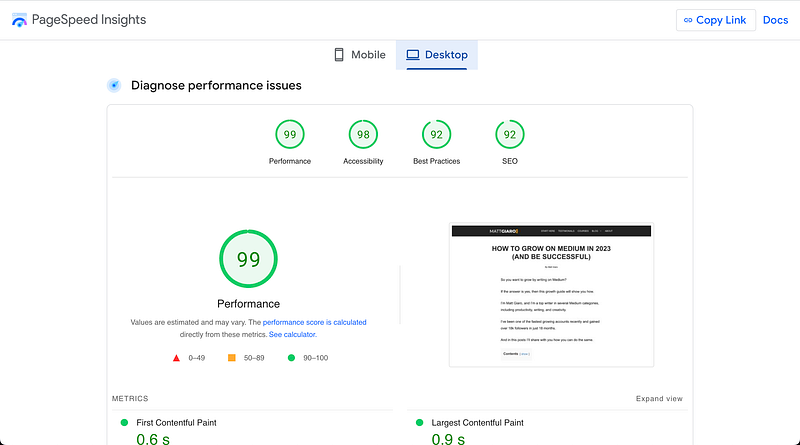
The goal is to rank 90+ on each indicator.
Here’s what a report of my website looks like:
If you run a WordPress website, the theme you’ll choose makes up 80% of your website's speed. So you want to go for a theme that’s lightweight and speedy.
But you don’t have to be a tech whiz to achieve those insanely high scores. I personally recommend this theme right here (affiliate link at no extra cost for you). It will allow you to get the same results I’m getting out of the box.
So, tune your website to fly. Start with these web vitals.
How to Monopolize Your Niche
Imagine you’re in a library.
You’re looking for information on a specific topic, say, the history of cinema. You'll find two books. One is a comprehensive account of cinematic history, and the other is a general arts book with one chapter on cinema. Which one would you choose?
The same goes for your website.
Why cast your net wide in an ocean full of unrelated topics when you can be a master angler in your own specific pond?
So instead of chasing a multitude of different topics, build a strong foundation in one topic. By doing this, you establish yourself as a go-to resource, a beacon of knowledge. This not only appeals to your readers, enticing them back time and again but also prevents the gut-wrenching experience of seeing your website slip into obscurity.
Here’s how it works.
Instead of writing one blog post about gardening, another about car maintenance, and a third about baking cookies, focus on just one subject. Write multiple posts about different aspects of that one topic. Each post should be a pillar supporting your overall knowledge structure. This is how you build topical authority.
I first built authority in the note-taking niche.
If you google:
- “how to build a Zettelkasten with Obsidian”
- or “para method alternatives”
- or “bear second brain,”
…you’ll likely see my website on page 1.
Start small, then expand.
Stop Chasing Stupid Keywords
It’s not about the size of the dog in the fight, but the size of the fight in the dog.
When it comes to keywords, it’s not the big ones that always win the race. Yes, they’re all shiny and glamorous, promising a flood of traffic.
But here’s the catch: those high competition keywords are like crowded arenas where everyone wants to be the champion.
Instead, why not focus on the less crowded, yet still passionate, small venues? By targeting lower competition keywords that you can actually rank for, you are positioning your blog post to be seen and read by an engaged audience, so that you can avoid the crushing disappointment of your content being lost in the ether.
Let’s take a closer look.
Long-tail keywords — those with three or more words — are often less competitive, yet still have a keen and eager audience. Imagine a niche hobby club versus a huge, bustling convention. Yes, the convention has more people, but in the club, you can actually hear yourself talk.
By choosing the right long-tail keywords, you are essentially getting onto the stage in front of an attentive, interested audience, rather than shouting from the back of a massive, indifferent crowd.
Don’t just enter the fight. Choose the right one.
Manipulate Your Reader’s Attention
Creating content without a captivating outline is like making a movie without a script.
You wouldn’t produce a blockbuster movie without a screenplay, right?
The same applies to your blog post. Before you dive into writing your content, it’s essential to come up with a compelling outline. An outline that not only provides a clear roadmap for your thoughts but also hooks the readers right from the start.
This strategy ensures that Google sees your content as valuable and helps avoid the devastation of your work being labeled as ‘irrelevant’, missing out on loads of free traffic.
Here’s what I mean.
Your outline should be like the spine of your content, holding everything together. Each section of the outline should correspond to a point or argument in your article.
For example, if you’re writing about home cooking for tired moms, your outline might include sections like:
- Easy recipes
- Weekly menus
- Time-saving cooking techniques
- Must-have ingredients to have at home all the time
- Basic tools every tired mom should have in their kitchen
- etc.
Each section should hook your readers in, making them want to read more.
Before you write, plan. Come up with a compelling outline.
Paint Your Path to Page 1
Pictures may be worth a thousand words, but in blogging, they’re priceless.
Think of your favorite storybook from when you were a child. What made it so engaging? The illustrations, right? They brought the story to life, making it more vivid and more real. In blogging, images serve the same purpose. By illustrating your articles with as many images as possible, you not only break up the text to make it more digestible but also ensure people stay longer and extract more value from your articles, helping avoid the distress of low engagement rates.
Here’s an example.
If you’re writing a step-by-step guide, don’t just tell your readers what to do. Show them. If you’re discussing a complex concept, use an infographic to simplify it. If you’re sharing a personal anecdote, add a relevant photo to make it more relatable.
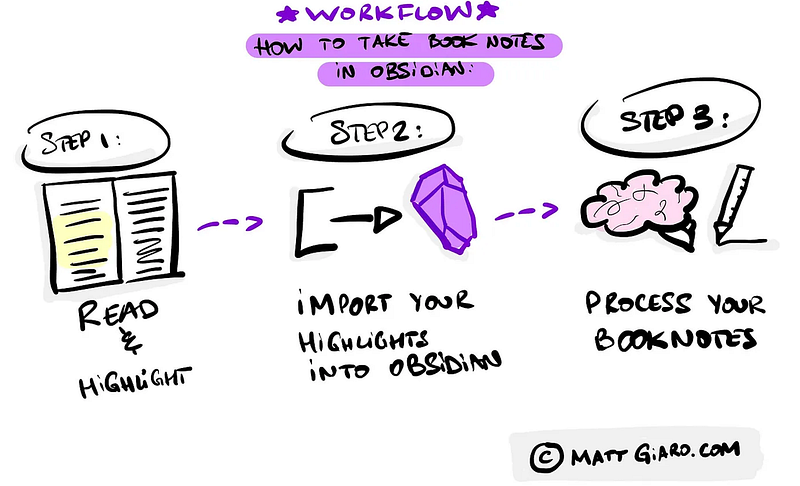
Here’s an example I used to illustrate how I take notes from books:
By doing so, you’ll not only improve user engagement but also make your content more visually appealing and memorable.
Don’t just tell. Show. Use images to breathe life into your content.
Stop Following Useless SEO Junk
SEO doesn’t have to be complicated.
Instead of searching for the latest hacks or tactics, follow this simple playbook.
I’ll see you on page 1!
Want to rank your website on page 1? Get my FREE course here (safe link to my website)


