
A Good Story Cannot Be Quarantined — Neither Can A Good Life
5 practical steps to living your best story right now
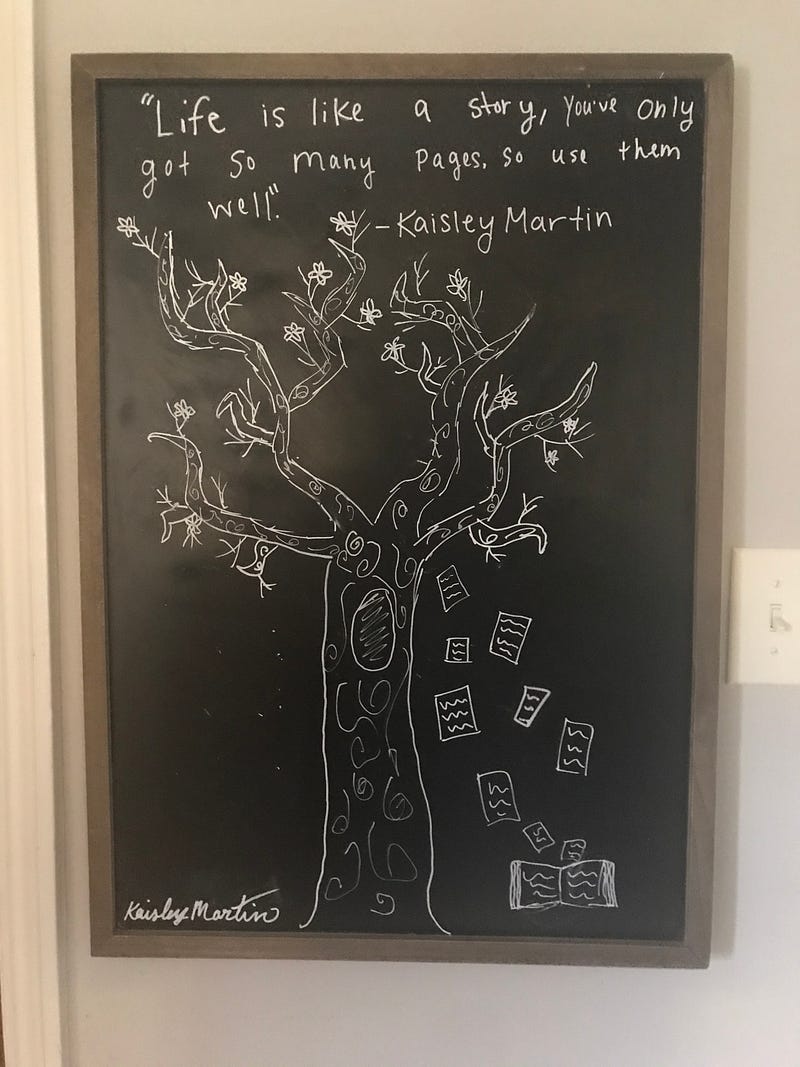
“Life is like a story, you’ve only got so many pages, so use them well.” — Kaisley Grace Martin
Above is a picture of the chalkboard we have hanging up in our kitchen right now. On it is an original quote and drawing by my imaginative 10-year-old daughter.
Oh, the wisdom of children.
She is right, of course. Every day that passes is another page filling up our own little short story on this side of eternity.
And yet, somehow with the onset of this global COVID-19 pandemic, we feel our stories are suddenly on hold — as if furloughed like a job on hiatus.
“When things get back to normal, I will do or be x, y, or z.”
In the meantime, we shrug our shoulders at temptation and simply fill our life’s pages with Netflix & Amazon Prime stories.
It doesn’t have to be this way.
Your Story Has Not Been Quarantined

Pandemic or no pandemic, we are only afforded so many pages to live out.
I understand the impulse to sloth. I even wrote about it in one of my newsletters about how our family has been coping with the COVID monster.
The problem is our world has perfectly evolved to take advantage of us during a time like this. Algorithms chase us down and trap us in a prison of mindless consumption — not necessarily with bad things, but with morally neutral devices veering us off course from our intended trajectory.
These vices widen the gap between the person we want to be and the person we currently are.
We are told to wait for a vaccine or for a public official to fix everything for us. And in the meantime, we reside ourselves to live a lesser version of our story.
I am here to remind you we are not on a never-ending Spring Break. Nor are we helpless over the pages that are written today.
Our stories are still happening and they are the only ones we get to live.
We cannot afford to look back when all is said and done and suddenly realize our narrative fell short of the life we intended.
There will always be something the world will exploit in order to put our stories on hold — war, pandemic, financial crisis, or some other uncertainty will paralyze us into perpetuity if we let it.
We cannot wait for these obstacles to lift.
It’s time to splash some cold water in our faces and remind ourselves that our stories quickly come and go like the morning dew.
We need to act now, take ownership of what’s written, and begin to fill each day’s page with meaning, purpose, and intention.
5 Simple Steps To Living A Better Story

“How we spend our days is, of course, how we spend our lives.” — Annie Dillard.
Our lives often don’t work like our favorite movies — we can’t count on the narrative to come and find us.
We have to actively seek out our place in God’s story.
Thankfully, there are guides out there to help us.
If someone like Victor Frankyl, a Jewish Neurologist who was imprisoned in a Nazi concentration camp, can take control of his story despite the most horrific circumstances imaginable to the human experience, then we can too.
The key to taking back a more fulfilling narrative is understanding and implementing the crucial elements that make up every great story arc.
As Donald Miller outlines in his book A Million Miles In A Thousand Years, a good story is about a character who wants something, overcomes conflict to get it, and is ultimately changed in the process.
Every great story contains these same critical elements — and here is how you can work to install them in your own life.
1. Know the point of your story.
“Desire, both the whispers and the shouts, is the map we have been given to find the only life worth living.”— John Eldredge
We have to understand the Controlling Themes of our lives.
We were made for eternity and we have a part to play. That part begins with knowing who we are and what we want.
I want everyone to know they are a part of an unfolding tale that is larger than themselves.
I want to write a book one day.
I want to be a part of creating the kind of company people are dying to work for and others are begging to purchase.
I want to be able to mow my lawn well into my nineties.
I don’t want my marriage to simply “make it” into old age. I want a best friend who knows me better than I know myself.
I want to raise children who know in the core of their being they are loved by not only Mom and Dad — but by the Creator of the universe.
These outcomes will not happen through osmosis, but the first step towards bringing them to realization is knowing that I want them.
In order to become the kind of compelling character we resonate within our favorite movies and novels, we need to first begin identifying the types of outcomes we want for our life.
Goals are important, sure, but the real game changers come when we can name the specific end products we desire to see in ourselves.
Once we’ve recognized these outcomes we can begin reverse-engineering for the installation of the specific behaviors that will bring those aspirations into fruition.
Ask yourself some of the following questions:
- What are the virtues and attributes you want to be listed off in your eulogy?
- What do you want people saying about you after you’re gone?
- What do you want to be good at or know a ton about?
- What experiences would you like to have?
- What are the things you find yourself reading about, watching or talking about over wine or coffee?
Search for the beauty around you that draws you in. Be curious.
2. Regularly imagine & plan for climax moments.
“Each day we are becoming a creature of splendid glory or one of unthinkable horror.” — C. S. Lewis
Once you’ve aptly named the outcomes you want in your life, you can begin to develop a recipe for your own personal gumbo soup of transformation.
Throw all of your unique experiences, desires, & hardships into a stew and come up with something revolutionary that only YOU have the ability to bring to the world.
You know your mission. You have identified the problems you want to solve and the person you want to become.
The next step is naming the kinds of experiences this person would have in their story.
What are the key characteristics of this person?
What sorts of actions would this future version of you have taken in order to become his or herself?
Use the answers to these questions to establish the routines, rhythms, and habits necessary for bringing your aspiring story to life.
Resolve to install the necessary behaviors your character needs for achieving the right ending.
3. Edit out the scenes that would ruin your climax moments.
“You cannot live on amusement. It is the froth on the water — an inch deep, and then the mud.” — George MacDonald
A compelling character is on a journey.
There is no wasted time in a captivating story.
Narratives are often neither convenient nor easy — and there is a cost to the arc of a good story if a character is not properly developed.
There is a place God is inviting you to do something that may act as the very doorway into becoming the character your story is calling for — so act accordingly and ruthlessly eliminate all of the scenes which are not contributing to that cause.
Once you have identified the proper climax scenes you want in your story, it is then time to begin editing those that need to go.
Expendable scenes detract from the tale that is being told.
Make note of the memories you could make today, tomorrow, next week, next month, and next year — and hold tightly to organizing your life’s story around only those scenes.
Hold yourself accountable.
Enlist others around you for help.
You can’t manage what you don’t measure — so track where and how your time is being sucked away.
What scenes do you need to edit out today?
You might use this as an opportunity to jump-start a daily diary or journaling practice.
4. Guard your story from the wrong kinds of outside influence.
“All of humanity’s problems stem from man’s inability to sit quietly in a room alone.” — Blaise Pascal
The enemy of your story wants to steal, kill and destroy your central plotline.
He does this in a multitude of ways — not the least of which is by drowning you in fear. He wants to paralyze you towards either inaction or action towards the wrong things.
In our present age, he does this via news headlines and technological addictions.
The character who tries to stay on top of everything never gets to the bottom of anything.
If you must check in on things — do it once per day. Get in and get out.
Your story does not need you to get into the weeds of every event that is happening to every person. You do not need to know everything that is happening in the world or every outcome that might happen.
What inputs do you need to reconsider? What sources of information and consumption are draining you away?
Amputate these sources with reckless abandon and replace them with real things. Swap them out with the sorts of elements that will actually bring your story forward.
Read real books out loud. Paint. Write. Make a gourmet meal. Get outside. Engage your soul in the stuff that makes you come alive.
5. Don’t live your story alone.
“The next best thing to being wise oneself is to live in a circle of those who are.” — C. S. Lewis
It is rare that a memorable character lives their tale alone.
Luke Skywalker had Han and Leia.
Frodo had the fellowship.
Anna had Elsa.
Now that your story is taking shape and you are willing to guard it at all costs — make sure you are not continuing on your journey alone.
It is said that Jim Rohn once pointed out we are the average of our five best friends. Seek out the others in your periphery who seem to be living a compelling narrative and choose to participate with them. Find your inklings and get to Level 10 with them. No matter the circumstances.
If a pandemic doesn’t allow for it, then get together in the world’s largest socially distant campfire circle.
Put a weekly driveway hangout on the calendar.
Make technology your slave — rather than the other way around — and conduct virtual meetups on the regular.
Who around you do you need to reach out to? Who do you need to check in with? How can you be companions on a collective journey?
Examine Today’s Page
Perhaps things lift soon. Or perhaps not.
Either way, now is the time to add in the mythos of your story.
In 10 years you will be the same person you are now — just further down the road of consequences and rewards to the choices you make on the page of today.
Now go and write.
Here’s how you can get the rest of my writing.
Ryan Douglas Martin resides in a northern suburb of Dallas, TX with his wife Katie and four children Kaisley Grace, Elijah Wyatt, Judah West, and June Selah. He helps operate a family construction company by day. He’s on Instagram, Twitter, LinkedIn, and occasionally Facebook. Though he’s probably never had an original thought, he possesses an omnivorous appetite for the insights of teachers much smarter than Him and he enjoys spreading their work widely. He is a Storyteller, and his mission is to help bring value to people by exploring, explaining and building community.