
A Geometric Understanding of Integration By Parts
Pushing past the formula to build a visual understanding of the concept of integration by parts
Recently I asked myself: if I was a mathematics high school teacher, how would I push my brightest students and prepare them to be great mathematicians?
I thought back to my time studying math in high school, and I realised that much of the math curriculum is fed to students in a very rote and formulaic way. They are given a standard approach and formula for a given type of problem, and they practice the approach again and again so that they can use it effectively when it comes up in an examination paper.
But learning how to approach a formulaic problem does not necessarily help you fully understand and appreciate the meaning of the concepts you are being taught. And if you don’t fully understand the meaning of the concepts you are being taught, you won’t know how to apply those concepts in unfamiliar territory.
To be a great mathematician, you have to kick into a higher level when the terrain becomes unfamiliar. In these situations, the formula won’t help you when you don’t properly understand what it actually represents. So I challenged myself to think of how I might teach a common high school mathematics topic in a way that took students past the formula and helped them understand what the formula represents.
Integration by Parts
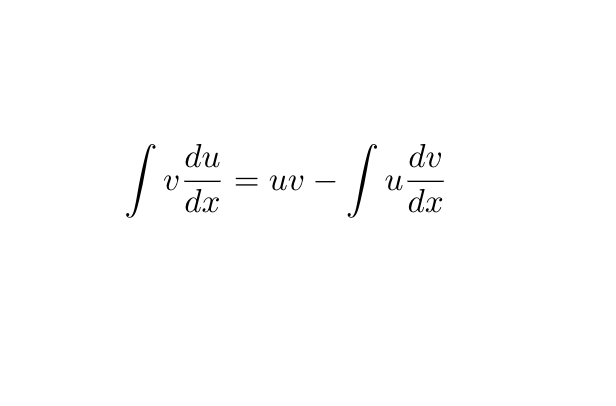
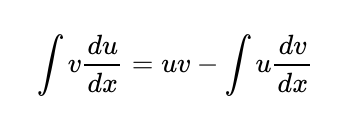
A very common method taught in high school math is integration by parts. Integration by parts is a formula used to integrate certain products of functions. Given a function v(x) and a derivative du/dx of another function u(x), we can use this formula to help calculate the integral of their product:
A simple example is calculating the integral of y = xcosx. If we take v = x and du/dx = cosx, our formula tells us:

with C as our standard constant of integration.
Now, I don’t know about you but I never really properly tried to understand this formula in any other way than simply memorizing it. But if we know what it means to integrate something, we can develop some pretty cool and helpful geometric interpretations of the formula for integration by parts, which I believe helps us get a deeper understanding of the concept. Let me show you what I mean.
Understanding Integration by Parts geometrically
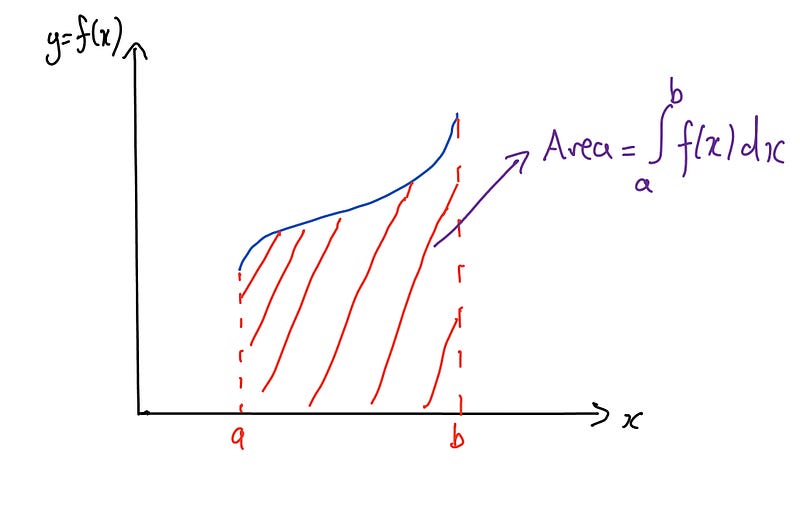
Let’s imagine we have a function f(x) and we want to integrate this function between values x = a and x = b. For simplicity, let’s keep everything in our first quadrant of cartesian space, so 0 ≤ a < b. Let’s also assume that f(x) is a positive, continuous increasing function for simplicity, so f’(x) ≥ 0. Geometrically, we understand that when we perform this integration, we are calculating the area under the curve of f(x) between x = a and x = b. Let’s look at a quick picture:
Now, we could also think about this another way. Let ⍺ be the value of f(a) and let β be the value of f(b). Now we can draw our picture like this and mark in a few different areas:
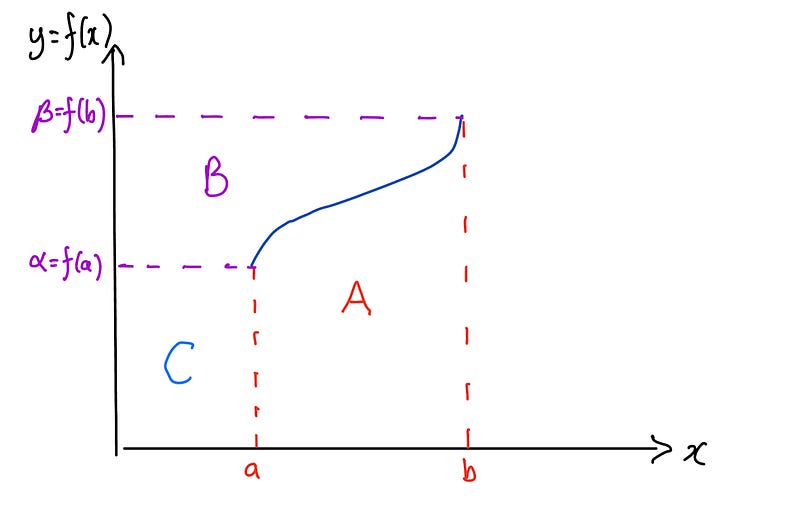
Area A is the value of our integral, and another way of calculating it would be to take the area of the large rectangle and then subtract areas B and C. This is, in fact, exactly what integration by parts does. Let’s take a look at how.
Let’s trivially rewrite our integral (Area A) as follows:
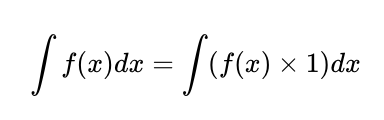
Now let’s take v = f(x) and du/dx = 1, then using our integration by parts formula, we get:
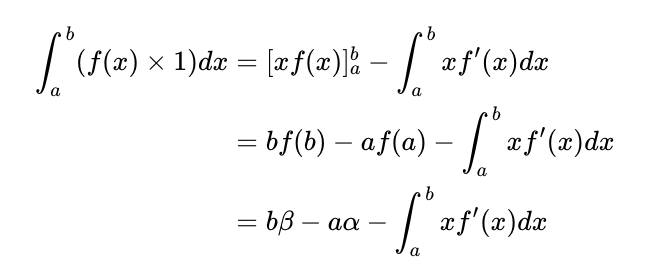
We can see that bβ is the area of the large rectangle and a⍺ is area C. Now let’s look at the final integral. We can also write f’(x) = dy/dx, so that:

and it’s now clear that this integral is equivalent to the area B in our picture. So we have an intepretation of integration by parts as a geometrically indirect way of calculating an area under the curve, by subtracting different segments of a rectangle so that the area of interest remains. Pretty cool!
A higher dimensional example
You can also follow this logic into higher dimensions. Consider this integral:
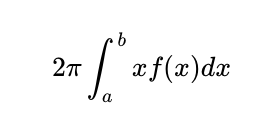
This integral represents the volume of a ‘donut’ formed by rotating the area under our curve of f(x) around the y axis. Now if we use the same integration by parts method, with v = f(x) and du/dx = x, we can derive the following (using an identical approach to the previous section):
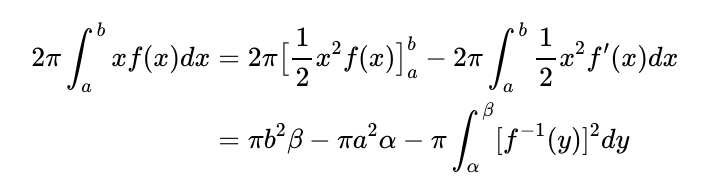
The first term represents the volume of the cylinder formed from rotating our large rectangle around the y axis. The second term represents the volume of the cylinder formed from rotating area C around the y axis, and the final integral term is the volume formed from rotating our area B around the y axis. Again, we can understand integration by parts as an indirect way of determining the volume of a rotational shape by taking the volume of a cylinder and subtracting segments away from it.
What did you think of this geometrical exposition of integration by parts? Perhaps you’d like to try it out on other geometries or with functions that are not purely confined to the first cartesian quadrant? Let me know how you get on.