
A Gentle Response to a Defense of the Reason the South Seceded From the Union
The Confederacy should’ve died when it lost in 1865
Dear Matt07924,
You have given me much to think about.
However, I respectfully disagree with your conclusions. I do know and understand that distinguished people such as yourself have diverse opinions about the subject of history. However, every fact I stated has links to the original material regarding the reasons the South went to war.
You see, there is no mystery about this.
The South told us specifically why they seceded from the United States.
“The “liberty” the Confederacy sought to preserve was the liberty to own human beings.”
You had three questions and some commentary in regards to my article.
I will respond to them below.
Questions 1 & 2
I put your first two questions together because they are really the same thing:
- Why would some kid from New Hampshire die to free the slaves? He could care less about slaves…even if he thought it was wrong. Most Northerners were not abolitionists…many Northerners owned slaves too. General Grant had a slave. There were slaves in New Jersey to harvest cranberries in the bogs.
- Why would some kid from Alabama die to keep the slaves? Most Southerners did not own slaves…only the plantation folks had slaves. Why would a poor kid living on a farm care about slaves…especially since the slaves kept the family poor as plantation owners would not hire workers if they can get free labour from slaves?
RESPONSE:
War is not usually a choice. Ask any soldier. My father — and many of our fathers went to Vietnam. We had no quarrel with the Vietnamese…they didn’t drop bombs on America, nor did they shoot at our boats or submarines. My dad didn’t know any Vietnamese. And he wasn’t asked for his opinion on the matter. Yet, as a professional soldier, he went to war in 1969.
War is not personal. No offence, kind sir, but no one cared what the kid from New Hampshire or Alabama thought. They did not receive a survey.
Soldiers (usually young) are recruited by their governments (local and federal) to fight. Fight who? Just kill the guy over…there. Sound familiar?
So to say that a soldier had no personal reason to go to war is a non-starter.
When the North made a call, they came. When the South made a call for soldiers, they came too.
To show you how confusing it was — some families had soldiers on both sides! Arkansas, for example, contributed soldiers to both North and South, yet it was officially a pro-slavery state.
The winners usually receive an incentive to fight. The survivors of the War of 1812 and the Civil War received pensions. Depending on the side they were on — they and/or their heirs received federal land grants.
As for slaves in the North: There are always exceptions. There were always some slaves in the North — especially if they travelled there with their owner. And likewise, everyone in the South was not a believer in slavery; there were several well-known abolitionists who were born and bred there.
But generally, the North was anti-slavery, and the South was pro-slavery.
Question 3 & More Commentary
- Why would Abraham Lincoln say the below during his inaugural yet go to war to free the slaves? “I have no purpose, directly or indirectly, to interfere with the institution of slavery in the States where it exists. I believe I have no lawful right to do so, and I have no inclination to do so. Those who nominated and elected me did so with full knowledge that I had made this and many similar declarations and had never recanted them…”
The cause of war in 1861 wasn’t slavery. It was about money. It was about the loss of millions in tax revenues. This is before the evil of the Federal Reserve System (printing money from nothing) so revenue for US govt came from tariffs. If the South left the Union, the North would have a huge economic hit as the South actually brought in a lot of revenue! Also, many of the ports in the North would go idle due to the South leaving the Union.
The great irony here is most white Northerners discriminated against blacks and subjected blacks to violent attacks before and during the period leading up to the Civil War. In fact, blacks were not allowed to vote, marry, or use the judicial system. Yes…this was the North!
The Emancipation Proclamation was Lincoln’s attempt to ‘change’ the focus of the war to something moral. Ironically the Emancipation Proclamation freed NO slaves. Read the proclamation! “. . . all persons held as slaves within any State or designated part of a State, the people whereof shall then be in rebellion against the United States, shall be then, thenceforward, and forever free.”
The proclamation was an effort by Lincoln to get the Southern slaves to join the Union army and fight as he was unable to get people to join the war effort. He did not free any slaves in the North or any state not in the war.
The Northerners were fighting to preserve the Union (DC did not want to lose tax revenue) and the Southerners were fighting to keep the Northerners out (The Northern armies were brutal — raping and murdering civilians).
Sorry to burst your bubble but whites both North and South were racist and to say the war was about freeing the slaves is a fanciful myth. It was a con job to disguise the real reason which is MONEY!
So, for every Southern General statue that is pulled down, the same needs to be done for the North. Neither side cared about the slaves. So….when will we tear down the Lincoln Memorial?
RESPONSE:
These are good comments. AND they are somewhat true. But they don’t go far enough. We’ll start with Lincoln.
You are correct in saying that Lincoln was not an abolitionist — and it is true he did not think that blacks were equal to whites. Honestly, he didn’t want to be bothered.
But he was pushed. There had been one compromise after another on the slave issue — the North wanted new states to the Union to be anti-slavery states. The South? They wanted any new states to be pro-slavery.
But South Carolina? They wanted ALL of the states to be pro-slavery. Since it wasn’t happening, they seceded.
That is not a compromise.
Their own words tell the tale:
“In December 1860, amid the secession crisis, former South Carolinian Congressman John McQueen wrote to a group of civic leaders in Richmond, Virginia, regarding the reasons as to why South Carolina was contemplating secession from the United States. In the letter, McQueen claimed that U.S. president-elect Abraham Lincoln supported equality and civil rights for African Americans as well as the abolition of slavery, and thus South Carolina, being opposed to such measures, was compelled to secede:”
They even bought the Church in:
“South Carolinian Presbyterian minister James Henley Thornwell also espoused a similar view to McQueen’s, stating that slavery was justified under the Christian religion, and thus, those who viewed slavery as being immoral were opposed to Christianity.”
So now if you were against slavery — you were anti-Christian.
There are no words.
The cause of the war is money
Secondly, we come to the statement about the cause of the war: money. You are partially correct.
But again, we have to go deeper.
The South had some value. They exported cotton, tobacco, and sugarcane-mainly. But who did the work? Slaves. The South was not as rich as you imagine. They counted the value of slaves as part of their wealth. Without free labor, their wealth was diminished. The South knew that they would be poorer without free labor. So yes, money was the cause of the war.
Slaves were money — and so the South had to fight to keep their slaves.
The South lost the war because they were beaten in three ways:
1. Their fighting strategies were not (Robert E. Lee may have been a “gentleman” but he wasn’t that good.) superior.
2. They didn’t have enough resources (if you rely on free labor and have little to no industrialization you’re screwed).
3. And when food ran out, as it did when slaves abandoned the South and stopped food production activities — Southern soldiers left the battlefield to go home to save their families from ruin.
“Temporary desertion was one solution as “thousands of husbands discharged themselves” to save their families over the course of the war.”
The South was doomed from day one. Since the North had already been focusing on building factories (the industrial revolution was just beginning in England and the United States) and automating as much as it could — instead of promoting forced free labour, it was always on a path to victory.
Beating and raping and torturing people ( and brutally separating families) to labour for you with no compensation is not a template for success.
That was the Confederate way.
The Northerners were fighting to preserve the Union. Lincoln said those words. But it wasn’t because they needed the South’s resources.
“The Northerners burned parts of South Carolina, Georgia, railroads, warehouses, plantations, and much, much more of the “wealth” of the South on the famous Sherman’s March to the Sea. Sherman took 60,000 soldiers on his destructive run through the South.”
The North didn’t care about the South’s riches or it’s money. And its money? It was worthless anyway.
In the West, Northern armies torched their way to New Orleans. The North needed the taxes from the South? How could that be? They burned everything they could get their hands on…in the South.
They called it “burning their way to victory.”
Tear down the Lincoln Memorial?
There is no need to tear down the Lincoln Memorial. Lincoln was not the traitor. Even more importantly, he did not lose.
Thirdly, no one said Lincoln wasn’t racist. As I mentioned before, he did not think blacks and whites were equal. But — yes. Read the proclamation. Do you see what he did? He freed the slaves in the South! Perfect, wasn’t it? He freed the Southern slaves, allowing them to more easily escape their bondage — thereby helping the North and hurting the south. He took away the free labour the South needed at a time they needed it more than ever.
Also — no one is saying that the North didn’t have its problems. They did and they still do. George Floyd was murdered in Minnesota. That’s real north. But the North didn’t want slavery to be the guiding light of their economic system.
The Civil War occurred because the South believed in their way of life. Cruel slavery was the root of their success.
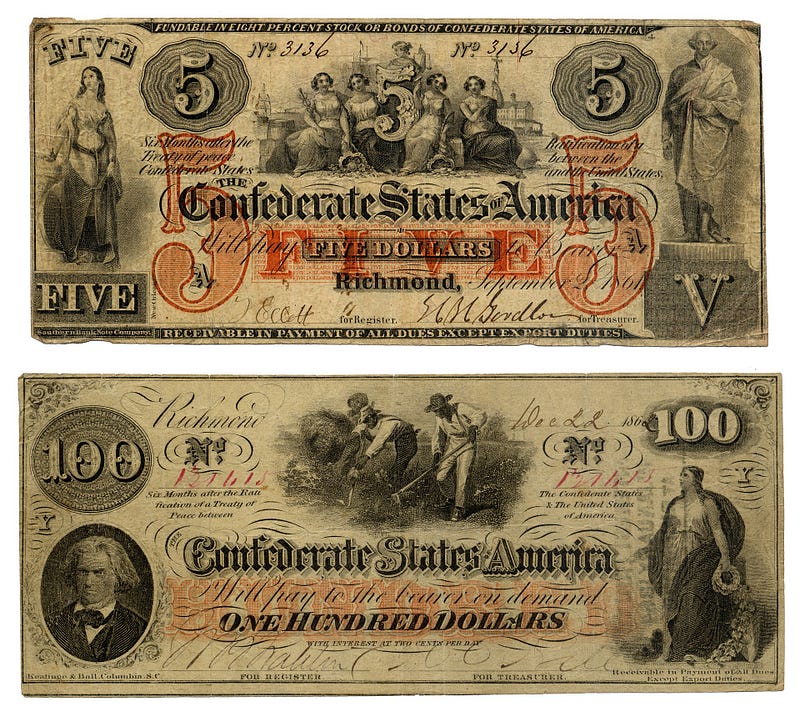
Their wealth was the forced labour from an enslaved people. That was their money. So yes, it was about money. Observe the Confederate $100 bill above: Slave money.
Their net and gross profits were directly related to slave labour.
In their depraved system, a slave was worth the cost of a vehicle — and sometimes even had the value of a house! Millions, no — hundreds of millions were at stake!
And that, my dear sir, is why the South went to war.


