
MEMOIR
A Genius In The Attic
Memories, wishes, lies, and a life telling stories
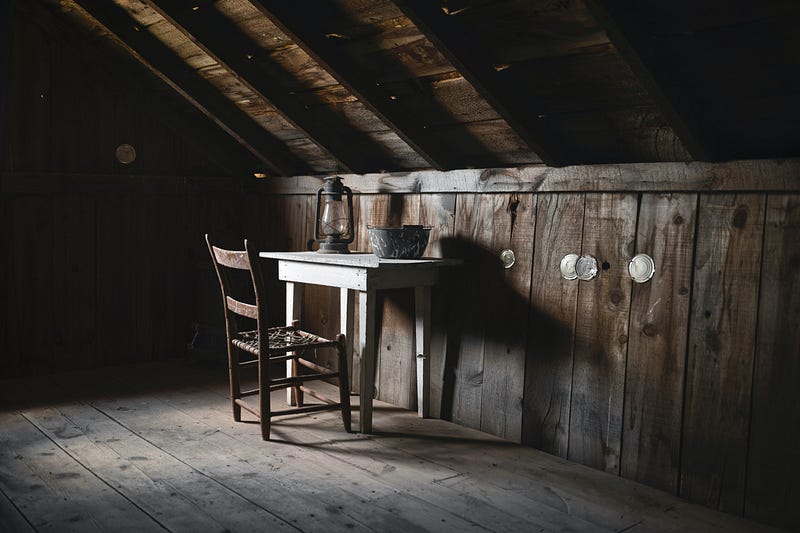
When I was in the fourth grade, we had a genius who lived in my closet and smelled strongly of garlic. He lived on the third floor, slept at odd hours of the day, and kept his mail in our cereal cabinet. It’s a credit to my absolute belief in the normalcy of my family that I didn’t find this strange in the least.
The genius and I shared the third floor, which was basically a converted attic. His bed was near a large walk-in closet where he kept most of his processions, including his TV, while my bed was across the room.
Most nights, while I was trying to fall asleep, he watched TV. The light would emanate from inside the closet like some strange Close Encounters moment, backlighting his inert body. The sound would be just loud enough to be somewhat distracting but not loud enough to be entertaining. He watched a lot of history and science shows on PBS.
How he came to live with us escapes me now, but I do know that my father had known him for years, and the genius, being without a place to live at the time, had been invited to come live with us, presumably because he had nowhere else to go.
His name was Tom Paine, like the American revolutionary who wrote the influential pamphlet Common Sense, and his family was originally from somewhere in California. Tom was an honest-to-God genius, a charter member of MENSA, and, in fact, was close personal friends with the American founder. Tom’s IQ may have been off the charts, but he suffered from various medical and emotional problems. He did not have great social skills and though brilliant, failed to grasp societal norms. Common sense was not necessarily something that had been inherited along with the name.
Because of his many issues, Tom was on permanent disability. As a way to try to combat his many ailments, Tom was very into holistic medicine and ate raw garlic as a way to “cleanse his body.” It’s safe to say that he wasn’t sneaking up on many people. When he was in the room, you knew it.
In the years he lived with us, and even years later, when he would simply get his mail from us, he would walk in unannounced, with this hair doing a pretty good impersonation of Albert Einstein, wave, open the cabinet over the stove where we kept the cereal and retrieve his mail.
Despite his troubles, Tom always seemed pretty happy, always had a nice word to say, and, though a bit weird to a ten-year-old, was always a gentleman. He had become such a fixture over the years that we barely noticed him.
I could be sitting in the kitchen with a friend, and Tom would come in the back door, say hello, quietly get his mail, and leave. My friend would just look at me.
“What,” I’d say.
“Who the hell was that?”
“Oh, just a family friend,” I’d say, then go back to watching cartoons.
Almost nothing fazes kids, so I never really felt the need to explain Tom and my friends didn’t bother much with the comings and goings of adults. Tom was a genius, was a friend of my father’s, lived in my closet for a time, and smelled powerfully of garlic. What else was there to tell?
The year before Tom came to live with us, we had moved from central Oklahoma to a rural suburb of Philadelphia, where my father took a job at a small Christian seminary. At the time, it felt like just one more move in a string of moves that had taken us from Oklahoma to Pennsylvania, Illinois, California, Tennessee, and back to Oklahoma again before returning inexplicably to Pennsylvania. Before entering the third grade, I attended four schools and lived in seven homes.
Not much fazed me.
Having left behind all our relatives, we became a somewhat insular clan, attending church and school functions but otherwise keeping to ourselves. My parents had no friends outside of religious life. My father worked in the seminary as an in-house ad agency for God, while my mother taught ballet and gymnastics to girls 3–7 in our home.
There were just four children at that time. My older sister Stacy, myself, and my younger brothers Bradley and Jason. We attended a Mennonite school as it was the only Christian school in the area that wasn’t Catholic. My parents were Oklahoma conservatives who had grown up vaguely Catholic before converting to fundamentalist evangelical Christianity.
My parents’ reluctance to place us in a godless public school, let alone a godless Catholic one, overshadowed the implausible pacifism of the Mennonites. Our classmates were mainly farmers and tradesmen descended from the German anabaptists who had settled in Eastern Pennsylvania, most notably the Amish.
At home and in church, we believed in the holy righteousness of American exceptionalism that led to wars fighting communism. At school, we practiced the inelegant art of pacifism, as seen through the eyes of small children. From personal experience and plenty of playground fights, I can say that children do not come by pacifism naturally, as it is a learned philosophy.
The seminary where my father worked was a small, dusty affair that housed students in a makeshift dormitory fashion. There was a gym with a full-sized basketball court in the basement that I never saw anyone use but us. The lights hummed and buzzed as they took ages to flicker on. The basketballs, most of them flat, were ancient leather artifacts that had been worn smooth by years of abuse.
On the top floor of the seminary was an impressive library, where, rather than discovering God, I found the confluence of sex and advertising within the pages of an epic collection of old National Geographics. Naked African tribes and black and white advertisements from the 40s and 50s for Oldsmobiles, Pepsodent, and Hoovers.
The student body was made up exclusively of young men who had come from far and wide to study Ancient Greek, Hebrew, and Biblical theology, to better understand the mysteries of the Gospel. Women need not apply. Through my father, they became my extracurricular instructors as I was endlessly curious about the world outside our little enclave, and we didn’t have the money for traditional hobbies.
When I discovered a deaf boy my age in the neighborhood, I learned sign language from one of the seminary students. When I became infatuated with a Korean girl at school, another student taught me Korean and even took me to a Korean church for a while. I briefly trained in the art of Tae Kwan Do until my parents worried I would use my newfound skills to beat up my younger brothers with greater ease.
The worlds of education, religion, and service were all jumbled together in a midwestern casserole of faith, evangelism, and sacrifice. And so it was that soon after graduating from the eighth grade, I found myself at a missionary boot camp in the middle of Missouri, preparing to deploy to South America. We were to build a school high in the mountains of Colombia, somewhere near the Venezuelan border.
It would prove to be a difficult summer. In addition to working 8–10 hours a day doing manual labor, we were asked to help prepare the meals and minister to the local villagers. We were required to memorize Bible verses daily to enjoy the pleasure of a shockingly ice-cold shower, gravity fed from the melting snow caps high above us. I don’t suppose I showered much that summer, as I can’t remember a single verse.
To pass the time when I wasn’t working, hand-washing my clothes, or studying to shower, I had one book I found tossed aside in an airport terminal. I would lay in my hammock (also my bed) and read. That is until an older missionary — in their 20s — determined that my precious paperback, about a covert team of special forces operating in Vietnam during the war, was not particularly edifying to God, so she burned it. Burned it.
I returned home that fall and met the two new Black children in our family, an adopted brother Michael (5) and a sister, Cicely (3), from Ohio, whom my parents had adopted while I was away braving the Missouri Christians of South America. I wasn’t completely unaware of the situation, as I had been part of the process early on and had received updates in the form of airmail letters. But still, it was a rather strange adjustment.
I was entering junior high and had enrolled in the public school district for the first time. For all my earlier travels, I had spent most of my school life to date sheltered in a secluded religious community with a small cadre of students where I was top dog. Suddenly I was thrust into a public institution with a greater population than my entire Mennonite community, let alone my former school. I went from being one of dozens to one of thousands. It was daunting.
After high school, I moved to Philadelphia to attend Temple University, and as I was backing out of the driveway, my siblings were dragging their furniture into my old room. It would be the last time I would ever call that house my home.
In my sophomore year, I began dating a woman I would be with for my remaining college years. She worked as a nurse and wanted nothing more than to start a family while I sought fame and fortune. Soon after graduating, she went off to find a family, and I pursued glamour in the music industry, complete with celebrities, expense accounts, booze, and cocaine. I met everyone from Elvis Costello to Sting, the Bare Naked Ladies to the Ramones, John Lee Hooker, Lyle Lovett, and many more. It was electric.
For most of my twenties, I dated half-heartedly and sporadically, sleeping with women I fancied but walking away the minute it got serious. I had no desire to have kids and wasn’t all that keen to be married. I had no delusions about the reality of raising a family. I’d already seen all I needed to see, and some of it, I wished I hadn’t.
But partying soon got old, and I left the entertainment world for the relatively sedate world of advertising, where I would shine again as a creative prodigy. I started a small agency with a former client, and we had a good run, winning numerous awards and making a name for ourselves as a small but potent creative agency.
Suffice it to say, I wasn’t looking for love when I met a beautiful, young, blonde woman while on vacation in the seaside town of Cape May, New Jersey. Even less so when I learned that she lived there year-round, far from my chosen career path, was separated from her husband, had a boyfriend, and had three young children in tow.
She might as well have announced that she was a former card shark on the run from the law and the mob and would I like to join her in robbing a bank or two before going to prison or being murdered by the mob.
I don’t know how it happened, but I inexplicably fell in love. It wasn’t rational. I wasn’t even sure it was a good idea, and nothing about it would be easy. But at every opportunity — and there were plenty — when given a choice, I chose to stay.
We have been married for over 26 years, somehow raising three functioning adults and accumulating seven beautiful grandchildren in the process. It hasn’t all been magical. If raising your own kids is difficult, raising other people’s kids is even more challenging. Fortunately for me, I’ve always believed in the normalcy of my family, regardless of all evidence to the contrary.
Tom the genius, once told me that true intelligence was the ability to think on more than one level at once, to hold multiple thoughts in your head simultaneously while you worked out a solution. It had nothing to do with thinking more broadly but more deeply.
He believed that we were all put on this earth for a purpose, even if we didn’t understand that purpose. Life was a problem to solve. An equation that resulted in a solution with no end — like pi. He didn’t believe that finding the answer was the reason for being, but that searching led to discovery, discovery to knowledge, and knowledge to truth.
Despite my lifelong belief in normalcy, my life has never been anywhere close to it, and that’s made all the difference. Tom would have said that was a truth worth discovering and reason enough for being.
I say it’s just another piece of the pi.
If you like what you’ve read here today, click to follow more posts by David Todd McCarty. If you’re not currently a Medium subscriber, sign up to read all of David’s articles for free, as well as thousands of other exciting writers.
Follow David Todd McCarty on Mastodon.