
A Game of Codes
Chapter 7 of The Family Business
“the use of atbash in the Bible sensitized the monks and scribes of the Middle Ages to the idea of letter substitution. And from them flowed the modern use of ciphers — as distinct from codes — as a means of secret communication.”
― David Kahn, The Codebreakers: The Comprehensive History of Secret Communication from Ancient Times to the Internet
I sat at the desk in my room at the top of the back staircase. Before me was the page from my notebook, upon which I had sketched the characters from the gravestone behind the school.
I was fascinated by codes, ciphers, and secret writing, and had read all of the books in our school libraries, including the encyclopedia articles, which might hold any information about these subjects.
The name from the headstone was the key to reading the secret message I had taken from the shrine.
Jimmy and I had devised an elaborate game involving ciphers and invisible writing over the past summer.
My first task was to find the key, and to do that, I had to find the proper reading of the kanji written on the tombstone.
Japanese has a complicated written language, with three alphabets. Two of the three alphabets, katakana, and hiragana, are phonetic, and the third, kanji, are characters taken originally from Chinese.
There are tens of thousands of kanji, and each may have multiple readings. Japanese words can be written either in kanji or a combination of kanji and hiragana, with non-Japanese words and slang usually written in katakana. Most Japanese names are written completely in kanji.
I could converse fluently with my Japanese friends because I learned to speak and understand the language naturally, from being immersed in the language for my entire life. But the written language was a different story. I could recognize some of the more common Kanji, but as an International School student, I was not offered schooling in the Japanese language, at least not in primary school.
There were two kanji from the name on the tombstone. The second kanji I knew well. It was the character for “rice field.” The second was one of the many kanji I did not know.
To take the easy way out would have been to ask Mrs. Tanaka how to read the character. She would likely have scolded me for my poor writing. I wouldn’t really have minded that, but as I was determined to find the reading myself, I started the slow process to look search for the kanji in Nelson’s Japanese-English Character Dictionary.
This task involved finding the radicals (components) contained within the kanji and then determining which of the several radicals it might be listed under in the dictionary. A set of rules governed which of its radicals an individual kanji would be listed under.
The radicals were listed on a chart at the beginning of the dictionary, ordered by stroke count, or the number of strokes it took to write the radical. Under each radical in the chart was a page number for finding the beginning of the section for that radical.
Within a section, the kanji were organized by stroke count, so it was also necessary to determine the number of strokes needed to write a kanji.
If everything went well, I would be able to use all of this information to find the kanji, and then try each of the readings for that kanji until I had the proper key to my message.
Naturally, everything did not go as well as I had hoped.
After nearly half an hour of trying different radicals, I could not find the entry in the dictionary. I became frustrated and seriously thought of rushing down and asking Mrs. Tanaka for the reading.
Then I heard my name being called.
“Martin!”
Welcoming the interruption, I slammed the dictionary closed, and rushed downstairs, almost running headfirst into my mother, who was just walking out of the kitchen.
“I need you to run to the market and get a dozen eggs,” she said, holding out a 500-yen bill.
I quickly snatched the money from her hand and ran out the door, catching a pair of flip-flops between my toes and sliding them onto my feet without slowing down, leaving my mother shaking her head in resignation.
“Be careful around the benjo ditch!” she yelled as I was halfway out the door.
I grimaced, remembering an altercation with a ditch full of raw sewage I’d had soon after learning to ride my bicycle. As I was turning a corner, I had come upon a truck headed straight for me. I turned my bike to the right to avoid the truck, falling into the ditch, and found myself up to my armpits in sewage. My family still had not let me live that down. My brother said he could smell me long before I arrived home.
I fetched my bike from the shed, and started down the road by our house, turning into a narrow paved road between the rice paddies. The fall harvest was winding down. The fields had been drained, let dry, and the rice cut by hand or by using small walk-behind harvesters. The grain was threshed and the stalks were bundled and tied, and stood in neat towers.
I passed a rice-stalk scarecrow wearing a conical straw sun hat, clad in old farm clothes. A crow sat on one arm, raising the alarm that a human was near, and challenging my advance. I continued on.
At the end of the street, I turned right into another narrow road, and soon came to a busy two-lane street. Here I waited for a green signal, and rode my bicycle across the street, continuing for a few blocks on a wide sidewalk.
On the right, I passed a small shrine surrounded by a moat where fishermen sat unmoving with long bamboo poles, each, no doubt, hoping to catch a prize carp while communing with nature.
After winding through a residential area, I finally arrived at the neighborhood supermarket near the train station.
I left the bike unattended in a jumble of bicycles of all sizes at the front of the store, and went inside. I quickly found the eggs, and joined the queue to pay.
By chance, I turned my head and looked around. Something caught my eye, and I went back to it. An advertisement for some kind of cosmetics, which in most circumstances I would have completely ignored.
But at the bottom of this poster, my eyes fixed upon a series of kanji in large, bold letters. The name I was looking for was there, along with something else: the translation of the name, along the bottom of a company logo, in big letters, “Takeda Pharmaceutical Company.”
As soon as I got back to my room, I started the preparations.
I had recently become interested in military stories. At the moment I was most of the way through a series of books the school library had about Lieutenant James Bigglesworth (“Biggles”) of the Royal Flying Corps during World War I, and his adventures in his Sopwith Pup biplane against the German flying squadrons.
In my readings, I had come across the use of codes and ciphers to hide information from the enemy. I became fascinated by this subject, and found a book in the high school library, aptly named “Codes and Ciphers,” which introduced me to the subject of Cryptography.
I learned that, in general, codes work on words and phrases, while ciphers work on individual letters in a written language.
Jimmy and I, well… mostly I, had devised what we thought was a clever twist on a simple substitution cipher.
The cipher was the easy part. Together, we each had made identical cipher wheels — two concentric wooden discs, one smaller than the other, held together in the center with a small nut and bolt so that the smaller disc could be rotated. Each disc was divided into 26 equal segments, and at the top of each segment was written a single letter in the English alphabet. We didn’t worry about capitalization, punctuation, or spaces.
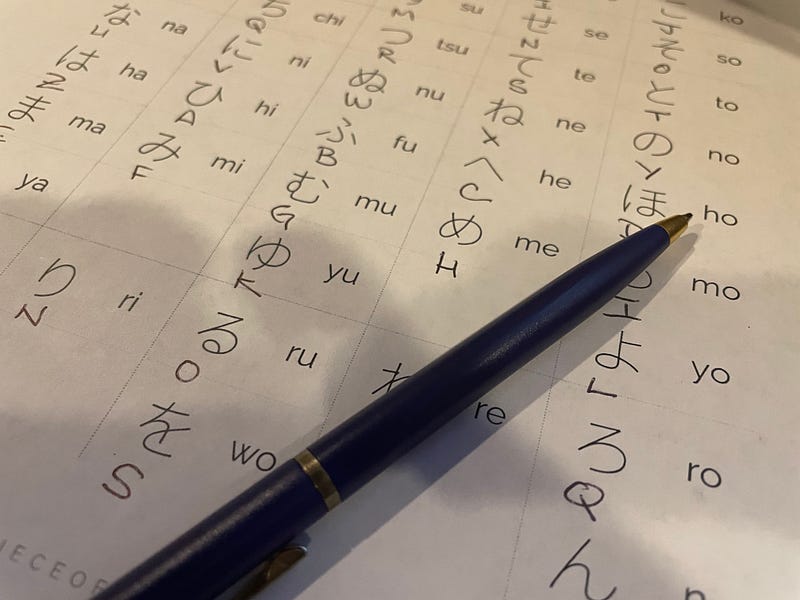
The trick was to use a key written in Japanese to encrypt and decrypt a message written in English. So we came up with a simple way to do this by assigning a letter from the English alphabet to each Japanese hiragana phonetic character, repeating the alphabet, since hiragana had many more characters than English.
I took the name from the tombstone (武田 — takeda) and converted it to hiragana, giving me three characters: た — ta, け — ke, and だ — da. Since I only needed two characters for the key, I discarded the last syllable.
Looking these up on my hiragana chart, I found that I had written the letter “P” next to た and “I” next to け.
I set up my Cipher Wheel so that the “P” on the outer disc aligned to the “I” on the inner disc. With the key set, I was ready to retrieve my message and to decipher it by finding the encrypted letters on the inner disc, and reading the results on the outer disc.
I went to my bookshelf, found my Bible, and retrieved the fortune slip taken from the Shinto Shrine, smiling inwardly at the irony of the action. It was safely hiding in John, Chapter 10. Ten for October, the current month.
I unfolded the paper and lit a candle on my desk, carefully heating the edge of the fortune to reveal the secret message which had been written using lemon juice instead of ink. When dry, the lemon juice had become invisible, but the heat of the candle slowly revealed, one and two at a time, a faint group of letters. I wrote the unintelligible sequence of letters on a fresh piece of paper, and extinguished the candle, opening the window to allow the smoke to escape.
Working with the code wheel, I quickly deciphered the message and wrote it down on the paper: “QUEENTOROOKFIVEXCHECKMATEXIWINXX,” then calling on my brain to make sense of this, I separated the words and added punctuation to produce a more readable version: “Queen to Rook 5, Checkmate, I win!”
My face suddenly became hot. “No way,” I thought. “There’s no way he could win the game this quickly.”
I walked over to the chessboard and moved his Queen.
Checkmate… again!
This was our second game of chess, and also my second loss. Jimmy was reading a book on chess strategy. I was of the mind that I shouldn’t need to learn anything past the rules in order to win.
My mom’s voice interrupted my thoughts.
“Martin, supper!”
As I fetched the message sheet to return it to John, Chapter 10, I glanced at the slip and noticed the actual fortune message for the first time. Translated, it meant “half-bad fortune.”
I wondered, was that for Jimmy Rivers, or for me? He was the one who procured the fortune slip. But he tied it to the tree, thus escaping, or possibly delaying a less than auspicious fate. Then, I came along and took the slip from the tree. Did that mean it was transferred to me?
Did my losing the chess match fulfill the contract?
I mulled on this with a slightly uneasy feeling in my belly as I descended the steps to join my family for dinner.
If you are enjoying my stories, I’d like to encourage you to sign-up for a Medium membership, for unlimited access to these and a world of wonderful stories by many talented writers. It’s likely much less than you think! Take a look, here: https://bartemanuel.medium.com/membership


