
Inventory Optimization
How much inventory do you need? It is all about supply, costs, and demand.
As explained in my book Inventory Optimization: Models & Simulation, for better or for worse, inventories lie everywhere in supply chains. The central question of how much inventory is needed and where it is needed is often an endless debate among colleagues, especially when the game of politics (rather than quantitative/qualitative analysis) drives decisions.
Inventory Done Right
Stocking products helps companies around the globe to supply their clients on time and provide a buffer against any unforeseen event. Moreover, since holding inventory disconnects the production process from the sales process, it allows planners to produce longer production batches, decreasing production costs.
In other words, inventory optimization done right protects you against supply & demand variations, reduces overall costs, and optimizes service level.
Inventory Done Wrong
Nevertheless, holding inventory comes with two main drawbacks. The first one is, of course, its cost: inventory is nothing more than sleeping cash that is depreciating over time. It costs money to store products. Moreover, stocking too much comes with risks. Will you really be able to sell all these products? Won’t they get obsolete as time passes by?
In short, the more you keep, the higher the cost and the riskier it gets.
Keeping less inventory might partially prevent the risk of dead/obsolete stock. Still, it won’t help to provide adequate service levels to your clients. Actually, in some cases, inventory management is so flawed that supply chains face both low service levels and dead/obsolete stock.
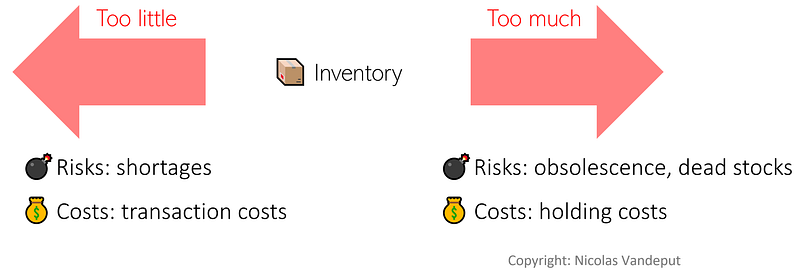
As shown in Figure “Inventory Trade-off,” we see that keeping the right amount of inventory is about doing the right trade-off between various risks and costs.
A Framework for Inventory Optimization
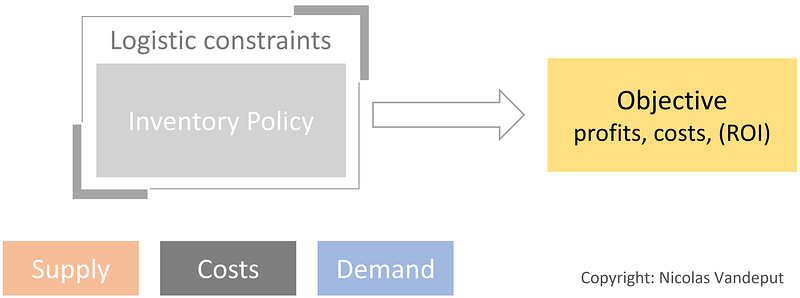
Inventory Optimization is the science of optimizing inventory policies to achieve an objective.
As shown in the Inventory Optimization Framework Figure below, inventory policies are just tools to achieve a specific objective. We will also need to consider the supply chain environment (supply, costs, and demand) while being restrained by logistic constraints (warehouse size, number of trucks, …).
Setting the right objective will allow us to choose the right tradeoff between too much and too little inventory.
Let’s discuss these elements (objective, inventory policies, supply chain environment) one by one.
️🎯 Objective
Before jumping into inventory policies, we should first define what business objective we are after. In other words, first, we need to see the big picture of what we want to achieve with our supply chain. Then, go into the details of inventory optimization.
A (Useless) Quest for Service Level
Most practitioners are looking after specific, arbitrary service level targets.
“We need to achieve 95% service level”
They want to have just enough inventory to achieve a specific service level target. Two questions come to mind:
- ❔ How do you know if 95% is optimal? Why not 98% or 92%? Should every single product reach a 95% service level? Or is it just an average?
- ❔ How do you define service level? There are many methods to quantify service level. In practice, some service level definitions will result in high scores (fill rate) or lower ones (cycle service level).[1]
A much better — and clearer! — objective for an inventory policy should be to minimize costs or maximize profits.
Service level should only be a byproduct of inventory optimization, not its main target.
Cost Minimization = Profit Maximization
Most models — like the famous EOQ inventory model — discuss cost minimization*, while others discuss profit maximization.
Both are essentially the same, at the condition that all the relevant costs are included in the model. You need to include the opportunity costs caused by backorders/lost sales in a cost model; so that minimizing the costs will result in the same optimum as a profit maximization exercise.
Optimizing an inventory policy for cost minimization (rather than for a targetted service level) will only work if all the relevant costs (including opportunity costs) are included in our model.
*Pay attention that most inventory models assume that sales are never lost but always backordered. In practice, it means that if you have some excess demand (demand > supply), you will face some backorder costs rather than the opportunity cost of unrealized profit (which might be much bigger than the backorder cost).
💰 Profit, Losses, and ROI
A business should be looking after return on investment (ROI) maximization: you want to maximize your profits and, at the same time, reduce your investments.
In other words, businesses want to be capital-efficient.
Nevertheless, optimizing a single product ROI will not result in an optimal ROI at the company level. This is because ROI should be measured and optimized at a global level (due to all the global capital investments) and can’t be optimized locally product by product.
In conclusion, each business wants to optimize its ROI. Nevertheless, creating a global model including all capital investments is trying to boil the ocean. Instead, we want to optimize each product’s profits, which is the same as minimizing each product’s costs — at the condition that we include all opportunity costs.
⚙️️ Inventory Policies
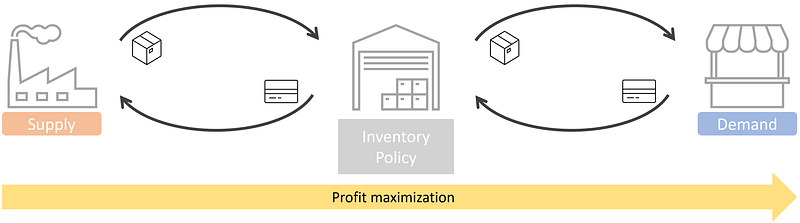
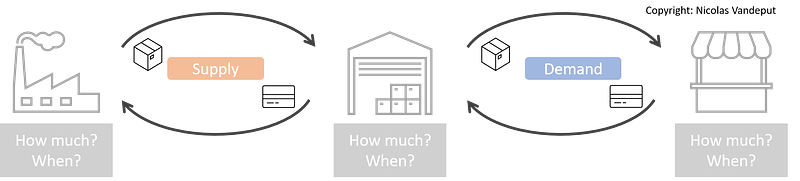
Inventory policies will control your stock levels by answering three simple, straightforward questions:
- 📦 How much to order
- 📆 When to order
- 🏭 Where to order
The third question (where to order) is often implicit — but not trivial! If each warehouse/ echelon knows when and how much to order, the inventory localization is implicitly solved. The question of where to locate inventory in a multi-echelon supply chain is called Multi-Echelon Inventory Optimization (MEIO). If you are interested in MEIO, I describe in my book a framework to easily solve MEIO for a distribution supply chain. [1]
Here are a few examples of inventory policies (you should easily identify how much to order and when to make an order):
- We order every Friday evening to our supplier so that they can prepare our order on Monday morning and deliver it on Tuesday. We always order enough to have three weeks of stock.
- We make an order every third business day of the month with our supplier in China. We replenish our stock to have a thousand pieces in stock.
- I go to the supermarket every Saturday morning. I buy enough milk bottles to have a total stock of 6 liters.
- When the stock level reaches three pieces, I order 10.
- As soon as I am left with two milk bottles in my refrigerator, I’ll go to the supermarket and buy 6.
- When my printer says I am left with only 10% of ink, I’ll order a new cartridge set.
Supply Chain Environment
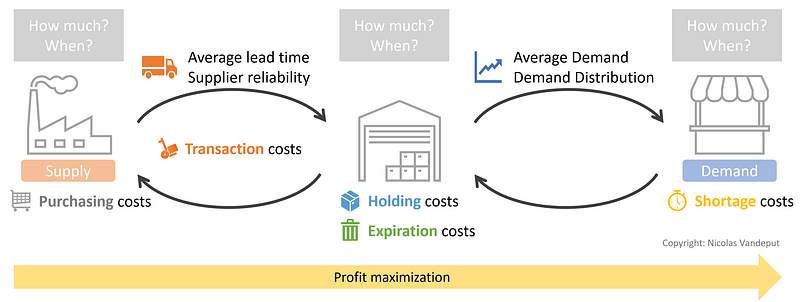
We now have an objective (profit maximization) and a tool to achieve it (inventory policies). We need to discuss the supply chain environment that will determine what the optimal inventory policy is. Three elements mainly determine this environment:
- 🏭 Supply
- 🛍️ Demand
- 💰 Costs
Supply and Demand
For each product, we should analyze:
- 🏭 Supply. The expected supply lead time, and its variability (is your supplier/production reliable?).
- 🛍️ Demand. We need to understand two aspects: 📊 The expected demand distribution: how much demand do you expect (on average), as well as how much variability. 📅 How much time your clients are willing to wait for your products. This is a driving force of your inventory policies: clients requesting readily available products will not be served the same way as clients accepting to wait for weeks.
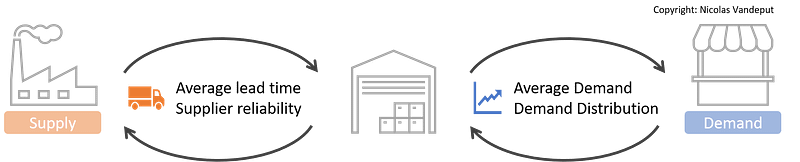
If you are just looking to reach a specific service level target, assessing demand and supply variability will be enough. But we are after profit maximization. This will require us to look at the costs incurred by our supply chain.
Costs
As shown in Figure “Inventory Costs,” we see 5 main cost types: 💳 purchasing, 🚚 transaction, 📦 holding, 🗑️ expiration, and 💶 shortage costs.
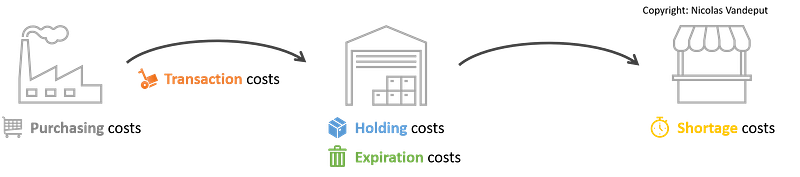
Let’s analyze these costs one by one.
1. Purchasing Costs 💳
This is basically the cost of goods sold (COGS): the purchasing price or the production costs.
A few effects can impact the purchasing costs:
- If the products are purchased from a supplier, the purchasing costs can sometimes be reduced thanks to volume discounts.
- The purchasing cost of some products tends to decrease over time. This is often the case for high-tech components.
2. Transaction Costs 🚚
The transaction costs are all the costs triggered by making an order (or a transaction) to a supplier (either internal or external).
Let’s divide these costs into the supplier and client sides.
- Supplier: transport, packaging, picking, change-over time, …
- Client: order inspection & reception, warehouse interims & employees, the time required to make an order (stock analysis, buying process, negotiations, …), …
Hint: Most of the employees in a warehouse work because of transactions (costs).
3. Holding Costs 📦
Costs related to storing (or possessing) products.
Variable part (more related to the products)
- Products’ cost of capital
- Obsolescence (think about high-tech products)
- Products’ insurance
- Damage, loss, thefts
- Inventory control (≠ inspections)
Fixed part (more related to the warehouse)
- Warehouse’s cost of capital
- Warehouse’s insurance
- Storing equipment/infrastructure
- Software/IT (WMS)
- Security
- Lighting, heating
Hint: You can easily picture (most of) the holding costs as all the costs that occur at night when the warehouse is sleeping. How much does it cost to leave all these products for one night in the warehouse? (Remember, most of the employees in a warehouse work due to transactions (in/out flows) and not because of the inventory.)
4. Expiration Costs 🗑️
All the costs related to throwing away products because of their shelf life/expiry date.
Expiration or Holding Costs? Expiration costs are somehow similar to holding costs as they increase with the amount of inventory on hand. Still, as their behavior is different — holding costs are much more linear than expiration costs — I like to keep these costs apart.
5. Shortage Costs 💶
The shortage costs are all the costs incurred when demand exceeds supply (there is an inventory shortage). Somehow, shortage costs are a mixture of lost revenues and client penalties.
Understand Your Client
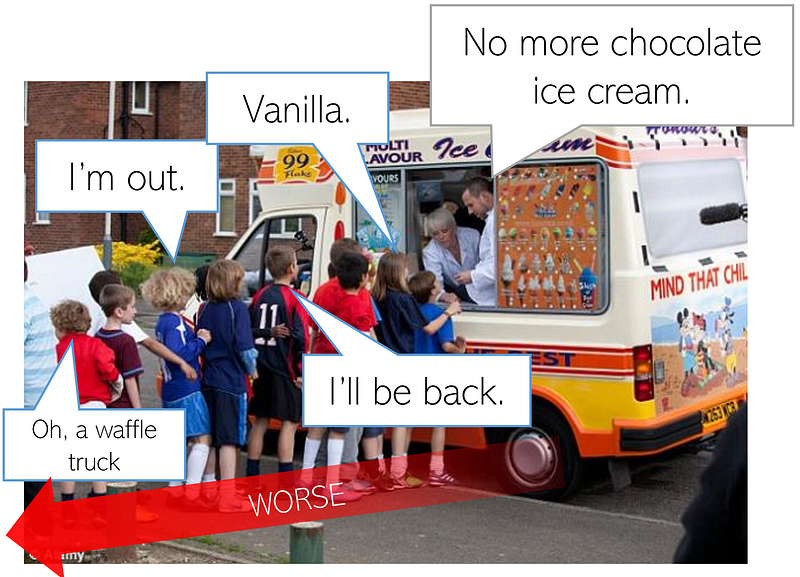
Before looking at the shortage cost estimation, we have to analyze what your clients' typical behavior is in case of shortage.
Are they going to… (from best to worst)
- …wait for the stock to be replenished?
- …buy another similar product instead?
- …abandon their purchase?
- …go to the competition?
Understanding their behavior will help us to estimate the (opportunity) cost of missing a sale.
See my previous article, “Capturing Unconstrained Demand in Supply Chains,” for more information about capturing actual demand rather than only sales.
Depending on your clients’ behaviour, being out-of-stock can result in backorders or lost sales. But it can be worse: loss of brand reputation, loss of bigger orders (if a specific piece was required for the order to be relevant), loss of information, or even halted production. Let’s review all these shortage effects one by one.
- Margin/profits. If you lose a sale, you missed the opportunity to realize some profits. Should the product margin be the baseline of any shortage cost estimation? As discussed earlier, it all depends on the buying habits of your clients. When facing shortages, if they like to buy another of your products instead, you will still be able to realize profits. So that you did not lose any real money (but still frustrated your clients).
- Goodwill/reputation. Suffering inventory shortages will result in either lost sales or backorders. Both will frustrate your clients. This is materialized by a loss of reputation (or goodwill) — even if your clients decide to buy another of your products instead. How can we estimate the value of this loss of reputation? Estimating the € value of the loss of reputation resulting from a lost sale/backorder is particularly difficult — if not impossible. But it is central to your strategy. If your supply chain strategy is to provide high service to your clients, you might want to give a generous value to this loss of reputation (in other words, you value your clients time and preferences). On the other hand, if you follow a low-cost strategy you might want to bypass the loss of brand reputation (in other words, you will optimize the costs of your supply chain and assume your clients will appreciate the low-price, lean supply chain and be patient).
- Competition. If you are running a head-to-head competition for a specific product, you might want to increase your shortage costs to reflect the fact that your competitor will make money each time one of your clients will face a shortage of your product.
- Contractual penalties. Some B2B contracts include a service level agreement (SLA). In this case, any poor service will result in penalties for the supplier. These should be included in the shortage costs.
- Loss of information/data. Most companies do not capture real demand but only track realized sales (remember, we forecast demand, not sales). Each time you face an inventory shortage, your sales will flatten to 0. If you use the realized sales as a proxy for the demand, so will be your demand estimation. This poor demand estimation will in turn influence your next forecast, resulting in bigger forecast errors, resulting in worse inventory allocation, resulting in more shortages… If you are struggling to properly capture demand, you could include a “data penalty” in the shortage costs.
- Production stops. In a manufacturing environment, missing a single sub-component will halt your overall production process. The cost of missing a component is then proportional to the opportunity cost of not running your entire production process.
- Emergency/Expedition. Facing backorders might (contractually) force you to expedite goods to your clients. The cost of doing such emergency expeditions (using faster transport lanes, special ad-hoc processes) should be added to the shortage costs.
Conclusion
Let’s recap our inventory optimization framework. We have,
- 1 Objective: 📈 profits
- 2 Questions: 📦 how much to order and 📆 when to order
- 3 Inventory drivers: 🏭 supply, 💰 costs, and 🛍️ demand
- 5 Costs: 💳 purchasing, 🚚 transaction, 📦 holding, 🗑️ expiration, and 💶 shortage
Acknowledgments
I would like to thank Stefan de Kok for his review, insights, and support.
Sources
[1] Vandeput, Nicolas (2020). Inventory Optimization: Models and Simulations, Berlin, Boston: De Gruyter, 2020. https://doi.org/10.1515/9783110673944
[2] Vandeput, Nicolas (2021). The 4-Dimensions Forecasting Framework. Towards Data Science. https://towardsdatascience.com/the-4-dimensions-forecasting-framework-f7884ec1472


