
A Fond Farewell to the Quietly Groundbreaking “Mom”
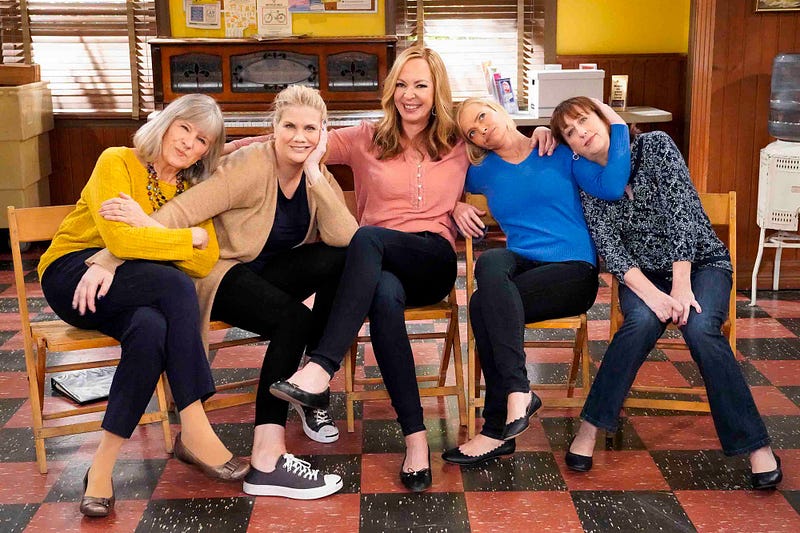
After 8 seasons and 170 episodes the veteran CBS sitcom wrapped its run last night. Over the course of its run, the show evolved from a zany family sitcom into a nuanced exploration of addiction, recovery, and sisterhood. Here, I pay tribute to the series’ impressive legacy and review its final episodes.
When I started writing on Medium in 2018, one of my first articles was about the evolution of the CBS sitcom Mom. I marveled at how over the course of its first five seasons it evolved from a fairly standard-issue family sitcom from the Chuck Lorre factory into perhaps the most honest, nuanced, and impactful portrayal of addiction and recovery in the history of network television. And now, just over three years later, I am writing about Mom’s series finale, which aired last night.
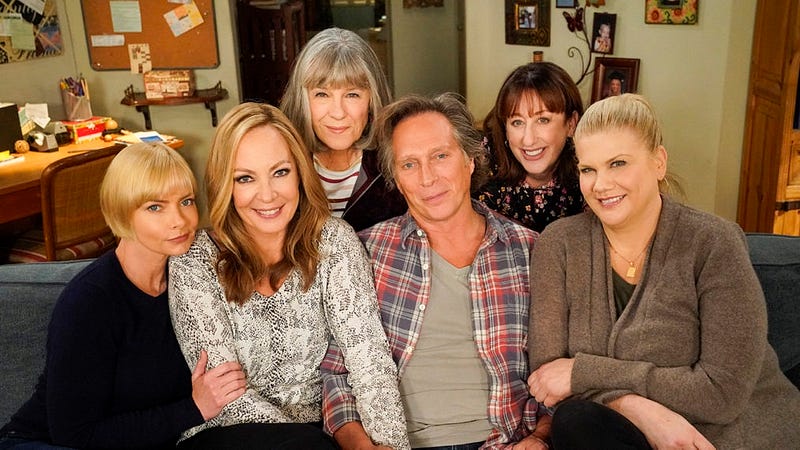
A Brief Overview of Mom
When Mom premiered on September 23, 2013, it was primarily a sitcom vehicle for Anna Faris (a beautiful comedienne who had made a name for herself in big screen comedies like The House Bunny and Lost in Translation) and Allison Janney (who already had four Emmys for her work on The West Wing and had done revered work in film and on stage). They played a dysfunctional mother-daughter duo of recovering addicts who are reunited and begin the rocky road toward reconciliation.
Faris and Janney were undoubtedly the highlights of the show as Christy and Bonnie Plunkett (respectively) but it wasn’t particularly focused on their relationship or their recovery in the early episodes. Plots tended to focus on Christy’s work life and love life and the trials and tribulations of being a single mother of two children. But over the course of the next few seasons, the entire supporting cast exited the series and were replaced by a host of veteran character actors who formed Christy and Bonnie’s recovery network.
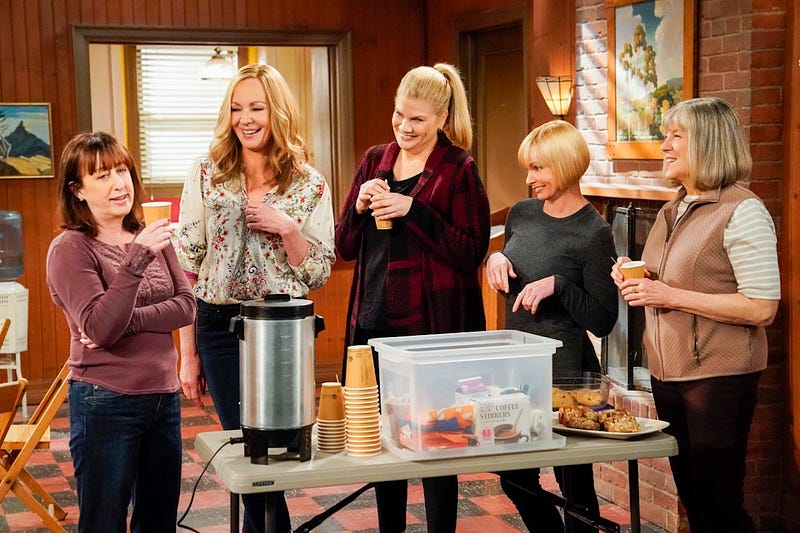
First came Marjorie (Dharma & Greg’s Mimi Kennedy), the warm, wise, and cat-loving woman who had been working Alcoholics Anonymous for decades and served as a role model, mentor, and sometimes sponsor for Christy and Bonnie. Then came Jill (My Name is Earl’s Jamie Pressly), an unfathomably wealthy and uptight divorcee navigating her newfound sobriety. Next was Wendy (Mad Men’s Beth Hall), a meek, kind nurse who was often the butt of the group’s jokes despite her unwavering support and loyalty. Finally, there was Tammy (3rd Rock From the Sun’s Kristen Johnston), who was a foster child with Bonnie and recently wrapped up a long stint in prison. Oh, and along the way, Adam (Prison Break’s William Fichtner) arrived as Bonnie’s paramour and eventual husband. The ensemble seemed to be refined and enhanced each successive season until the show had a powerhouse septet that rivaled the very best ensembles on television.
Although the last three seasons didn’t have dramatic twists at nearly the same frequency and intensity than it did in its early seasons (which included numerous deaths, relapses, and other tragedies), they did tackle a number of meaningful issues rarely seen in a sitcom. Christy went through the humiliation and exhilaration of resuming her education. Bonnie committed to the first functional romantic relationship in her life and finally worked out her issues in therapy (with her therapist Trevor, fabulously played by The Office’s Rainn Wilson in a recurring role). Marjorie grieved the loss of her husband, struggled to reconnect with her son, and faced her own mortality. Jill did some soul-searching, found love in the unlikeliest of places, and struggled with infertility and depression. And Wendy, well Wendy didn’t get many plot lines unfortunately, but she did date a married man and fight to be heard among her friends. As this all unfolded, there were farcical setups abound and hilarious verbal sparring at AA meetings, at the bistro, and in their living rooms.
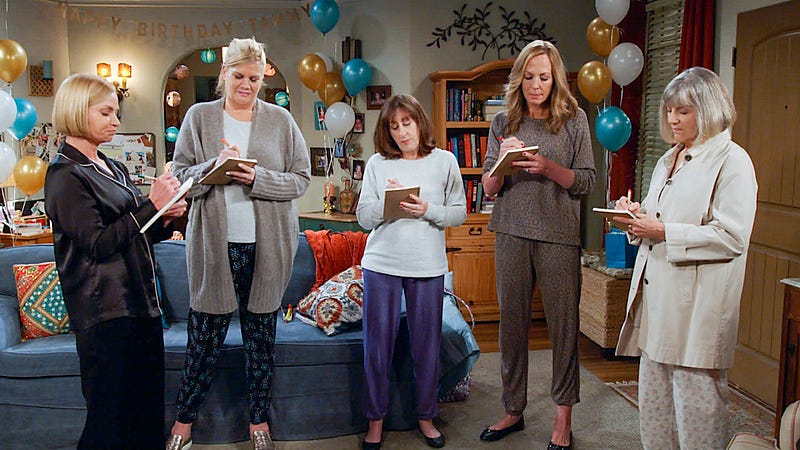
For the entirety of its lengthy run, Mom was a series that continuously evolved. However, some external developments unfolded in the show’s final two seasons seriously impacted the series. The first was COVID-19, which shortened the seventh season and resulted it ending an awkwardly unresolved note as there were still two episodes left to be filmed. The second was the departure of star Anna Faris. For reasons that are still unclear, Faris decided not to return for the series 8th (and what would be final) season and she did so quite late in the game. The result is that her departure is only discussed (not depicted on screen). Both of these factors led to the final two seasons feeling a bit incomplete and jerky at times (particularly the start of the final season), but the writing staff and ensemble cast are so remarkably gifted that they pulled it off with aplomb, correcting course swiftly and rarely letting the struggle to keep up with all these changes show.
Reviewing the Final Episodes
Leading up to the final two episodes, there were signs that Mom was heading toward its conclusion. It didn’t take the typical approach long-running sitcoms take where they spend their final episodes simultaneously bringing back key plot lines and characters and building tension about how it would all end. Rather, it focused on meaningfully concluding the character arcs of its main characters.
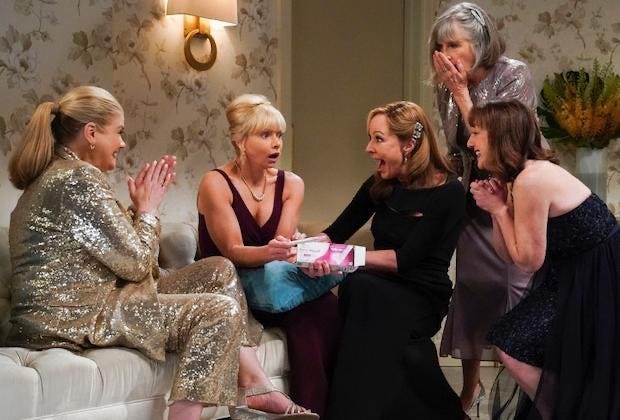
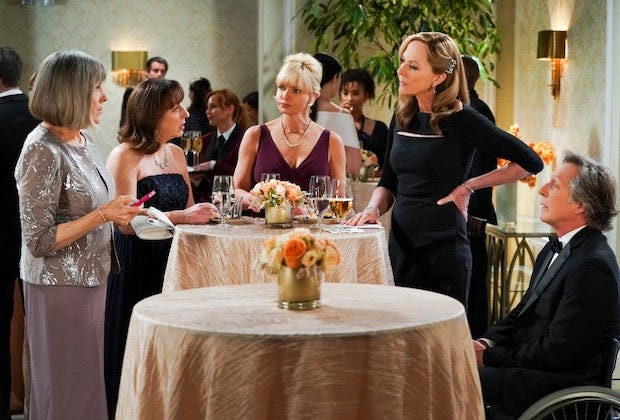
The penultimate episode was a masterful ensemble outing that deftly balanced comedy and drama. Marjorie was honored with an award for being a “Community Hero” at a fancy banquet. She asked Bonnie to introduce her, a task that Bonnie attacks with her typical combination of hubris and revelry. Bonnie’s speech introducing Marjorie, which begins as a roast and ends as a heartfelt ode, is a dramatic highpoint of the season and is performed masterfully by Allison Janney. When Marjorie realizes that not only did her son attend the banquet but was also the one who nominated her, Mimi Kennedy does Emmy-worthy acting with barely a word.
Meanwhile, Jill realized that what she thought was a stomach bug was actually a sign that she was pregnant, Tammy romantically pursued their limo driver, and Wendy had a hilarious wardrobe malfunction. Jamie Pressly played Jill’s arc flawlessly, while Kristen Johnston and Beth Hall did terrific comic work. Most of the episode takes place at the banquet and the limo rides to and from the banquet. This setup allows the show to feel more like an event (as it barely uses the traditional settings at all) and to allow for the entire ensemble to interact to an atypical degree. The cast was top notch, the writing was sharp and meaningful, and it was directed and edited superbly.
The series finale of Mom had a few threads that were unsurprisingly mostly centered around Bonnie. The opening scene featured Bonnie trying to connect with a reluctant AA newcomer named Shannon (Two and a Half Men’s Melanie Lynskey). Her hopelessness about recovery and her contentious relationship with her abusive, meth-addicted mother Jolene (Mike & Molly’s Rondi Reed) unfolded throughout the episode. Although it may seem like a questionable decision to devote even a second of screen time in a series finale to never-before-seen characters, this served the important purpose of showing how much Bonnie had grown as they represent what Bonnie was like less than a decade earlier and demonstrating how compassionate and confident Bonnie had become. (It was also a nice touch that they were played by recognizable cast members from other Chuck Lorre hits.)
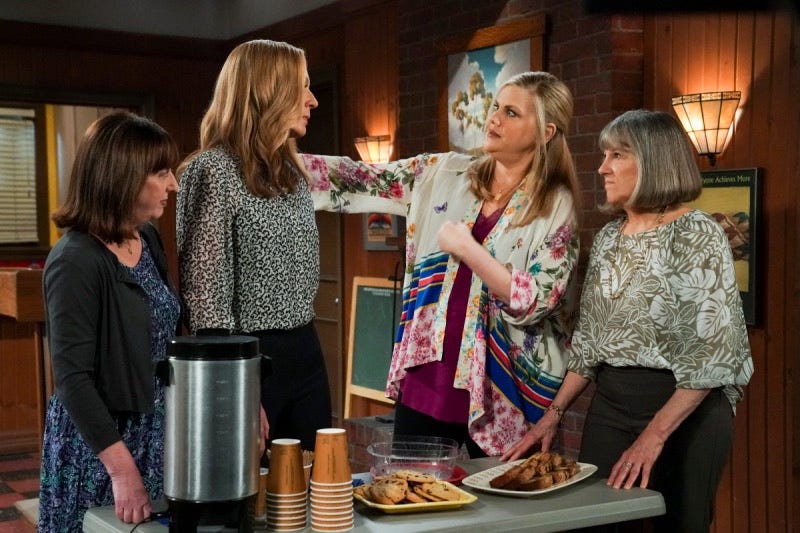
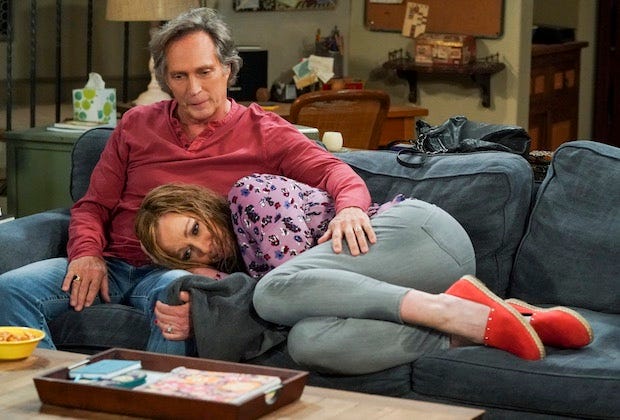
There are several other plot threads in the final episode. Jill, now four months pregnant, decides to marry Andy at the courthouse. Tammy, still dating the limo driver from the prior episode and feeling very optimistic about it, runs into the judge that sentenced her at the courthouse and gets a chance to show how much she’s grown. And, most notably, Adam has a cancer scare that sends Bonnie running to Marjorie for guidance and pulling through in a big way as a wife. The episode has its share of laughs, but it is most notable for its remarkably poignant final scene that involves Bonnie doing a “share” at an AA meeting in which she powerfully reflects on her evolution from being wildly destructive, delusional, and near-death to a “grateful alcoholic.” She expresses her deep love for her friends, husband, and — in a nice touch — her daughter and grandchildren (who were once such a prominent part of the show). Janney pulls it off with the flawless execution you would expect the woman that has an Oscar, a BAFTA, a Golden Globe, seven Emmys, seven Screen Actors Guild Awards, and two Tony nominations.
Touchingly, after Bonnie is done speaking she goes back and sits with her friends and Wendy gets up and goes to the podium and asks “Who else wants to share?” Not only is this a beautifully open-ended and symbolic final line but the writers’ decision to give the final line to Wendy was unexpected and delightful given that she was frustratingly underused throughout the show’s run.
There was some speculation among fans and industry folks about whether Faris would return for the final episode. She headlined the show for 152 episodes and, as mentioned above, never actually got an on-screen send-off. Christy was referenced two or three times but did not appear (nor did any former cast members). The show’s creator announced that they did not ask her to return, deciding to honor her decision to leave the show. However, I suspect that it was also a creative decision made to avoid having the finale feel disjointed by simultaneously wrapping up the plot arc of the existing characters and catching viewers up with a former one. Whatever the exact reasons for it, the exclusion of Christy was probably the right call from a creative perspective. However, it was a somewhat sad and frustrating one for long-time fans who never really got closure.
Ultimately, Mom’s final episode was just about as beautiful as it could have been. And that’s no small feat. It’s not easy to pull off a great series finale. In fact, I wrote about the decades-long struggle in depth here. The typical series finale involves major life changes, usually babies, weddings, and moves, that involve huge surges of emotion and change the characters’ lives forever. This was the case with The Mary Tyler Moore Show, The Golden Girls, Cheers, Frasier, Friends, The Office, Modern Family, and countless others. Many of them are exciting, touching, and satisfying, but they can also veer toward being over-the-top, overstuffed, and contrived. (And then there’s those that just go completely off the rails in disastrous ways, like Seinfeld, Roseanne, and Will & Grace.)
But the Mom series finale by and large avoided these things. Sure, there was a courthouse wedding and the cancer scare but, ultimately, it was a subdued exploration of how the central characters have grown. It actually reminded me quite a bit of the finale of Everybody Loves Raymond (another CBS sitcom) in terms of style and themes. In that finale, which like the Mom finale was also a standard half hour episode rather than a supersized one, a health scare regarding Raymond pushed atypically emotional moments among the cast members, culminating in a tender final scene that underscored how much these characters love each other despite their years of bickering and dysfunction.
The Legacy of Mom
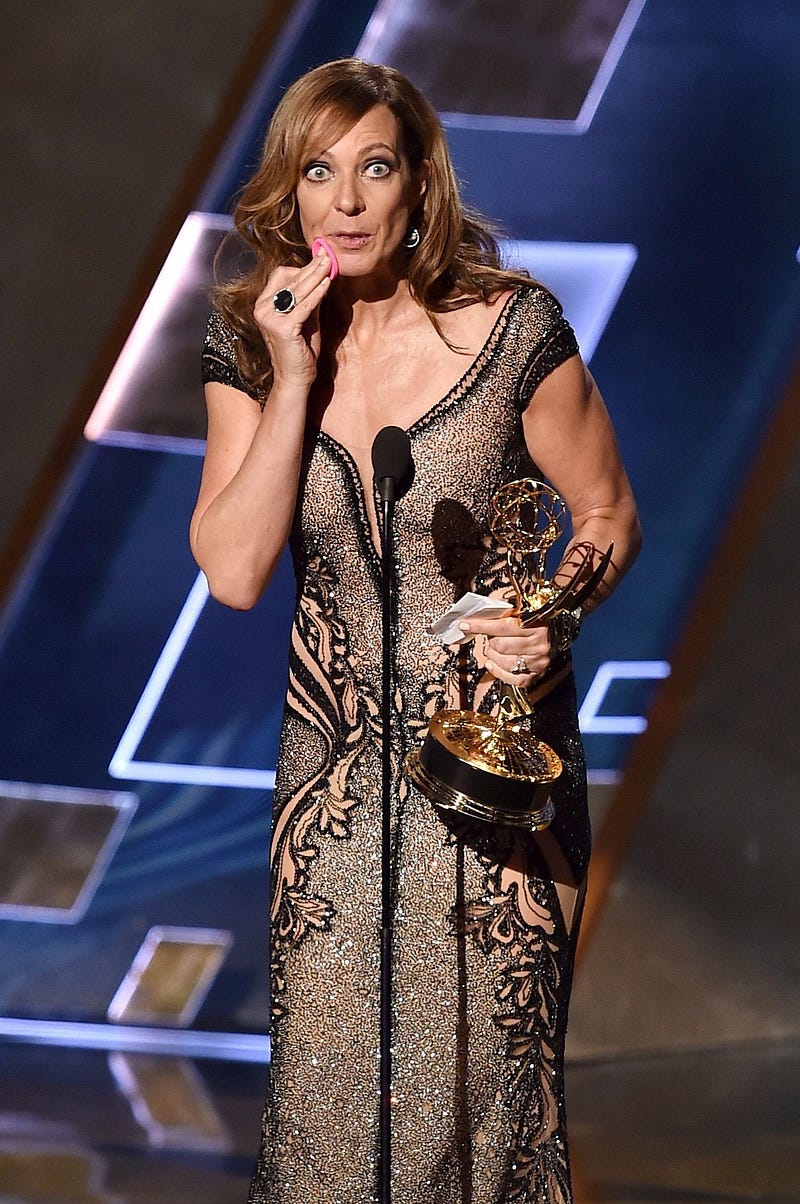
Mom leaves behind an impressive legacy. Its eight season run enters it into the upper echelon of longest running sitcoms in history. It was a solid ratings hit, ranking among the top 40 most watched series on television for nearly every season of its run. It marked another long-running hit for Chuck Lorrie, who had previously launched long-running sitcoms like Two and a Half Men and The Big Bang Theory. It won a pair of Emmys for Allison Janney and contributed to her record-breaking Emmy haul. It fared even better with the Critics’ Choice Awards, which has nominated it for 12 major awards, including three for Best Comedy Series and 9 for its actors (5 for Janney and 1 each for Kennedy, Pressly, Fichtner, and guest star Ellen Burstyn).
But Mom’s true legacy goes far beyond its respectable ratings and honors. It’s true legacy lies in its remarkable evolution and its groundbreaking portrayal of addiction and recovery. Arguably no television series in history (and certainly none on network television) ever examined addiction and recovery to such a nuanced degree. Whereas most other shows have traditionally used addiction as a salacious, fleeting plot point, Mom put it front and center and expressed an unprecedented interest in seeing what happens after people hit rock bottom. (Rock bottom is where most addiction plot arcs usually end in film and on television.) For 170 episodes, the show explored what happens to people as they rebuild their life after rock bottom. Not just people, but women. And not just women, but women in their 40s, 50s, 60s, and 70s. As a result, Mom was far more radical and meaningful than it appeared.
Many people in recovery and women of a certain age saw themselves reflected on Mom in a way that was deeply moving for people. Although I am not an addict or an older woman, the show was impactful for me. It showed me that the network television multi-camera comedy could still entertain and surprise. It raised my bar for how long-running television series could — and should — grow and evolve over the course of their runs. It introduced me to some truly gifted actors of whom I have become big fans. It provided me approximately 3,500 minutes of entertainment over the years. And, most importantly, it helped me see people with substance use problems in my personal and professional life in markedly different ways.
My sincere hope is that Mom remains on a high-profile streaming service in its entirety (the first seven seasons are currently available on Hulu) and finds a second life as new people discover the show and make their way through its spectacular eight seasons. Because even though Mom amassed considerable fans and acclaim during its run, it deserves much, much more.

Click here to follow the author on Medium and Twitter.
Read articles about classic television comedies by this author:
- The Glorious and Long Overdue Arrival of “The Nanny” on Streaming
- “Friends” at 25: The One with the Analysis
- Celebrating 35 Years of “The Golden Girls”
- “The Muppet Show”’s Arrival on Streaming
- The Legacy of “Modern Family”
- My Final Night with “Will & Grace”
- “Murphy Brown”: Where She’s Been and Why She’s Back


