
A Fifth Fundamental Operation of Arithmetic and the Beauty of Parallel Calculus
An amazing journey through the unknown

We all know the four basic operations of arithmetic: addition, subtraction, multiplication, and division. In school, we were all forced to trivially add and subtract numbers again and again, keep track of remainders, etc. until it was printed in our brains how these operations work.
It is only much later we find out that there are really only two fundamental operations on the real numbers, namely addition and multiplication. Subtraction is just addition by a negative number and division is just multiplication by a fraction.
In this article, we will explore a fifth operation of arithmetic that, in my humble opinion, is almost just as natural as the others. Moreover, we will show how to use this operation to build a completely new kind of calculus that I call parallel calculus. Just as we have derivatives and integrals, we have parallel derivatives and parallel integrals.
In this alien calculus, the parallel derivative of x² is x/2, which we will show, and the parallel derivative of ln(x) = ln(x)²/x.
We even have parallel Taylor series and parallel Fourier series, parallel Laplace transforms, etc! But let’s start with the beginning before someone gets choked in their coffee before getting to the good part.
Before we begin, I need to inform the reader that the operation that I am about to inflict upon you is well-known - however, I have not seen the corresponding “parallel differential and integral operators” anywhere in the literature. If you can find a source exploring that, I would be very interested in receiving a link from you.
As far as I know, this is unchartered territory and we are about to go on a journey into this unexplored mathematical world.
Parallel addition and subtraction
Let’s start by defining parallel addition and parallel subtraction and discuss where the word parallel in the name of the operation comes from.
In the literature, there are several different notations for this operation. It is always a tough choice for an author to choose a notation that makes sense, so I hope that you will have me excused for the following choice.
For any numbers x and y (in the extended complex plane), we define their parallel sum to be:

Note that we have x Δ ∞ = x so ∞ is the identity for this operation.
If you don’t know what the extended complex plane is, it is basically a way to take all “infinities” and collapse them into one point. Since for the complex numbers, this is like tying a bag, the extended complex plane is seen topologically as a sphere and we sometimes call it a Riemann sphere.
For the real numbers, this is the projectively extended real line and this is seen as a circle instead of a number line where the two points -∞ and ∞ coincide (we imagine them glued together). Thus it makes sense to talk about the point at infinity and there is no ambiguity in dividing by zero for example.
With that out of the way, we can define parallel subtraction:

We have x ∇ x = ∞ which is in analogy to x - x = 0.
Geometrically, the reason we call it parallel addition is that it is the result of a certain measurement involving two parallel lines. Specifically, the name parallel comes from the use of the operator computing the combined resistance of resistors in parallel.
In the below diagram, you can see geometrically where it comes from.
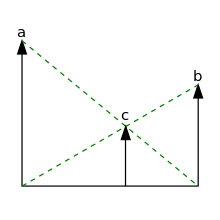
We see from the drawing that ∞ is the right identity, for if we extend b wlog to infinity then its line will cross the other line at a. These operations have a treasure trove of fantastic properties that we will now state for the parallel addition but it will hold mutatis mutandis for the parallel subtraction.
- x Δ y = yΔ x (commutativity)
- x (y Δ z) = xy Δ xz (distributivity)
- (x Δ y) Δ z = x Δ (y Δ z) (associativity)
- x Δ ∞ = x (identity)
- x Δ 0 = 0
- x Δ x Δ ⋅⋅⋅ Δ x = x / n (n-fold parallel summation is division by n).
- (x Δ y)² = x² Δ y² Δ 1/2 xy
Moreover, we have that it splits sums in the denominator into sums of fractions:

One of the reasons I find it so natural is because it answers a very natural question. Just like we have power rules and logarithm rules that give a correspondence or relation between the operations of addition and multiplication, this operation is the result of multiplying different roots or different based logarithms in the following sense:

These facts kind of fill the gap in our power rules toolbox and for some reason, very few people ask the questions that need such answers.
By the geometric picture above, it is quite clear that if x and y are positive real numbers, then x Δ y < x and x Δ y < y but what about x Δ y = x - y? What must the ratio x/y be for this to be true? With a little algebra, you can show that the only ratios that satisfy this equation are x/y = φ and x/y = -1/φ where φ = (1 + √5)/2 is the golden ratio. As x and y were assumed positive numbers, x/y = φ. Pretty neat if you ask me.
One of the interesting corners of this topic is the topic of infinite parallel series. For example, because the distributive law and associative law hold for multiplication and parallel addition, we can prove that
1 Δ x Δ x² Δ ⋅⋅⋅ = 1 / (1 ∇ x),
whenever |x| > 1. This result is of course 1 - 1/x. More about this when we get to parallel Taylor series!
We could keep exploring interesting facts about this operation (there are parallel polynomials with parallel root formulas etc.) but the real goal here is to connect it to its corresponding calculus which we will now take a look at.
Parallel calculus
Let’s start by recalling the definition of the derivative. Given a continuous function f, we define its derivative to be:

if the limit exists (i.e. for all x, the limit needs to be the same no matter which direction we let h run in).
The parallel derivative is defined completely in analogy with the above except that we swap + for Δ, - for ∇, and we let h go to infinity (the identity for this operation). The definition then becomes:

given that the limit exists!
Notice that both the numerator and denominator tend towards infinity, so we have an “∞/∞” expression just like the derivative is a “0/0” expression.
The first obvious thing to check is parallel linearity. That is, if h(x) = a f(x) Δ b g(x), then

So the parallel derivative respects parallel addition and parallel subtraction. Be careful because it doesn’t respect regular addition and subtraction as we are used to from the d/dx operator.
The next thing we might want to try is to parallelly differentiate something simple like f(x) = x^a. We have by actually using the definition, some rules, and taking the limit that:

which of course reminds us of the derivative with a division instead of multiplication. In particular, we note that the parallel derivative of 1/x is -1/x² just as we are used to.
Two more interesting and practical results that we can find by using the definition are:

which is a refreshingly new result and

which is even more interesting.
You can find those yourself by using, L’Hôpital’s rule, which will lead to an explosion of algebra and nested fractions, so you might want to take a deep breath first.
Before taking parallel derivatives of more exotic functions, we need some tools (tools are called theorems by the way, but we will not be that formal here). Just like we have rules for differentiation like the product rule, quotient rule, chain rule, etc., we have analogous rules for parallel derivatives.
The parallel product rule
It turns out that we have a product rule for parallel differentiation.

As an example, we can calculate the parallel derivative of x ln(x).

One of the most powerful tools is the parallel chain rule:
The parallel chain rule

These two rules make us capable of finding the quotient rule since:

and after finding a common denominator, we get the following result.
The parallel quotient rule

With this new power in hand, we can now find out how to parallelly differentiate a sum of functions (yes that is harder than it sounds).
The parallel sum rule

If you want it for subtraction, you just flip the two parallel operators in the expression. Note that this is similar to differentiating a parallel sum.

So this is in some sense an expression for how they are related.
Parallel Taylor series
At this point, you are probably wondering what the eigenfunctions look like for the parallel differential operator. In particular, we might want to know the solutions to the parallel differential equation:

and to find that, we need a fundamental tool from analysis but in this case parallel analysis namely the equivalent of Taylor series in this parallel world.
However, to make the computations more manageable, we restrict our theory to Maclaurin series (Taylor series about 0).
We don’t have enough space to dig deep into the theory nor to discuss convergence issues. Instead, I will state the result and let the interested reader pursue it.
If a function f is infinitely continuously parallelly differentiable at x=∞, then we can write its corresponding parallel Maclaurin series:

which, if f is parallelly analytic, equals f(x) in some neighborhood of 0 and we can write this more compactly :

for some set of convergence. Note that it is fine if some of the evaluations like f(∞) is infinity since we are working with the projectively extended real or complex numbers.
Indeed we can now check by a repeated use of the chain rule that

By parallel integration (which we haven’t really discussed yet) on both sides, we get the result:

But what about our fixed functions or eigenfunctions? Well, the canonical Maclaurin series for such functions must look like the following:

and indeed we can check by using the parallel chain rule that the parallel derivative of e^(-1/x) is itself.
By using this theory, it is easy to find analogs of sine and cosine. It turns out that there is an Euler identity for parallel addition as well and it is easy to verify the following.

and that these functions behave much like sine and cosine with respect to our operation. They have a parallel derivative period of 4 like sine and cosine the parallel derivative of one gives plus or minus the other. They are 1/(2π) periodic and one can even develop parallel Fourier theory using these as the basis functions and parallel integrals which we will touch upon in a bit
Parallel integration
We will define a parallel antiderivative or indefinite integral of a function f to be simply a function F = I f such that the parallel derivative of F is f.
So for example, if f(x) = x, then

for some constant C. Note that the notation now uses a Δ in the superscript and not ∇. The integral is also parallelly linear like its differential counterpart.
We have a parallel integration by parts rule!
Parallel integration by parts
The following analog to integration by parts holds:

Let’s try to use this formula to find the antiderivative to the function f(x) = x e^(-1/x).

Now it is easy to check this result by the parallel product rule and use of the distributive law for parallel addition.

Conclusion
Parallel calculus has its place in mathematics! It is beautiful and we have just scratched the surface of it. We don’t have time to explore it further now, but I encourage you to go and explore stuff like parallel differential equations, parallel Fourier series, parallel integral transforms, etc.
I hope that you have some follow-up questions in the comments that could start some interesting discussions. Maybe even challenges to the readers like: what is the parallel derivative of f(x) = sin(x)² or maybe parallel integrals like Gaussian integral challenges…
For now, I hope that I have convinced you to go explore this yourself or at least tell people about it so we can get even more knowledge about this fascinating subject.
Edit: After publishing the article, I have developed the theory further and I have proved that

which is a fantastic result if you ask me. Who would have thought that the above operator is linear with respect to parallel addition and multiplication?
We can then solve a differential equation to get:

which makes me simply… speechless. Note that when we add a constant to the antiderivative in the denominator it corresponds to parallelly adding a constant to the fraction — which makes sense.
Oh and did I mention that I also found an equivalent of the Abel summation formula? That has to go into a sequel.
Thanks for reading.


