
A Father’s Day Reflection
On being the dad of a son with PDA
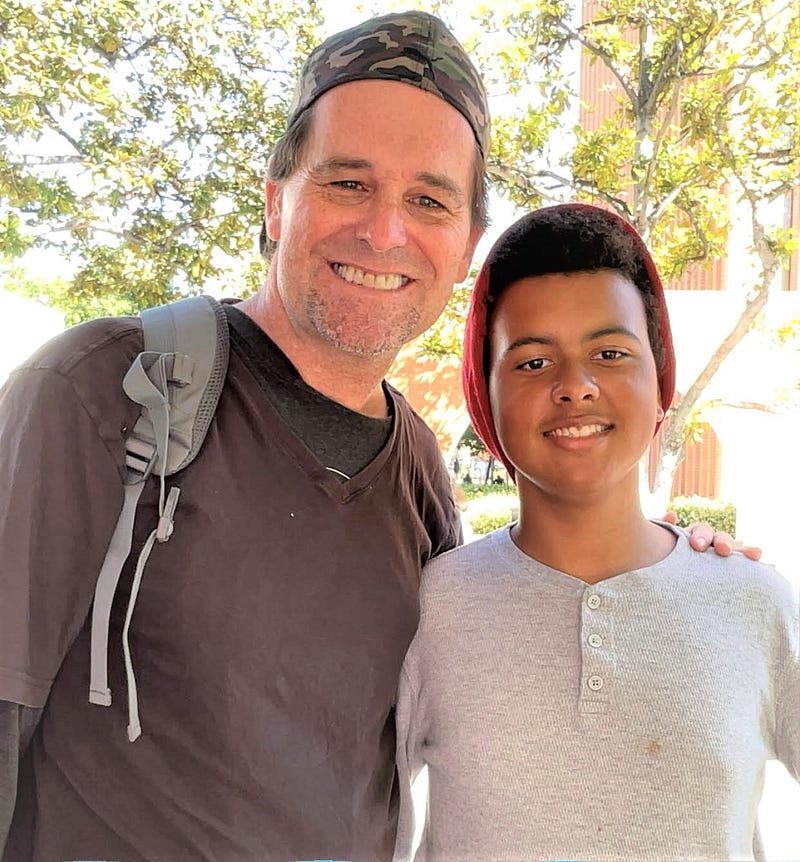
Fourteen years into being a father, and I’m still figuring it out.
Does anyone ever?
It seems like once I figure out one aspect of parenting, my son transitions from one phase of childhood to another, and I’m back again in learning mode.
Or my wife watches a YouTube video by a mother with a son with Pathological Demand Avoidance (PDA), a lesser-known part of the autism spectrum diagnosed only in the UK. The video is a ‘light bulb moment’ for her because the traits that didn’t make sense under an autism diagnosis are a fit for PDA.
And she encourages me one afternoon to watch a YouTube video on PDA with her by Harry Thompson on PDA. We sit on the black leather sofa in our living room with ear pods plugged into a splitter cable and listen to Harry explain about PDA as our son watches a Disney TV show, and everything changes.
“Hello, my name is Harry, and today I’m going to talk about PDA or Pathological Demand Avoidance Syndrome, and the reason why I am going to talk about this is because, after doing some cursory research on YouTube, I noticed there’s not a lot of videos on this subject. In particular, there is not a lot of videos … I haven’t seen any actually … by people with PDA talking about it.” — Harry Thompson
Pathological Demand Avoidance (PDA)
Harry lists the seven distinguishing characteristics of PDA, and my wife and I listen to each one and pause the video to discuss if our son has these traits:
- Obsessively resisting and avoiding the ordinary demands of everyday life
- Using social strategies as part of the avoidance of demands
- Appearing sociable on the surface, but lacking depth and understanding
- Excessive mood swings and impulsivity
- Extreme comfort in role play and pretend
- Language delay with a great deal of catch up
- Obsessing over things, particularly people
We conclude that our son has most of the PDA traits, and it’s like reading a book or watching a movie a second time, but now seeing it for the first time.
My son was ten, and I felt like I was just beginning to grasp who he is.
So Father’s Day is more than ordering take-out from my favorite restaurant or my wife buying me a T-shirt and shorts, or even getting a card from my son or being the one who gets to pick the movie that our family watches together.
Father’s Day is about my desire to understand my son and to relate and parent him in a way that is most effective in meeting his unique neurodiverse needs.
Parenting PDA style
I’ve come to learn that parenting “with PDA in mind” means giving fewer demands and using more indirect communication — to be flexible and allow for some negotiation instead of having rigid expectations for his behavior.
Instead of telling him to “clean his room,” my wife and I have learned a better way to communicate with him is to ask, “How is your room looking?” And then ask him what day he wants to clean it … Friday, Saturday, or Sunday?
Instead of giving him a deadline at fourteen for his bedtime, we realize as a neurodiverse teenager that nighttime is when he feels freest to pursue his creative endeavors and to let his imagination unwind free from demands.
I don’t know how to describe what he does, but it’s a hybrid of storytelling, voice-over acting, and freeform creativity. And I know it’s the time he feels free to be himself apart from the implicit and explicit demands of the day.
So my wife and I have learned to make bedtime more flexible, and it helps he is unschooled and doesn’t have to wake up for an 8 a.m. class the next day.
Acceptance of neurodiversity
The most important thing I’ve learned as the parent of an autistic child is to accept his neurodiversity. He is always going to be an outside-the-box kid who thinks and acts differently, and I want him to know I accept him for who he is.
The etymology of the word “autism” is composed of two parts, “aut” and “ism.” The prefix “aut” comes from the Greek word “autos,” meaning “self.” The suffix “ism,” which is also Greek, implies a state of being or condition.
And so I want my son to feel comfortable living in a state of being himself.
As the parent of a neurodiverse child, I’ve also learned you have to be willing to adjust your expectations if the one-size-fits-all school curriculum doesn’t fit your child or if the school environment isn’t inclusive of neurodiverse kids.
“Two roads diverged in the woods, and I — I took the one less traveled by, and that has made all the difference.” — Robert Frost, The Road Not Taken
I feel like these lines describe the parenting adjustment my wife and I have made to help our son to continue to grow in his development.
It might not be a path others believe is right, but they haven’t spent a day with our son. They don’t know how he and many autistic kids are self-directed learners — or how my son tunes out if doesn’t have an interest in the subject.
Father’s Day plans
So this is what I plan to do on Father’s Day — just enjoy being with my son and embrace him as the one-of-a-kind, wacky, blossoming teenager that he is.
I plan to laugh, smile, joke around, and remember that parenting, first and foremost, is about a relationship with my son that’s constantly changing.
One day he doesn’t like if I sing to a song in the car and, hey, that’s okay.
Or he doesn’t like me to watch his favorite tv shows with him anymore.
I give him space and time alone, but I also seek out those pockets of time to connect with my son — by doing one of his favorite activities.
Baking brownies, making pancakes, or taking a walk at night at the park.
Or eating his favorite caramel chocolate chip cookies from Sprouts.
Thanks for reading my story.
Here’s a YouTube video I created to encourage you in your creativity.
New to Medium? For $5 a month, you get access to thousands of articles. Use my referral link to join, and I will get a small bonus.