
A famous Evangelical book was white supremacist
The ‘Scofield Bible’ has an ugly history
Since 1909, it’s been seen by Evangelicals as nearly divine. Those famous footnotes explained everything to you.
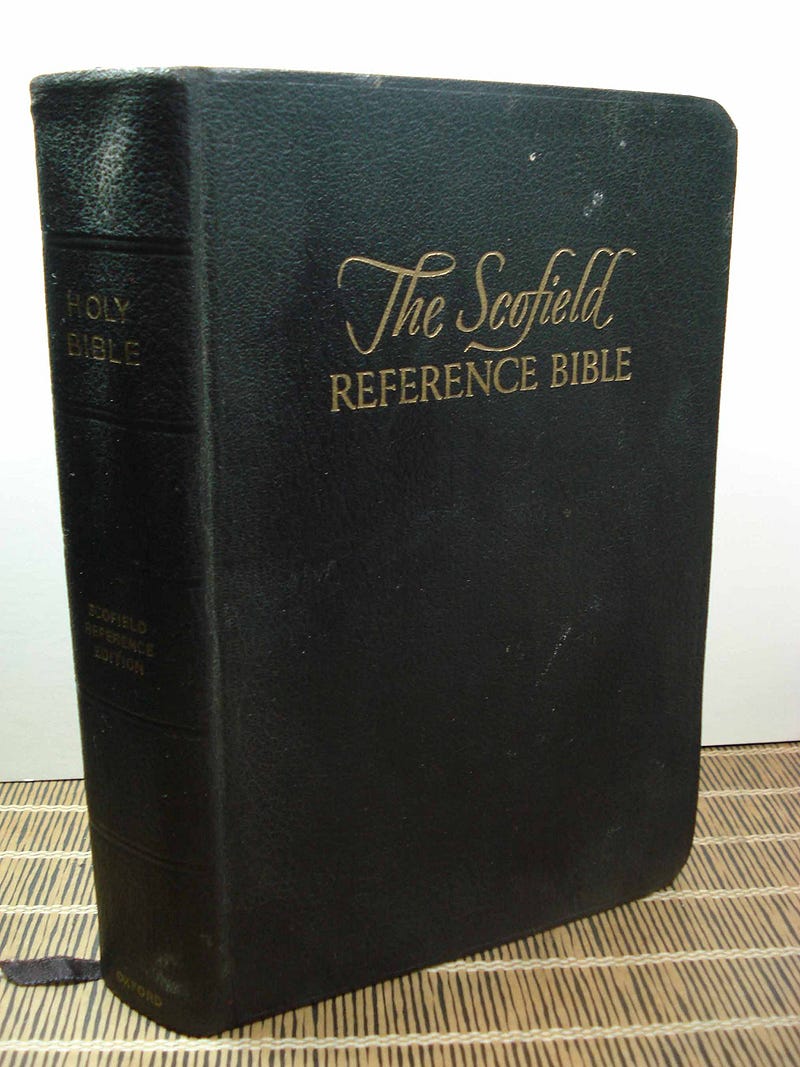
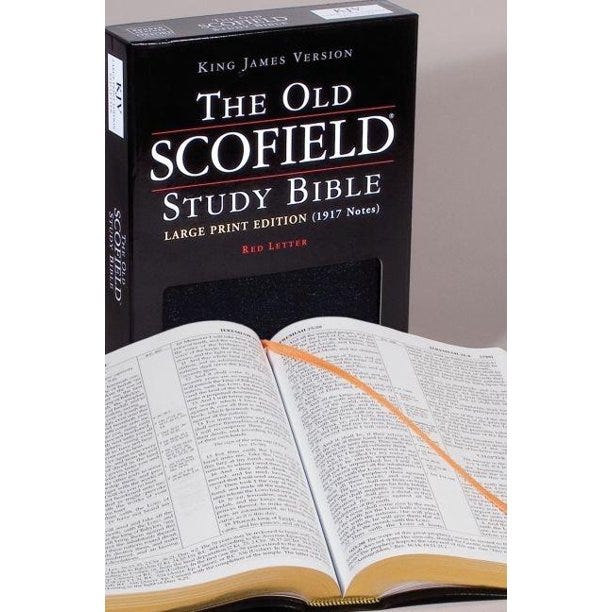
Selling millions of copies, the Scofield Reference Bible is a key Evangelical text—and a staple of my childhood. I only realize now it was a blast of race hate by Cyrus Scofield, a former Confederate soldier.

I didn’t know Scofield was a lifelong Southerner.
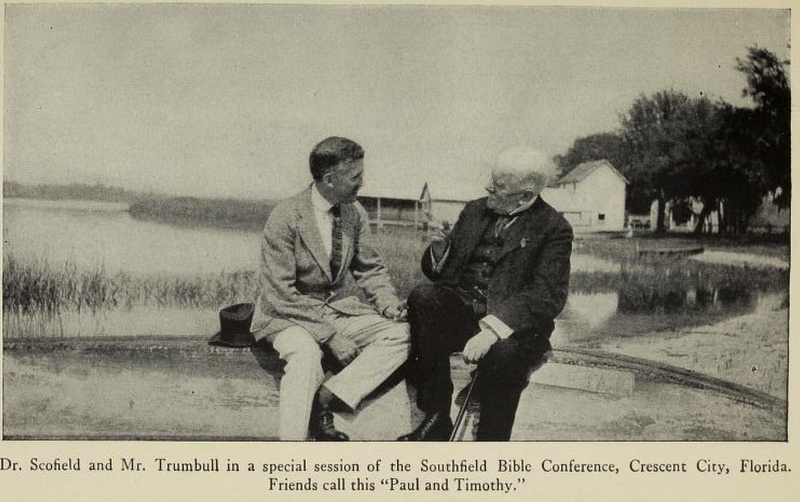
Cyrus Ingerson Scofield was born on August 19, 1843 and raised in Tennessee. A biography of him, Charles Trumbull’s The Life Story of C.I. Scofield, was published in 1920. Even Evangelical readers must’ve been skeptical of this narration of the hero’s youth:
“The slavery of that region was of a mild, kindly, patriarchal form. Like so many others in the South, masters and mistresses and slaves loved one another.”
As a biographer, Trumbull came across as a superfan, as Scofield was presented as a spirit of divine love.
“Dr. Scofield loves all nature — not only men and women and children, but the whole created world, still so beautiful in spite of what Satan and sinners have done to mar God’s work.”
In 1988, Joseph M. Canfield had a less flattering portrait in his biography, The Incredible Scofield and His Book. He told a tale about a one-time Confederate soldier who’d grifted his way to the top of the Evangelical world.
The book was a prosecution for fraud.
On point after point, Canfield’s biography of a Christian hero read like a legal indictment. Scofield had been accused of bribery and theft when holding public positions. He’d lied about being in the Confederate Army. There was suggestion he’d been in jail, and a heavy drinker.
He’d been divorced, and cruelly ignored two daughters on the grounds that their mother was Catholic. He refused child support even after he’d become wealthy from his Bible. He left his daughters out of his will.
Though Scofield was called ‘Dr.’ and presented as a Bible scholar, Canfield found he had no formal theological education—or any college education. It appears that Scofield just decided to call himself ‘Dr.’ and put a ‘D.D.’ after his name to boost his profile. He didn’t know either Hebrew or Greek.
Canfield noted Scofield’s racism.
In 1904, Scofield spoke to a gathering of Confederate veterans. His archived notes for the speech included the line:
“right superior race to bear white man’s burden of an inferior race in its own way.”
This was all deeply shocking to hard-core Evangelicals—especially the divorce. As one reviewer put it: “One must wonder, given Canfield’s research, if he was even a Christian.”
Typically, Canfield’s book wasn’t even read, or if it was, it would be dismissed as the ravings of an anti-Evangelical.
In 2009, the religion did issue a response to Canfield’s book in The Scofield Bible: Its History and Impact on the Evangelical Church. Here, R. Todd Mangum concluded that “in the final analysis C.I. Scofield seems to have lived a life of high Christian character.”
Though one matter was acknowledged.
Mangum noted that at Genesis 9:25, Scofield wrote that Noah’s son Ham would have “an inferior and servile posterity.”
That was the old racist idea that the cursed progeny of Noah’s son Ham were Africans. In the slave-owning South, this view had often been held out as God’s authorization for slavery.
The note, Mangum acknowledged, reflected Scofield’s “Southern influence,” which he found “most unfortunate.”
As he added:
“This point in The Scofield Reference Bible would give stature and popularity to the theory of the curse of Ham-that black people are inferior to people of other races and destined to be their servants-throughout broad areas of the American fundamentalist-evangelical world.”
The line was quietly removed in revisions done later by its publisher, Oxford University Press. But the original is widely read to this day. And Scofield’s admirers, to this day, will say that the “inferior and servile posterity” hadn’t “in any way whatsoever” referred to Black people.

Scofield pioneered the genre of the ‘study Bible’.
Now a staple of Evangelicalism, the Scofield Bible allowed a new idea that the Bible could finally be ‘understood’. To grasp the meaning of those enigmatic lines, one had just to glance down at the explanatory notes—which all led to ‘Premillennial’ theology and the anticipation of the world ending.
All Christians had to do was wait. Jesus would return in ‘the Rapture’, and take them to Heaven. Scofield laid it all out.
Until then, they were to sit out politics. Fundamentalists of the early 20th century, and still today, try to remain “above” the tawdry affairs of the world. They were just to wait. The timelines were obsessively mapped out. The Rapture would happen, and the Tribulation. The Antichrist would come along, and sweep along with him the evil tide of humanity.
Was it all stemming from racism?
The idea was advanced in a 2016 paper by the scholar Nathaniel Grimes. In “The Racial Ideology of Rapture,” published in the Baptist journal Perspectives in Religious Studies, Scofield was described as appealing to white Southern Christians.
Or as Grimes puts it:
“…the white identity that had been under fire since the Civil War found a welcome sense of security.”
White Southerners, dismayed by the outcome of the Civil War, felt little interest in helping to create a racially-integrated society. Under Scofield’s teaching, they’d retreat into religious seclusion, and live in communities that were racially segregated—with religious reinforcement.
No better world was seen as possible.
The world was going to Hell on a cosmic timeline. The Apocalypse was approaching for the world that was seen as deeply evil. The challenges of the “Reconstruction” period could just be evaded.
I was startled by Grimes’ suggestion that, for Scofield, Black people were not included in the Rapture. The supremacy and segregation that white Christians were losing on earth had shifted to ‘Heaven’.
I searched out anything in Scofield’s writing that spoke to a different view.
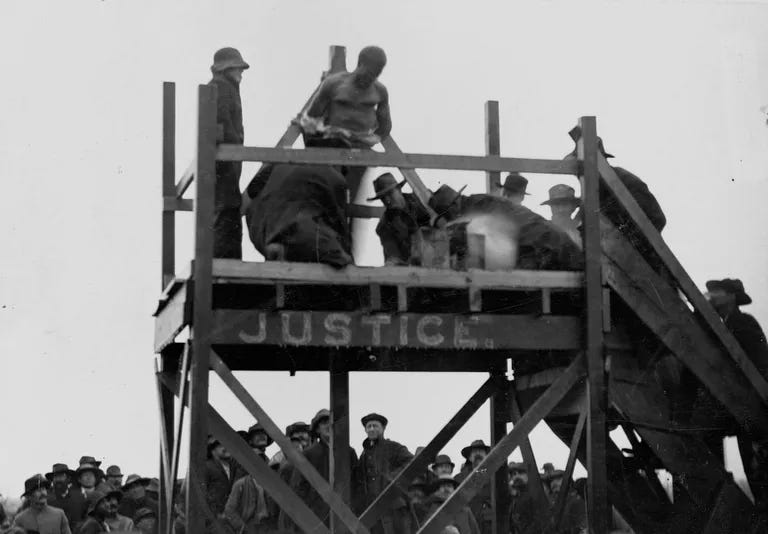
There was an anecdote. In 1893, a Black man named Harry Smith was seized by a mob in Paris, Texas for having supposedly raped a three-year-old white girl. He was tortured and burned alive.
Scofield wasn’t in Texas at the time, and wrote to a friend about the incident:
“The outrage committed by the negro, and that committed upon him, alike illustrate the problem to be solved here. Surely the Gospel is the only remedy.”
But I find no record of Scofield doing any kind of activism on racial reconciliation. The period following the Civil War might’ve been a nice time for Christians to be doing that.
By World War II, the “Scofield Bible” became the Bible of Evangelicalism.
As the scholar Cortney S. Basham notes:
“Many Christians read Scofield’s notes as an infallible guide to prophecy interpretation, and held his ideas as ‘Biblical’ doctrine. Scofield’s Bible had sold nearly ten million copies by 1967, and 2.5 million more copies from 1967–1990.”
It provided the cultural platform, as well, for Dallas Theological Seminary. The school was founded after his death by a friend of Scofield’s named Lewis Sperry Chafer, who wrote a ‘systematic commentary’ that was marketed as being like the ‘Scofield Notes’ dramatically expanded.
Dallas Theological Seminary became training ground for Evangelical clerics, and a hub of ‘Rapture’ talk. And it didn’t admit Black students.
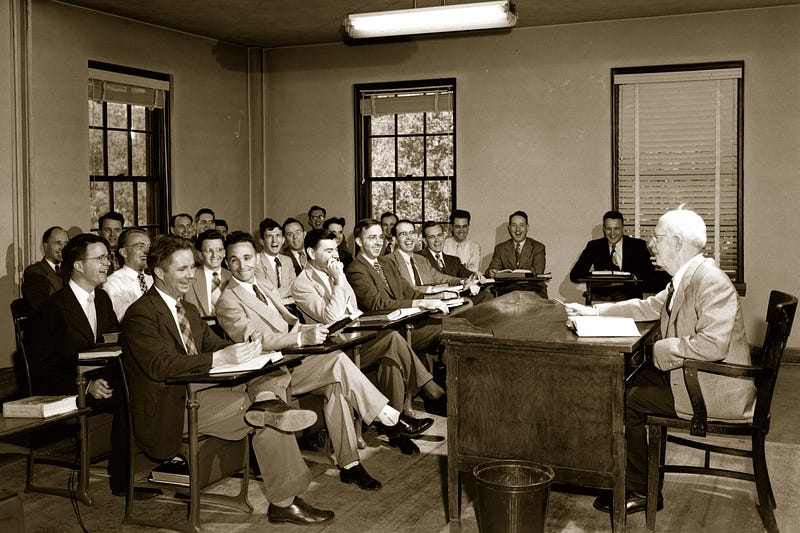
As a private institution, DTS evaded desegregation imposed on public schools in 1954.
The first Black student was admitted in 1966, though the school didn’t even begin to own its investment in racist theology. That waited until…2021?
In a recent statement, the current president says:
“At DTS, we acknowledge our past and present sins, our American forefathers’ sins, and those of the American church. We acknowledge that the trade and treatment of enslaved people — people created by God to mirror His image — was evil, unrighteous, and often justified by misuse of Scripture.”
I’m startled by a realization. From Scofield to Lewis Sperry Chafer, from Charles C. Ryrie to J. Dwight Pentecost to Hal Lindsey, on and on, there is a system of Evangelical clerics and commentators deeply rooted in racism seen as coming directly from God. 🔶
For further reading:
The Man Who Sold the Apocalypse
Was Christian doomsday writer Hal Lindsey just a hustler?
medium.com
- D. Jean Rushing, “From Confederate Deserter to Decorated Veteran Bible Scholar: Exploring the Enigmatic Life of C.I. Scofield 1861–1921" (2011 M.A. thesis)
- Cory M. Marsh, “The Rapture: Cosmic Segregation or Antidote for Oppression?” (2019 conference paper in response to Nathaniel P. Grimes’ “The Racial Ideology of Rapture”)