
A Duuudely Irish Soda Bread
My modifications to a wonderful recipe for a non-traditional Irish soda bread
I am not a cook, a baker, or in any way a foodie. The fact that I am posting this on my woodworking publication should be fair warning to you! But I like this recipe, and, and true to my nature, I love even more my experiments and modifications to it.
Just so you know, I have not a hair of Irish on me. My connection to Ireland is no deeper than me mooning over photos of Irish country-sides and especially the steep and rocky western coast. The closest I’ve ever come to Ireland was a month’s solo backpacking trip to Scotland and the gorgeous Western Isles which are a good salty spit away from Ireland if the wind blows right. The wind rarely blows right, and usually in your face.
During my Scottish sojourn, I also passed through Wales on my way back to the London airport. I went to Wales because I wanted to hike up the tallest mountain in the UK, Mt. Snowdon in the northwest corner of Wales. The weather in the UK is always suspect, and sure enough my hike to the top was rewarded with English fog and mildly curious, soggy sheep.
I imagine that if the weather was fine I could have peeked into Ireland from the top of Mt. Snowdon, the way that you as an obnoxious geeky kid climbed the tree in your yard to peek over the fence into your neighbor’s teenage daughter’s bedroom. What? You didn’t do that? You weren’t geeky? Or obnoxious? And you lived in Illinois where there are no trees taller than a stalk of corn? I’m sorry for you. I can’t imagine your depleted childhood.
So, there I was at the top of Mt. Snowdon, breathing deeply all the fumes from all the Gaelic bakeries at once, and being infused with the smell of Irish soda bread. At least that’s the fiction I recall decades later as I write this.
The author of the recipe acknowledged that her (mom’s) recipe was not at all traditional. And that gave me permission to make my modifications, and which, while minor, make this a patently duuudely Irish soda bread. I highly recommend it. Well, actually, I highly recommend that you do the same, tweak and play, and report back your results and what you liked and what you didn’t.
1. The original Annaliese Griffin recipe…
Let me quote here the original recipe:
Irish Soda bread recipe:
Ingredients:
- 2 cups flour
- 1/4 cup sugar
- 1/2 teaspoon baking soda
- 1 teaspoon baking powder
- A good pinch of salt
- 6 tablespoons butter
- 3/4 cup buttermilk
- 1 egg
- 1 cup chopped dates (optional)
- 2 tablespoons finely chopped crystalized ginger (optional)
Instructions:
- Preheat the oven to 350° F (175° C). Line a baking tray with parchment or a baking mat.
- If using the dates and ginger, chop them now and combine in a small bowl with a light dusting of flour to help keep the sticky pieces separate.
- Combine the dry ingredients in a large bowl. Cut the butter into small pieces and use fingers or a pastry blender to rub into the dry mixture until no chunks remain and you have a uniform texture. (This can also be an also be done in short pulses with a food processor.) Add the dates ginger and mix to distribute evenly.
- In a separate bowl, whisk the buttermilk and egg together. Stir the wet ingredients into the dry ingredients with a spatula or wooden spoon. The mixture will be heavy and sticky. Dust your hands with flour and form into a rough ball and place it on the prepared baking tray. Slice an “X” on the top.
- Bake for 45 minutes. The top should be golden brown, craggy, and firm. Cool for 10 minutes before cutting. Serve with butter, marmalade, or whatever else seems delicious.
Got that?
I highly recommend you go with the author’s recipe first, and see if it fits perfectly into the Irish soda bread-shaped hole in your soul. If it does, no need to change anything. If it is like a square peg in a round hole, then start tweaking away.
2. The small duuudely modifications…
First of all, why on earth would you limit yourself to 6 tablespoons of butter? That is three quarters of a stick, and you expect me to put the remaining 2 tablespoons back in the fridge, lonely and amputated from the rest of its family? Put the whole freaking stick of butter in the bowl! There you go. Eight whole freaking tablespoons, buddy. You can never have enough. That’s a good change to the recipe.
I then used a fork and mashed the butter into the dry ingredients (no need to modify those components, and I didn’t feel like doing a design-of-experiments series of recipes to optimize the dry ingredients).
The recipe called for you to work the butter into the dry ingredients “until no chunks remain and you have a uniform texture”. Do you think I do that? I mash the butter until my tender duuudely hands feel tired, and I stop. There are no big chunks of butter in the bowl, but neither do I have a uniform chunkless texture. Go ahead, scratch that “until no chunks remain” from the recipe too. Good change!
Then, the recipe calls for dates and crystallized ginger. What? Dates and ginger? I’m married, so I don’t have any more dates, but if I did, they would definitely be with someone named Ginger. As it is, this duuudely household has neither of those, so scratch them from the recipe too.
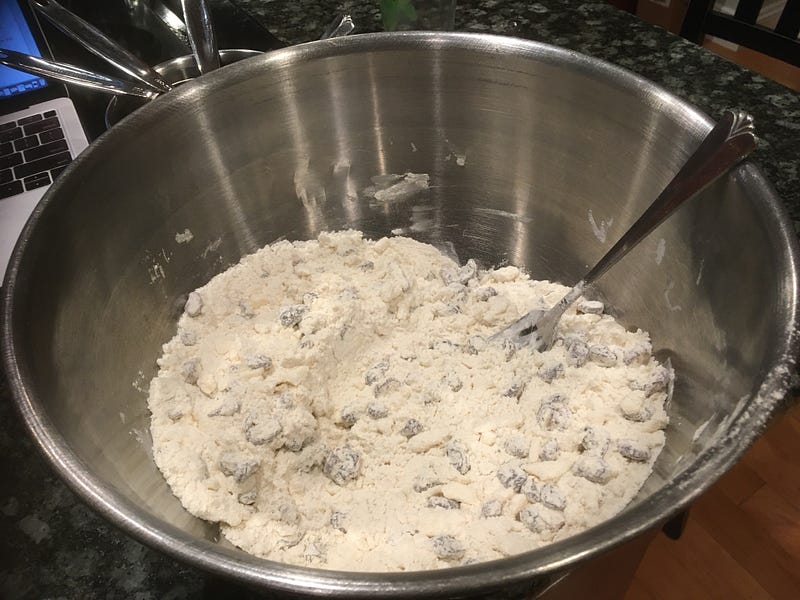
I do have a replacement for those ingredients, however. I use half a cup of raisins and half a cup of craisins (dried cranberries). The raisins I think have the sweetness and moisture of dates, and the cranberries have some of the tartness I’m sure ginger would have contributed. I suspect this is the most forgiving part of the recipe, and you can put in whatever you want to personalize your non-traditional, bastardized, adulterated, degraded, shunned-by-the-Irish-diaspora Irish soda bread. Go ahead! Whatever it is, I know it’s a good change.
This is what mine looked like after this step.
Now there’s the matter of buttermilk. What? I love butter as much as the next duuude, but buttermilk? Who the heck has that around? Not in this household! But I happened to have some heavy cream and some vinegar.
I added 2 tablespoons of vinegar (I had cider vinegar) into ¾ cup of heavy cream, stirred, and let that sit for 10 minutes. And there was my replacement for buttermilk.
The chemistry behind that is that baking soda needs an acid to release gases, and to cause your baked goods to rise. You can confirm this in a small experiment your kids probably did in school: mix baking soda with vinegar to make their model volcanoes erupt.
Buttermilk is fermented milk. Fermentation by micro-organisms like Lactococcus lactis yields lactic acid, which is why buttermilk is used to activate the baking soda in this recipe.
That is also why my home-made replacement using heavy cream and vinegar worked just as well.
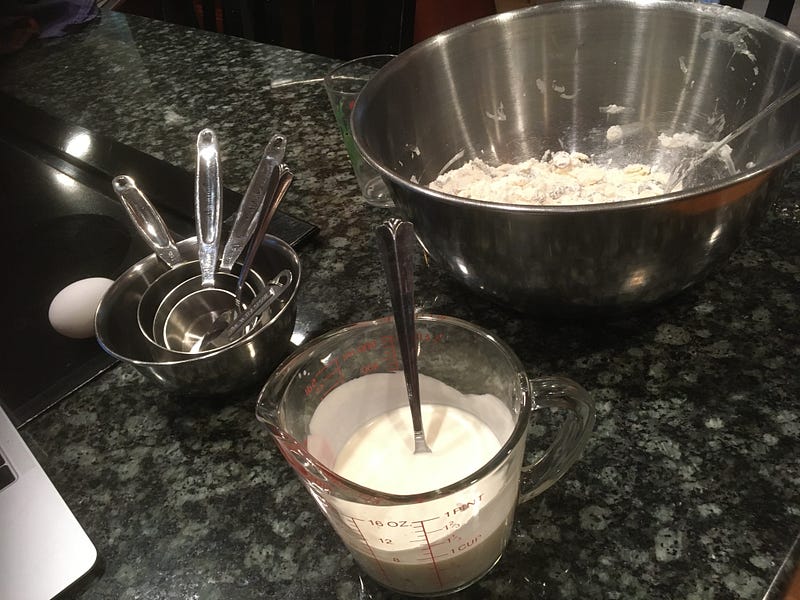
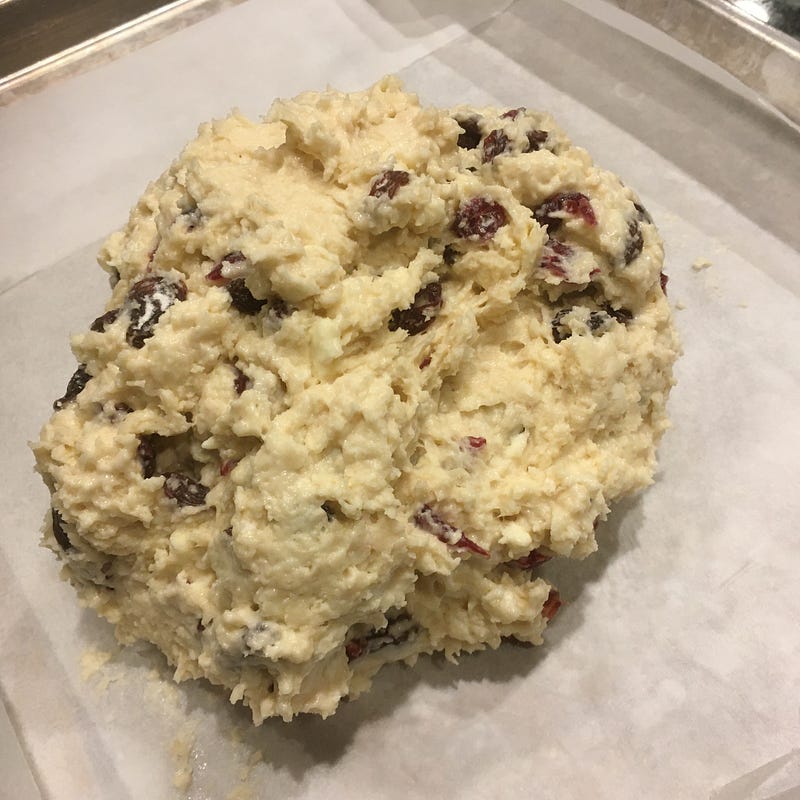
There was one slight problem with my choice of straight heavy cream. When I mixed the wet ingredients (my “buttermilk” and a beaten egg), into the dry ingredients, it was not wet and sticky enough, as the recipe described. It was quite dry and powdery. My liquid ingredients needed a bit more moisture, so I think I would have been better served with a 50:50 mix of heavy cream and milk.
I added a couple splashes of whole milk to loosen the mixture up and get the sticky consistency the recipe described.
When I had that consistency, I just dumped it out of the bowl directly onto parchment paper on an aluminum pan. None of this fiddly shaping with my hands. Just dump it out. Look at that. Quite photogenic, don’t you think?
The recipe called for 45 minutes at 350 F. I had to go about 55 minutes in my oven. I tested with a thin non-laquered wooden chopstick to make sure there was no raw dough (it was still wet at 45 minutes).
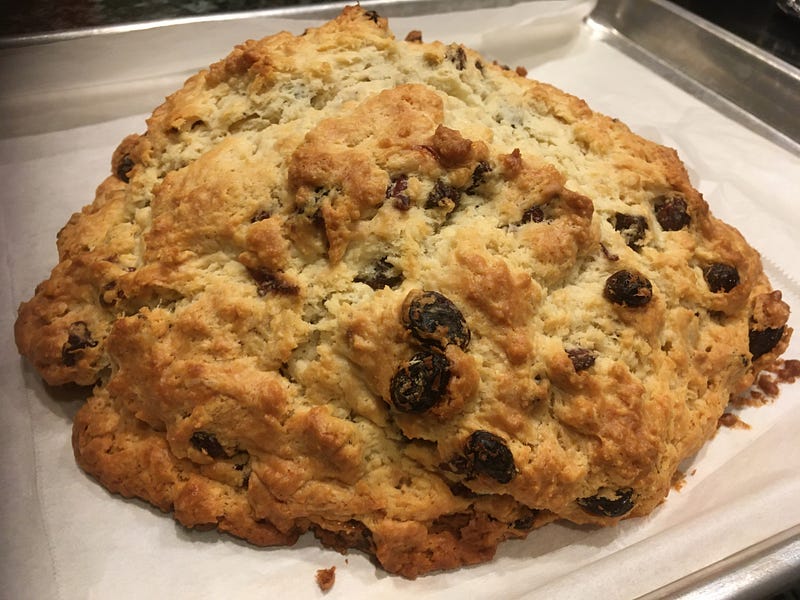
But finally, I ended up with a nicely golden bastardized and duudely Irish soda bread here:
Happy experimenting — and let us know how yours turns out!
I’ve been lucky enough to encounter a couple wonderful writers here who have immense yumminess running through their posts, who write about food in a most wonderful and inspiring way. Lucy The Eggcademic (she/her) and Cooking at Home. You can see I approach food more like a carpenter than a cook!
Thank you for reading, and please share on your social media or by email.
Follow this publication: https://medium.com/woodworkers-of-the-world-unite
Twitter at https://twitter.com/DuuudeScience
Facebook at https://www.facebook.com/sciences.duude.1/
Email at [email protected]


