
A dog’s eye view of demential decline
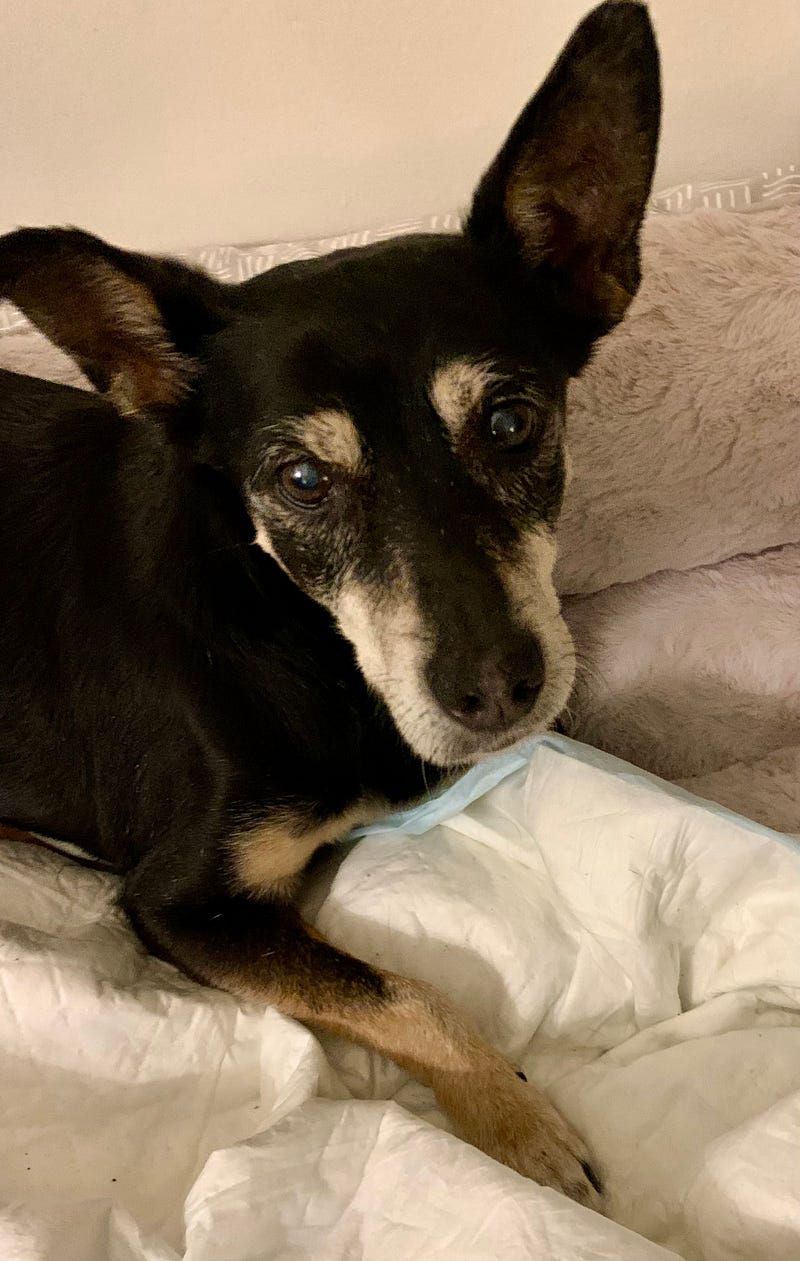
My old dog is following my nonagenarian mother’s tracks. Not literally: my mom has been dead for two decades and my dog doesn’t have the stamina to follow anyone’s tracks these days. But their behaviors lockstep in eerie ways.
Mom died at 91. For the last three years of her life, she didn’t recognize me. Alzheimer’s does that to your mind. She didn’t remember my name, or the names of any of her other children or grandchildren. She didn’t know where she was, or how she got there. She couldn’t use a fork or spoon so her nourishment came from a feeding tube. She had literally forgotten how to walk so she remained bedridden, semi-curled up on one of those expensive mattresses designed to prevent decubitus.
Although she didn’t know me, she was always happy and welcoming when I came to visit her in the nursing home. Her eyes would shine, not in recognition of me but in realization that she had a visitor who had come to pay attention to HER. I was company, and she was delighted.
My four-legged daughter Giada has read Mom’s playbook (although, as a dog, she can’t technically “read”. Also, being mostly blind, she can’t read regardless). She is nosing 18, admirably old for a canine but not Methuselah-old for a 20-pound mutt. She is not in a nursing home, she is in her own home, and we have been together for almost 17 years. Until recently she had always been joyous, exuberant, playful, and loving. Now she may not recognize me any more clearly than my mother did, though she seems happy for the attention.
There are differences. My mother’s hearing remained good right up till the end. She could hear the door to her room open before I stepped inside, and she would do a pale imitation of preening for me, or any other guest. She had been a stunning model as a young woman and remained a little vain about her looks.
Dogs don’t have vanity issues, but they do rely on their hearing. Giada’s is shot so I can understand why she doesn’t come to the door to greet me when I return from an outing. She flinches when I lean down to pet her as she sprawls on her rug because she hasn’t heard me approach.
She can’t see me either, as her cataracts are robbing her of eyesight. She can’t play with her ball or squeaky toys because she can’t find them when they bounce by. She can’t play Hide and Seek with snacks, a game she used to love. In theory she could still smell the treats I used to hide around the house, but since she can’t see them anymore, we don’t play that game.
Mom was able to see me pretty well. She knew I was female, she saw that I was younger than her fellow patients (so I was probably not a patient), she knew I was not a regular member of the hospital staff. That’s about as far as it went for me. She ALWAYS recognized my father when he arrived for his daily visits and she greeted him by name. So . . . good eyesight, right?
Giada hasn’t forgotten how to walk. Arthritis has curtailed her movements though, so she spends most of her time dozing on her sleeping pad. She can no longer reach the sofa or upholstered chairs in the house that used to be hers for the asking. Sometimes she will make little noises in her sleep and her arthritic legs will move as if she were dreaming about running. She had been a very successful hunter in her youth, so maybe dreams allow her to relive her glory days and relieve the frustration she must otherwise feel with her current limitations.
I don’t know about my mother’s dreams. In her final years she couldn’t carry on a conversation so her dreams and incoherent thoughts were probably indistinguishable; they crashed into each other like bumper cars. She couldn’t read or watch TV because there wasn’t enough of a connect between her functioning eyes and ears and her retreating brain. Between family visits, she spent most of her time dozing in bed. Dozing, not dreaming. A person with Alzheimer’s has the wherewithal to dream, research suggests, but they are most likely to be nightmares, not joyful recreations of pleasant pursuits.
Another difference is the level of affection displayed. Before Alzheimer’s took over, Mom was warm and loving . . . at times almost to the point of needy desperation. She gave affection readily, and she wanted reciprocation. When her brain became addled, she couldn’t initiate hugs or kisses anymore, but she still loved being embraced and fussed over.
Giada had never been a demanding dog in terms of affection. She didn’t enjoy constant attention but she would greet us effusively at the door, lick us gratefully for a treat, wag her tail joyously when an outing was imminent. During the day, she used to lie on a rug in my study, absorbing the atmosphere and nudging me for an occasional pat. At dinner, she would sit alertly by the table, basking in our company and not coincidentally hoping some scraps might fall her way. In the evening, she would curl up next to us on the sofa when we were watching TV, her body against ours, breathing synchronically. Her eyes would glow at the occasional belly rub or Good Dog recognition and her whole body would express delight.
None of this happens anymore. Over the past two years she has become distant physically and emotionally. During the day she mostly stays on her sleeping pad. She may absent-mindedly wander into my study but then she wanders out. She may wander into the kitchen when we are eating, but randomly. She has to be reminded to go out for her toilette, and she has daily accidents between outings. My mother wore diapers during her bedridden phase, but Giada has enough presence of mind to know that they are denigrating, and she fights decaying tooth and unclipped nail to remove them from her body.
She responds to me vacantly. She retreats from my touch until she senses who I am. Then I may be rewarded with a very slow tail wag or a tentative lick on my hand . . . but not always. When we are on our ‘outings’ (they don’t count as walks anymore) and she senses a neighborhood dog nearby, she is palpably distressed. She used to be confident and sociable, now she is fearful and anxious. If she can get close enough to identify said dog by his scent, she relaxes a little. But if it is a canine she doesn’t know, she pulls desperately to cross the street and create distance.
Mom perceived threats under the bed and in the closet and in her bedside lamp. Giada’s fears are based on more concrete stimuli — doors closing, windows opening, keys jangling — which make her seem more ‘rational.’
But in the end both human mother and dog daughter were and are tormented by unearthly demons. What did Mom see as she lay in bed day after day? What did she contemplate as she stared at her gnarled hands or the cheap pink fluff of the nursing home blanket? The nursing home soused her in narcotics to keep her calm and complacent, but what lay beneath her drug-addled surface?
Giada is not as drugged up, and is therefore not as complacent. She stumbles around, staring out into space and barking at the radiator, a corner of the living room, and the window near her bed. Is she barking at imagined monsters, or at something more profound — the approaching wisps of her own mortality? If so, she is more in tune with life’s ultimate reality than Mom was . . . or the rest of us for that matter.
###